Baseball Card Prices Dropping October 2026: 10 Key Insights
Explore why baseball card prices are dropping October 2026, which cards lost value most, and smart strategies for buying the dip with Midpoint app.

Estimated reading time: 8 min
Key Takeaways
- October 2026 sees a decline in baseball card prices, especially mid-tier rookies and base cards.
- Postseason hype fading impacts player-card values and can lead to market corrections.
- New card releases and increased supply are factors contributing to price changes.
- Vintage and high-end cards often show more resilience amid market fluctuations.
- Using tools like Midpoint to check card centering and AI grading can help collectors make informed decisions during market dips.
Baseball card prices dropping in October 2026 has drawn attention from collectors and investors. After a strong postseason surge, many cards are experiencing price adjustments. In this article, we explore factors influencing current market trends, highlight which baseball cards are seeing notable value changes, and share strategies for collectors aiming to navigate the dip effectively. Whether you hold raw or graded cards, understanding the nuances of this market phase is important, and tools like Midpoint can provide useful insights for grading and portfolio tracking.
30-day price movers — live data from Midpoint's card database, as of 2026-10-04. Prices move; Midpoint refreshes these daily.
| Card | Raw | PSA 10 | 30-day | |
|---|---|---|---|---|
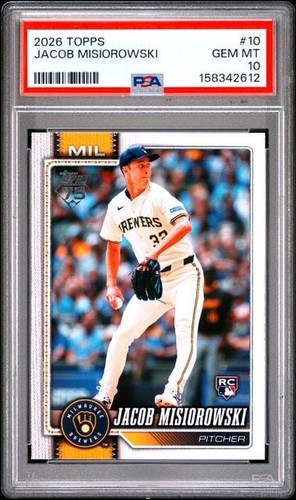 |
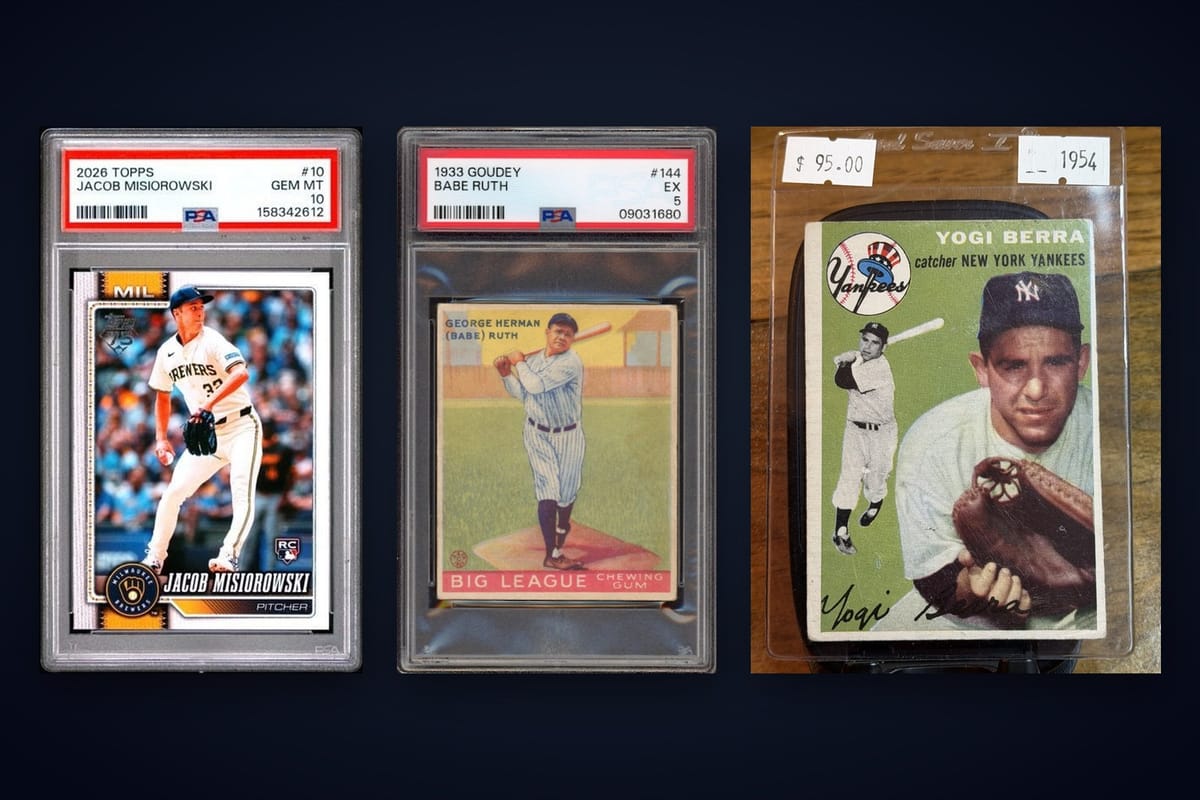
Jacob Misiorowski [1952 Variation] #10 2026 Topps |
$51.00 | $368.00 | -75.8% |
 |
Babe Ruth #144 1933 Goudey |
$8,182 | $3,329,125 | -41.6% |
 |
Yogi Berra #50 1954 Topps |
$62.00 | $14,218 | -20.3% |
 |
Lou Gehrig #37 1934 Goudey |
$2,874 | $1,176,611 | -19.4% |
 |
Joe DiMaggio #26 1939 Play Ball |
$1,850 | $643,029 | -17.7% |
 |
Phil Rizzuto #17 1954 Topps |
$25.05 | $5,143 | -17.6% |
 |
Cam Schlittler [True Photo Variation] #111 2026 Topps |
$157.13 | $702.74 | -9.2% |
 |
Ken Griffey Jr. #220 1989 Bowman Tiffany |
$16.96 | $17,344 | -8.7% |
 |
Sandy Koufax #123 1955 Topps |
$824.00 | $380,565 | -6.8% |
 |
Al Kaline #125 1957 Topps |
$39.78 | $10,221 | -4.8% |
 |
Kevin McGonigle [SSP] #697 2026 Topps Series 2 |
$130.63 | $623.98 | -4.3% |
 |
Shohei Ohtani [Blue Refractor] #1 2026 Topps Chrome |
$1,313 | $6,447 | -3.8% |
Look up any card's current raw and graded value in Midpoint — and get an estimated grade before you pay to submit.
1. October 2026 Market Overview: Declining Baseball Card Prices
As of 2026-10-04, the baseball card market is experiencing a cooling period following the intense playoff season. The excitement that drove prices up during the postseason is fading, leading to a broad correction. Many cards, particularly base and mid-tier rookie cards, have seen notable declines in their market values over the last 30 days.
This trend appears across both raw and PSA 10 graded cards, indicating a widespread market adjustment rather than isolated incidents. The influx of new releases and increased supply from collectors selling also contribute to the price changes.
2. Mid-Tier Modern Rookies and Base Cards Leading Price Drops
The most significant declines are observed with mid-tier modern rookies and standard base cards. For example, the 2026 Bowman Draft Pick of a promising but not breakout rookie has reportedly dropped in raw value recently. Similarly, common base cards from popular sets like the 2026 Topps Series 1 have seen values decline.
These cards tend to be sensitive to hype cycles and postseason performance. Without sustained playoff success or breakout moments, demand can soften, pushing prices down. Collectors should approach these cards cautiously and monitor ongoing performance and market sentiment.
3. Postseason Hype Fading and Its Impact on Player-Card Prices
Postseason hype often drives short-term spikes in card prices based on player performance and media attention. Once the playoffs end, this hype typically fades, and many prices revert to pre-playoff levels or lower. Cards of players who performed well but lack long-term star potential may be especially vulnerable.
This effect was observed in October 2026 when some breakout rookies saw their card values decline within weeks of the playoffs ending. The market tends to correct as collector focus shifts away.
4. New Card Releases and Oversupply Diluting Demand
October 2026 has seen an influx of new card releases, including numerous parallel sets and limited editions. While these often generate excitement initially, they also increase supply substantially. This oversupply can divide collector attention and funds, reducing demand and prices for existing cards.
Collectors holding cards from earlier 2026 releases or previous years may expect continued downward pressure on prices unless their cards have unique rarity or star power. Smart collectors can consider targeting undervalued cards with potential during this dip.
5. Breakout Rookies and Postseason Performers Showing Higher Volatility
Cards of breakout rookies and standout postseason performers are experiencing higher price volatility. Some have rebounded slightly after initial drops, while others continue falling. This volatility reflects ongoing uncertainty about the players’ future performance and market speculation.
For instance, certain 2026 rookie cards graded PSA 10 have fluctuated in value over the past month, making timing and grading accuracy important considerations for buyers and sellers.
6. Vintage Cards and Established Stars Display Relative Price Resilience
Unlike mid-tier modern cards, vintage baseball cards and those featuring established stars often hold value better amid the October 2026 downturn. Their scarcity and historical significance can create a floor that new releases and hype cycles don’t easily disrupt.
This resilience is seen in the relatively stable prices for 1980s and 1990s star cards, which have declined less compared to modern rookies. Collectors seeking stability might focus here during market dips.
7. Raw vs. Graded Cards: PSA 10 Premiums and Price Changes
PSA 10 graded cards continue to command premiums, but even they are not immune to falling baseball card prices in October 2026. While raw cards have lost value on average, PSA 10 versions have seen milder declines, illustrating their relative value retention.
This gap underscores the importance of grading quality and centering precision. Using AI grading tools like Midpoint can help collectors estimate PSA grades ahead of submission, potentially saving costs and maximizing value.
8. Verifying Falling Prices with Recent Sold Listings and Realized Sales
To confirm market trends, collectors should review recent sold listings and realized-sale data rather than relying on listing prices alone. Actual sales reflect true market value and can highlight rapid changes in pricing.
Midpoint’s card lookup feature aggregates this data across many cards, enabling users to track raw vs graded values, see price trends, and verify the extent of recent declines in real time.
9. Precise Card Identification: Year, Set, Parallel, Player, and Grade
Accurate card identification is crucial during volatile markets to avoid mispricing. Knowing the exact year, set, parallel, player, and grade helps collectors buy or sell with confidence. Variants and parallels can differ significantly in value even within the same player’s cards.
Midpoint’s extensive database and lookup tools make this precise identification straightforward, helping collectors navigate the complex market landscape efficiently.
10. Strategies for Buying the Dip and Grading Smartly
During the October 2026 price dip, collectors should consider several strategies to optimize their investment:
- Buy undervalued cards with strong centering and condition: Use Midpoint’s centering calculator and AI grading to pre-grade cards before purchasing or submitting for PSA/BGS grading.
- Sell before further declines: Monitor recent sales data to time exits from highly volatile or fading-hype cards.
- Grade selectively: Focus grading submissions on cards with near-perfect centering and edges to maximize grade and resale value.
- Diversify with vintage and established star cards: These often show more price stability and can balance risk in a fluctuating market.
Leveraging digital tools and market data during this period can help collectors identify buying opportunities amid falling baseball card prices.
Conclusion
The baseball card market in October 2026 is experiencing a correction influenced by fading postseason hype, increased supply from new releases, and shifting collector focus. Mid-tier modern rookies and base cards are seeing notable value declines, while vintage and high-end cards tend to remain more stable. Whether you hold raw or graded cards, understanding these dynamics and using precise grading tools like Midpoint can support informed buying and selling decisions. By verifying recent sold prices and accurately identifying cards, collectors can better navigate market dips and manage their investments.
Explore Midpoint to enhance your collecting strategy with AI-driven grading estimates, centering measurements, and real-time market data.
FAQ
Q: Why are baseball card prices dropping in October 2026?
A: Prices are dropping due to a combination of fading postseason hype, increased supply from new card releases, and collectors selling after recent value spikes. These factors contribute to a market correction typical after peak demand periods.
Q: Which baseball cards are losing value the fastest right now?
A: Mid-tier modern rookie cards and base cards from popular 2026 sets are among those experiencing notable price declines in the last 30 days.
Q: Do baseball card prices usually drop after the playoffs?
A: Yes, post-playoff price corrections are common as hype fades and demand normalizes. Cards tied to players without sustained star power may drop more sharply.
Q: Are PSA 10 baseball cards holding their value better than raw cards?
A: Generally, PSA 10 graded cards tend to have smaller price declines compared to raw cards, reflecting the premium buyers place on high-grade condition.
Q: Should I buy baseball cards during the October 2026 price dip?
A: Buying during a dip can be advantageous if you focus on well-centered, high-quality cards with potential for long-term value. Using Midpoint’s grading tools can help identify these opportunities.
Q: How can I check the current value of my baseball cards using recent sold prices?
A: Use apps like Midpoint that aggregate recent sold listings and realized-sale data to get accurate and up-to-date market values for both raw and graded cards.
Free to start
Try the Midpoint app
Grade any card from a photo, see its raw and PSA 10 value, and track what your collection is worth — free.
Get it on iPhoneGet it on Android