Best 1910 Baseball Cards: Top Valuable Cards and Grading Tips
Discover the best 1910 baseball cards, their values raw and PSA 10, key sets, and grading tips to maximize your collection’s worth.

Estimated reading time: 9 min
Key Takeaways
- The best 1910 baseball cards come from iconic sets like T206, T210 Old Mill, E98, M116 Sporting Life, and E103 Williams Caramel.
- Top cards feature Hall of Famers such as Honus Wagner, Shoeless Joe Jackson, and Ty Cobb, with PSA 10 versions often commanding premium prices.
- Condition and precise centering significantly impact value, making pre-grading tools like Midpoint helpful.
- Authenticity verification is important due to common reprints and forgeries in 1910 card collecting.
- Collecting strategies vary from budget buyers focusing on regional sets to advanced collectors pursuing complete registry sets.
The best 1910 baseball cards remain some of the most sought-after and valuable vintage cards today. Whether you’re a seasoned collector or just starting, understanding which 1910 cards are worth money, how grading influences their value, and how to identify authentic examples can help you make informed decisions. This guide walks through the major 1910 sets, key star players, grading insights—including PSA 10 premiums—and tips for collectors at all levels. Plus, discover how digital tools like Midpoint can help you measure card centering and estimate grades before costly submissions.
| Set | Notable Cards | Set Size | Grading Notes |
|---|---|---|---|
| T206 | Honus Wagner, Ty Cobb | 524 | Highly prized; PSA 10 examples are very rare |
| T210 Old Mill | Regional players, minor leagues | 220 | Condition-sensitive; regional rarity |
| E98 Sporting Life | Shoeless Joe Jackson | 24 | Smaller set; fewer high-grade examples |
| M116 Sporting Life | Star players, caramel cards | 30+ | Scarce high-grade examples |
| E103 Williams Caramel | Hall of Famers, rare rookies | ~20 | Fragile edges; grading premiums possible |
Card values — live data from Midpoint's card database, as of 2026-09-04. Prices move; Midpoint refreshes these daily.
| Card | Raw | PSA 10 | Gem premium | |
|---|---|---|---|---|
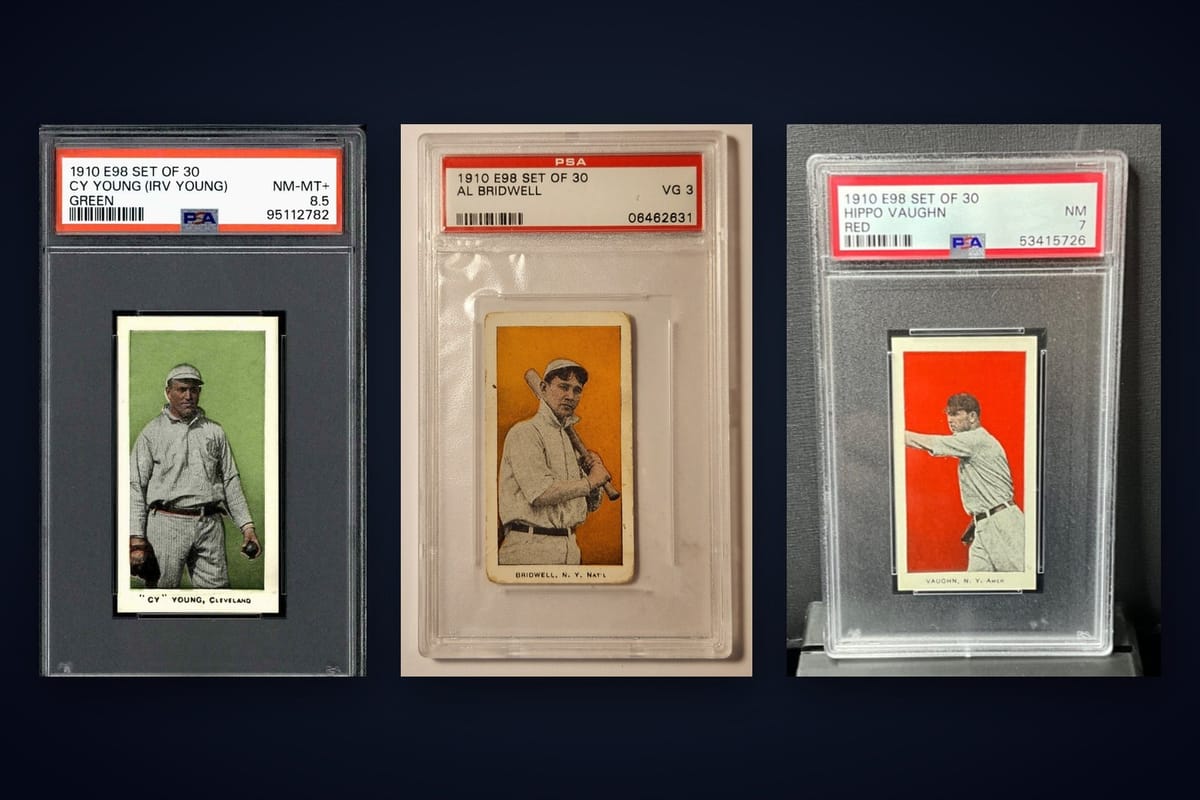
![Cy Young Irv Young [Green] 1910 E98 Set of 30 card](https://i.ebayimg.com/images/g/SogAAOSwAHRmquWe/s-l500.jpg) |
Cy Young Irv Young [Green] 1910 E98 Set of 30 |
$9,995 | $120,000 | 12× |
![Al Bridwell [Orange] 1910 E98 Set of 30 card](https://i.ebayimg.com/images/g/3RsAAeSwsx1ow5Tx/s-l500.jpg) |
Al Bridwell [Orange] 1910 E98 Set of 30 |
$8,500 | — | — |
![Hippo Vaughn [Red] 1910 E98 Set of 30 card](https://i.ebayimg.com/images/g/qesAAeSwLbVpk7U6/s-l500.jpg) |
Hippo Vaughn [Red] 1910 E98 Set of 30 |
$5,400 | — | — |
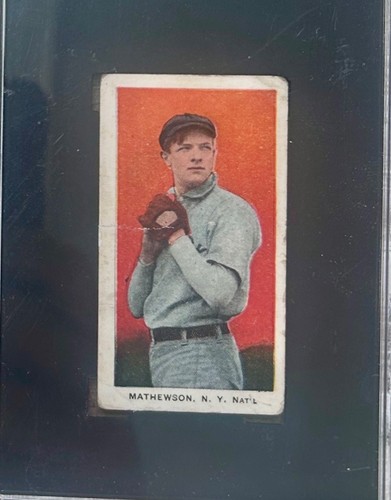 |
Christy Mathewson 1910 E93 Standard Caramel |
$4,920 | — | — |
![Johnny Evers [Red] 1910 E98 Set of 30 card](https://i.ebayimg.com/images/g/cjUAAOSw5QBnx6DI/s-l500.jpg) |
Johnny Evers [Red] 1910 E98 Set of 30 |
$869.00 | — | — |
 |
Red Dooin 1910 E93 Standard Caramel |
$56.00 | — | — |
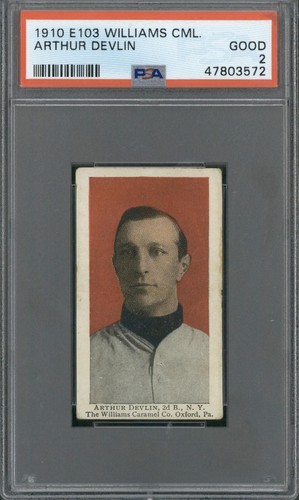 |
Arthur Devlin 1910 E103 Williams Caramels |
$792.00 | — | — |
 |
Cy Young 1910 E93 Standard Caramel |
$608.50 | — | — |
 |
Ty Cobb 1910 E93 Standard Caramel |
$56.44 | — | — |
![Harry Davis [Red] 1910 E98 Set of 30 card](https://i.ebayimg.com/images/g/KsgAAeSw3w1qE2Mj/s-l500.jpg) |
Harry Davis [Red] 1910 E98 Set of 30 |
$17,400 | — | — |
Look up any card's current raw and graded value in Midpoint — and get an estimated grade before you pay to submit.
1. T206 Honus Wagner: The Crown Jewel
No discussion of the best 1910 baseball cards is complete without the legendary T206 Honus Wagner. This card is among the rarest and commands very high prices. As of 2026-09-04, raw examples in decent condition can fetch tens of thousands, while PSA 10 graded copies have sold for multi-million dollar amounts at auction.
The T206 set, produced by the American Tobacco Company, includes 524 cards featuring many Hall of Famers like Ty Cobb and Walter Johnson. The Honus Wagner’s scarcity—believed to be due to Wagner’s objection to his likeness being used—makes it a highly coveted prize.
- PSA 10 population: fewer than 12 known
- Grading premium: PSA 10 examples command significantly higher prices than lower grades
- Condition challenges: centering and surface wear are common issues
2. T210 Old Mill: Regional Gems and Minor League Stars
The T210 Old Mill set is prized for its regional focus and inclusion of many minor-league players, making it unique among 1910 baseball cards. With 220 cards, this set is smaller than T206 but appreciated for its colorful backs advertising Old Mill tobacco.
Cards in this set are especially sensitive to condition, with edges and centering playing a major role in value. PSA 10 copies are exceptionally rare, and values increase for star players and rare regional stars.
- Notable players: Shoeless Joe Jackson, various minor leaguers
- Sharp edges and good centering are key grading factors
- Regional appeal adds to value for collectors specializing in local history
3. E98 Sporting Life: Featuring Shoeless Joe Jackson
The E98 Sporting Life set is smaller, with only 24 cards, but includes the sought-after Shoeless Joe Jackson rookie card. These cards were issued as premiums in a magazine and have a distinct look and feel compared to tobacco cards.
Because of the set’s limited size and distribution, high-grade PSA 10 examples are scarce and can command strong premiums. Condition issues such as surface wear and corner sharpness are common challenges.
- PSA 10 Shoeless Joe Jackson E98 examples can reach high values
- Cards often show minor surface flaws due to magazine distribution
- Smaller set size means fewer complete collections
4. M116 Sporting Life: Caramel Card Rarity
The M116 Sporting Life set, also known as a caramel card set, features a number of Hall of Famers and star rookies. These cards were inserted into caramel candy packages, resulting in a fragile format prone to edge wear and staining.
Collectors prize M116 cards for their bright color and rarity in high grades. PSA 10 examples are very scarce, and the value gap between raw and gem mint can be substantial.
- Set size: 30+ cards with notable rookies
- Condition concerns: edge chipping and caramel residue
- Grading premiums for clean examples can be significantly higher than raw prices
5. E103 Williams Caramel: Fragile High-Grade Challenge
The E103 Williams Caramel set is another candy-era series notable for its delicate cards and inclusion of key Hall of Famers. Edges are often worn, making PSA 10 grades rare and valuable.
Collectors focusing on rare 1910 baseball rookie cards often seek E103 examples as cornerstone pieces. Their fragile nature means investing in proper storage is essential.
- Typical card condition includes edge wear and light surface flaws
- PSA 10 examples can command multiples of raw card prices
- Storage tips: see our ultimate collector’s guide to protect fragile cards
6. Key 1910 Hall of Famers and Star Players
1910 baseball card sets feature several Hall of Famers whose rookie and early cards remain highly valued. Top names include:
- Honus Wagner (T206): Among the most valuable player cards from 1910
- Shoeless Joe Jackson (E98, T210): Sought-after rookie cards
- Ty Cobb (T206): Another iconic Hall of Famer with prized cards
- Walter Johnson and Nap Lajoie: High-value stars in multiple sets
These players’ cards often show significant price differences between raw and PSA 10 grades due to their popularity and scarcity of top conditions.
7. Understanding Condition and Grading Impact on Value
Condition remains the single biggest factor affecting the value of 1910 baseball cards. Centering, corners, edges, and surface quality all combine to determine a card’s grade. PSA, BGS, CGC, and TAG have varying grading scales, but all reward well-centered, clean cards with high grades.
For example, a 1910 Honus Wagner card graded PSA 10 can be worth substantially more than a raw or lower-graded counterpart. The gem-premium gap is especially wide in these vintage sets due to the scarcity of perfect examples.
Using AI-based tools like Midpoint’s free centering calculator can help collectors estimate the centering grade down to the millimeter before paying for professional grading.
8. How to Identify Authentic 1910 Baseball Cards
Because 1910 cards are highly collectible, the market contains numerous reprints and forgeries. Collectors should verify authenticity by examining:
- Card backs: Genuine cards often have distinct tobacco, caramel, or magazine back prints
- Printing variations: Early 20th-century techniques produce unique dot patterns and ink textures
- Paper quality and thickness: Authentic cards use period-correct stock
Consulting grading guides and expert databases helps. Additionally, comparing cards using Midpoint’s AI surface and edge detection tools can highlight inconsistencies indicative of fakes.
9. Price Ranges and Auction Results for Notable 1910 Cards
As of 2026-09-04, here are typical price ranges reported for key 1910 cards, though actual prices can vary widely based on condition and market demand:
- T206 Honus Wagner: Raw cards often start around $50,000; PSA 10 examples have sold for multi-million dollar amounts
- E98 Shoeless Joe Jackson: Raw cards can range from $20,000 to $50,000; PSA 10 examples may reach six-figure values
- T210 Old Mill Shoeless Joe Jackson: Raw cards often start around $15,000; PSA 10 examples are rare and can command high prices
- M116 Sporting Life star rookies: Raw cards may range from $5,000 to $15,000; PSA 10 examples can be worth significantly more
Complete or near-complete sets in high grade can fetch premium prices at auction, often exceeding six figures depending on condition and rarity.
10. Collecting Strategies: Budget vs. Advanced Registry Collectors
Collectors with different budgets and goals approach 1910 baseball cards differently:
- Budget buyers often focus on regional and minor-league sets like T210 Old Mill, where lower prices and interesting player stories abound.
- Advanced registry collectors pursue complete, high-grade sets such as T206 and E98 for maximum investment value and prestige.
- Investing in precise pre-grading tools like Midpoint helps all collectors avoid costly grading mistakes and maximize returns.
Conclusion
The best 1910 baseball cards combine rarity, condition, and iconic player appeal to create some of the most valuable cards in the hobby. Understanding the key sets—T206, T210 Old Mill, E98, M116 Sporting Life, and E103 Williams Caramel—and the star players featured helps collectors target worthwhile investments. Condition and grading remain paramount, with PSA 10 versions often exponentially increasing value. Leveraging modern AI tools like Midpoint to measure centering and estimate grading before submission is a smart move to protect your investment and enhance your collection’s value over time.
FAQ
Q: What are the most valuable 1910 baseball cards?
A: The most valuable include the T206 Honus Wagner, E98 Shoeless Joe Jackson, and T210 Old Mill Shoeless Joe Jackson. PSA 10 grades of these cards typically command the highest prices.
Q: Which 1910 baseball card sets are the rarest?
A: The E98 Sporting Life and M116 Sporting Life sets are smaller and have fewer high-grade examples, making them rarer in top condition. T210 Old Mill’s regional focus also adds rarity for specific cards.
Q: How can I tell if a 1910 baseball card is authentic?
A: Check the card back printing, paper quality, and ink patterns. Use expert guides and tools like Midpoint’s AI grading to detect inconsistencies that may signal reprints or forgeries.
Q: What is the difference between T206, T210, E98, and M116 cards?
A: T206 is a large tobacco set with 524 cards; T210 Old Mill focuses on regional and minor-league players; E98 Sporting Life is a small magazine premium set; M116 Sporting Life are caramel cards with fragile edges.
Q: How much are 1910 baseball cards worth in different grades?
A: Values vary widely, but PSA 10 grades often sell for significantly more than raw cards, especially for star players and key sets.
Q: Which Hall of Famers appear in 1910 baseball card sets?
A: Notables include Honus Wagner, Shoeless Joe Jackson, Ty Cobb, Walter Johnson, and Nap Lajoie, among others.
Free to start
Try the Midpoint app
Grade any card from a photo, see its raw and PSA 10 value, and track what your collection is worth — free.
Get it on iPhoneGet it on Android