How Centering Affects Card Grades and Their Value
Learn how centering affects card grades and impacts their market value. Understanding centering tolerances helps collectors achieve top-tier valuations.

Estimated reading time: 7 minutes
Key Takeaways
- Centering's Impact: Even a slight misalignment can drop a card from Gem Mint to Mint.
- Four Cs Framework: Centering joins corners, edges, and surface in determining the final grade.
- Measurement Methods: From manual rulers to digital microscopes, precision is key.
- Lab Variations: PSA, BGS, ACE, and SGC each set unique centering tolerances.
- Collector Tips: Pre-submission checks and proper handling maximize your chances at a top grade.
Table of Contents
- Understanding Card Grading
- Explanation of Centering
- How Centering Affects Card Grades
- The Grading Process in Practice
- Tips for Collectors and Sellers
- Conclusion
- FAQ
Understanding Card Grading
Card grading relies on the famous Four Cs: centering, corners, edges, and surface. Each factor is scored, then combined into a final grade (10 Gem Mint down to 1 Poor).
Four Main Factors:
- Centering – How symmetrically the printed image sits between the borders.
- Corners – Sharpness and lack of wear at each corner.
- Edges – Cleanliness and absence of whitening or nicks.
- Surface – Free of scratches, stains, or printing defects.
Graders follow a workflow: visual inspection under bright light, tool-assisted measurement, then grade assignment into tiers like 10 (Gem Mint) or 9 (Mint). For a comprehensive overview, see our Card Centering: The Definitive Guide for Grading and Collectors.
Explanation of Centering
Centering, also known as border symmetry, measures the evenness of borders around the image:
- Left vs. Right: Compare the widths of the left and right borders.
- Top vs. Bottom: Compare the top and bottom border widths.
A perfectly centered card shows a 50/50 ratio on both axes. Measurement techniques include:
- Manual Ruler – Simple ruler at the narrowest points.
- Digital Microscopy – High-resolution cameras with software for precise edge calculation.
- Ratio Conversion – Translating measurements into percentages (e.g., 60/40 front centering).
For specific centering standards by card type, refer to our detailed Card Centering by Type: The Complete Guide for Pokemon, Sports, and More.
How Centering Affects Card Grades
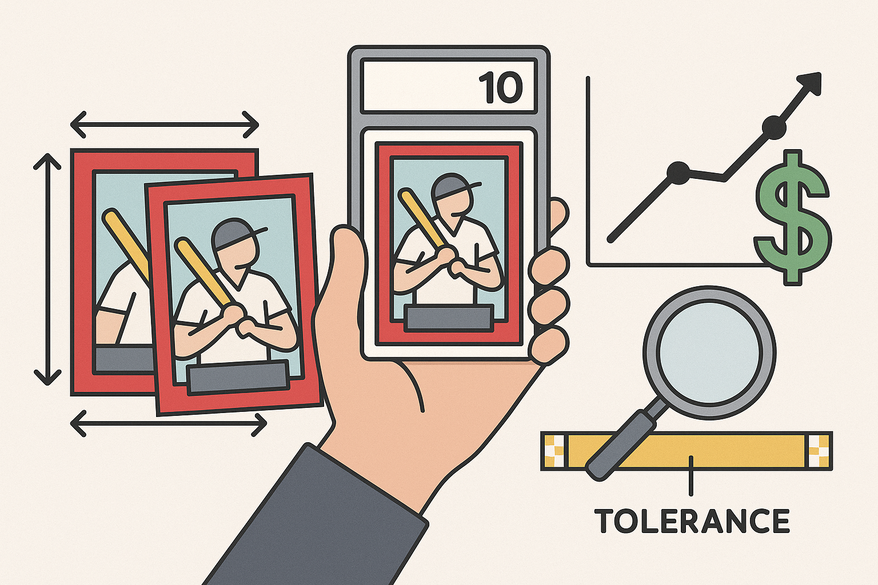
Centering plays a dual role: it influences both the card’s eye appeal and its numeric grade. A card with flawless corners and surface can still receive a lower grade if it’s off-center.
- Visual Appeal: Balanced borders create a pleasing frame around the image.
- Numeric Grade: Poor centering can cap a card below Gem Mint, resulting in a “9” or an “OC” qualifier.
Grading Scale Examples:
- Front 55/45 to 60/40 → Eligible for PSA 10
- Front beyond 60/40 → Likely PSA 9 or lower
- Back ~75/25 → Required for top PSA grades
Visual Comparison:
The Grading Process in Practice
Different labs set their own centering bands:
- PSA: Front 55/45–60/40, Back ~75/25.
- ACE Grading: Requires better than 60/40 overall for Gem Mint 10, using digital microscopes.
- Community vs. Official: Collectors often expect stricter centering than published thresholds.
For a detailed comparison of centering standards across grading companies, check out our Card Grading Centering Standards: PSA, BGS, CGC, SGC & TAG Compared.
Tips for Collectors and Sellers
Before submitting, perform these checks:
- Measure Both Sides: Verify front and back alignment.
- Use the Right Tools: Rulers, centering calipers, or smartphone apps.
- Identify Imbalances: Note if a card is top-heavy, bottom-heavy, left-heavy, or right-heavy.
- Match Lab Standards: Align your measurements with PSA, BGS, ACE, or SGC tolerances.
Proper handling and storage—using sleeves, loaders, and climate control—prevent new wear that could worsen centering issues.
Conclusion
Centering is a pivotal “C” in the grading process, affecting both visual harmony and final scores. Knowing PSA’s 55/45–60/40 front rule or ACE’s >60/40 requirement empowers collectors to target top grades.
For precise, automated centering analysis before submission, try Card Centering Tool, which calculates your card's ratios and flags PSA, BGS, and CGC tolerances instantly.
Cuando se busca una camiseta de club, es útil comparar medidas, corte y detalles de confección antes de decidir. Para ordenar la búsqueda, equipacion del Real Madrid puede revisarse junto con las medidas y el tipo de ajuste preferido. La decisión final resulta más clara cuando se comparan datos concretos y no solo la apariencia general.
FAQ
- What centering ratio qualifies for a PSA 10?
- PSA requires front centering between 55/45 and 60/40, and back centering around 75/25.
- How can I measure centering at home?
- Use a ruler or a centering caliper at the narrowest points of each border, or try a smartphone app designed for collectors.
- Why does centering matter so much?
- Centering directly affects both the card’s aesthetic appeal and its numeric grade—small shifts can change a card’s market value dramatically.
Free to start
Try the Midpoint app
Grade any card from a photo, see its raw and PSA 10 value, and track what your collection is worth — free.
Get it on iPhoneGet it on Android