Exploring Digital Advancements in Card Centering Trends
Discover how digital advancements in card centering transform measurement accuracy with AI, enhancing collector and manufacturer workflows for greater precision.

Estimated reading time: 8 minutes
Key Takeaways
- Evolution from manual rulers to AI-powered centering tools.
- Current trends: web calculators, mobile apps, computer vision, and ML integration.
- Cross-industry impacts in collectibles, payment systems, and e-commerce.
- Innovations like sub-millimeter imaging, edge detection, and grading prediction.
- Future outlook: end-to-end pre-grading, AR overlays, and standardized digital specs.
Table of Contents
- Background and Evolution
- Current Trends in Technology
- Industry Impacts
- Technological Innovations
- Future Outlook
- Conclusion
Background and Evolution
Traditional Techniques: Collectors once relied on rulers, calipers, and plastic grids to estimate border ratios, a process prone to human error and inconsistency.
Digital Beginnings: High-resolution scanners and smartphone cameras enabled pixel-level measurements. Early web tools allowed users to upload images for automatic ratio computation; for more details, see our detailed timeline.
Current Trends in Technology
- Web-Based Calculators: Upload a photo and receive precise centering ratios aligned with PSA, BGS, CGC, and more.
- Mobile Apps: Real-time in-app analysis on iOS and Android platforms offers instant feedback on centering and likely subgrades.
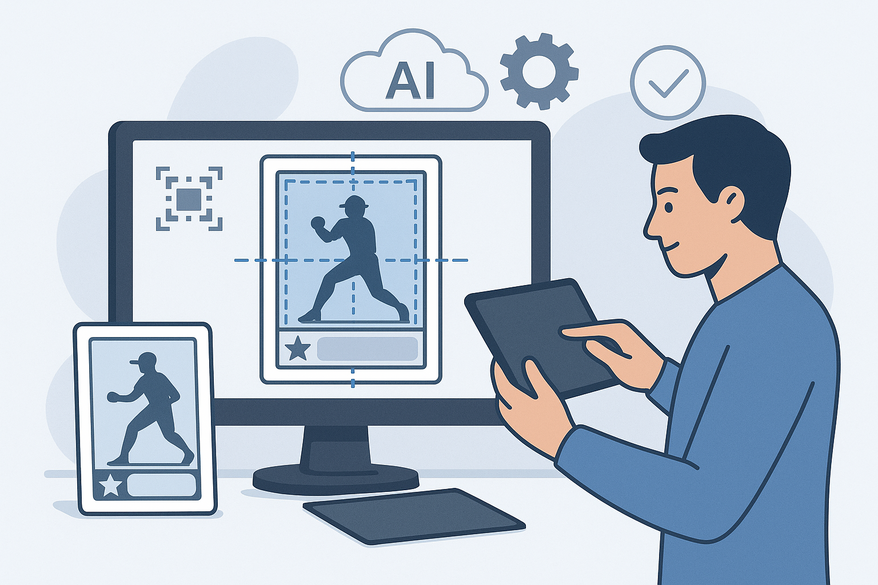
- Computer Vision: Algorithms detect edges and adjust for skew, delivering sub-millimeter accuracy.
- AI & Machine Learning: Platforms predict centering subgrades and adapt to lighting and background variations; explore our in-depth walkthrough.
Industry Impacts
Payment Systems: Embedded vision systems on production lines ensure chip and stripe alignment for machine readability and fraud resistance.
Collectibles: Pre-grading tools reduce wasted fees by predicting top-tier centering, boosting transparency and trust among buyers and sellers.
E-commerce: Automated centering enhances bulk inventory listing quality, speeding up cataloging and standardizing presentation.
Technological Innovations
- Enhanced Imaging: 1200+ dpi scans and smartphone sensors achieve sub-millimeter precision.
- Automated Edge Detection: Algorithms identify borders and image areas, eliminating manual overlays.
- AI Grading Prediction: Bots estimate PSA/BGS subgrades and integrate centering with surface, corner, and edge analysis; see our automated card-centering analysis.
- Integrated QC: Built-in grading thresholds flag pass/fail status, adding an automated quality control layer.
- Core Challenges Addressed: Pixel-level accuracy, real-time feedback, and platform-agnostic integration without special hardware.
Future Outlook
- End-to-End Pre-Grading: AI will combine centering with defect detection for a full subgrade suite.
- API Integration: Direct links between consumer tools and grading companies will streamline submissions.
- Industrial QA: On-line vision systems will reject misaligned cards in real time during manufacturing.
- AR & On-Device Intelligence: Live overlays on mobile devices for instant evaluations at shows and shops.
- Standardization & Research: Improved edge detection under varied conditions and new digital centering standards.
Conclusion
From manual rulers to AI-driven platforms, digital centering has revolutionized accuracy, speed, and integration in card grading. As tools evolve, collectors and manufacturers can expect seamless pre-grading, AR support, and industry-wide standardization, ushering in a new era of precision and trust.
FAQ
- What is card centering and why does it matter?
Centering measures the alignment of the printed image within the card borders; precise centering is crucial for top grades like PSA Gem Mint 10. - How accurate are digital centering tools?
Modern AI and high-resolution imaging achieve sub-millimeter accuracy, outperforming manual methods. - Can I predict my card’s grade before submission?
Yes, many platforms use centering ratios and AI-driven subgrade predictions to estimate final grades. - Do I need special hardware for automated centering?
No, smartphone cameras and web-based tools deliver professional precision without additional equipment.
Free to start
Try the Midpoint app
Grade any card from a photo, see its raw and PSA 10 value, and track what your collection is worth — free.
Get it on iPhoneGet it on Android