The Evolution of Card Centering: From Eye-Tests to AI Precision
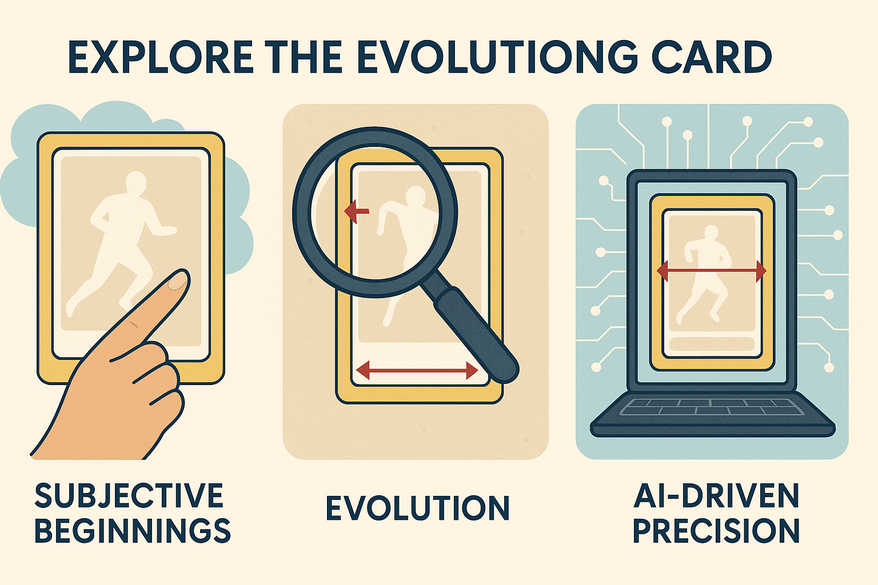
Explore the evolution of card centering, a critical grading factor, from its subjective beginnings to AI-driven precision in modern grading standards.

Estimated reading time: 7 minutes
Key Takeaways
- Centering precision: from an informal eye-test to AI-driven millimeter accuracy.
- Critical grading pillar: centering often dictates whether a card achieves gem-mint status.
- Historic milestones: PSA’s 1987 scale, BGS’s 1998 subgrades, and digital imaging advances.
- Tolerance benchmarks: strict ratios like 55/45 front and 75/25 back for top grades.
- Future outlook: AI, laser imaging, and new label features will drive even tighter standards.
Table of Contents
- Introduction
- Background on the Evolution of Card Centering
- History of Grading Standards
- Card Centering Standards Timeline
- The Evolution of Card Centering in Practice
- Future Trends in the Evolution of Card Centering
- Conclusion: The Evolution of Card Centering
- FAQ
Introduction
Card centering—how evenly a printed image sits within a card’s borders—is one of the most critical factors in trading card grading. In the early days, centering moved from a vague eye-test concept to one of the most precisely defined, technology-driven parts of card grading. Today, centering is widely regarded as one of the four core grading pillars—and is often the single biggest factor that holds cards back from gem-mint grades.
In this post on the evolution of card centering, we’ll explore:
- The history of grading standards and how centering became quantifiable
- A card centering standards timeline
- A comparison of major graders’ centering benchmarks
- Future trends driving even tighter centering precision
To remove guesswork from your submission strategy, try the free Card Centering Tool web app—it instantly measures border ratios and flags PSA, BGS, and CGC tolerance compliance before you pay grading fees.
Background on the Evolution of Card Centering
What Is Card Centering?
Card centering measures border balance by comparing opposite sides:
- Formula: smaller border ÷ larger border × 100, calculated left–right and top–bottom
- Example: Left border = 3 mm, right border = 2 mm → 2 ÷ 3 ≈ 0.67 → 67/33 or roughly 60/40 centering
When border ratios drift far from 50/50, graders assign lower centering scores. For a detailed walk-through on manual and digital measurement techniques, see our step-by-step guide for measuring card centering.
Centering as a Manufacturing Defect
- Centering issues occur in printing/cutting, not in post-production handling.
- Off-center cards cannot be “fixed” without reprinting.
- Professional graders treat centering as its own sub-component, not as damage.
Weight in Modern Grading
Centering is one of four main sub-scores in most grading systems:
- Corners
- Edges
- Surface
- Centering
Even with near-perfect corners, edges, and surface, weak centering can prevent a top grade.
Early Collector Practices
- Descriptive labels: “well-centered,” “slightly off-center,” “OC”
- Simple tools: rulers or paper templates
- Variable print quality: frequent miscuts and “diamond cuts” in older sets
History of Grading Standards
The history of grading standards shows how centering moved from opinion to precise metrics.
Pre-1980s: Informal Judgments
- No third-party grading; condition assessed casually
- Centering recognized as important but lacked numeric thresholds
- Terms like “fair,” “good,” or “off-center” varied by seller
1987 – PSA’s 10-Point Scale
- PSA launches a formal 1–10 grading scale
- Centering becomes an explicit criterion alongside corners, edges, and surface
- Rough percentage guidelines published
For an in-depth breakdown of PSA’s centering tolerances (55/45 front, 75/25 back for a PSA 10), see PSA’s 10-point scale centering requirements.
1998 – BGS Introduces Subgrades
- BGS adds separate 1–10 subgrades for centering, corners, edges, and surface
- This highlights centering’s distinct role in the overall grade
2000s–2010s – Digital Imaging & Pre-Screening
- Rise of phone apps, scanning tools, and computer-vision services to calculate centering ratios
- Collectors use templates and online tools to pre-check centering before submission
~2020s – AI & Laser Measurement
- AGS adopts AI and laser imaging for objective centering metrics
- Other platforms deploy computer-vision algorithms for millimeter-level analysis
Card Centering Standards Timeline
- Pre-1970s: Centering judged solely by eye; no formal guidelines
- 1970s: Descriptive terms used but no numeric scales
- 1987 – PSA 10-Point Scale: First formal centering thresholds
- 1998 – BGS Subgrades: Centering subgrade introduced
- Early 2000s: PSA’s ~60/40 front centering guideline for a PSA 10
- 2010s: Digital pre-screening tools proliferate
- 2020–2023: AI & laser-based centering measurement
- Mid-2020s: PSA tightens Gem Mint to ~55/45 front and 75/25 back
The Evolution of Card Centering in Practice
Grading Companies’ Centering Benchmarks
- PSA: 55/45 front & 75/25 back for PSA 10
- BGS: 10 subgrade ≈ 50/50; 9.5 allows up to 55/45
- SGC: Similar strict ratio thresholds
- Ace Grading: ≤ 60/40 = 10; 65/35 = 9; etc.
- AI-Driven (AGS, TAG): Millimeter-level metrics via machine vision
Explore a full centering tolerance comparison.
Collector Impact
- Pre-screening: reject cards below critical ratios (e.g., <55/45)
- Price premiums: true 50/50 cards command higher resale value
Community Debates
- PSA tightening as population control vs. consistency
- Subjectivity in human grading vs. objectivity of AI
- Vintage leniency discussions due to historic print limitations
Future Trends in the Evolution of Card Centering
AI & Computer Vision
- Exact centering percentages reported
- Millimeter-precision measurements
Hardware Advances
- Laser imaging and high-resolution scanners
- Automated border detection
New Label Features
- Centering sub-scores on all labels
- “Perfect Centering” or “Centered 10” badges
- Distinct standards for modern vs. vintage issues
Market Effects
- Continued gem population control and premium pricing
- Data-driven valuation models using centering data
- Ongoing collector education on centering criteria
Conclusion: The Evolution of Card Centering
From informal eye-test assessments to AI-powered millimeter analysis, the evolution of card centering underscores the hobby’s drive for precision and transparency. Milestones such as PSA’s 1987 10-point scale, BGS’s 1998 subgrades, and the advent of digital imaging in the 2010s paved the way for today’s tight 55/45 front centering requirement for a PSA 10.
Understanding centering’s journey helps collectors evaluate raw cards with realistic expectations, refine submission strategies, and interpret population reports and price differentials. Share your stories of grades missed due to centering, experiences with different graders, and your views on AI versus human-measured centering to keep this conversation moving forward.
FAQ
What is card centering and why is it important?
Card centering measures how evenly the printed image sits within border edges. It’s one of four main grading pillars and often the key factor preventing a card from achieving a gem-mint grade.
How do grading companies measure centering?
Graders calculate the ratio of the smaller border to the larger border on opposite sides (left–right and top–bottom) and express it as a percentage (e.g., 55/45). Modern methods use AI and laser imaging for millimeter-level precision.
Can I pre-screen my cards for centering before submission?
Yes. Collectors use rulers, templates, scanning apps, and online tools—like the Card Centering Tool—to check centering ratios and avoid fees on off-center submissions.
Are centering requirements different for vintage versus modern cards?
Many graders apply leniency to vintage issues due to historic print limitations. However, modern cards are held to stricter benchmarks—often 55/45 front and 75/25 back for top grades.
Will AI replace human graders for centering?
AI and machine vision offer objective, repeatable centering metrics, reducing subjectivity. Yet human oversight remains vital for nuanced judgment on edge cases and historical exceptions.
Free to start
Try the Midpoint app
Grade any card from a photo, see its raw and PSA 10 value, and track what your collection is worth — free.
Get it on iPhoneGet it on Android