7 Emerging Grading Tech Trends in Card Centering Technology
Discover the latest emerging grading tech trends transforming card centering technology with AI tools, boosting accuracy and confidence for collectors.

Estimated reading time: 7 minutes
Key Takeaways
- Automation is transforming centering: AI and computer vision replace subjective eyeballing with precise measurements.
- Multi-platform tools: Mobile apps, desktop scan workflows, and physical templates cater to all collector needs.
- Integration & workflows: Batch analysis, digital overlays, and blockchain promise end-to-end transparency and efficiency.
- Real-world impact: Better pre-grading decisions, cost savings, and a level playing field for new and experienced collectors alike.
- Challenges remain: Aligning standards across grading companies and ensuring user accuracy are ongoing hurdles.
Table of Contents
- I. Introduction to Emerging Grading Tech Trends
- II. Background on Card Centering Technology
- III. Traditional vs. Modern Approaches
- IV. Overview of Current Innovations
- V. Detailed Exploration of Key Trends
- VI. Impact on Industry and Collectors
- VII. Case Studies & Real-World Examples
- VIII. Concluding Thoughts
- FAQ
I. Introduction to Emerging Grading Tech Trends
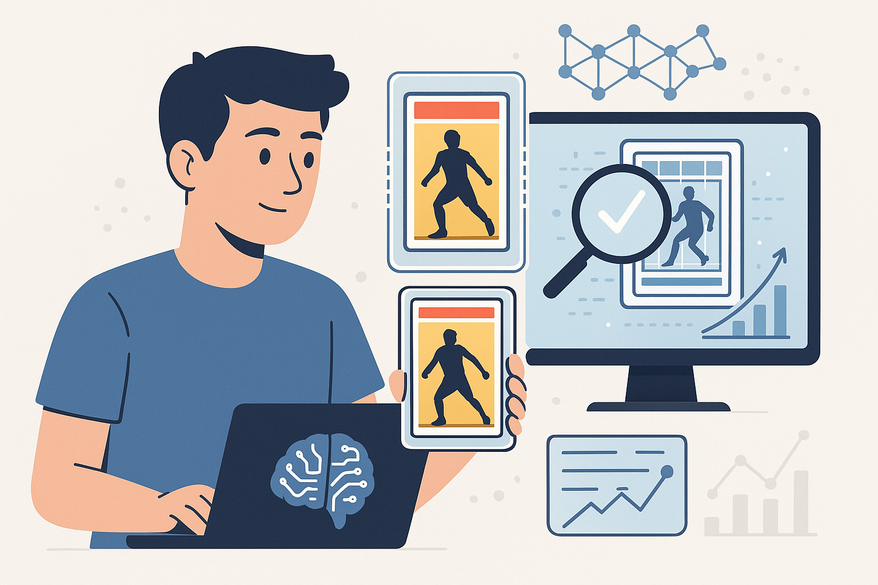
“Emerging grading tech trends” refers to the new wave of software, hardware, and AI tools transforming collectible card grading—especially centering. Traditionally, graders eyeballed border ratios; today, automated measurement tools deliver precise left/right and top/bottom percentages. This shift boosts accuracy, repeatability, and confidence for collectors and grading services alike. For a detailed step-by-step on how to measure card centering, explore our in-depth guide.
Card centering technology automates measurement of a card’s borders, replacing subjective eyeballing with data-backed percentages. When centering is off by even a fraction, subgrades—and final slab grades—can change dramatically, impacting market value.
Before you send your cards off for grading, you can now get a quick centering check online. Card Centering Tool measures both front and back centering ratios against PSA, BGS, and CGC tolerances, so you know which submissions are worth the fee.
II. Background on Card Centering Technology
Early methods relied on human judgment and simple tools. Collectors and graders compared border thickness by eye, often using printed grids or basic rulers to gauge whether cards met standards like 60/40 or 55/45 centering. Accuracy varied widely between individuals and lighting conditions, leading to inconsistent subgrades.
- Manual eyeballing introduced subjectivity.
- Printed grids offered rough guides, not precise metrics.
As card values and grading fees rose, quantification became essential. Collectors scanned cards at 1200 dpi and used basic measurement software to derive border ratios. First-generation mobile apps employed edge-detection algorithms to automate percentage calculations. More recent AI-powered tools blend manual alignment overlays with automated analysis for high precision.
III. Traditional vs. Modern Approaches
Traditional grading methods:
- Human graders visually compare card borders, assisted by magnifiers or static templates.
- Inconsistent results, especially near borderline centering thresholds.
- Dependence on grader experience and lighting.
Modern, tech-driven approaches:
- Automated border detection pinpoints edges and computes precise centering ratios within seconds.
- AI-enhanced mobile apps guide card alignment and predict centering outcomes for PSA, BGS, CGC, SGC, TAG, and ACE.
- Digital overlays let users fine-tune placement on-screen, reducing misalignment errors.
These methods reduce subjectivity, increase repeatability, and empower both novices and professionals to make informed pre-grading decisions. For a deep dive into centering tolerances across grading companies, check out PSA vs BGS vs CGC: Centering Tolerances Compared.
IV. Overview of Current Innovations
A. Mobile Centering Calculators
- Card Centering Calculator (Android): sophisticated computer-vision algorithms detect borders and calculate exact left/right and top/bottom ratios optimized for major grading companies.
- Gradeon Card Centering & Grading Tool (iOS): AI-powered predictions for centering grades across PSA, BGS, CGC, SGC, TAG, and ACE.
B. Desktop/Online Scan Tools
High-resolution (1200 dpi) scan upload workflows provide precise centering feedback before card submission, ideal for dealers and power collectors.
C. Modern Physical Templates
- Legends Card Center Tool: clear percentage guides indicate green/red grading suitability.
- Black Label Metrics: hybrid physical alignment aid paired with video tutorials for accurate centering evaluation.
D. Recent Advancements
- Fully automated border detection replaces manual placement.
- AI models handle diverse card designs, foils, and colored edges.
- Multi-company standard integration ensures predictions align with each firm’s tolerance ranges.
- Smartphone deployment brings professional-quality centering analysis to hobbyists.
For a roundup of top tools to try in 2024, see 5 Best Card Centering Tools for Perfect Grading in 2024.
V. Detailed Exploration of Key Trends
- AI & Computer Vision for Automated Centering: Advanced AI and computer vision detect card borders and calculate centering automatically, encoding centering rules for PSA, BGS, CGC, SGC, and more.
- Workflow Automation for Efficiency & Consistency: Batch analysis via 1200 dpi scans and instant mobile centering at point of purchase streamline decision-making and reduce human error.
- Precision-Focused Innovations: Exact centering percentages mapped to official grading scales, with AI that adapts to varied border designs and tight tolerances.
- Integration with Digital Grading Ecosystems: Centering analysis modules become part of end-to-end digital pre-grading platforms covering surface, corners, edges, and centering.
- Blockchain & Digital Certification (Forward-Looking): Storing on-chain records of centering metrics alongside NFT-style slab data for tamper-evident grading history.
VI. Impact on Industry and Collectors
A. Collectors
- Improved pre-grading decisions via home apps, scans, and templates.
- Cost control by avoiding low-centered submissions.
- Level playing field for new collectors through AI guidance.
- Caution: centering is one of five subgrades; surface, corners, and edges also matter.
B. Dealers & Grading Services
- Dealers optimize inventory grading budgets with standardized pre-screening.
- Grading companies face pressure to adopt transparent, consistent centering protocols.
- Potential disputes if app metrics diverge from final slab results.
C. Benefits & Challenges
- Benefits: accuracy, precision, consistency, efficiency, trust.
- Challenges: aligning multi-company standards, user capture errors, narrow centering focus, slow adopters.
VII. Case Studies & Real-World Examples
- Card Centering Calculator (Android): Most accurate border-detection algorithms with multi-grader preview modes.
- Gradeon (iOS): AI-driven centering ratios and multi-company score predictions.
- Edge Grading High-Res Scan Workflow: 1200 dpi uploads for pre-grading centering analysis.
- Legends Card Center Tool: Physical template with green/red indicators.
- Black Label Metrics Centering Tool: Hybrid physical aid with video tutorials.
VIII. Concluding Thoughts
Emerging grading tech trends in card centering technology are driving the hobby toward AI- and algorithm-driven measurement for objective, repeatable centering metrics, automated workflows that replace subjective eyeballing, and integration into broader digital grading pipelines. Collectors and dealers who adopt these tools can make smarter pre-grading decisions, streamline operations, and build greater trust in centering outcomes.
Ready to see how well your cards center before you pay grading fees? Try Card Centering Tool today to measure your cards down to the millimeter and get instant PSA, BGS, and CGC estimates.
FAQ
- How accurate are AI-powered centering tools?
Most modern apps boast accuracy within ±0.5%, but results can vary with lighting and camera quality. - Can I trust a mobile scan over a professional grader?
Mobile scans offer excellent pre-screening, but final slab grades may still differ slightly due to proprietary grading protocols. - Do all grading companies use the same centering tolerances?
No—PSA, BGS, CGC, SGC, TAG, and ACE each have unique thresholds. Integration tools map ratios to each firm’s standards. - Is blockchain certification widely adopted?
Only a few forward-looking services currently store on-chain metrics, but adoption is growing for transparency and security.
Free to start
Try the Midpoint app
Grade any card from a photo, see its raw and PSA 10 value, and track what your collection is worth — free.
Get it on iPhoneGet it on Android