Shaquille O'Neal Cards Worth Money: Values and Grading
Discover which Shaquille O'Neal cards are worth money, raw vs PSA 10 values, key rookies, rare inserts, and the best cards to grade.

Estimated reading time: 14 min
Key Takeaways
- Not every Shaq card is valuable; the biggest money cards are usually key rookies, low-pop inserts, and rare parallels in top condition.
- For Shaquille O'Neal cards worth money, condition matters more than almost anything else: centering, corners, edges, and surface flaws can make or break value.
- Completed sales are the most reliable guide to price; high eBay asking prices often overstate what collectors actually pay.
- The best Shaquille O'Neal cards to grade are generally clean rookies, Beam Team, 1993 Ultra Scoring Kings, and low-pop premium inserts with strong eye appeal.
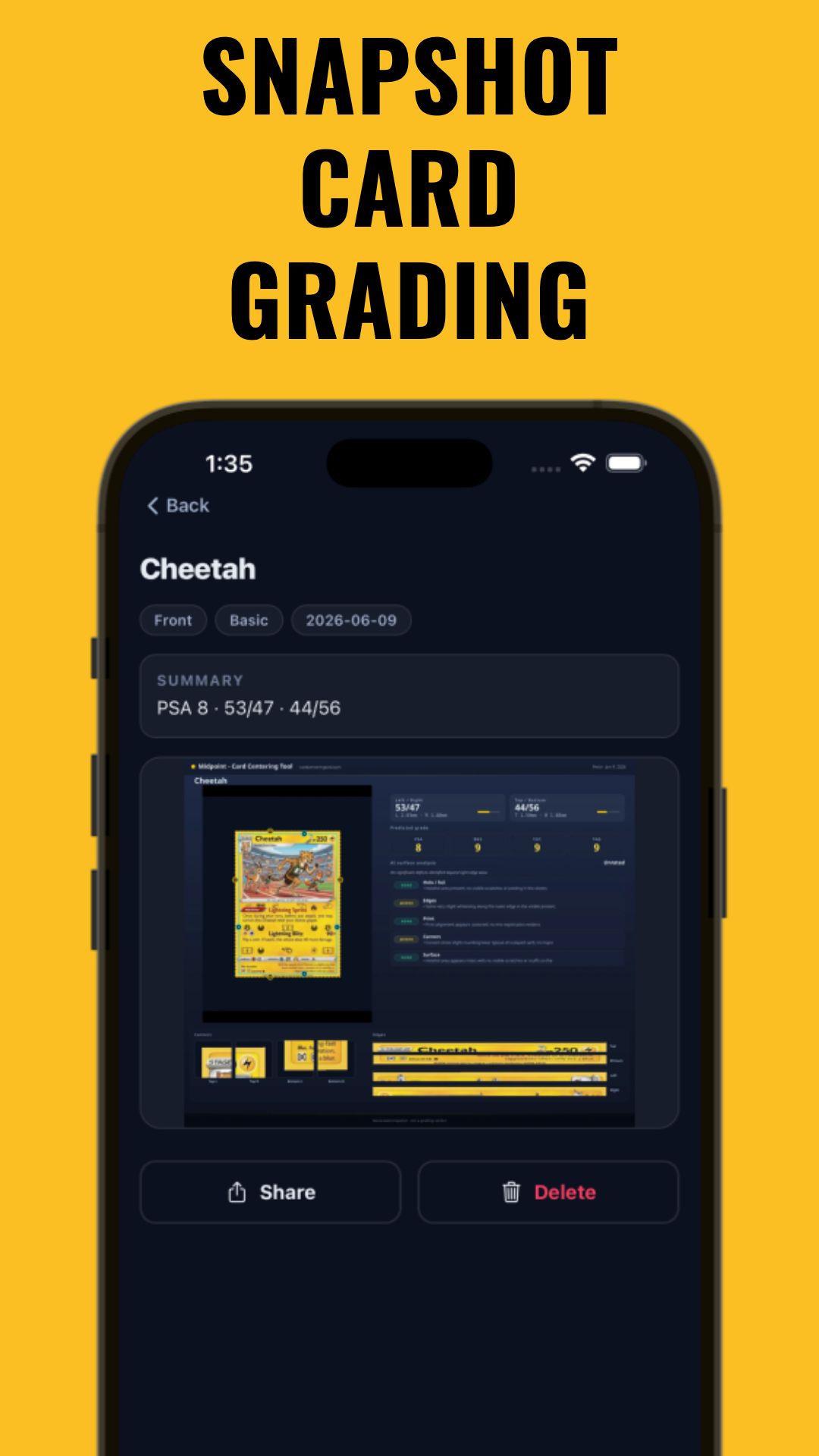
- Use Midpoint to check centering and get an AI grade estimate before you spend on grading fees.
Card values — live data from Midpoint's card database, as of 2026-09-04. Prices move; Midpoint refreshes these daily.
| Card | Raw | PSA 10 | Gem premium | |
|---|---|---|---|---|
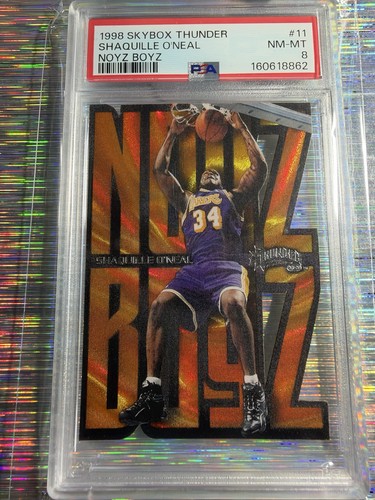 |
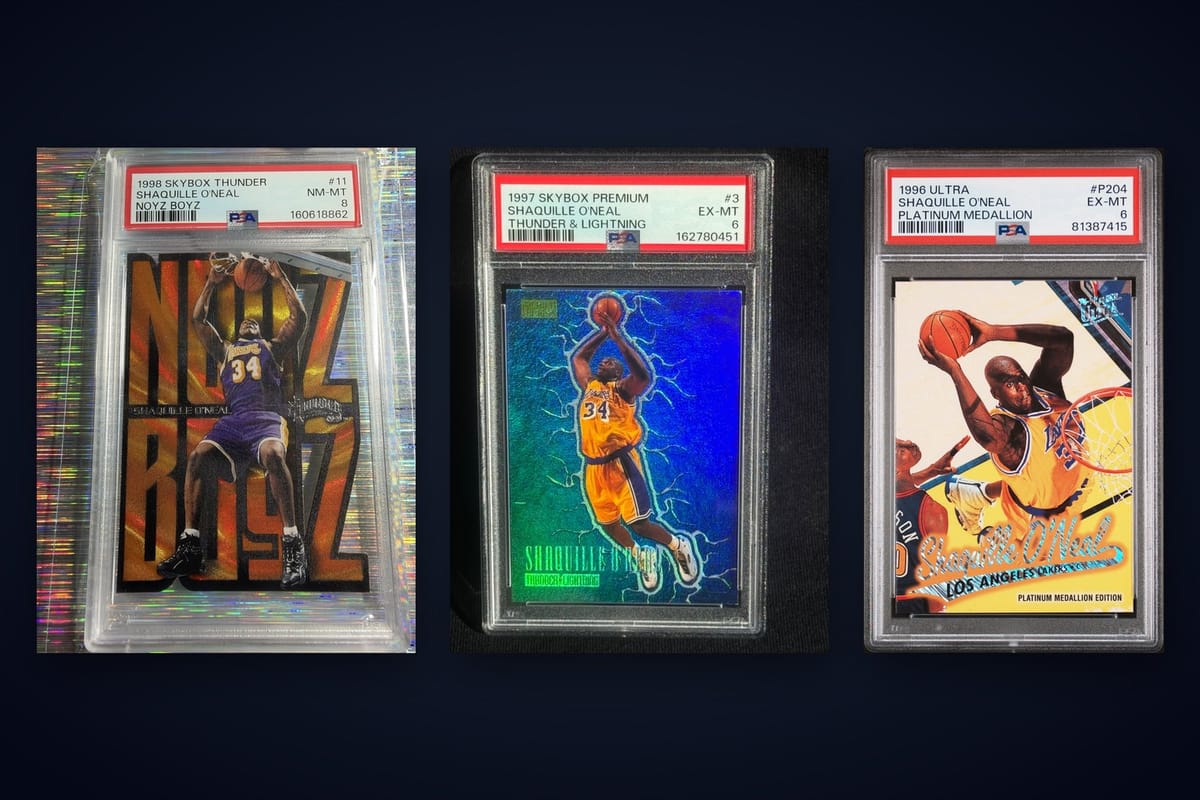
Shaquille O'Neal #11 1998 Skybox Thunder Noyz Boyz |
$1,583 | $30,745 | 19.4× |
 |
Shaquille O'Neal #3 1997 Skybox Premium Thunder & Lightning |
$1,055 | $27,159 | 25.8× |
 |
Shaquille O'Neal #P-204 1996 Ultra Platinum Medallion |
$512.04 | $25,766 | 50.3× |
 |
Shaquille O'Neal [Members Only] #21 1992 Stadium Club Beam Team |
$600.16 | $21,097 | 35.2× |
 |
Shaquille O'Neal #4GT 1997 Skybox Premium Golden Touch |
$703.94 | $16,535 | 23.5× |
 |
Shaquille O'Neal #8 1993 Ultra Scoring Kings |
$447.00 | $15,629 | 35× |
 |
Shaquille O'Neal [Refractor] #17 1999 Bowman's Best |
$223.50 | $15,000 | 67.1× |
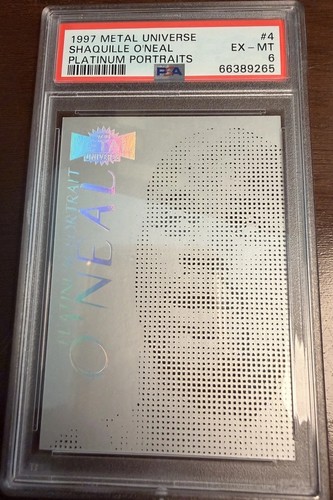 |
Shaquille O'Neal #4 1997 Metal Universe Platinum Portraits |
$1,275 | $14,000 | 11× |
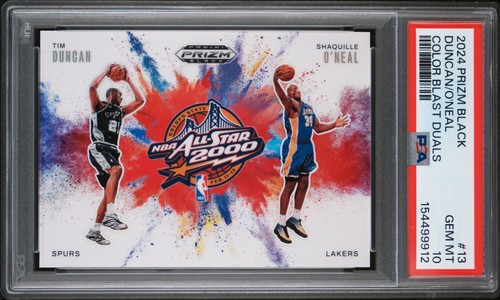 |
Shaquille O'Neal / Tim Duncan #13 2024 Panini Prizm Black Color Blast Dual |
$3,250 | $13,244 | 4.1× |
 |
Shaquille O'Neal #4 1998 Skybox Premium That's Jam |
$1,082 | $12,900 | 11.9× |
 |
Shaquille O'Neal #M8 1995 Skybox Premium Meltdown |
$320.01 | $12,619 | 39.4× |
 |
Shaquille O'Neal #4 1997 Ultra Ultrabilities Superstar |
$427.50 | $11,007 | 25.8× |
Look up any card's current raw and graded value in Midpoint — and get an estimated grade before you pay to submit.
Table of Contents
- Section 1: What Makes Shaquille O'Neal Cards Worth Money
- Section 2: Shaquille O'Neal Rookie Cards and Base Cards to Know
- Section 3: The Most Valuable Shaquille O'Neal Cards
- Section 4: Raw vs Graded Shaq Card Value
- Section 5: How to Identify Valuable Shaq Cards Fast
- Section 6: Which Shaq Cards Are Worth Grading
- Section 7: Market Trends, Selling Tips, and Final Buying Advice
Section 1: What Makes Shaquille O'Neal Cards Worth Money
Rookie years, inserts, and scarcity
When collectors search for Shaquille O'Neal cards worth money, they are usually chasing a simple formula: first-year cards, tough inserts, and scarce parallels with strong grading potential. Shaq has one of the deepest trading-card runs in the hobby, which means his cardboard spans everything from $1 commons to high-end cards that can sell for hundreds or thousands when the right collector shows up.
The most important money-makers are not random base cards. They are usually cards with one or more of these traits:
- Rookie-year status from 1992-93
- Insert scarcity or early premium-issue distribution
- Low population in high grades
- Strong eye appeal, especially centered copies
- Recognizable brand prestige such as Upper Deck, Stadium Club, and Metal Universe
Why condition swings value so much
Shaq cards from the early 1990s were heavily collected, which means many copies were handled, packed, and stored poorly. For that reason, condition is often the difference between a few dollars and a serious premium. Even a desirable rookie can lose a lot of value if it has off-centering, whitening, scratches, print dots, or soft corners.
That is why collectors compare raw cards to graded copies before buying or submitting. A raw card may look good in a photo, but centering and surface issues are often hidden. If you want a practical way to screen cards before grading, Midpoint’s centering and grading workflow can help you spot weak cards early and focus only on the ones worth the submission fee.
Completed sales vs asking prices
One of the biggest mistakes is confusing eBay listings with real market value. Asking prices can sit far above what buyers actually pay, especially on hot names like Shaq. For accurate pricing, look at completed sales and sold comps, not stale listings. That matters even more for rare inserts and graded copies, where one outlier listing can distort perception.
In practice, the market for Shaq cards is shaped by a mix of nostalgia, grading demand, and scarcity. A well-centered, sharp 1992-93 rookie can outperform a much flashier card in poor condition. On the other hand, a rare insert can outperform a rookie if the print run is low enough and the grade is strong.
Section 2: Shaquille O'Neal Rookie Cards and Base Cards to Know
The core 1992-93 rookie checklist
If you are building a checklist of Shaquille O'Neal rookie card value, start with the 1992-93 issues that collectors ask about most often. These are the cards that show up repeatedly in searches, price checks, and grading submissions:
- Upper Deck #1 and #1b Trade
- Topps #362
- Topps Gold
- Stadium Club #247
- Fleer #401
- Fleer Ultra #328
- SkyBox #382
- NBA Hoops #442
Those cards are the foundation of Shaq collecting. Some are common and affordable in raw form, while others become much more attractive in near-mint or gem mint condition. The difference is often subtle: a small tilt in centering, a faint edge nick, or a surface scratch can move a card from “worth grading” to “sell raw and move on.”
Why Upper Deck and Topps lead the conversation
The Upper Deck #1 rookie is one of the most recognized Shaq cards because it leads the set and has instant name recognition. The #1b Trade variation matters because collectors value variations differently, and a variation can carry its own premium depending on how it was distributed and how many survive. Topps #362 and Topps Gold are also key because they represent the mainstream rookie lane with broad collector appeal.
These base rookies are not all equal. Some raw copies are still only modestly priced, but a sharp PSA 10, BGS black label contender, or high-grade SGC example can move into a different tier entirely. That is why the smartest collectors separate “common card” from “premium condition copy.” They are not the same market.
Everyday cards that stay affordable
Not every Shaq rookie is expensive. In fact, many copies of the 1992-93 base rookies are still accessible because supply is large. Cards such as NBA Hoops #442 and some Fleer or SkyBox issues can often be found for only a few dollars in lower grades or raw condition. These are useful for new collectors who want the rookie-year look without paying for scarcity.
That accessibility is part of the appeal. You can build a meaningful Shaq collection on a budget, then upgrade only the cards that justify professional grading. If you are unsure which one is which, use the card number, set name, and variation first, then compare the card’s condition against known grading standards before pricing it.
Section 3: The Most Valuable Shaquille O'Neal Cards
The cards that usually lead the market
When collectors talk about the most valuable Shaquille O'Neal cards, a few names come up again and again. The headliners often include 1992-93 Stadium Club Beam Team #21, Members Only variants, 1993 Ultra Scoring Kings, and 1997-98 Metal Universe Precious Metal Gems Green #50. These cards stand out because they combine player demand, design appeal, and relative scarcity.
The Beam Team insert is especially famous because it is visually iconic and well known among basketball card collectors. Members Only versions matter because factory-set or special-distribution variants can carry a separate premium from standard copies. The 1993 Ultra Scoring Kings card is another major chase because it sits in a premium insert lane that collectors continue to respect. And the 1997-98 Precious Metal Gems Green #50 is often cited as a high-end Shaq chase card due to its status as a scarce parallel from one of the hobby’s most popular insert eras.
Rare parallels and low-print-run issues
Scarcity alone does not guarantee value, but it creates the conditions for value when demand is strong. That is why serial-numbered cards, factory-set Members Only cards, and tough parallel issues should always be checked carefully. A standard-looking Shaq card may turn out to be a limited parallel or special distribution version that is worth far more than the base issue.
Collectors should also pay attention to the set year and issue type. Early premium inserts from the 1990s often have very different supply dynamics than today’s serial-numbered cards. Some were difficult to pull from packs; others were distributed through sets or special promotions. The market rewards collectors who can identify those details correctly.
Examples of accessible versus premium cards
At the lower end, many raw Shaq base cards and common rookies remain only a few dollars. At the higher end, top-grade rookies, Beam Team copies, and rare premium inserts can command much more. The exact spread depends on condition and grade, but the broad structure is clear: common base cards are entry-level, while low-pop inserts are where serious money lives.
That is why a single Shaq collection can include both inexpensive nostalgia pieces and true trophy cards. If you are buying, be patient and compare set-by-set. If you are selling, do not assume every Shaq card belongs in the “valuable” bucket just because the player is famous.
Section 4: Raw vs Graded Shaq Card Value
How grading changes the price ladder
The difference between raw and graded cards is often dramatic. A raw Shaq card might look nice in a photo, but once it is encapsulated and assigned a PSA, BGS, SGC, or CGC grade, the market can reprice it immediately. This is especially true for key rookies and premium inserts where collectors aggressively pay for top condition.
Prices can vary widely between raw copies and high-grade examples, so check current sold comps for the exact card. The main point is not a single number; it is the structure of the market. Raw copies are usually the cheapest entry point, PSA 8 and SGC 8 typically sit in the middle, PSA 9 and BGS 9.5 often represent strong collector demand, and Shaquille O'Neal PSA 10 copies can command the biggest premiums when the card is popular and the population is tight.
Why top grades matter so much
A PSA 10 or equivalent can be a different product from a raw card, even if the card looks similar at first glance. The reason is confidence: buyers trust that the gem copy is sharp, centered, and problem-free. That trust becomes even more important with 1990s cards, where production quality can vary a lot.
For graded markets, the label matters, but condition still drives the outcome. BGS, SGC, and CGC all have collectors who prefer their own grading style and slab aesthetics. But when a card is truly special, the underlying quality is what matters most. The highest-grade copies usually attract the strongest bidding because they are the hardest to replace.
Reading the market correctly
Use sold comps, not wishful pricing. A raw card in great condition may still be a better buy than a low-grade slab if the card has room to upgrade. On the other hand, a gem mint example of a desirable insert can be a relatively safe hold because supply is limited, though no card is guaranteed to hold or gain value.
For collectors who want to avoid bad grading bets, centering is the first filter. Midpoint’s precise centering measurement and AI grade estimate can help you decide whether a card has the visual traits needed for a strong submission. If the centering is off, you often know before you spend grading money.
Section 5: How to Identify Valuable Shaq Cards Fast
Start with year, set, and card number
Before checking price, identify the card correctly. This sounds basic, but it prevents a lot of mistakes. Start with the year, then the set name, then the card number, and finally look for any variation or parallel indicator. A Shaq rookie from 1992-93 can mean several different products, and the difference between standard issue and a special parallel can be huge.
Use this quick checklist:
- Year: Is it 1992-93, 1993-94, or later?
- Set: Upper Deck, Topps, Stadium Club, Fleer, Ultra, SkyBox, Hoops, Metal Universe
- Number: The printed card number should match the checklist
- Variation: Trade, Gold, Members Only, insert, or parallel
- Condition: Centering, corners, edges, and surface
Spotting premium variations
Some valuable Shaq cards hide in plain sight because the difference is small. Members Only cards, factory-set issues, and certain premium parallels can look like ordinary base cards unless you know what to inspect. Look for text differences, foil treatment, special logos, serial numbers, and subtle design changes.
For base rookies, the most common issues are centering and print quality. For inserts, it is often surface scratching and edge wear. For shiny cards like Metal Universe or foil-heavy issues, even tiny defects show fast under light. Those flaws matter because collectors pay for clean presentation, not just famous names.
Authenticity and pre-grading checks
Never price a card until you are sure it is authentic and correctly identified. Counterfeits may be less common on some 1990s cards than on modern high-value issues, but reprints, altered cards, trimmed edges, and fake “mint” claims still appear. Check print alignment, font consistency, gloss, and edge behavior before you assign value.
If you are planning to sell or submit, a pre-grade review saves time. Measure centering, inspect the corners under light, and note any scratches or print defects. If you want a fast way to do that before sending in cards, the Free Centering Calculator and Midpoint’s grading tools can help you decide whether a card deserves a submission slot.
Section 6: Which Shaq Cards Are Worth Grading
The best grading candidates
The best Shaquille O'Neal cards to grade are the ones where a higher grade can realistically create a large value jump. That usually means key rookies, premium inserts, and low-pop cards that look very clean under inspection. Not every Shaq card deserves grading, even if it is old or famous.
Good grading targets often include:
- 1992-93 Upper Deck #1 in exceptional condition
- 1992-93 Upper Deck #1b Trade with strong centering
- 1992-93 Stadium Club #247 and Beam Team #21
- 1993 Ultra Scoring Kings
- 1997-98 Metal Universe Precious Metal Gems Green #50
What to look for before submission
Inspect the card under bright, even lighting. Look for:
- Centering: front and back borders should be balanced
- Corners: no fraying or whitening
- Edges: no chipping or dull wear
- Surface: no scratches, print lines, dimples, or haze
If one issue is obvious, do not force the grade. The submission fee, shipping, and waiting time only make sense when the card has a realistic shot at a premium result. That is especially true on non-popular commons, where grading may cost more than the incremental value.
Using tools to avoid bad submissions
This is where digital grading support helps. Midpoint can estimate PSA, BGS, CGC, and TAG-style outcomes from centering, corners, edges, and surface before you pay to submit. Estimates are not guarantees of the grade a company will assign. That matters because centering is one of the easiest flaws to measure and one of the most common reasons a card misses gem status. If you want more confidence before you grade, compare your card against a proven grading framework and use image-based measurement instead of guesswork.
For collectors working through a stack of Shaq cards, that saves real money. A small number of gem candidates can justify grading; a pile of off-center commons usually should not.
Section 7: Market Trends, Selling Tips, and Final Buying Advice
Why Shaq prices have risen again
Shaquille O'Neal cards may have benefited from renewed collector interest and hobby nostalgia. When a player remains a major cultural figure, card demand can outlive the original set cycle. Check recent sold comps to see whether a specific card is actually trending up, since prices vary by card and grade.
Momentum matters too. Once collectors start chasing the same rookie and insert cards, attention can compound quickly. The result can be a stronger market for key issues, especially high-grade examples and premium inserts with low supply. But that does not mean every Shaq card is rising equally. The best performance usually concentrates in the most recognizable and scarcest cards.
How to sell or buy intelligently
If you are selling, present the card cleanly and clearly. Include the set, year, card number, and condition notes. Show front and back images with enough detail to verify centering and surface quality. If the card is graded, mention the slab company and grade exactly as labeled.
If you are buying, compare completed sales across multiple grades. Watch for sellers who use one high asking price to imply a fake market. Also remember that a raw card with sharp centering may be a stronger value than a lower-grade slab if you believe it can grade higher later.
Bottom line on value
The Shaq market is broad, but the logic is consistent. Common base cards are affordable. Key rookies can be worth grading. Rare inserts and premium parallels are where serious money can happen. And the best copy is usually the one with the cleanest centering and the fewest visible defects.
If your goal is to separate a $3 card from a card worth grading, start with identity, then condition, then scarcity. That process will get you much closer to the real answer than any hype-driven listing ever will.
For collectors who want a smarter grading decision, check the card first, then submit selectively. If you want a practical way to do that, Midpoint helps you measure centering and estimate grade before you spend money on grading fees.
Conclusion
Shaquille O'Neal cards worth money are not hard to find once you know what to look for. The key rookies from 1992-93, the headline inserts like Beam Team and Precious Metal Gems Green, and the right high-grade copies make up most of the serious value in the market. The rest comes down to condition, rarity, and whether the card has the kind of collector demand that supports real sales.
Before you buy, sell, or grade, identify the exact set and variation, compare completed sales, and inspect the card carefully. That simple process will help you avoid overpaying for common copies and focus your money on the Shaq cards that genuinely stand out.
FAQ
Q: How much is a Shaquille O'Neal rookie card worth?
A: It depends on the exact set, variation, and condition. Common raw Shaq rookies can be only a few dollars, while high-grade copies and premium variations can be worth much more. Always check the card number, set, and sold comps before pricing it.
Q: What is the most valuable Shaq basketball card?
A: The most valuable Shaq basketball cards are typically premium inserts and rare parallels, often including 1992-93 Stadium Club Beam Team #21, Members Only variants, 1993 Ultra Scoring Kings, and 1997-98 Metal Universe Precious Metal Gems Green #50 in strong condition. Check recent sold comps to see which currently sells for the most.
Q: Which Shaquille O'Neal cards are worth money?
A: The most reliable money cards are 1992-93 rookies, high-grade rookies from Upper Deck, Topps, Stadium Club, Fleer, Ultra, SkyBox, and Hoops, plus rare inserts and parallels with low supply and strong collector demand.
Q: How much is a 1992-93 Upper Deck Shaq rookie card worth?
A: Value depends on condition and whether it is the #1 or #1b Trade version. Raw copies may be modest, but clean, high-grade examples can bring a meaningful premium. The best way to price it is by comparing completed sales for the exact variation and grade.
Q: Is the Shaq Beam Team card worth money?
A: Yes. 1992-93 Stadium Club Beam Team #21 is one of the most sought-after Shaq inserts. Value depends heavily on condition and grade, with sharp copies typically drawing much more interest than off-center or worn examples.
Q: How do I know if my Shaq card is valuable?
A: Start by identifying the year, set, and card number, then check whether it is a rookie, parallel, insert, or special variation such as Members Only. After that, inspect centering, corners, edges, and surface, and compare completed sales rather than asking prices.
Free to start
Try the Midpoint app
Grade any card from a photo, see its raw and PSA 10 value, and track what your collection is worth — free.
Get it on iPhoneGet it on Android