
Hockey Card Prices Rising November 2026: 10 Cards to Watch
Hockey card prices rising in November 2026? See which cards and players are trending, how raw and PSA 10 compare, and whether to buy, hold, sell or grade.

Estimated reading time: 9 min
Key Takeaways
- The hockey card market in November 2026 is selective. A handful of players and formats are climbing while much of the broader market stays soft.
- Young Guns, McDavid and Ovechkin rookies, and rising young stars like Jacob Fowler, Lane Hutson and Easton Cowan are the names most often cited as trending.
- Premium formats (autographs, patches, serial-numbered parallels, short prints) and PSA 10 or BGS 9.5 copies usually carry the strongest interest.
- Always confirm a price move with completed sales, not a single asking price, before you buy, sell or grade.
If you are searching for hockey card prices rising November 2026, here is the short answer: this is not a rising tide. The hockey card market in November 2026 is a story of selective gains against broader softness. Some trending hockey cards are pulling away, and plenty of others are flat or drifting down.
This guide walks through ten things worth knowing about hockey cards going up in value right now. We cover the players, the formats, raw versus graded, the dip candidates, and how to check any number yourself. The table above lists raw and PSA 10 values as of 2026-11-22. Use it alongside the notes below, and treat every figure as a snapshot, not a promise.
30-day price movers — live data from Midpoint's card database, as of 2026-11-22. Prices move; Midpoint refreshes these daily.
| Card | Raw | PSA 10 | 30-day | |
|---|---|---|---|---|
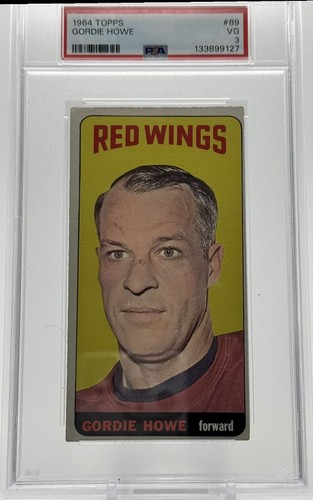 |
Gordie Howe #89 1964 Topps |
$134.53 | $34,965 | +54.1% |
 |
Howie Meeker #72 1951 Parkhurst |
$95.00 | $21,014 | +40.7% |
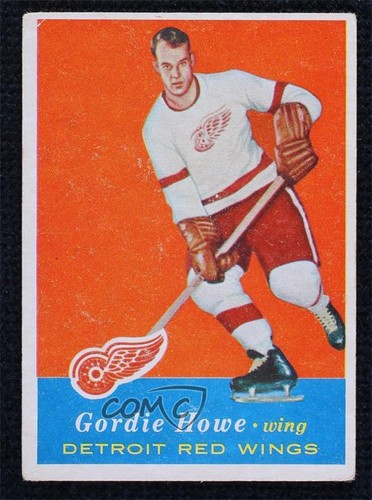 |
Gordie Howe #42 1957 Topps |
$209.02 | $57,648 | +37.3% |
 |
Harry Lumley #47 1951 Parkhurst |
$53.81 | $13,572 | +31.1% |
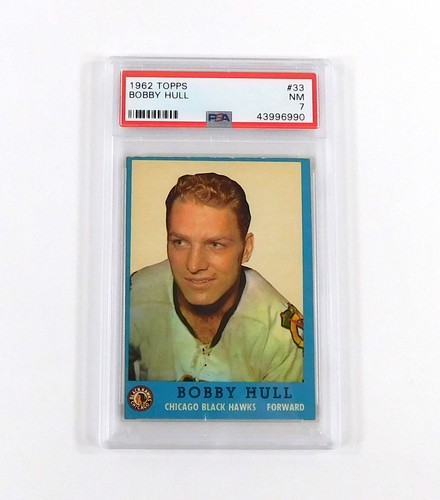 |
Bobby Hull #33 1962 Topps |
$87.18 | $15,401 | +23.9% |
 |
Maurice Richard #2 1959 Parkhurst |
$100.00 | $19,575 | +23.6% |
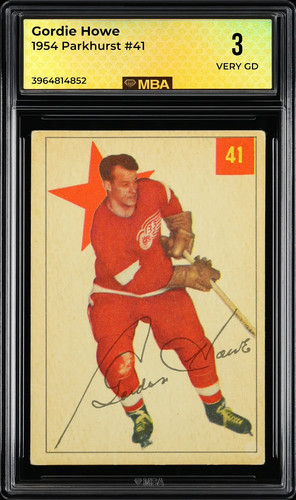 |
Gordie Howe #41 1954 Parkhurst |
$136.35 | $31,534 | +23.6% |
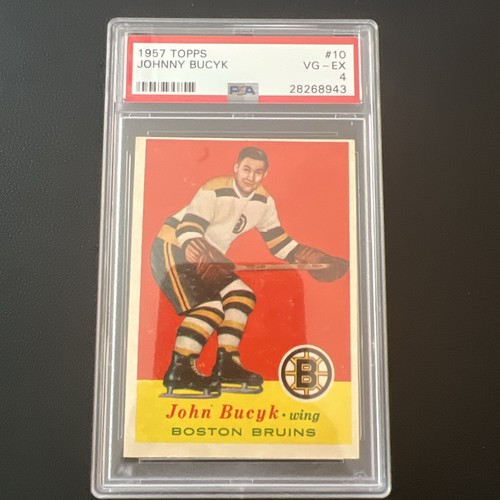 |
Johnny Bucyk #10 1957 Topps |
$316.50 | $66,092 | +22.9% |
 |
Connor McDavid [Autograph] #226 2015 SP Authentic |
$5,067 | $20,000 | +21.2% |
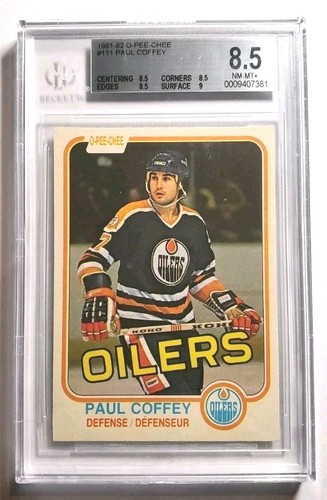 |
Paul Coffey #111 1981 O-Pee-Chee |
$22.78 | $15,001 | +21.2% |
 |
Ted Lindsay #56 1951 Parkhurst |
$170.30 | $43,509 | +20.3% |
 |
Gordie Howe #109 1966 Topps |
$99.67 | $15,156 | +15.8% |
Look up any card's current raw and graded value in Midpoint — and get an estimated grade before you pay to submit.
1. Jacob Fowler Young Guns
Goalie Young Guns rarely lead a hobby conversation, which is why Jacob Fowler's card stands out. Collectors tend to pay up when a young player's on-ice results give the card a story, and Fowler's early play has reportedly put his Upper Deck Young Guns on some watchlists.
Goalie cards are volatile. A strong week can lift prices quickly, and a rough stretch can erase the gain just as fast. Fowler's card is a momentum play, not a long-term anchor.
- Why it moves: rookie momentum and a limited supply of clean copies.
- Watch for: a run of comparable sales at the new level, not one outlier.
- Condition matters: Young Guns are notorious for off-center borders and edge chipping.
2. Connor McDavid Rookies
McDavid rookies are the benchmark card of the modern hockey hobby. Their price action is rarely explosive, but they often hold value better than speculative cards. That is the main reason they keep showing up in discussions of hockey cards going up in value.
For a long-term holder, a McDavid rookie is a store-of-value card. Raw copies and high-grade copies can trade very differently, so compare like for like. Check the raw and PSA 10 values in the table above before deciding which version fits your budget.
- Best for: collectors who want a blue-chip hold rather than a quick flip.
- Risk: a high entry price means condition and centering decide your return.
3. Alex Ovechkin Young Guns Renewed
Ovechkin's Young Guns Renewed cards sit in an interesting spot. They connect a legendary career to a modern, accessible product. When a player's career milestones dominate the news, demand for his cards often follows.
The caution here is simple: Renewed products are not the original rookie, and collectors price them accordingly. Know exactly which card you are buying, and compare only against the same set and parallel.
- Why it moves: career-milestone attention and legacy demand.
- Check: set, parallel and print run before comparing any two sales.
4. Cole Caufield and Lane Hutson
These two represent the established young-star tier. Cole Caufield's scoring and Lane Hutson's offensive production from the blue line keep both in the trending hockey cards conversation, particularly their Young Guns.
Awards buzz is a real price catalyst for this group. A strong awards narrative or a standout month can move a card quickly. It can also reverse if production slows.
- Buy signal: several recent completed sales above the prior range.
- Sell signal: a price spike with no matching increase in sold listings.
5. Easton Cowan and Cutter Gauthier
Prospect-to-NHL storylines drive a lot of hockey card hype. Easton Cowan and Cutter Gauthier are good examples of players whose cards can respond to roster news, breakout games and early-season production.
Early-career cards carry the most risk and the most upside. If a player stalls, the card can retrace fast. Keep position sizes small and avoid paying peak-hype prices for a single card.
- Strategy: buy on pullbacks, not on the day a highlight goes viral.
- Format tip: Young Guns and low-numbered parallels tend to hold interest better than base cards.
6. Evan Bouchard and Kirill Kaprizov
Evan Bouchard and Kirill Kaprizov show how strong play can move cards for players past the rookie stage. Bouchard benefits from big-game performance and playoff visibility. Kaprizov has long been a favorite among collectors who track star forwards.
These are generally more stable than prospect cards. Gains tend to be steadier, and their cards can respond to awards talk and contract news.
- Why it moves: consistent production and star-level attention.
- Good for: collectors who prefer proven players over speculation.
7. Premium Formats: Autographs, Patches, Serial-Numbered Parallels and Short Prints
Across the hockey card market in November 2026, premium formats tend to draw the strongest interest. A scarce card often holds up better when general demand cools, because there are fewer copies to go around.
Here is what to prioritize:
- Autographs: on-card signatures usually draw more interest than stickers.
- Patch cards: multi-color or logo patches typically command a premium over plain swatches.
- Serial-numbered parallels: the lower the print run, the tighter the supply.
- Short prints and rare inserts: scarcity helps, but only if buyers actually want the player.
Scarcity without demand is just a rare card nobody wants. Always check that comparable copies are actually selling.
8. Raw vs PSA 10 and BGS 9.5: Where Grading Pays
The gap between a raw card and a PSA 10 or BGS 9.5 can be large, which is exactly why condition decides your return. Look at the raw and PSA 10 columns in the table above. The spread tells you how much of a card's value is riding on a perfect grade.
Grading costs real money, so the math has to work. If the gap between raw and graded barely covers fees, grading is a poor bet. If the gap is wide and your copy looks clean, grading can make sense. To understand how the companies differ, see this breakdown of grading scale differences by company.

Before you submit anything, estimate the grade. Centering is a common reason Young Guns miss a 10, and how centering impacts card value is worth understanding first. Midpoint gives you an estimated PSA, BGS, CGC and TAG grade from centering, corners, edges and surface before you pay to submit.
9. Cards Trending Down: Macklin Celebrini, Ivan Demidov and Jakub Dobes
Not every name is climbing. Macklin Celebrini, Ivan Demidov and Jakub Dobes are among the players whose cards some collectors report as having cooled, so verify against recent completed sales. For a patient collector, that is where buy-the-dip ideas come from.
A falling price is not automatically a bargain. Ask two questions first:
- Is the dip driven by a short slump, or by something that changes the player's long-term outlook?
- Are recent sales still clearing at the lower price, or is the market still searching for a floor?
If the player's outlook is intact and sales are stabilizing, a dip can be a good entry. Scale in slowly rather than buying all at once. For scarce cards, this guide on grading low population cards is a useful companion.
10. How to Verify Value and Decide: Buy, Sell, Hold or Grade
The most important skill in a market like this is separating real appreciation from a single hot listing. Asking prices are opinions. Completed sales are facts.
Use this checklist before acting on any price move:
- Completed sales: look for several recent sales, not one.
- 30-day change: compare the recent range to the prior month.
- Exact card: match set, parallel, print run and serial number.
- Condition: raw copies vary widely, so compare photos closely.
- Grading population: a high PSA 10 count can limit upside.
Then apply a simple framework:
- Buy: a rising card with multiple confirming sales and a pullback to a reasonable level.
- Hold: blue-chip cards like McDavid rookies when your thesis is long term.
- Sell: a sharp, hype-driven spike with thin sales behind it.
- Grade: a clean, well-centered copy where the raw-to-graded gap clearly beats the fees. Our guide on how to pre-grade your card walks through the steps.
You can also check centering with the free centering calculator before you decide.
Conclusion
The hockey card market in November 2026 rewards selectivity. A few players, mostly Young Guns, star rookies and premium formats, are carrying the gains, while the broader market is still soft. Use completed sales to confirm every move, compare raw and PSA 10 values side by side, and treat dips in names like Celebrini, Demidov and Dobes as research targets, not automatic buys.
If you are weighing a grading submission, run your card through Midpoint first. You can look up raw and graded values, estimate the grade and track your collection over time, all free on iOS and Android.
FAQ
Q: Why are hockey card prices going up in November 2026?
A: Gains are generally tied to player performance, rookie momentum, awards buzz and fresh releases, and they are concentrated in specific cards. Strong games and breakout stretches can draw buyers to Young Guns and premium formats.
Q: Which hockey cards are rising in value right now?
A: Names frequently cited include Jacob Fowler Young Guns, Connor McDavid rookies, Alex Ovechkin Young Guns Renewed, Cole Caufield, Lane Hutson, Easton Cowan, Evan Bouchard, Kirill Kaprizov and Cutter Gauthier. Check the table above for raw and PSA 10 values as of 2026-11-22.
Q: Are Connor McDavid and Alex Ovechkin rookie cards still good investments?
A: They are established, widely traded cards that tend to hold value better than speculative ones. No card is guaranteed to rise, so check recent completed sales, condition and your budget first.
Q: What hockey cards should I buy in November 2026?
A: Focus on cards with confirmed demand: Young Guns of rising players, rookies of stars, and scarce formats like autographs, patches and serial-numbered parallels. Consider buying dips only when the player's outlook is intact and sales are stabilizing.
Q: Is it better to buy raw hockey cards or PSA 10 graded cards?
A: It depends on the gap between raw and graded prices. Graded cards give certainty on condition, while raw cards can offer upside if your copy grades well. Estimate the grade before paying for grading, especially for centering-sensitive cards like Young Guns.
Q: Is the hockey card market rising overall or only for select players and cards?
A: Only for select players and cards. Gains are concentrated in a few names and premium formats, while much of the broader market remains soft.
Free to start
Try the Midpoint app
Grade any card from a photo, see its raw and PSA 10 value, and track what your collection is worth — free.
Get it on iPhoneGet it on Android


