1952 Topps Baseball Cards Value: Ultimate Collector’s Guide
Explore the 1952 Topps baseball cards value, grading impact, top cards, and pricing guide to maximize your collection's worth.

Estimated reading time: 15 min
Key Takeaways
- The 1952 Topps set is one of the most valuable and iconic baseball card sets in history, prized for its design, player roster, and scarcity in high grades.
- Card value varies dramatically by condition and PSA grade, with PSA 10 examples often commanding very high premiums, sometimes reaching into the millions.
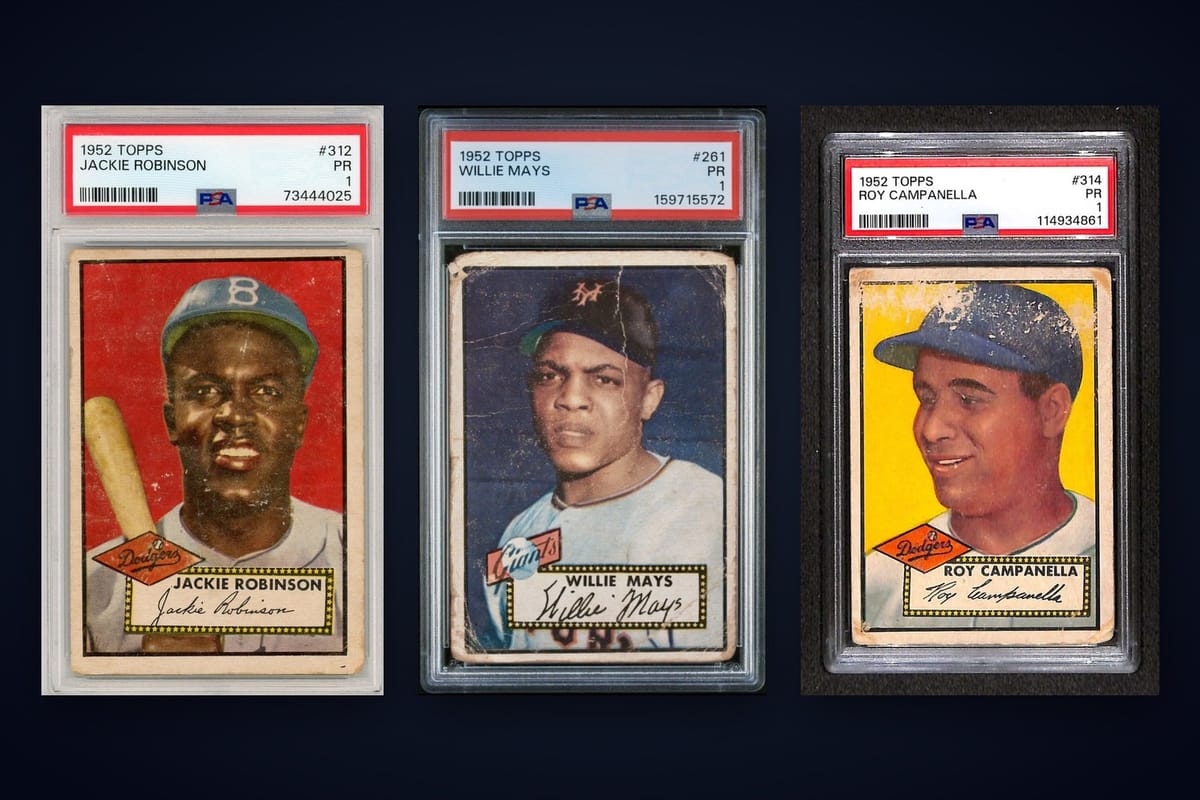
- Key cards like Mickey Mantle #311, Willie Mays #261, and Jackie Robinson #312 define the set’s high-end market and attract intense collector demand.
- Identifying front/back variations, centering, and print type distinctions are important for accurate valuation and grading decisions.
- Using tools like Midpoint’s AI grading and centering analysis can help collectors make informed decisions on which 1952 Topps cards may be worth grading and investment.
Card values — live data from Midpoint's card database, as of 2026-08-23. Prices move; Midpoint refreshes these daily.
| Card | Raw | PSA 10 | Gem premium | |
|---|---|---|---|---|
 |
Jackie Robinson #312 1952 Topps |
$5,949 | $1,447,682 | 243.4× |
 |
Willie Mays #261 1952 Topps |
$2,610 | $635,517 | 243.5× |
 |
Roy Campanella #314 1952 Topps |
$1,353 | $334,112 | 247× |
 |
Hoyt Wilhelm #392 1952 Topps |
$1,223 | $297,663 | 243.4× |
 |
Pee Wee Reese #333 1952 Topps |
$681.79 | $163,311 | 239.5× |
 |
Yogi Berra #191 1952 Topps |
$235.67 | $56,778 | 240.9× |
 |
Bob Feller #88 1952 Topps |
$100.85 | $55,632 | 551.6× |
 |
Orestes Minoso #195 1952 Topps |
$203.50 | $37,789 | 185.7× |
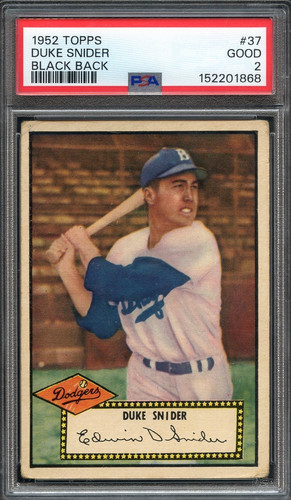 |
Duke Snider [Black Back] #37 1952 Topps |
$134.29 | $33,181 | 247.1× |
 |
Warren Spahn #33 1952 Topps |
$130.50 | $32,181 | 246.6× |
|
Warren Spahn [Black Back] #33 1952 Topps |
$130.07 | $31,330 | 240.9× |
 |
Billy Martin #175 1952 Topps |
$116.25 | $28,229 | 242.8× |
Look up any card's current raw and graded value in Midpoint — and get an estimated grade before you pay to submit.
Table of Contents
- Section 1: Overview of the 1952 Topps Baseball Card Set
- Section 2: How Condition and PSA Grading Affect 1952 Topps Baseball Cards Value
- Section 3: Most Valuable 1952 Topps Cards and Their Price Ranges
- Section 4: Understanding Variations and Checklist Structure
- Section 5: The Value of Key Stars and Hall of Famers
- Section 6: Complete Set Value and Buying/Selling Considerations
Section 1: Overview of the 1952 Topps Baseball Card Set
The 1952 Topps baseball card set is one of the most iconic and valuable collections in the trading card hobby, often considered a holy grail of vintage baseball cards. Released during a pivotal era in baseball history, this set captures the transition from simpler black-and-white cards to the vibrant, larger-format style that set the standard for decades to come. The set features 407 cards, encompassing key rookies, established stars, and Hall of Famers from the early 1950s.
The Significance of the 1952 Topps Set
Topps revolutionized baseball card design in 1952 by introducing larger cards measuring 2-5/8" x 3-3/4", which was significantly bigger than prior issues. These cards featured full-color player photos on the front, combined with detailed statistical and biographical information on the back. This was a major departure from earlier, smaller sets that mainly used illustrations or limited color. The 1952 set marked the beginning of modern baseball card collecting, and its bright, bold design helped spark lasting collector interest. Because it includes many legendary players and rookies, it has remained a cornerstone for collectors worldwide.
Set Composition and Card Numbers
The set’s 407 cards cover a wide spectrum of players, from everyday commons to superstar Hall of Famers. The numbering runs from #1 through #407, but the cards are not uniformly distributed in rarity or condition:
- Star players like Mickey Mantle (#311), Willie Mays (#261), and Jackie Robinson (#312) are among the most sought-after and command the highest prices.
- Rookies and lesser-known stars such as Roy Campanella (#128) and Eddie Mathews (#270) offer strong collector interest and value.
- High-number cards (#400–407) are generally scarcer, as they were printed in smaller quantities and are harder to find in good condition.
- Checklist cards (#300–309) are also relatively rare and can carry premiums, as they were often removed or lost from sets.
Why 1952 Topps Cards Are So Valuable
The value of 1952 Topps cards is driven by their rarity in high grades, historical significance, and demand from both vintage and modern collectors. Despite the set's large print run—estimated at 75 million cards—the survival rate of high-grade specimens is low due to the thin cardstock and rough handling in the 1950s. This scarcity is especially pronounced for key cards, which can command very high prices. Raw cards in lower condition can be affordable for casual collectors, often ranging from single digits to a few hundred dollars, while PSA 9 and 10 grades, especially for key cards, have sold for very high amounts. The set’s design and player selection also contribute to its desirability, making it a cultural icon beyond just the hobby.
Section 2: How Condition and PSA Grading Affect 1952 Topps Baseball Cards Value
Condition is the single most important factor affecting the value of 1952 Topps baseball cards. The grading scale from PSA (Professional Sports Authenticator), ranging from 1 (Poor) to 10 (Gem Mint), is the industry standard for determining market value and buyer confidence. Minor differences in centering or surface quality can mean significant differences in value for key cards.
Condition Factors Impacting Card Value
Several physical characteristics influence how much a 1952 Topps card is worth, and understanding these details is essential for collectors and sellers:
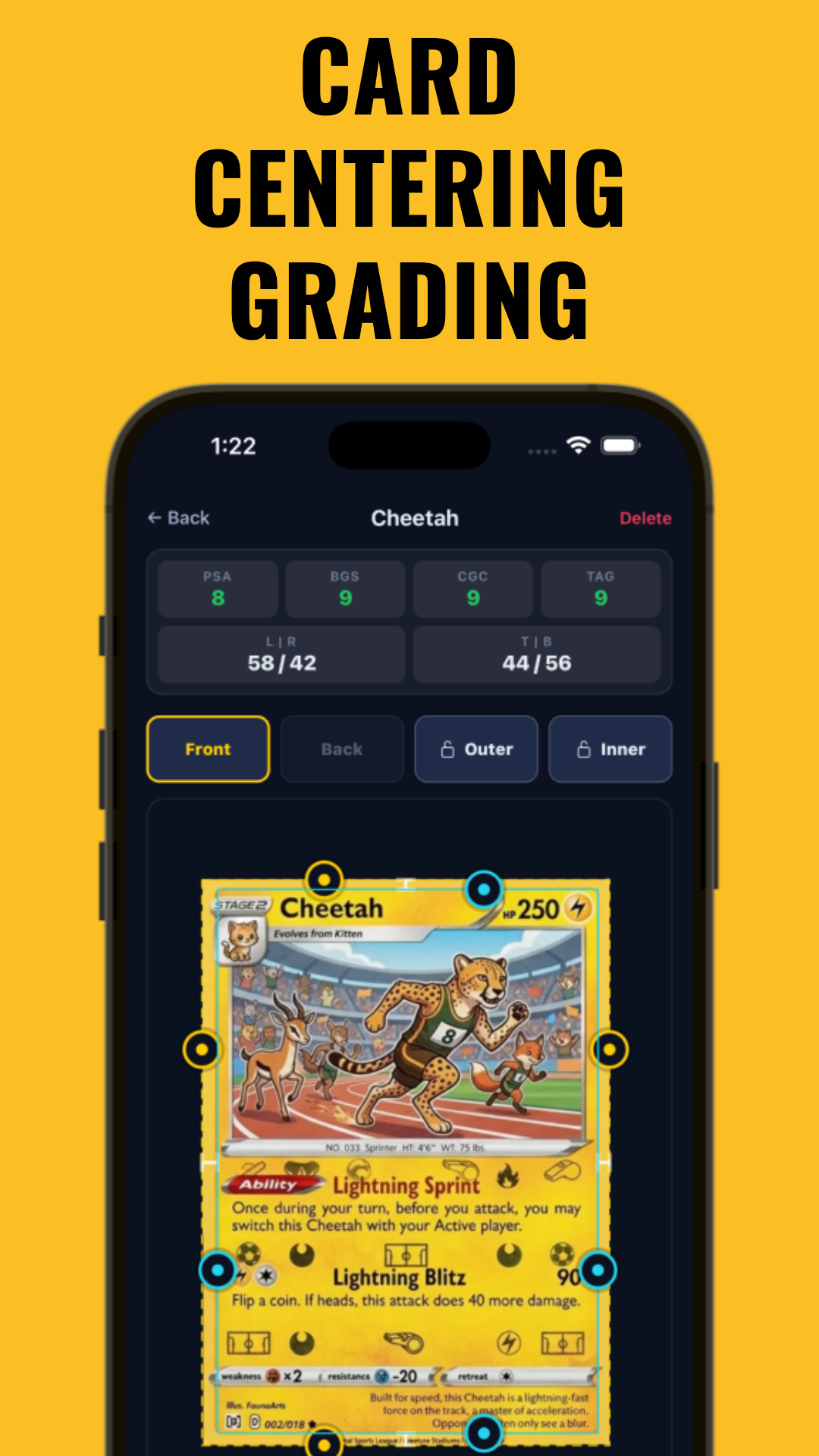
- Centering: The 1952 Topps set is notorious for off-center printing. Cards perfectly centered within 55/45 or better are very rare. Midpoint’s precise centering measurement can detect millimeter differences that impact a card’s grade and thus its value. For example, a Mickey Mantle #311 card centered 60/40 might grade PSA 8, but one at 55/45 or better could achieve PSA 9 or 10, significantly increasing its value.
- Corners and Edges: Sharp, clean corners and minimal chipping or wear dramatically increase a card’s grade. Due to the thin cardstock of the 1952 set, even slight fraying or rounded corners can drop a card’s grade by several points. Collectors pay special attention to corner condition, as it affects both aesthetics and durability.
- Surface: Scratches, stains, creases, and gloss loss reduce eye appeal and can lower grades. The 1952 Topps cards used a glossy finish that is prone to surface wear, especially on the fronts. Creases, even minor ones visible only under magnification, can reduce a card’s grade significantly. Stains or discoloration on the back can also affect grading.
- Print Defects: The set has some common print defects such as color misregistration and ink dots, which generally do not affect grading unless they impact eye appeal.
PSA Grading Scale and Value Impact
The PSA grading scale ranges from 1 (Poor) to 10 (Gem Mint). For 1952 Topps cards, the grade can multiply the raw value by large factors. Here’s a general breakdown:
- Raw Condition: Common cards may be worth anywhere from $1 to $50 in raw condition, depending on centering and surface quality. Low-grade key cards like Mickey Mantle can still fetch thousands raw.
- PSA 7–8 (Near Mint to Near Mint-Mint): Cards showing relatively minor flaws but still attractive. These grades often increase raw card values by several times. For example, a PSA 7 Mickey Mantle can fetch around $150,000, while a PSA 8 may sell for $300,000–$400,000.
- PSA 9 (Mint): High-grade cards with near-perfect centering, sharp corners, and clean surfaces. These are rare and command significant premiums. Mickey Mantle #311 PSA 9 cards have sold for around $1 million or more, and Willie Mays PSA 9 examples fetch several hundred thousand dollars.
- PSA 10 (Gem Mint): The pinnacle grade, awarded to cards with virtually no visible flaws, perfect centering (typically 55/45 or better), and flawless corners and surface. PSA 10 examples of key cards like Mickey Mantle #311 have sold for multi-million dollar amounts, reflecting extreme scarcity and collector demand. Only a handful of PSA 10s exist for the most coveted cards.
Using Midpoint for Pre-Grading Assessment
Before submitting cards for costly professional grading, collectors can use Midpoint’s AI digital grading and centering tool to estimate grades precisely. By uploading high-resolution images, Midpoint analyzes card centering to the thousandth of a millimeter, assesses surface condition cues, and compares them to PSA standards. This pre-grading assessment helps collectors avoid unnecessary grading fees on cards unlikely to achieve high PSA grades and identifies the best candidates for submission. For example, a collector with multiple Mickey Mantle #311 cards can quickly select the best-centered and cleanest examples to send in, maximizing grading ROI. Midpoint also helps detect subtle front/back variations and print types that impact value.
Section 3: Most Valuable 1952 Topps Cards and Their Price Ranges
The 1952 Topps price guide highlights several cards that stand out for their value and desirability. Below is a detailed breakdown of the most valuable cards with approximate value ranges as of 2026-08-23, including both raw and graded prices.
Mickey Mantle #311 Value by Grade
The Mickey Mantle #311 card is the undisputed king of the 1952 Topps set and one of the most valuable sports cards ever produced. Its value by grade is notable and highlights the premiums for high-grade examples:
- Raw Condition: Priced roughly between $5,000 and $20,000, depending on centering, surface condition, and corner sharpness. Lower-grade raw cards are more common, but raw cards with decent eye appeal can still command thousands.
- PSA 7: Approximately $150,000. Cards in this grade show some centering and corner imperfections but remain highly desirable.
- PSA 8: Valued between $300,000 and $400,000. This grade indicates excellent centering (usually 60/40 or better), sharp corners, and minimal surface wear.
- PSA 9: Around $1 million or more, reflecting outstanding condition with near-perfect centering and pristine surfaces. PSA 9s are rare for Mantle #311.
- PSA 10: Record sales have exceeded $5 million, showcasing the extreme premium for gem mint condition. Fewer than 10 PSA 10 Mickey Mantle #311 cards are known to exist.
Willie Mays #261 Value by Grade
Willie Mays #261 is another top-tier card, prized for the Hall of Fame player’s stature and the card’s scarcity in top conditions:
- Raw: Typically ranges from $2,000 to $10,000, depending on condition. Well-centered and clean examples command the higher end.
- PSA 7: Roughly $75,000. Cards graded PSA 7 show solid centering and minimal surface flaws.
- PSA 8: Between $150,000 and $250,000, reflecting near-mint condition with strong eye appeal.
- PSA 9: Usually above $400,000. PSA 9 cards are rare due to the set’s centering and surface challenges.
- PSA 10: Over $1 million, with only a handful certified in gem mint condition.
Jackie Robinson #312 Value by Grade
Jackie Robinson’s #312 card carries immense historical significance as the first African American MLB player in the modern era:
- Raw: Typically $1,000 to $5,000, with value tied closely to condition and centering.
- PSA 7: Around $50,000. Cards at this grade are collectible but show minor imperfections.
- PSA 8: $100,000 to $150,000, reflecting excellent condition.
- PSA 9: $200,000 or more, with high demand from collectors focused on sports history.
- PSA 10: Currently over $600,000, with very few known copies graded Gem Mint.
Section 4: Understanding Variations and Checklist Structure
The 1952 Topps set includes subtle front and back variations as well as a unique checklist structure that affect card rarity, grading, and ultimate value. Collectors must be adept at identifying these differences to maximize returns.
Front and Back Variations
A few significant variations can affect card valuation:
- Gray-back vs White-back: Some cards, including checklists and star players, were produced with both gray and white backs. Gray-back variants are generally scarcer and can command premiums. For example, the Mickey Mantle #311 gray-back is rarer and sought after by advanced collectors.
- Printing Variations: Certain cards have minor differences in player photos, text, and errors. For instance, some Willie Mays cards have variations in the placement of statistics or spelling mistakes, which can increase collector interest.
- Color Differences and Gloss: Variations in card gloss due to print runs and storage conditions can affect grading and value, with more glossy and vibrant cards preferred.
Checklist Cards and High-Number Scarcity
The set includes checklist cards (#300–309) that are rarer due to lower production and are often missing from incomplete sets. These cards are notable because they serve as a catalog of other cards in the set and are frequent targets for completionists. High-number cards (#400–407) were printed in smaller quantities, making them scarcer and often commanding premiums, especially in high grades. For example, card #405 featuring Stan Musial is a sought-after high-number card.
Impact on Grading and Valuation
Identifying these variations correctly is important before grading or listing cards for sale. Misidentifying a gray-back as a white-back can affect value, as can overlooking a print variation. Tools like Midpoint help collectors verify centering and surface details to differentiate variants accurately and avoid costly mistakes. Additionally, understanding the nuances of checklist card numbers versus regular cards aids collectors in building and valuing complete sets.
Section 5: The Value of Key Stars and Hall of Famers
Besides the marquee cards of Mantle, Mays, and Robinson, other Hall of Famers and stars from the 1952 Topps set carry strong collector interest and value, offering opportunities for diversified collecting and investment.
Eddie Mathews and Roy Campanella
- Eddie Mathews (#270): Raw cards generally range from $200 to $1,000 depending on condition. PSA 9 examples can exceed $20,000, reflecting Mathews’ status as one of the premier third basemen in MLB history. PSA 10 copies are very rare and can command higher prices at auction.
- Roy Campanella (#128): Raw values tend to be $300 to $1,200. PSA 9 grades hover around $25,000, with PSA 10 examples commanding premiums above $40,000. Campanella’s popularity and career make his card highly collectible.
Pee Wee Reese and Yogi Berra
- Pee Wee Reese (#302): Raw values typically range from $150 to $800 depending on centering and surface condition. PSA 9 cards can fetch near $15,000, with PSA 10 examples rare and potentially more valuable.
- Yogi Berra (#120): Raw condition cards generally sell between $200 and $900. PSA 9 grades can reach up to $18,000, reflecting Berra’s Hall of Fame status and collector demand.
Commons and Lower-Tier Stars
Most commons are affordable in raw condition, often in the $1 to $20 range, with value primarily driven by centering and surface quality. Mid-grade PSA 7–8 grades can multiply values several times, especially for well-centered cards. Rarer stars and rookies often warrant grading submissions, provided condition is strong. Collectors who start with commons can gradually build value and work towards higher-grade acquisitions over time.
Section 6: Complete Set Value and Buying/Selling Considerations
Owning a complete 1952 Topps set is a dream for many collectors, but value and feasibility depend heavily on condition, card completeness, and authenticity.
Value of Complete Sets
Complete 1952 Topps sets vary widely in value based on condition and grading level:
- Raw, well-centered complete sets: Estimated value ranges from $20,000 to $50,000. These sets often contain a mix of condition grades but maintain overall completeness and decent eye appeal.
- PSA 7–8 graded complete sets: These are much rarer due to the difficulty in obtaining high-grade commons and stars in a full set and can sell for significantly higher amounts.
- PSA 9+ complete sets: Extremely rare and considered trophy collections, these can command prices exceeding $1 million at auction or private sale.
Buying Tips
- Verify card authenticity and condition using trusted grading tools like Midpoint before purchase. This reduces the risk of overpaying for off-centered or damaged cards.
- Check for front/back variations and ensure checklist completeness to avoid missing key cards or variants that add value.
- Consider starting with commons and key rookies to build value gradually and learn the nuances of the set.
- Buy from reputable dealers or auction platforms with guarantees and return policies to protect your investment.
Selling Tips
- Grade high-value cards to maximize sale price, as graded cards command higher demand and transparency in the market.
- Use portfolio tracking tools such as Midpoint to monitor your collection’s value over time and decide when to sell for optimal returns.
- Understand market trends and demand for 1952 Topps cards, as prices can fluctuate based on player popularity, historic anniversaries, and market liquidity.
- When selling complete sets, consider professional appraisals and auction houses specializing in vintage sports memorabilia to reach serious collectors.
For detailed grading and centering analysis, visit Midpoint to make informed decisions on your 1952 Topps cards and enhance your collecting strategy.
Conclusion
The 1952 Topps baseball cards value varies widely, anchored by iconic cards like Mickey Mantle #311, Willie Mays #261, and Jackie Robinson #312. Condition and PSA grading dramatically influence price, with top grades commanding significant premiums that can reach into the millions. Understanding the set’s checklist structure, subtle front and back variations, and card condition factors is important for maximizing value. Leveraging AI tools like Midpoint for pre-grading and centering measurement can save time and money, helping ensure you submit only the most promising cards for professional grading. Whether collecting key stars or pursuing a complete set, knowledge, precision, and strategic grading decisions can pay off in this legendary vintage series.
FAQ
Q: How much is a 1952 Topps Mickey Mantle card worth?
A: The Mickey Mantle #311 card ranges from approximately $5,000 in raw condition to over $5 million for a PSA 10 gem mint example. The value increases significantly with condition, centering, and grade, with PSA 9 and 10 copies commanding the highest premiums.
Q: What is a 1952 Topps Jackie Robinson card worth?
A: Jackie Robinson #312 cards vary from about $1,000 raw to over $600,000 for PSA 10 graded examples, reflecting the player’s historic importance and card scarcity in top condition. Mid-grade PSA 7–8 cards sell in the $50,000 to $150,000 range.
Q: How much are 1952 Topps commons worth?
A: Common cards in raw condition typically range from $1 to $20, depending on centering and surface quality. Mid to high PSA grades (7–9) can increase values several times, especially for well-centered and clean cards.
Q: Which 1952 Topps cards are the most valuable?
A: The most valuable cards include Mickey Mantle #311, Willie Mays #261, Jackie Robinson #312, and rarer high-number (#400–407) and checklist (#300–309) cards. High-grade PSA 9 and 10 examples of these cards command the highest prices.
Q: How do condition and PSA grade affect 1952 Topps card values?
A: Condition factors such as centering, corners, edges, and surface quality heavily influence PSA grades. Since PSA grades multiply card values significantly, a PSA 10 card can be worth hundreds or thousands of times more than a raw low-grade version. Perfect centering and flawless surfaces are especially rare and valuable in this set.
Q: How much is a complete 1952 Topps set worth?
A: Raw complete sets can be worth between $20,000 and $50,000 or more, depending on overall condition. PSA 7–8 graded sets often sell for significantly higher amounts, while PSA 9+ complete sets are extremely rare and can command prices exceeding $1 million.
Free to start
Try the Midpoint app
Grade any card from a photo, see its raw and PSA 10 value, and track what your collection is worth — free.
Get it on iPhoneGet it on Android