
1954 Parkhurst Hockey Cards Value: Ultimate Price & Grading Guide
Discover the 1954 Parkhurst hockey cards value, top cards, grading tips, and price guide for raw and PSA 10 graded cards to maximize your collection's worth.

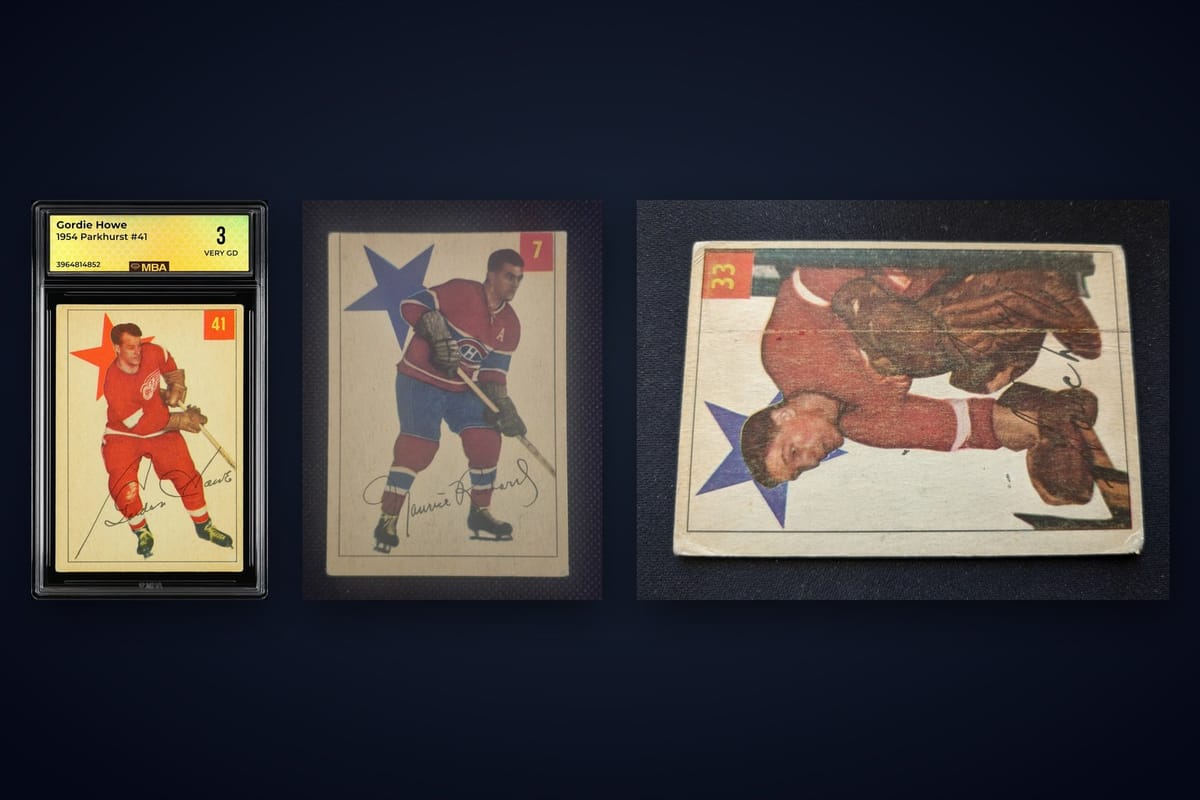
Estimated reading time: 15 min
Key Takeaways
- The 1954-55 Parkhurst hockey set includes 100 cards, featuring star players and unique facsimile-autograph designs that contribute to its vintage appeal.
- Top valuable cards often cited include Maurice Richard #7, Gordie Howe #49, and Terry Sawchuk #33, with PSA 10 grades generally commanding significant premiums over raw values.
- Condition factors such as centering, corners, surface quality, and card backs critically affect value and grading outcomes, with subtle differences significantly impacting final grades.
- Using AI grading tools like Midpoint can help collectors estimate PSA, BGS, and CGC grades before costly submissions, potentially increasing chances of successful grading and maximizing return.
- Complete set values, rookie card premiums, and short print variations influence market prices and collector demand, especially when combined with high-grade condition.
Card values — live data from Midpoint's card database, as of 2026-09-04. Prices move; Midpoint refreshes these daily.
| Card | Raw | PSA 10 | Gem premium | |
|---|---|---|---|---|
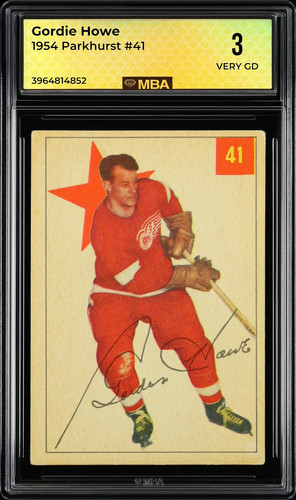 |
Gordie Howe #41 1954 Parkhurst |
$131.54 | $29,944 | 227.6× |
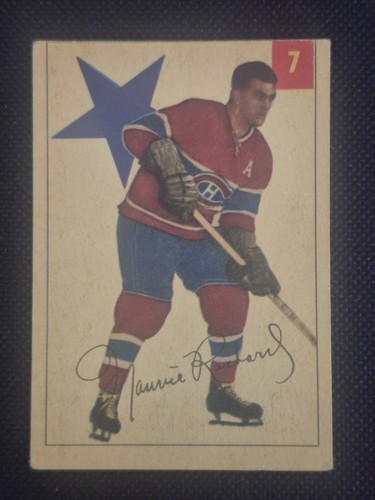 |
Maurice Richard #7 1954 Parkhurst |
$116.55 | $26,223 | 225× |
 |
Terry Sawchuk #33 1954 Parkhurst |
$114.12 | $26,066 | 228.4× |
 |
Fred Sasakamoose #82 1954 Parkhurst |
$115.00 | $24,930 | 216.8× |
 |
Jean Beliveau #3 1954 Parkhurst |
$80.45 | $18,164 | 225.8× |
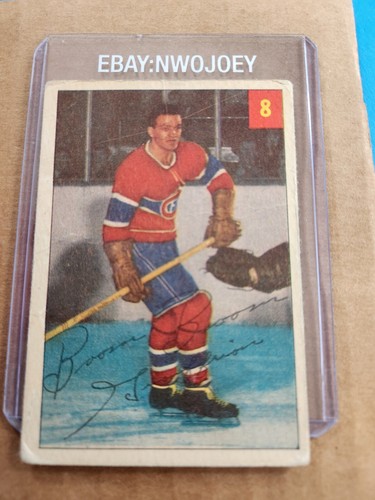 |
Boom Boom Geoffrion #8 1954 Parkhurst |
$35.34 | $8,087 | 228.9× |
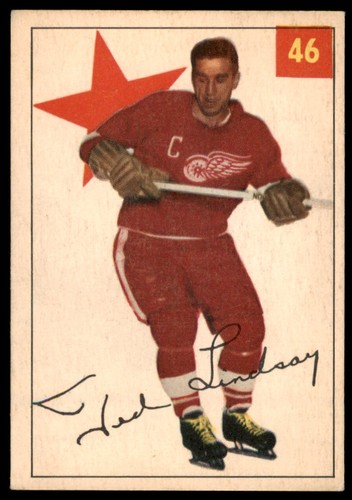 |
Ted Lindsay #46 1954 Parkhurst |
$24.85 | $7,667 | 308.5× |
 |
Sawchuck Stops Boom Boom #100 1954 Parkhurst |
$29.47 | $6,615 | 224.5× |
 |
Harry Lumley #16 1954 Parkhurst |
$24.93 | $5,657 | 226.9× |
![Placid Plante [Foils Tireless Teeder] #99 1954 Parkhurst card](https://i.ebayimg.com/images/g/6XYAAeSwzXdqV~gf/s-l500.jpg) |
Placid Plante [Foils Tireless Teeder] #99 1954 Parkhurst |
$24.42 | $5,629 | 230.5× |
![Plante Protects [Against Slippery Sloan] #98 1954 Parkhurst card](https://i.ebayimg.com/images/g/1rMAAeSw82ZqGeRy/s-l500.jpg) |
Plante Protects [Against Slippery Sloan] #98 1954 Parkhurst |
$23.50 | $5,375 | 228.7× |
 |
Red Kelly #42 1954 Parkhurst |
$23.25 | $5,354 | 230.3× |
Look up any card's current raw and graded value in Midpoint — and get an estimated grade before you pay to submit.
Table of Contents
- Section 1: Overview of the 1954-55 Parkhurst Hockey Card Set
- Section 2: 1954 Parkhurst Price Guide — Raw vs Graded Values
- Section 3: Most Valuable 1954 Parkhurst Cards and Key Rookie Cards
- Section 4: Grading Impact and 1954 Parkhurst PSA 10 Value Explained
- Section 5: Condition Factors Affecting 1954 Parkhurst Cards Worth Grading
- Section 6: Variations, Errors, and Short Prints in the 1954-55 Parkhurst Set
- Section 7: How to Authenticate, Grade, and Sell Your 1954 Parkhurst Cards
Conclusion
FAQ
Section 1: Overview of the 1954-55 Parkhurst Hockey Card Set
Set Composition and Design Features
The 1954-55 Parkhurst hockey card set is a landmark in vintage hockey collecting, consisting of 100 cards. The set was released during the post-war boom of hockey card production, at a time when Parkhurst was one of the leading Canadian manufacturers. This set features a mix of player cards and action cards that capture on-ice moments, offering collectors a snapshot of professional hockey from the mid-1950s.
Cards measure the standard 2-5/8" x 3-3/4" size, typical for the era, made from relatively thin cardboard stock that is prone to wear over time. A hallmark of this set is the unique facsimile-autograph printed on each card face, which adds a collectible charm and a sense of player connection. This autograph is a printed reproduction of the player's signature, not hand-signed, but still a distinctive design element.
The players featured range from Hall of Fame legends to promising rookies, making the set desirable for collectors seeking both star power and historical depth. The set also includes a handful of action shots that display game situations and team interactions, a feature that was relatively novel for hockey cards at the time.
Player Cards vs. Action Cards
The set distinguishes itself by including action cards that depict game scenes, which are less common and generally considered more valuable due to their limited print runs and visual appeal. These action cards often showcase multiple players, increasing their appeal to collectors looking for dynamic imagery.
Player cards remain the centerpiece of the set, featuring iconic stars like Maurice Richard (#7), Gordie Howe (#49), and Terry Sawchuk (#33). These individual portrait-style cards focus on the player's image and facsimile autograph, often making them more sought-after, especially in higher grades. The action cards, while fewer, provide a complementary dimension, often being more challenging to find in top condition due to their heavier handling by collectors and fans.
Collectibility Factors
- Facsimile-autograph design: This feature adds authenticity and nostalgic appeal, making the cards more personal and desirable to collectors who value the player's signature look.
- Production volumes: Compared to some other contemporary sets, the 1954-55 Parkhurst cards were produced in quantities that contribute to their scarcity, especially for certain key cards and condition levels.
- High representation of iconic players: The presence of multiple Hall of Famers and star athletes elevates the set's status and demand.
- Condition sensitivity: Due to the age, thin card stock, and printing techniques of the era, many cards suffer from wear, making well-preserved examples particularly rare.
- Unique design elements: The combination of portrait and action cards, facsimile autographs, and period-specific typography contribute to the set's distinctive look.
Below is an example price table summarizing market values by card number and condition as of 2026-09-04.

Section 2: 1954 Parkhurst Price Guide — Raw vs Graded Values
Raw Card Value Spectrum
Raw 1954 Parkhurst cards show a broad spectrum of values depending largely on condition and the player featured. Cards in lower grades such as Good (G) or Very Good (VG) typically range from around $15 to $200 for common players. Condition issues such as rounded corners, creases, and surface wear cause these values to cluster at the lower end.
Cards graded in Near Mint (NM) or Mint (MT) condition command higher prices, sometimes several hundred dollars for common stars. For example, Maurice Richard #7 in Good condition is valued at approximately $180 as of 2026-09-04, but the same card in Near Mint condition can approach $1,200 raw, illustrating the significant impact of condition on value.
Other star cards like Gordie Howe #49 and Terry Sawchuk #33 display similar patterns, with raw values increasing sharply with improved condition. This makes condition assessment critical for collectors aiming to maximize their investment.
Graded Card Value Premiums
Graded cards, especially those graded by reputable services such as PSA (Professional Sports Authenticator), BGS (Beckett Grading Services), or CGC (Certified Guaranty Company), generally command premiums over raw counterparts. This is particularly true for cards graded PSA 9 (Mint) and PSA 10 (Gem Mint), which are rare for a vintage set of this age.
The 1954 Parkhurst PSA 10 values for top cards can multiply raw prices by 5x to 10x or more, depending on population reports and collector demand. Examples include:
- Maurice Richard #7 PSA 10: Valued at approximately $12,000, reflecting the rarity of near-perfect condition examples.
- Terry Sawchuk #33 PSA 10: Fetches prices reported around $9,500, demonstrating strong market demand for goalie cards.
- Gordie Howe #49 PSA 10: Commands values near $8,000, underlining the enduring popularity of the 'Mr. Hockey' card.
These premiums are driven by collector preference for gem mint condition and the scarcity of well-preserved vintage cards, especially given the fragile nature of cards from the 1950s.
How Midpoint Helps Estimate Value
Using AI digital grading tools like Midpoint allows collectors to objectively evaluate their cards before submitting them to grading companies. Midpoint analyzes key grading factors such as centering, corners, edges, and surface condition by comparing uploaded images with a large database of graded cards.
This pre-submission insight helps collectors identify which cards have a realistic chance of achieving high grades (e.g., PSA 9 or 10), thereby avoiding unnecessary grading fees on lower-grade cards. Additionally, Midpoint's detailed breakdowns can guide collectors in prioritizing restoration or conservation efforts to improve grading outcomes.
For example, a card with near-perfect centering but minor corner wear might still be a candidate for submission, while one with poor centering and edge damage may be best kept raw or sold as a lower-grade collectible.
Section 3: Most Valuable 1954 Parkhurst Cards and Key Rookie Cards
Top Value Stars in the Set
Several cards stand out as among the most valuable 1954 Parkhurst cards, driven by a combination of player legacy, card scarcity, and condition rarity:
- Maurice Richard (#7): Known as 'The Rocket,' Richard is the most iconic player in the set. His card is considered the crown jewel, particularly in PSA 9 and 10 grades, with recent auction sales reported exceeding $12,000 for gem mint copies.
- Gordie Howe (#49): 'Mr. Hockey' is a perennial favorite among collectors. His card's value is bolstered by his legendary career and high demand, with PSA 10 copies valued around $8,000.
- Terry Sawchuk (#33): A Hall of Fame goaltender, Sawchuk's card is highly sought after, especially in top grades where it commands prices near $9,500.
- Jacques Plante (#41): Another premier goalie, Plante's card enjoys strong interest, especially from goalie collectors and fans of the Montreal Canadiens dynasty.
- Jacques Laperriere (#61): This notable rookie card has seen growing interest in recent years, with prices rising steadily as collectors seek early career cards of Hall of Famers.
Key Rookie Cards Worth Collecting
The 1954-55 Parkhurst set includes several rookie cards that influence overall value and collector interest:
- Alex Faulkner (#46): A solid NHL player whose rookie card shows consistent demand among vintage enthusiasts.
- John Ferguson (#64): Known for his physical play, Ferguson's rookie card is increasingly recognized for its historical importance.
- Cesare Maniago (#70): A goaltender whose rookie card is gradually appreciating, particularly in high-grade condition.
While these rookies generally do not reach the price heights of star veterans, their scarcity in high condition and growing fan bases contribute to steady appreciation, especially among collectors focused on rookie card sets.
Why These Cards Command Premiums
- Legacy and Hall of Fame status: Players inducted into the Hockey Hall of Fame or with legendary status naturally attract higher demand.
- Low surviving population in high-grade condition: The fragile nature of the cards means few survive with sharp corners, perfect centering, and flawless surfaces.
- Historical significance: Early career or rookie cards, and those capturing iconic players at their peak, hold special appeal.
- Market trends: Growing interest in vintage hockey cards and nostalgia-driven collecting have contributed to recent price increases.
Section 4: Grading Impact and 1954 Parkhurst PSA 10 Value Explained
Understanding PSA 10 and Gem Mint Grades
A PSA 10 grade signifies a 'Gem Mint' card, representing nearly perfect condition. To achieve this grade, a card must exhibit exceptional centering (typically within 55/45 to 60/40 ratios), razor-sharp corners with no visible wear, a flawless surface free of scratches, stains, or print defects, and a clean back without discoloration or damage.
For the 1954-55 Parkhurst set, achieving PSA 10 is extremely rare due to the age, paper stock, and printing methods used. Many cards from this era show natural wear or manufacturing imperfections, making gem mint examples prized collector items.
Value Multipliers from Grading
Cards graded PSA 10 often command multipliers of 5x to 10x over raw Near Mint values, reflecting the premium placed on perfection. For instance, Maurice Richard #7 raw Near Mint cards average around $1,200, while PSA 10 specimens have realized auction prices near $12,000 as of 2026-09-04.
Similarly, Terry Sawchuk #33 and Gordie Howe #49 also see substantial price increases upon achieving PSA 10 grades, underscoring how grading can influence market pricing.
The grading premium derives from collector willingness to pay for assurance of quality, rarity of flawless examples, and the increased liquidity of graded cards in the marketplace.
Population and Market Dynamics
Population reports from grading companies provide data on card rarity at each grade level. For the 1954 Parkhurst set, population numbers show relatively few PSA 10 examples exist for the most valuable cards, highlighting scarcity.
This scarcity, combined with consistent collector demand and the iconic status of players, supports upward price momentum. Market dynamics also respond to trends such as increased vintage collecting, nostalgia waves, and renewed interest in hockey history.
Collectors should monitor population reports and recent auction results to gauge market conditions. A card with a low population at PSA 10 but strong recent sales is more likely to appreciate than one with many graded copies.
Section 5: Condition Factors Affecting 1954 Parkhurst Cards Worth Grading
Centering: The Millimeter Difference
Centering measures how well the printed image sits within the card borders. For the 1954-55 Parkhurst cards, centering ranges widely due to printing inconsistencies of the era. Minor off-centering of just 1-2 millimeters can determine whether a card reaches PSA 9 or PSA 10.
For example, a card centered 55/45 is generally acceptable for PSA 10, but 60/40 or worse centering often caps the grade at PSA 9 or below. Midpoint's precise centering measurement tool analyzes card scans down to the millimeter, enabling collectors to objectively assess this critical factor before submission.
Collecting cards with the best centering increases the likelihood of obtaining high grades and commanding top market prices.
Corners, Edges, and Surface Condition
- Corners: Sharp, clean corners are essential for premium grades. Rounded, frayed, or bent corners are one of the most common condition issues and can reduce grades by multiple points.
- Edges: Edge chipping, paper loss, or slight wear around the edges also negatively impact grades. Cards from the 1950s are prone to this due to handling and storage conditions over decades.
- Surface: Scratches, stains, print defects, or surface gloss loss affect grading. Surface wear is especially noticeable under magnification and can be caused by mishandling or environmental factors.
Other Condition Impacts
- Creases and folds: Even minor creases substantially lower grade and value, often making cards ungradable for top-tier categories.
- Stains and discoloration: Foxing, staining from moisture, or exposure to sunlight can diminish aesthetic appeal and grading potential.
- Gum residue and back condition: Residual gum on card backs, common in vintage cards, can cause discoloration or stickiness, detracting from value.
- Alterations and trimming: Any evidence of trimming, corner rounding, or restoration is heavily penalized and often flagged during grading, reducing both grade and resale value.
Investing in proper assessment tools and adhering to best practices for storage—such as using acid-free sleeves, top loaders, and temperature-controlled environments—is critical. Guides like How to Store Valuable Cards provide detailed strategies for preservation.
Section 6: Variations, Errors, and Short Prints in the 1954-55 Parkhurst Set
Lucky Premium Backs and Variants
Within the 1954-55 Parkhurst set, certain cards feature "lucky premium" backs, which are subtle printing variations or corrected errors on the card backs. These variants often include differences in text alignment, font style, or minor statistical corrections. Though not always widely documented, these premium backs are sought by knowledgeable collectors due to their increased scarcity.
For example, some cards had initial print runs with typos in player statistics that were corrected in later runs, creating two distinct back versions. The rarer original backs tend to attract premiums, especially in high-grade condition.
Corrected vs Uncorrected Errors
Error cards in this set are relatively rare but include misspelled player names, incorrect team affiliations, or color registration issues. Corrected versions were printed later and are more common, which may reduce their value.
Uncorrected error cards, such as a misspelled name or wrong jersey number, can command premiums due to their novelty and scarcity. Collectors of error cards often seek these for specialized collections, further enhancing demand.
Short Prints and Their Effect on Pricing
Although the 1954-55 Parkhurst set was largely evenly printed, certain cards were distributed in smaller quantities or pulled early from production, effectively creating short prints. These cards are often more challenging to find in high-grade condition, which increases their desirability.
Short print cards may also result from variations in regional distribution or packaging differences. For instance, some cards were less commonly found in certain Canadian provinces or U.S. markets, leading to localized scarcity.
Collectors often pay premiums for short prints, particularly when combined with strong condition or key player status. Identifying these short prints requires careful research and comparison with population reports.
Section 7: How to Authenticate, Grade, and Sell Your 1954 Parkhurst Cards
Authentication and Identifying Fakes
Due to the set’s age and value, counterfeit cards exist in the market. Authenticity checks involve examining print patterns, card stock texture, ink saturation, and facsimile autograph details. Vintage cards often have distinct printing characteristics such as dot patterns or paper fiber composition that counterfeiters may fail to replicate precisely.
Digital magnification tools and ultraviolet light examination can help detect inconsistencies. Additionally, consulting expert databases, online forums, and authentication services provides further verification. Collectors should approach suspiciously priced cards or those with unusual characteristics cautiously.
Pre-Grading Steps and Using AI Tools
Before submitting cards to grading companies like PSA or BGS, collectors should perform a detailed condition assessment. Using AI grading apps such as Midpoint provides an objective and data-driven estimation of likely grades, based on analyzing centering, corners, edges, and surface condition from uploaded images.
This pre-grading evaluation helps collectors decide which cards merit the cost and time investment of professional grading. For example, cards predicted to grade PSA 8 or above may justify submission, while those expected to grade lower might be better sold raw.
Collectors are advised to capture high-quality scans or photographs, ideally under consistent lighting, to maximize AI accuracy. Pairing AI insights with personal expertise improves submission success rates and can result in higher returns.
Selling Strategies and Price Comparisons
- Market research: Compare recent eBay auction sales and completed listings for similarly graded cards. Pay attention to sale prices rather than asking prices to gauge true market value.
- Auction houses: Consider consigning high-value cards or complete sets to reputable auction houses specializing in vintage sports cards, which may reach dedicated collectors and achieve premium prices.
- Online platforms: Use established marketplaces with grading verification and buyer protections to maximize exposure and safety.
- Portfolio tracking: Utilize collector apps and tools to monitor market trends, population changes, and price fluctuations to time sales effectively.
- Presentation: Well-photographed, accurately described listings with grading certification typically attract more interest and higher bids.
Proper grading, authentication, and presentation maximize sale prices and collector interest, helping you get the best return on your 1954 Parkhurst hockey cards.
Conclusion
The 1954-55 Parkhurst hockey cards represent a coveted vintage set with rich history, unique design features, and valuable star cards that continue to captivate collectors. Understanding their value requires close attention to condition nuances, grading standards, and evolving market trends.
Key cards like Maurice Richard #7 and Terry Sawchuk #33 command significant premiums at PSA 10, reflecting their scarcity and collector demand. Tools like Midpoint empower collectors to pre-grade and measure centering precisely, enhancing decision-making around which cards are worth submitting for professional grading.
Whether you hold a single star card or a complete 100-card set, informed grading, condition assessment, and market knowledge are essential to unlocking maximum value in the 1954-55 Parkhurst hockey collection, helping ensure your vintage cards remain treasured assets.
FAQ
Q: How much are 1954 Parkhurst hockey cards worth?
A: Values vary widely based on card, condition, and grading. Raw cards range from around $15 for common players in low condition to over $1,000 in Near Mint condition for star cards. PSA 10 graded cards can reach between $8,000 to $12,000 or more for top players like Maurice Richard and Terry Sawchuk as of 2026-09-04.
Q: What is the most valuable 1954-55 Parkhurst hockey card?
A: Maurice Richard #7 is generally considered the most valuable card in the set, particularly when graded PSA 10, with values reported around $12,000 due to its rarity and iconic status.
Q: How much is a 1954 Parkhurst Maurice Richard card worth?
A: Raw Near Mint copies are valued around $1,200 on the secondary market, while PSA 10 graded versions have sold for about $12,000 recently.
Q: How much is a 1954 Parkhurst Terry Sawchuk card worth?
A: Terry Sawchuk #33 commands roughly $9,500 for PSA 10 graded cards, with raw values varying widely depending on condition, generally lower than graded counterparts.
Q: Are 1954-55 Parkhurst rookie cards valuable?
A: Yes, rookie cards such as Jacques Laperriere, John Ferguson, and Cesare Maniago have value, especially in high grades, though their prices are typically below star veterans. Their importance lies in scarcity and growing collector interest.
Q: What is a complete 1954-55 Parkhurst hockey card set worth?
A: Complete sets in raw condition vary but commonly range in the low thousands. High-grade graded complete sets, particularly with PSA 9 or 10 cards, can sell for significantly higher amounts, depending on overall card condition and market interest.
Free to start
Try the Midpoint app
Grade any card from a photo, see its raw and PSA 10 value, and track what your collection is worth — free.
Get it on iPhoneGet it on Android


