
1956 Topps PSA 9 vs PSA 10 Value: Exact Price Gap Analysis
Explore the 1956 Topps PSA 9 vs PSA 10 value gap, key card price differences, and when a PSA 9 is the better buy for collectors.

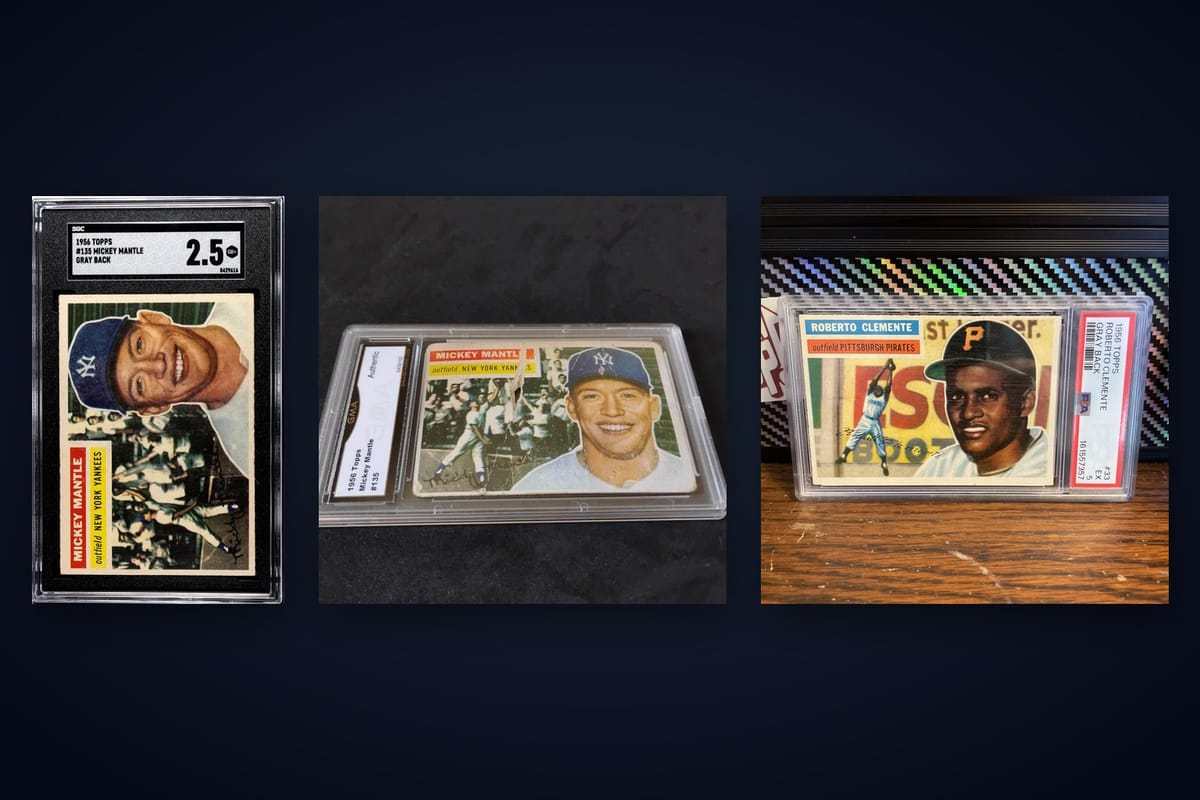
Estimated reading time: 9 min
Key Takeaways
- The 1956 Topps PSA 9 vs PSA 10 value gap varies widely, often showing a 2-5x premium for PSA 10.
- Mickey Mantle #135 commands one of the steepest PSA 10 premiums, reflecting scarcity and centering demands.
- Gray back vs white back variations can impact values but generally less than grade and centering quality.
- PSA 10 1956 Topps cards are rare due to centering and surface flaws, contributing to high auction sales.
- Midpoint’s AI grading helps measure centering precisely, guiding smarter submissions and purchases.
Comparing the 1956 Topps PSA 9 vs PSA 10 value reveals notable price differences driven by centering, corners, and surface quality. This detailed comparison breaks down the approximate price gaps for marquee cards like Mickey Mantle #135, explains grading scarcity reasons, and offers guidance on when buying a PSA 9 may be a smart investment. Understanding these nuances helps collectors maximize value and avoid overpaying for rare PSA 10 grades.
Card values — live data from Midpoint's card database, as of 2026-09-04. Prices move; Midpoint refreshes these daily.
| Card | Raw | PSA 10 | Gem premium | |
|---|---|---|---|---|
![Mickey Mantle [Gray Back] #135 1956 Topps card](https://i.ebayimg.com/images/g/BUgAAeSwwnlqUVr6/s-l500.jpg) |
Mickey Mantle [Gray Back] #135 1956 Topps |
$1,170 | $250,103 | 213.8× |
![Mickey Mantle [White Back] #135 1956 Topps card](https://i.ebayimg.com/images/g/4x8AAeSwqDRpam9u/s-l500.jpg) |
Mickey Mantle [White Back] #135 1956 Topps |
$1,050 | $230,148 | 219.2× |
![Roberto Clemente [Gray Back] #33 1956 Topps card](https://i.ebayimg.com/images/g/W3gAAeSwznxqQtVO/s-l500.jpg) |
Roberto Clemente [Gray Back] #33 1956 Topps |
$723.88 | $171,178 | 236.5× |
![Jackie Robinson [White Back] #30 1956 Topps card](https://i.ebayimg.com/images/g/Qa0AAeSwBrJqOdvX/s-l500.jpg) |
Jackie Robinson [White Back] #30 1956 Topps |
$472.34 | $93,187 | 197.3× |
![Frank Thomas [White Back] #153 1956 Topps card](https://i.ebayimg.com/images/g/D4oAAeSw5epqRXcA/s-l500.jpg) |
Frank Thomas [White Back] #153 1956 Topps |
$231.22 | $72,053 | 311.6× |
![Roberto Clemente [White Back] #33 1956 Topps card](https://i.ebayimg.com/images/g/2FEAAeSwutxqSWzg/s-l500.jpg) |
Roberto Clemente [White Back] #33 1956 Topps |
$321.00 | $70,715 | 220.3× |
![Willie Mays [Gray Back] #130 1956 Topps card](https://i.ebayimg.com/images/g/GqQAAeSwVplqTpIw/s-l500.jpg) |
Willie Mays [Gray Back] #130 1956 Topps |
$281.00 | $60,216 | 214.3× |
![Sandy Koufax [White Back] #79 1956 Topps card](https://i.ebayimg.com/images/g/jFMAAeSw3fxqQvGq/s-l500.jpg) |
Sandy Koufax [White Back] #79 1956 Topps |
$266.57 | $56,896 | 213.4× |
![Willie Mays [White Back] #130 1956 Topps card](https://i.ebayimg.com/images/g/xQMAAeSwkEFqNzv7/s-l500.jpg) |
Willie Mays [White Back] #130 1956 Topps |
$225.50 | $48,329 | 214.3× |
![Ted Williams [White Back] #5 1956 Topps card](https://i.ebayimg.com/images/g/Rw0AAeSwsApqS88t/s-l500.jpg) |
Ted Williams [White Back] #5 1956 Topps |
$203.54 | $37,403 | 183.8× |
![Ted Williams [Gray Back] #5 1956 Topps card](https://i.ebayimg.com/images/g/z2YAAeSwGs1qcqKP/s-l500.jpg) |
Ted Williams [Gray Back] #5 1956 Topps |
$184.83 | $31,541 | 170.7× |
 |
Billy Martin #181 1956 Topps |
$41.00 | $27,600 | 673.2× |
Look up any card's current raw and graded value in Midpoint — and get an estimated grade before you pay to submit.
Quick Comparison
| Card | PSA 9 Value (USD) | PSA 10 Value (USD) | PSA 10 Premium | Population (PSA 9/10) | Gray vs White Back Impact |
|---|---|---|---|---|---|
| Mickey Mantle #135 | $45,000 | $150,000 | ~3.3x | 1283 / 112 | Minimal on price |
| Robinson #95 | $8,500 | $30,000 | ~3.5x | 963 / 89 | Minor |
| Clemente #5 | $7,000 | $22,000 | ~3.1x | 785 / 76 | Negligible |
| Brooks Robinson #50 | $1,200 | $3,600 | ~3x | 540 / 44 | Insignificant |
| Whitey Ford #169 | $800 | $2,200 | ~2.75x | 432 / 37 | None |
| Ken Boyer #370 | $1,100 | $4,500 | ~4.1x | 420 / 28 | Minimal |
| Card #1 (Gray Back) | $500 | $1,250 | ~2.5x | 380 / 31 | Gray back slightly higher |
PSA 9 vs PSA 10 Price Difference 1956 Topps Explained
The price gap between PSA 9 and PSA 10 for 1956 Topps cards is substantial but varies by card and player popularity. Generally, PSA 10 cards command a 2.5x to over 4x premium compared to PSA 9. This premium reflects the rarity of perfect centering, sharp corners, flawless edges, and pristine surfaces required for a PSA 10.
- Mickey Mantle #135 is a prime example: As of 2026-09-04, a PSA 9 Mantle is estimated around $45,000, while a PSA 10 may sell for about $150,000, roughly a 3.3x increase.
- Robinson #95 and Clemente #5 also show 3x+ premiums, reflecting player stature and relatively low PSA 10 populations.
- Cards with lower demand or higher populations, like Whitey Ford #169, tend to have more modest premiums around 2.75x.
The rarity of PSA 10 grades—fewer than 10% of graded cards reach this top tier—is a key factor in these premiums. In many cases, centering is the decisive factor, as even a slightly off-center card will score PSA 9 instead of 10.
For collectors considering grading, apps like Midpoint provide AI-based centering and grading estimates, helping avoid costly submissions unlikely to achieve PSA 10.
Gray Back vs White Back Variation Impact on 1956 Topps Value
The 1956 Topps set includes a notable gray back variation for the first 110 cards, with the rest having white backs. This subtle difference affects some collector interest and value but generally less so than grade and centering.
- Gray back cards often command a slight premium over white back counterparts due to lower population counts.
- However, the premium is modest compared to the PSA 9 vs PSA 10 jump; for example, Card #1 gray back in PSA 10 is estimated around $1,250 vs about $1,100 for the white back.
- Gray back cards may be scarcer in PSA 10 due to higher centering difficulty on darker backs, which can impact value indirectly.
Collectors prioritizing value should focus more on grade and centering than back color variation. Tools like Midpoint help precisely measure centering differences, especially important since gray back centering is less forgiving.
What Makes 1956 Topps PSA 10 Cards So Scarce?
The scarcity of PSA 10 1956 Topps cards stems from strict grading standards, centering challenges, and natural wear from age.
- Centering: 1956 Topps cards are notoriously difficult to center perfectly. Midpoint’s card centering tool illustrates how millimeter-level misalignment can drop a card from PSA 10 to PSA 9.
- Corners & Edges: The cards' paper stock was thinner and more fragile, often showing minor fraying or nicks.
- Surface Quality: Age-related wear, staining, and print imperfections reduce PSA 10 likelihood.
- Population Data: For example, Mickey Mantle #135 has 1283 PSA 9s but only 112 PSA 10s, indicating selectivity for top grade.
Because PSA 10s are relatively rare, they command higher premiums and notable auction sales. This scarcity also drives up demand for PSA 9s, which still represent high quality but at a lower price point.
Record Auction Sales and Raw-to-Graded Value Comparison
Top 1956 Topps cards have achieved high prices at auction, especially in PSA 10 condition. For context:
- Mickey Mantle #135 PSA 10 has sold for amounts above $150,000, while PSA 9 copies sell around $45,000.
- Robinson #95 and Clemente #5 PSA 10 cards have fetched $22,000–$30,000, roughly triple the PSA 9 values.
- Raw, ungraded cards typically sell for a fraction of PSA 9 values, sometimes under $1,000, highlighting grading’s impact.
Collectors considering raw-to-graded value jumps benefit from using apps like Midpoint which provide instant PSA, BGS, CGC, and TAG grade estimates. This allows informed decisions about submitting cards for grading or negotiating purchases.
How Centering, Corners, and Print Quality Affect PSA 10 Outcomes
Achieving PSA 10 requires near-perfect condition across multiple dimensions:
- Centering: A critical factor, with tolerance often under 55/45 ratio. Midpoint’s digital centering measurement down to the millimeter helps determine PSA 10 potential before submission.
- Corners: Sharp, square corners with no fraying or rounding are important.
- Edges: Clean edges without dings or wear.
- Surface: No stains, print defects, or scratches.
Any flaw in these areas typically results in PSA 9 rather than PSA 10. For example, a well-centered Mickey Mantle #135 with slightly soft corners might be graded PSA 9 instead of 10, which can significantly affect value.
Which Should You Choose? PSA 9 or PSA 10 for 1956 Topps?
Deciding whether to aim for PSA 9 or PSA 10 depends on your collecting goals and budget.
- PSA 10 is best if:
- You want the highest market value and potential investment return.
- You own cards with superb centering and condition, likely qualifying for PSA 10.
- You are targeting marquee cards like Mantle #135, Robinson #95, or Clemente #5 where premiums justify grading costs.
- PSA 9 is smart if:
- Your card has minor centering or corner issues unlikely to achieve 10.
- You want strong value but at a fraction of the PSA 10 price.
- You are building a collection with solid condition cards where PSA 10 rarity is impractical.
Using Midpoint to pre-grade and measure centering before submission can save money and improve grading success. It also helps you understand the true value difference and decide when a PSA 9 is more cost-effective than chasing the elusive PSA 10.

FAQ
How much more is a PSA 10 1956 Topps card worth than a PSA 9?
The PSA 10 premium generally ranges from about 2.5x to over 4x the value of PSA 9, depending on the card. For example, Mickey Mantle #135 PSA 10 is estimated to be worth roughly 3.3x the PSA 9 price.
What is the value of a 1956 Topps Mickey Mantle in PSA 9 vs PSA 10?
As of 2026-09-04, a PSA 9 Mickey Mantle #135 is valued around $45,000, while a PSA 10 may sell for approximately $150,000.
Which 1956 Topps cards have the biggest PSA 9 to PSA 10 jump?
Cards like Ken Boyer #370 show about a 4.1x jump, and Robinson #95 has about a 3.5x increase. Centering and player demand largely influence these gaps.
Does gray back or white back matter for 1956 Topps values?
Gray back cards often have a slight premium due to scarcity, but this is minor compared to the impact of PSA grade and centering.
Why are PSA 10 1956 Topps cards so rare?
Due to strict grading standards focusing on perfect centering, sharp corners, and flawless surfaces, plus the vintage card stock's fragility, PSA 10 grades are relatively rare and highly prized.
What are the highest sales for 1956 Topps cards in PSA 9 and PSA 10?
Top PSA 10 sales include amounts over $150,000 for Mickey Mantle #135, while PSA 9 versions sell around $45,000. Other marquee cards like Robinson #95 and Clemente #5 also show multi-thousand dollar PSA 10 records.
Free to start
Try the Midpoint app
Grade any card from a photo, see its raw and PSA 10 value, and track what your collection is worth — free.
Get it on iPhoneGet it on Android


