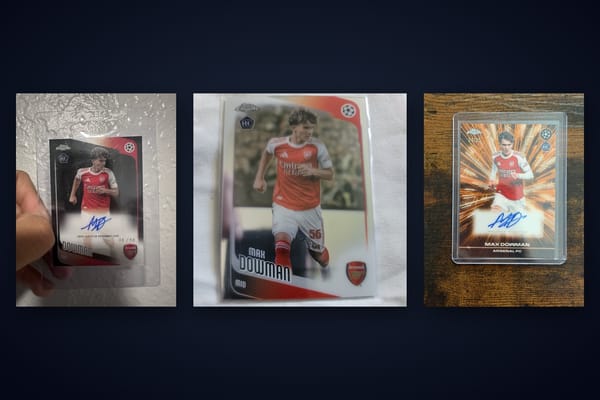
How Centering Impacts Card Value: A Detailed Guide
Discover how centering impacts card value, grading, and resale. Learn to assess centering for PSA, BGS, and CGC with tips and tools like Midpoint.


Estimated reading time: 7 min
Key Takeaways
- Card centering significantly affects trading card value and grading outcomes.
- Grading companies like PSA, BGS, and CGC use strict centering standards.
- Even minor off-centering can reduce a card’s grade—and its market price.
- Pre-grading your card’s centering with digital tools like Midpoint saves money and surprises.
Table of Contents
- Section 1: What Is Card Centering and Why Does It Matter?
- Section 2: How Centering Is Measured
- Section 3: Grading Standards for Centering (PSA, BGS, CGC, TAG)
- Section 4: How Centering Impacts Card Value and Sale Price
- Section 5: Tools and Tips for Assessing Centering
Section 1: What Is Card Centering and Why Does It Matter?
Understanding Card Centering
Card centering refers to the alignment of a trading card’s printed image within its borders. Ideally, the borders on all sides should be of equal width. Poor centering means one or more borders are noticeably thicker or thinner than the others.
Why Centering Affects Value
- First impression: Off-center cards are immediately noticeable—collectors and graders often see this before anything else.
- Scarcity of well-centered cards: Perfectly centered cards are less common, making them more valuable.
- Grading impact: Even if a card is otherwise flawless, poor centering can prevent it from achieving a top grade.
Collectors and investors prioritize centering because it directly correlates to eye appeal and perceived quality.
Section 2: How Centering Is Measured
Manual vs. Digital Methods
Centering is typically measured as a percentage or ratio comparing the widths of opposite borders. For example, a card might be described as 55/45 left-to-right, meaning the left border is 55% of the total border width, and the right is 45%.
- Manual measurement: Using rulers or calipers, collectors estimate border widths, but inconsistencies are common.
- Digital tools: Apps like Midpoint allow you to upload a card image and receive instant, millimeter-level centering analysis, reducing human error and guesswork.
Key Terms Explained
- Horizontal centering: Measures left and right border symmetry.
- Vertical centering: Measures top and bottom border symmetry.
- Centering ratio/percentage: Expressed as two numbers adding to 100 (e.g., 60/40).
For a deeper look at centering measurement technology, check out this post on AI-powered centering analysis.
Section 3: Grading Standards for Centering (PSA, BGS, CGC, TAG)
Major Grading Companies’ Requirements
Each grading company has its own centering standards for top grades:
- PSA: For a PSA 10, centering must be approximately 55/45 or better on the front and 75/25 on the back.
- BGS: BGS 10 requires 50/50 centering on the front (with up to 55/45 allowed), and 60/40 on the back.
- CGC: CGC Pristine 10 allows up to 55/45 on the front and 75/25 on the back.
- TAG: TAG considers both front and back centering, with precise digital measurements influencing the final grade.
Cards that fall outside these parameters can be downgraded, impacting their potential resale value.
How Centering Lowers Grades
- One grade drop: Slight off-centering can take a card from a Gem Mint 10 to a Mint 9.
- Major off-centering: More noticeable issues may lower a card two or more grade levels.
This is why pre-grading your card’s centering before submitting can save you the disappointment (and cost) of a lower-than-expected grade.
Section 4: How Centering Impacts Card Value and Sale Price
Market Examples
Buyers pay a premium for cards with top grades, and centering is a key driver. For example, a PSA 10 can be worth several times more than a PSA 9, even if the only difference is centering quality.
- Well-centered cards are more likely to receive higher offers from collectors and investors.
- Severely off-center cards are often relegated to the “raw” market or sell at a discount—sometimes 30-50% less than perfectly centered counterparts.
Eye Appeal and Liquidity
- Eye appeal: Well-centered cards are visually balanced, making them easier to sell.
- Liquidity: Graded cards with strong centering tend to move quickly in the market.
If you’re considering submitting a card for grading, understanding how centering impacts card value is critical. Using a pre-grading tool reduces risk and maximizes return. For a step-by-step grading guide, see How to Pre-Grade Your Card.
Section 5: Tools and Tips for Assessing Centering
Why Use a Digital Tool?
Manual centering assessment is time-consuming and prone to mistakes. With a digital tool like Midpoint, you get instant feedback and grading estimates for PSA, BGS, CGC, and TAG—all before spending $30+ on submission fees.
Best Practices
- Scan or photograph your card in high resolution and good lighting.
- Use a digital tool to measure both horizontal and vertical centering down to the millimeter.
- Compare centering percentages to the standards for your target grading company.
- Factor in both front and back centering for the most accurate estimate.
For more on how accurate digital grading tools work, read this guide to card grading estimates.
Conclusion
Centering is one of the most important factors in trading card grading and value. Even a pristine, pack-fresh card can lose value if centering is off. By understanding standards, measuring accurately, and leveraging digital tools like Midpoint, you can make informed grading decisions and maximize your card’s worth. Try Midpoint today to see how your cards measure up before you submit.
FAQ
Q: How much does off-centering decrease card value?
A: Off-centering can lower a card’s grade by one or more levels, often reducing value by 30% or more compared to a perfectly centered card.
Q: Can a card still get a top grade if centering is slightly off?
A: Each grading company has specific leniency. Some minor off-centering may still receive a top grade if it falls within allowed parameters.
Q: What’s the best way to measure centering before grading?
A: Use a digital tool like Midpoint for precise, millimeter-level centering measurement and instant grading estimates for PSA, BGS, CGC, and TAG.
Q: Does back centering matter as much as front centering?
A: Front centering is weighted more heavily, but back centering is still considered by all major grading companies and can influence the final grade.
Free to start
Try the Midpoint app
Grade any card from a photo, see its raw and PSA 10 value, and track what your collection is worth — free.
Get it on iPhoneGet it on Android