
1957 Topps Football Cards Value: Complete Price Guide & Grading Insights
Explore the definitive 1957 Topps football cards value guide, including top rookies, grading impact, checklist variants, and selling tips.

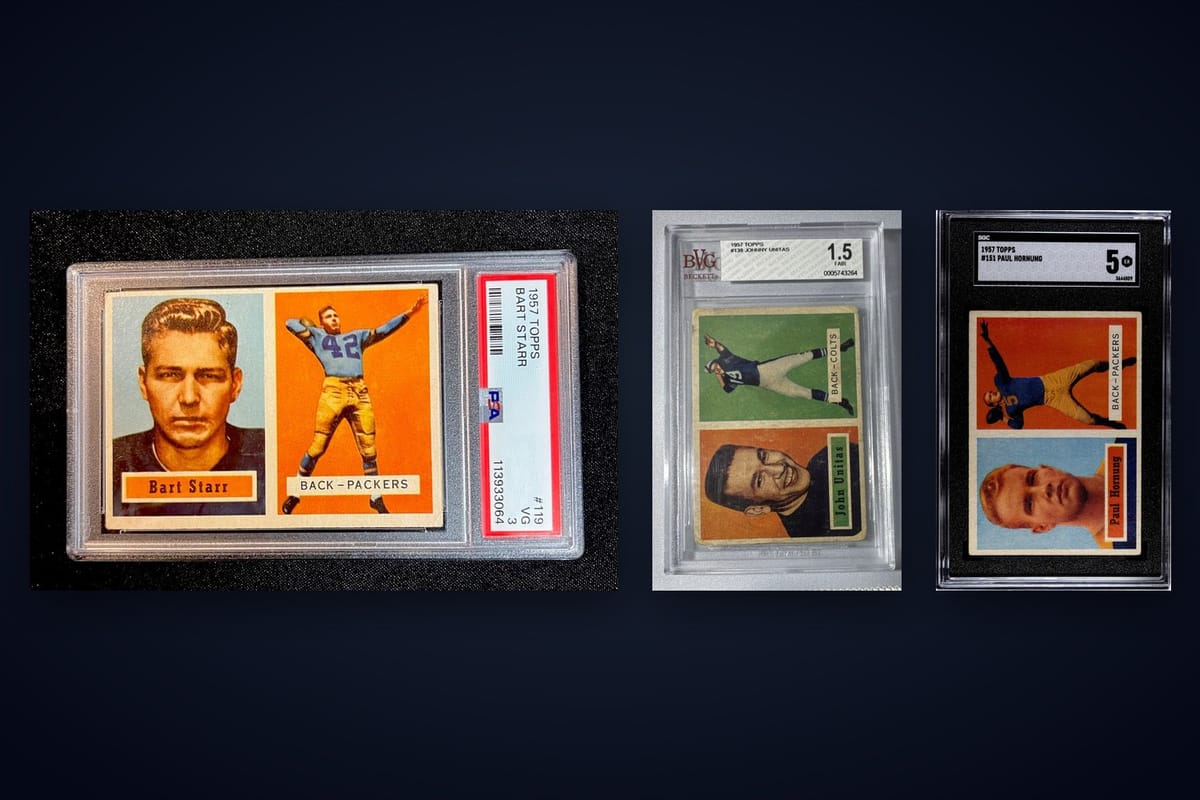
Estimated reading time: 15 min
Key Takeaways
- 1957 Topps football cards remain collectible, with key rookies and Hall of Famers often commanding higher prices, sometimes reaching five-figure sums for pristine examples.
- Grading significantly affects value; PSA 10 copies can be worth multiple times more than raw cards, making condition assessment important.
- Set variations like Bazooka and Twin Blony backs, plus error cards such as the Bill Sherman #58 misprints, influence collector interest and can add a premium.
- Condition factors such as centering, corners, edges, and surface flaws are critical for maximizing value, with centering often being the most challenging to perfect.
- Using tools like Midpoint’s AI grading app can help pre-assess card grade and centering before costly submissions, enabling collectors to better target grading opportunities.
Card values — live data from Midpoint's card database, as of 2026-10-07. Prices move; Midpoint refreshes these daily.
| Card | Raw | PSA 10 | Gem premium | |
|---|---|---|---|---|
 |
Bart Starr #119 1957 Topps |
$599.99 | $124,832 | 208.1× |
 |
John Unitas #138 1957 Topps |
$361.88 | $82,929 | 229.2× |
 |
Paul Hornung #151 1957 Topps |
$348.45 | $72,685 | 208.6× |
 |
Dick Lane #85 1957 Topps |
$42.65 | $8,570 | 200.9× |
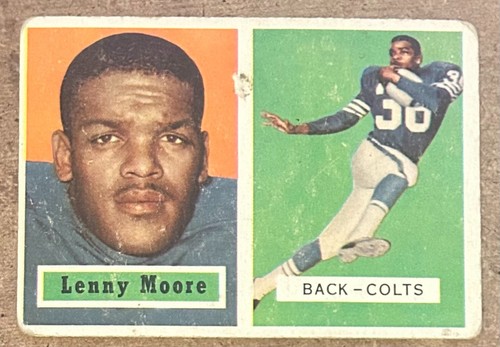 |
Lenny Moore #128 1957 Topps |
$27.50 | $8,100 | 294.6× |
 |
Tank Younger #152 1957 Topps |
$8.10 | $4,993 | 616.4× |
 |
Earl Morrall #104 1957 Topps |
$21.74 | $4,537 | 208.7× |
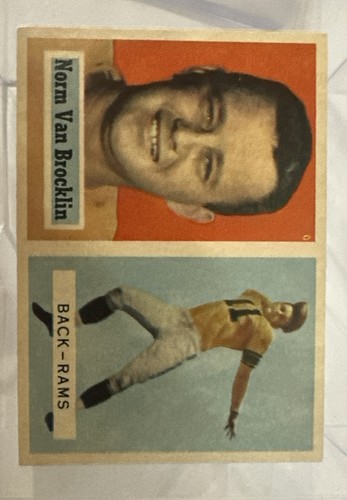 |
Norm Van Brocklin #22 1957 Topps |
$19.66 | $4,085 | 207.8× |
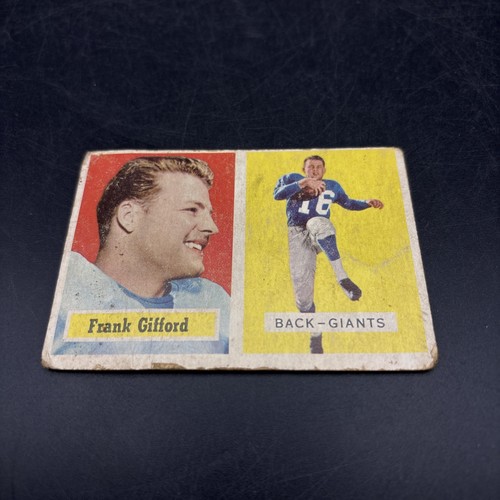 |
Frank Gifford #88 1957 Topps |
$16.65 | $3,999 | 240.2× |
 |
Hugh McElhenny #95 1957 Topps |
$18.91 | $3,949 | 208.8× |
 |
Bobby Layne #32 1957 Topps |
$19.00 | $3,917 | 206.1× |
 |
Joe Perry #129 1957 Topps |
$8.62 | $3,661 | 424.7× |
Look up any card's current raw and graded value in Midpoint — and get an estimated grade before you pay to submit.
Table of Contents
- Section 1: Overview of the 1957 Topps Football Set
- Section 2: Most Valuable 1957 Topps Football Cards
- Section 3: Understanding 1957 Topps Card Condition and Grading
- Section 4: Checklist Variations and Error Cards
- Section 5: Price Differences: Raw vs Graded Cards
- Section 6: How to Identify and Authenticate 1957 Topps Football Cards
- Section 7: Selling and Protecting Your 1957 Topps Collection
Conclusion
FAQ
Section 1: Overview of the 1957 Topps Football Set
The Complete 154-Card Checklist
The 1957 Topps football set is a classic cornerstone for collectors, featuring a total of 154 cards. The set includes a diverse collection of NFL stars and rookies from the era, capturing an important moment in football history. The set consists of:
- Base cards featuring star players and rookies, each card numbered sequentially from #1 to #154.
- Double print cards, which include two images or print layers on one card, making them rarer and more sought-after among collectors.
- Checklist cards, which serve both as a completion tool for collectors and verification of card numbering.
- Variations with different backs — notably Bazooka and Twin Blony backs — which add an additional layer of complexity and rarity.
Each card showcases a player’s portrait or action shot, with the player’s name, team, and position clearly indicated. For example, card #1 features Johnny Unitas, a notable quarterback, while card #119 highlights Bart Starr, whose rookie card is prized by collectors. The set balances rookies, veterans, and Hall of Famers, capturing the excitement of the 1950s NFL.
Set Structure and Rarity
This set is prized for its relatively low print runs compared to some other years, which elevates the scarcity and desirability of high-grade examples. The overall print run is estimated to be in the hundreds of thousands, but surviving high-grade copies are scarcer due to age, handling, and production variations.
The double print cards and checklist cards add depth and complexity. For instance, double print cards often have a faint overlapping image or double exposure, which occurred during the printing process and was not intended, making them less common. Checklist cards exist in two primary back variations—Bazooka and Twin Blony—with Twin Blony backs generally considered less common and sought after by specialists.
Due to the 66+ years since production, condition sensitivity is high. Cards with sharp corners, clean edges, and good centering are uncommon, which is why grading becomes pivotal in establishing market value.
Popular Card Types Within the Set
- Commons: The majority of the 154 cards are commons, featuring well-known players of the era. While commons tend to have lower individual value, condition still significantly influences their prices; a well-preserved common can be worth several times more than a heavily worn one.
- Double Prints: Cards with two images or print layers, often resulting from printing errors, are rarer and attract collectors who specialize in anomalies and rarities.
- Rookies: Notable rookie cards, including Bart Starr (#119) and Johnny Unitas (#138), are collectible and often the centerpiece of the set due to their historical significance and scarcity in top condition.
- Checklist Cards: These cards provide a roadmap to the entire set and are important for completionists. Their variations in back design can affect collector interest and value.

Section 2: Most Valuable 1957 Topps Football Cards
Key Hall of Fame Cards
The most valuable 1957 Topps football cards feature NFL legends whose significance and condition command higher prices in the marketplace. These cards are prized for the players they depict and their scarcity in high-grade condition. Standouts include:
- Bart Starr (#119): His rookie card is among the most sought after in the set. As of 2026-10-07, PSA 10 copies have been reported to reach values over $12,000, reflecting Starr’s status as a Green Bay Packers quarterback and Super Bowl MVP.
- Johnny Unitas (#138): Another premier rookie card, prized for its iconic status as one of the greatest quarterbacks of all time. PSA 10 copies have been known to fetch around $15,000. Unitas’s card is often considered the crown jewel of the set.
- Paul Hornung (#151): A Hall of Famer with a loyal collector following, Hornung’s card in top grade has been valued near $6,000. Hornung’s versatility and role in Packers history contribute to the card’s appeal.
Other Noteworthy High-Value Cards
Beyond the marquee rookies, cards of Hall of Famers like Jim Brown (#73), Raymond Berry (#25), and Lenny Moore (#61) also enjoy premium prices, especially in high-grade condition. For instance, Jim Brown’s card has been valued at approximately $2,500 in PSA 9 condition, reflecting his dominance in the NFL and scarcity of well-preserved copies.
Cards of other stars such as Gino Marchetti (#150) and Y.A. Tittle (#104) also command respectable prices in the hundreds to low thousands, depending on grade.
Rarity and Popularity Driving Value
Cards like Bart Starr and Johnny Unitas stand out not only for their player legacy but also because fewer high-grade copies exist. The 1957 Topps set suffered from issues such as poor centering and print defects, reducing the number of cards eligible for PSA 9 or 10 grades. This scarcity of well-centered, minimally flawed cards further boosts prices as collectors compete for the best examples.
Moreover, the desirability of rookies tends to increase over time, as these cards represent a player’s entry into the professional ranks and often carry sentimental and investment value.
Section 3: Understanding 1957 Topps Card Condition and Grading
Grading Companies and Scales
The primary grading companies for 1957 Topps football cards are PSA (Professional Sports Authenticator), BGS (Beckett Grading Services), CGC (Certified Guaranty Company), and TAG Grading. Each uses a 1 to 10 scale, where 10 represents Gem Mint condition.
- PSA: The most recognized grading company, PSA grades cards from Poor (1) up to Gem Mint (10). PSA 10 cards are the benchmark for highest value.
- BGS: Uses a similar 1-10 scale but provides subgrades for centering, corners, edges, and surface, allowing collectors to understand strengths and weaknesses.
- CGC: A newer entrant in sports card grading, CGC also offers detailed subgrades and is gaining acceptance.
- TAG Grading: Known for a focus on centering and surface quality, TAG is popular among certain collectors but less mainstream.
The 1957 Topps PSA 10 value is often considered the gold standard for premium prices and can exceed raw card prices by a large margin — sometimes 10x or more.
Key Condition Factors
- Centering: This is the most critical factor for 1957 Topps cards. Centering refers to the alignment of the printed image relative to the card borders. For PSA 10, centering generally must be approximately 55/45 or better, meaning the image is nearly perfectly centered. Even a slight misalignment can result in a grade drop.
- Corners: Corners should be sharp and free of fraying or rounding. Cards from this era often have worn or softened corners, which reduce grade potential.
- Edges: Edges must be clean and free of chipping or white spots. Edge wear is common due to handling and storage over decades.
- Surface: The card surface should be free of print defects, creases, stains, scratches, or scuffs. Glossiness and color vibrancy also impact grading.
Among these, poor centering is a leading cause of grade reductions for this set. A card with perfect corners and surface but off-center may receive a PSA 8 or lower instead of a 9 or 10.
Using AI Tools for Pre-Grading
Before investing $30 or more on professional grading fees, collectors may benefit from AI-powered pre-grading tools like Midpoint. Midpoint uses advanced image recognition and machine learning to analyze card centering down to the millimeter and estimate grades across PSA, BGS, CGC, and TAG scales.
This enables collectors to:
- Assess whether a card is likely to qualify for premium grades like PSA 9 or 10.
- Determine if centering is within acceptable ranges before submission.
- Save money by avoiding grading submissions for cards unlikely to receive high grades.
- Track collection condition and value digitally over time.
For example, a collector with multiple Bart Starr rookies can use Midpoint to identify which cards have the best centering and surface condition, prioritizing those for grading submission.
Section 4: Checklist Variations and Error Cards
Checklist Variations
The 1957 Topps football set includes several checklist cards, which help collectors verify set completion. These checklist cards exist with two primary back variations:
- Bazooka Back: Featuring branding and graphics associated with Bazooka bubble gum, these backs are more common.
- Twin Blony Back: A unique back design with different graphics and text, generally considered less common and thus more desirable to collectors.
Collectors often seek to acquire both versions to complete specialized sets, and Twin Blony backs can command a premium due to their relative rarity and condition challenges.
Bill Sherman #58 Error Variations
The #58 Bill Sherman card is notable for error variations that impact its collectibility and value. These errors include:
- Misprints in text alignment, such as spacing or font inconsistencies.
- Image misregistration leading to minor double images or blurred areas.
- Color variations that indicate printing anomalies.
Some error versions are rarer and more sought after by collectors who specialize in printing anomalies, sometimes commanding premiums over standard versions, particularly if graded highly.
How Variations Affect Value
Collectors seeking complete or specialized sets prize checklist and error variations, making them worth tracking and grading carefully. Cards with confirmed error variations, especially in good condition, can fetch premiums over standard versions. For example, a PSA 9 Bill Sherman #58 with an error variation might sell for modestly more than the standard version in the same grade.
Awareness of these variations also helps sellers accurately list and price cards, while buyers can hunt for rarities that add uniqueness to their collections.
Section 5: Price Differences: Raw vs Graded Cards
Raw Card Values
Raw 1957 Topps football cards vary widely in value depending on condition, centering, and surface quality. For example, a raw Bart Starr rookie (#119) in EX/EX-MT condition (approximately PSA 6-7 quality) might be valued around $350, but this figure can vary based on the sharpness of corners, centering, and presence of any surface imperfections.
Commons and non-rookie cards in raw condition may range from a few dollars up to $50 depending on condition and player popularity.
Graded Card Premiums
Graded cards command substantial premiums over raw counterparts. For instance, as of 2026-10-07, Bart Starr’s PSA 10 rookie card has been valued at approximately $12,500, representing a significant price increase over raw EX/EX-MT examples. This premium reflects collector confidence in the card’s authenticity and condition.
- PSA 7 copies often sell for around $1,200-$1,500 for top rookies, reflecting a solid mid-grade condition.
- PSA 8 cards can jump significantly to $4,000-$5,000, demonstrating the importance of sharp corners and better centering.
- PSA 9 and 10 cards command the highest prices, with a sharp price jump especially between 9 and 10 grades.
The Gem Premium Gap
The difference between a PSA 9 and PSA 10 card — often called the "gem premium gap" — is significant, frequently doubling or tripling the card’s value. This gap is particularly pronounced for marquee rookies like Johnny Unitas and Bart Starr, where pristine centering and flawless surfaces are rare.
For example, a PSA 9 Johnny Unitas rookie card might be valued at $7,500-$8,500, while a PSA 10 can reach $15,000 or more.
Understanding this gap helps collectors decide if grading is worthwhile. Using AI tools like Midpoint can help predict if a card qualifies for PSA 10 grades by analyzing centering and surface, thereby optimizing grading investments.
Section 6: How to Identify and Authenticate 1957 Topps Football Cards
Identifying Genuine Cards
Authentic 1957 Topps football cards have distinct design features and physical characteristics. Collectors should verify the following to help ensure authenticity:
- Card Dimensions and Thickness: Genuine cards measure approximately 2-1/2 by 3-1/2 inches with a relatively thin cardstock typical of the era, unlike thicker modern cards.
- Color Accuracy and Print Clarity: The 1957 Topps cards exhibit vibrant but slightly muted colors due to age, with clear, sharp text and player images. Colors should not appear overly bright or digitally enhanced.
- Back Designs: The backs feature distinctive Bazooka or Twin Blony designs, with characteristic fonts and logos. Familiarity with these backs helps detect fakes or reproductions.
Common Counterfeit Signs
Fake or altered cards may exhibit one or more of the following warning signs:
- Blurry or pixelated images inconsistent with 1950s printing technology.
- Inconsistent font styles or misspelled player names.
- Incorrect card stock weight or thickness, often heavier or lighter than originals.
- Unusual glossiness or lamination not present on authentic cards.
- Edges that appear cut or trimmed, sometimes done to improve centering artificially.
- Altered surfaces, including recoloring or retouching.
Checking centering and edges with precise measurement tools, such as calipers or digital centering apps like Midpoint, can help detect altered or counterfeit cards.
Authentication and Grading Services
Professional grading companies provide authentication services and encapsulate cards to prevent tampering. Submitting cards to PSA, BGS, or CGC ensures expert validation of authenticity and condition.
However, preliminary AI tools like Midpoint assist collectors in verifying card authenticity and condition before submission, reducing risk and expense. These tools analyze card features algorithmically, flag potential issues, and estimate grading outcomes, empowering collectors to make informed decisions.
Section 7: Selling and Protecting Your 1957 Topps Collection
Best Practices for Selling
When selling 1957 Topps football cards, maximizing return and minimizing risk are key. Consider these best practices:
- Professional Grading: Getting cards graded by PSA, BGS, or CGC can increase sale price significantly, especially for key rookies and Hall of Famers.
- Choosing the Right Platform: Utilize platforms with active sports card communities and transparent pricing, such as eBay, auction houses specializing in sports memorabilia, or dedicated card marketplaces.
- Detailed Listings: Provide high-resolution photos showing front and back, close-ups of corners, edges, and centering, along with condition notes to build buyer confidence.
- Timing Sales: Monitor market trends and major sports events or anniversaries that may spike interest and prices.
- Consider Auctions: For rare or high-value cards, auctions can generate competitive bidding and higher sale prices.
Storage and Preservation
Proper storage is vital to maintain card condition over time. Tips include:
- Use acid-free sleeves and top loaders to protect cards from physical damage.
- Store graded cards in protective cases or boxes designed for sports cards.
- Maintain cards in climate-controlled environments to avoid temperature and humidity extremes that can warp or degrade card stock.
- Avoid direct sunlight, which can fade colors and damage surfaces.
- Handle cards by edges with clean hands or gloves to prevent oils and dirt buildup.
For comprehensive advice on storage, see our Ultimate Collector’s Guide to Card Storage.
Tracking Collection Value Over Time
Managing a valuable collection means monitoring its value as market conditions fluctuate. Apps like Midpoint offer portfolio tracking features that allow collectors to:
- Log all cards with images and details.
- Track estimated values based on recent market sales.
- Receive alerts on value changes or grading opportunities.
- Analyze collection strength and identify cards worthy of grading or sale.
Using such tools empowers collectors to make data-driven decisions about buying, holding, or selling cards.
Conclusion
The 1957 Topps football cards value landscape offers opportunities for collectors and investors alike. With iconic rookies such as Bart Starr and Johnny Unitas leading the set, condition and grading heavily influence prices. Variations like checklist backs and error cards add complexity and appeal to the set’s allure, rewarding knowledgeable collectors who understand these nuances.
Thanks to tools like Midpoint, collectors can digitally assess centering and estimate grading outcomes before costly submissions, helping to make informed investment decisions. Whether you’re a seasoned collector or just starting, understanding the intricacies of the 1957 Topps set equips you to maximize your cards’ potential value in today’s market.
FAQ
Q: How much are 1957 Topps football cards worth?
A: Values vary widely by card and condition. Raw common cards may be worth a few dollars, while high-grade rookies like Bart Starr (#119) and Johnny Unitas (#138) have been known to fetch $12,000 to $15,000 or more in PSA 10 condition as of 2026-10-07.
Q: What is the most valuable 1957 Topps football card?
A: The Johnny Unitas rookie card (#138) is generally considered the most valuable, especially in PSA 10 condition, where it can be worth around $15,000. Bart Starr’s rookie (#119) also commands top prices.
Q: How much is a 1957 Topps Bart Starr rookie card worth?
A: In raw EX/EX-MT condition, it may be valued near $350, but a PSA 10 graded Bart Starr rookie card has been valued at about $12,500 as of 2026-10-07.
Q: How much is a 1957 Topps Johnny Unitas rookie card worth?
A: The Johnny Unitas rookie card (#138) in PSA 10 condition is valued around $15,000. Raw copies vary widely depending on condition but are significantly less.
Q: What are the checklist variations in the 1957 Topps football set?
A: The set features checklist cards with Bazooka and Twin Blony backs. These variations affect rarity and collector interest, with Twin Blony backs generally considered rarer.
Q: Are 1957 Topps football cards worth grading?
A: Yes, especially for key rookies and Hall of Famers. Grading can multiply card value substantially, particularly if the card is well-centered and free of defects. Using AI tools like Midpoint helps assess grading potential before submitting.
Free to start
Try the Midpoint app
Grade any card from a photo, see its raw and PSA 10 value, and track what your collection is worth — free.
Get it on iPhoneGet it on Android


