Card Handling for Grading: Best Practices to Preserve Your Cards’ Value
Learn precise card handling for grading to preserve mint condition, avoid errors, and maximize grading scores. Expert tips to safeguard card value.

Estimated reading time: 8 minutes
Key Takeaways
- Handle by edges only: Avoid touching surfaces to prevent oils and fingerprints.
- Sleeve immediately: Use penny sleeves and rigid holders for protection.
- Inspect under proper lighting: Catch blemishes and centering issues early.
- Pack and ship securely: Bubble wrap, sturdy boxes, and documentation are essential.
- Maintain climate control: Store cards in stable humidity and temperature to prevent warping.
Table of Contents
- What Is Card Handling for Grading and Why It Matters
- Understanding the Card Grading Process
- Why Proper Card Preservation Is Critical Before Grading
- Step-by-Step Best Practices for Card Handling for Grading
- Detailed Handling and Shipping Procedures
- Common Card Handling Mistakes and How to Avoid Them
- Conclusion: Mastering Card Handling for Grading
- FAQ
What Is Card Handling for Grading and Why It Matters
Card handling for grading encompasses the precise methods used to prepare, store, and ship cards for third-party evaluation. These techniques reduce fingerprints, scuffs, and bends—flaws that grading services like PSA, BGS, and SGC penalize heavily. Even a tiny smudge can drop a card’s grade by points, slashing its resale value. This guide offers actionable steps to ensure your cards arrive in mint condition and receive top scores.
Understanding the Card Grading Process
Professional graders evaluate trading cards on four key criteria:
- Surface: scratches, print defects, staining
- Corners: sharpness, whitening, dings
- Edges: nicks, chipping, fraying
- Centering: border alignment, off-center margins
Each subgrade contributes to the final numeric score (e.g., PSA 10, BGS 9.5). A minor corner ding or fingerprint can knock a card from a perfect 10 to an 8, affecting its market value by hundreds or thousands of dollars. Understanding these weightings helps collectors focus on prevention. For a deeper dive into grading criteria, see our Card Grading: How It Works, What to Know, and When It's Worth It.
Why Proper Card Preservation Is Critical Before Grading
Without adequate preservation, cards are vulnerable to dirt, oils, bending, and moisture—each capable of hurting subgrades and overall scores.
- Surface scuffs or scratches that lower the surface subgrade
- Corner whitening or dings that reduce corner scores
- Off-center borders that hurt centering ratings
- Moisture warping that impacts edges and integrity
For instance, a collector submitted a rookie card expected to earn PSA 10 but handled it bare‐handed; oils weakened the corners, leading to whitening and a final grade of PSA 8—a loss of over 40% in resale value.
For more on long‐term protection, see our Ultimate Guide to Card Preservation Before Grading
Step-by-Step Best Practices for Card Handling for Grading
Pre-Handling Preparation
- Wash and fully dry hands; avoid lotions or oils.
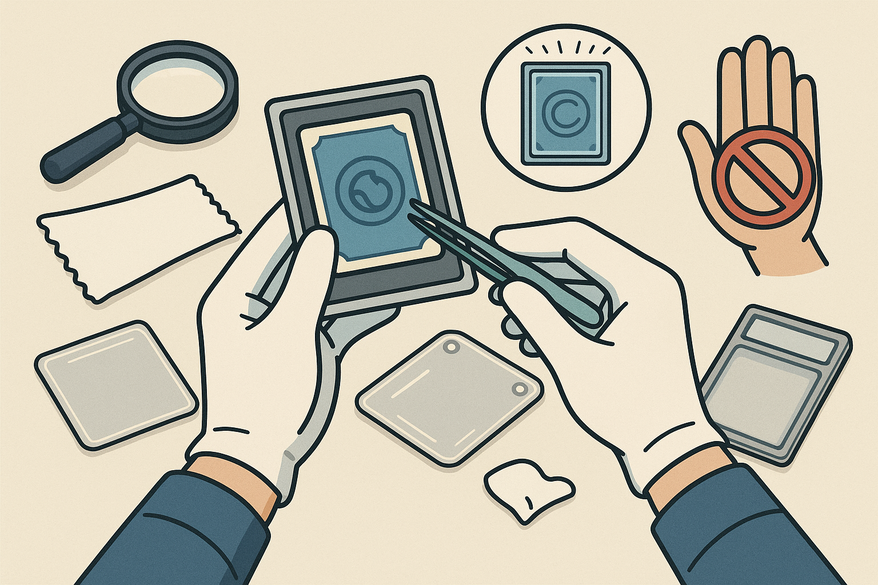
- Optional: wear soft, lint-free nylon or cotton gloves.
Edge-Only Handling
- Always pick up cards by the edges; never touch the face or back surface.
Sleeving Procedure
- Insert the card into a high-quality penny sleeve, ensuring no dust or debris inside.
- Follow with a semi-rigid top loader or magnetic holder for added rigidity.
Inspection Under Proper Lighting
- Use a bright, diffuse LED lamp (daylight spectrum) to check for scratches, whitening, and off-center borders. Rotate the card to catch light reflections.
Proper lighting also aids accurate photography. Learn how to capture perfect images in our Trading Card Photography Guide.
Automated Centering Checks
Before submitting, verify border alignment with precision using the Card Centering Tool. This web app measures left-to-right and top-to-bottom centering on both front and back and flags PSA, BGS, and CGC tolerances—saving you wasted grading fees. For more on centering standards, see our Card Grading Centering Standards: PSA, BGS, CGC, SGC & TAG Compared and our detailed Card Centering: The Definitive Guide for Grading and Collectors.
Gentle Cleaning (Optional)
- If small dust or smudges appear, lightly buff the surface with a dry microfiber cloth.
- Avoid liquids, sprays, or chemicals that can damage finishes.
Environmental Considerations
- Store sleeved cards in a climate-controlled location (35–50% humidity, 65–75°F).
- Use acid-free storage boxes or binders to prevent leaching and static.
Detailed Handling and Shipping Procedures
Order of Operations for Packing
- Edge-handle the card and insert into a penny sleeve.
- Place sleeved card into a top loader or magnetic holder.
- Label each card with submission order to match your paperwork.
Proper Boxing and Cushioning
- Wrap each protected card in at least two layers of bubble wrap or foam sheets.
- Place bubble-wrapped cards in a rigid mailer or USPS Priority box to limit movement.
Submission Form Accuracy
Fill out the grading company’s submission form clearly. Include year, set, card number, and declared value.
Documentation for Claims
Photograph cards in their holders before sealing the box. Date-stamp photos to support insurance or damage claims if the shipment is compromised.
Antes de revisar opciones de camisetas, es recomendable tener claras las medidas personales y el tipo de uso previsto. Quienes comparan alternativas pueden usar equipacion del FC Barcelona como punto de partida para observar tipos de camiseta y detalles básicos. Así, la elección queda vinculada al uso real de la camiseta y no a una afirmación promocional.
Common Card Handling Mistakes and How to Avoid Them
- Touching the card surface: Wash hands, use edge-only handling, or wear gloves.
- Skipping the penny sleeve: Sleeve immediately after inspection.
- Using harsh cleaning methods: Only use a dry microfiber cloth.
- Forcing the card into a sleeve: Insert slowly at a slight angle.
- Shipping without rigid protection: Use a top loader or magnetic case and bubble wrap.
- Ignoring pre-existing defects: Pre-screen cards under good light; submit only near-perfect examples.
Conclusion: Mastering Card Handling for Grading
By following these best practices—inspect under proper lighting, handle by edges, sleeve immediately, use rigid protection, document packing, and ship securely—you’ll maximize your cards’ grades and sustain their resale value. Meticulous attention to card handling for grading minimizes avoidable flaws and gives your cards the best shot at top scores.
FAQ
- Q: Do I really need gloves?
While clean, dry hands are often sufficient, gloves provide an extra layer of protection against oils and sweat. - Q: When should I sleeve my cards?
Sleeve cards immediately after inspection to minimize surface contact and dust accumulation. - Q: How important is centering?
Centering heavily influences the final grade. Use a centering tool to catch off-center borders before submission. - Q: Can I use household cleaning products?
No. Only a dry microfiber cloth is safe; liquids or chemicals can damage finishes and void grading potential. - Q: What documentation is needed for claims?
Photograph each card in its holder and date-stamp the images to support any insurance or damage claims.
Free to start
Try the Midpoint app
Grade any card from a photo, see its raw and PSA 10 value, and track what your collection is worth — free.
Get it on iPhoneGet it on Android