Mastering Graded Cards Investment: Why Centering Drives Value
Master graded cards investment by understanding why centering drives value with higher grades, resale liquidity, and downside protection.

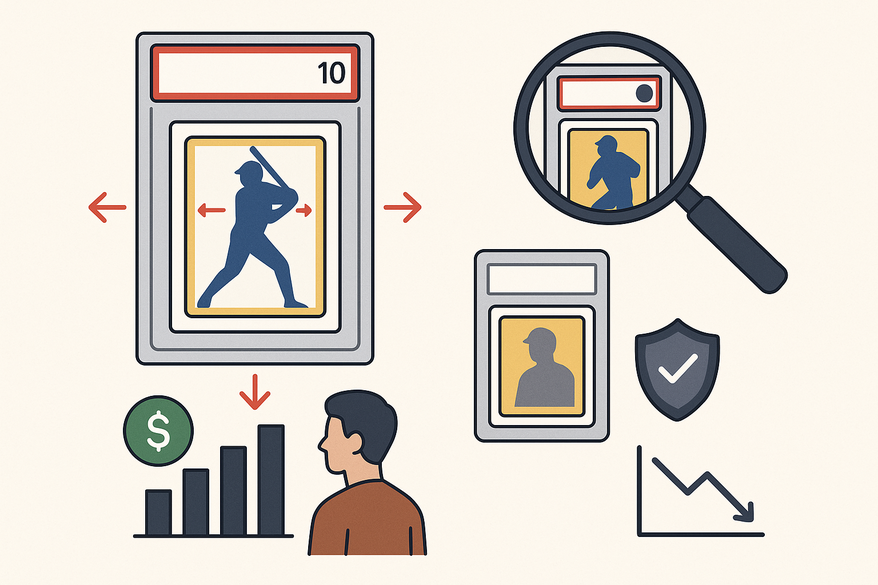
Estimated reading time: 8 minutes
Key Takeaways
- Centering is the primary driver of numeric grades and market value;
- Well-centered cards command higher premiums, liquidity, and downside protection;
- Automated tools like the Card Centering Tool remove guesswork;
- A clear centering checklist and grading report analysis prevent costly mistakes;
- Balance acquisition cost vs. centering quality to optimize long-term returns.
Table of Contents
- Introduction
- Understanding Graded Cards
- What Grading Actually Evaluates
- How Professional Grading Companies Work
- The Role of Centering in Graded Cards
- Defining Centering
- Why Centering Is Crucial to Grade & Value
- Aesthetics & Perceived Rarity
- Investment Implications of Centering
- How Centering Affects Long-Term Value
- Comparing Well-Centered vs. Poorly Centered Cards
- Price Difference Examples
- Evaluating Graded Cards as an Investment
- What to Look for: Centering Checklist
- Verifying Grades & Reading Grading Reports
- Red Flags Even with High Centering Scores
- Conclusion
- FAQ
Introduction
Graded cards investment involves buying, grading, and trading cards based on condition and rarity. When you slab a card, a third-party grading company—like PSA, BGS, SGC, or CGC—authenticates it, encapsulates it in a tamper-evident case, and assigns a numeric score from 1 to 10. This process transforms raw cards into trusted, liquid assets.
To remove guesswork, many investors use automated tools such as the Card Centering Tool, which measures border ratios with sub-millimeter accuracy and flags whether a card meets centering tolerances for top grades.
"Grading boosts a trading card’s appeal and market value, and a PSA 10 can sell for 3–5× the value of the same raw card." — Splint Invest
By mastering centering, you can target top-tier slabs, optimize acquisition costs, and build a portfolio of high-confidence collectibles.
Understanding Graded Cards
What Grading Actually Evaluates
Grading hinges on four condition pillars:
- Centering: alignment of the printed image within the borders;
- Corners: checks for whitening, rounding, or damage;
- Edges: inspects chipping, whitening, or fraying;
- Surface: looks for scratches, scuffs, or printing defects.
Note: Perfect corners or a flawless surface can’t fully offset poor centering.
How Professional Grading Companies Work
- PSA: simple 1–10 scale, highest resale values;
- BGS: subgrades for centering, corners, edges & surface; premium 9.5–10 tiers;
- SGC: vintage specialist with solid modern demand;
- CGC Cards: strict standards for TCG and comics, growing in premiums.
The grading process follows six steps:
- Submission;
- Authentication;
- Condition evaluation;
- Grade assignment;
- Encapsulation;
- Population reporting.
The Role of Centering in Graded Cards
Defining Centering
Centering is the ratio of border widths top vs. bottom and left vs. right. For example, PSA 10 often requires 55/45 or better on the front and 75/25 on the back. Graders use digital templates and magnifiers under bright lighting to measure tolerance. Perfect centering means nearly equal borders on all sides.
For a step-by-step measurement process, see the step-by-step guide to measuring card centering.
Why Centering Is Crucial to Grade & Value
- Visible flaw: off-center borders are instantly noticeable in photos or auctions;
- Grade gatekeeper: perfect corners and surface can’t rescue poor centering from missing top grades;
- Condition rarity: well-centered examples in difficult sets become scarce and command premiums.
For a deeper dive into grading tolerances, see centering tolerances compared.
Aesthetics & Perceived Rarity
- Eye-appeal premium: symmetrical cards draw higher bids, even within the same grade;
- Visual impact: iconic cards (e.g., Charizard Base Set) look best when perfectly centered;
- Rarity effect: top-centered examples of centering-challenged sets are highly sought after.
Learn more about the eye-appeal premium in card collecting.
Investment Implications of Centering
How Centering Affects Long-Term Value
- Premium pricing: well-centered raw cards have a higher chance of top-tier slabs, driving 3–10× resale multiples;
- Resale liquidity: top-centered slabs sell faster with more bidder competition;
- Downside protection: in market corrections, best-centered examples retain value better.
For further reading, explore the PokéMaster Vault guide and our market downturn analysis.
Comparing Well-Centered vs. Poorly Centered Cards
Well-centered cards:
- Pros: higher top-grade hit rates, stronger liquidity and demand;
- Cons: higher raw acquisition costs, increased competition.
Poorly centered cards:
- Pros: lower cost entry, vintage scarcity can offset flaws;
- Cons: limited upside, slower sales requiring discounts.
Price Difference Examples
- A modern PSA 10 with strong centering sells for 3–5× a raw near-mint and 2–3× a PSA 9;
- A PSA 8 or 9 with perfect centering can outperform a higher-grade but off-center slab.
Evaluating Graded Cards as an Investment
What to Look for: Centering Checklist
- Front centering: compare left vs. right, top vs. bottom border thickness;
- Back centering: note tolerance differences by grader;
- Consistency check: ensure slab appearance matches grade expectations;
- Comparative analysis: review sold listings and identify better-centered examples.
Learn how to spot off-center cards before grading in our off-center detection guide.
Verifying Grades & Reading Grading Reports
- Use PSA Cert Verification and BGS Cert lookup;
- Prioritize balanced high centering subgrades (e.g., BGS 9.5 Centering 9.5);
- Consider cross-grading only if raw centering meets target tolerances.
Red Flags Even with High Centering Scores
- Trimming/alteration: unnaturally uniform borders or overly sharp edges;
- Overgraded slabs: older lenient eras with mismatched standards;
- Slab condition: cloudy or scratched cases;
- Population context: high-pop cards allow cherry-picking of best centering.
Conclusion
Centering is a cornerstone of graded cards investment: it shapes numeric grades, eye appeal, condition rarity, and resale value. To succeed:
- Study centering standards of top graders;
- Analyze real-world sales to see price impacts;
- Start small to master grading economics;
Treat centering as core due diligence and build a smarter, more confident investment strategy.
FAQ
- Q: What is centering tolerance for a PSA 10?
A: PSA typically requires a 55/45 front ratio or better and 75/25 on the back. - Q: Can I improve centering after grading?
A: No—centering is fixed at grading. Use automated tools before submission. - Q: How do I verify card authenticity?
A: Use official certification lookups on PSA and Beckett sites. - Q: Are centering tools reliable?
A: Automated Centering tools offer sub-millimeter precision for confident grading decisions.
Free to start
Try the Midpoint app
Grade any card from a photo, see its raw and PSA 10 value, and track what your collection is worth — free.
Get it on iPhoneGet it on Android