Ivan Demidov Cards Worth Money: Values, Grading & Top Picks
Discover which Ivan Demidov cards are worth money, rookie card values, PSA 10 pricing, rare parallels, and the best cards to grade for maximum return.

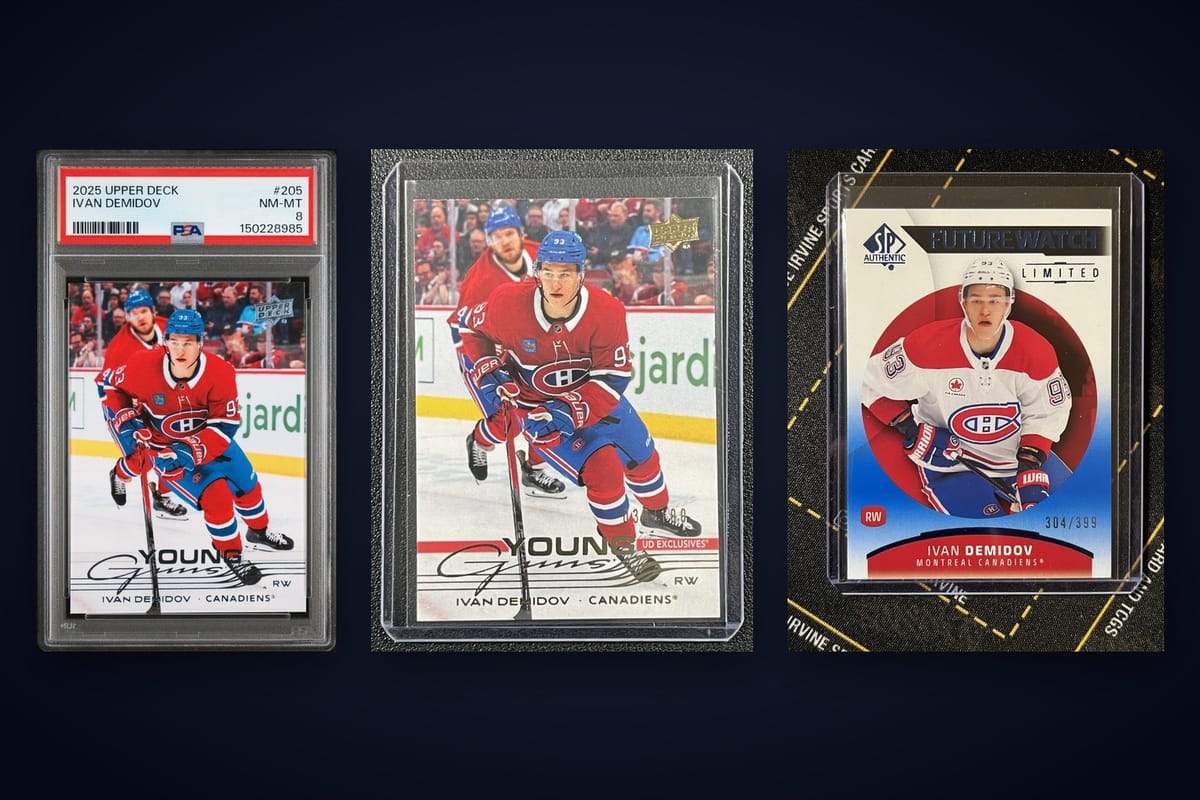
Estimated reading time: 15 min
Key Takeaways
- Ivan Demidov's Young Guns rookie cards are popular among collectors, with PSA 10 graded versions often commanding higher prices than raw cards.
- Rare parallels like Outburst Red and Golden Treasures inserts tend to have higher value due to limited print runs and collector interest.
- Raw card prices vary widely; centering, surface quality, and edges significantly impact grading outcomes and resale value.
- Choosing the best Ivan Demidov cards to grade involves understanding population counts, variant scarcity, and set provenance.
- Using tools like Midpoint can help pre-grade cards by assessing centering, corners, edges, and surface condition before submission, potentially reducing grading costs and maximizing returns.
Card values — live data from Midpoint's card database, as of 2026-09-04. Prices move; Midpoint refreshes these daily.
| Card | Raw | PSA 10 | Gem premium | |
|---|---|---|---|---|
 |
Ivan Demidov [Outburst Red] #205 2025 Upper Deck |
$5,203 | $22,254 | 4.3× |
 |
Ivan Demidov [Exclusive] #205 2025 Upper Deck |
$1,270 | $5,262 | 4.1× |
 |
Ivan Demidov #149 2025 SP Authentic |
$921.00 | $4,332 | 4.7× |
 |
Ivan Demidov [Clear Cut] #205 2025 Upper Deck |
$527.00 | $3,100 | 5.9× |
 |
Ivan Demidov [Outburst] #205 2025 Upper Deck |
$412.84 | $1,328 | 3.2× |
 |
Ivan Demidov #B-1 2025 Upper Deck Allure 16-Bit |
$455.00 | $1,275 | 2.8× |
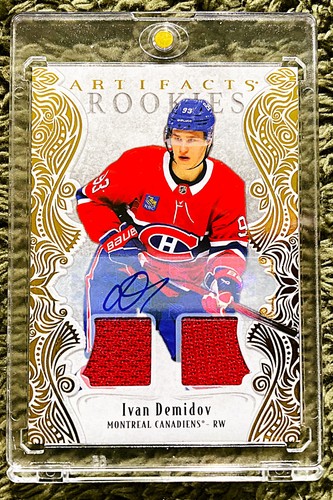 |
Ivan Demidov [Rookies Auto Material] #174 2025 Upper Deck Artifacts |
$289.00 | $1,197 | 4.1× |
 |
Ivan Demidov [Rainbow Foil Green] #542 2025 O-Pee-Chee |
$250.00 | $1,115 | 4.5× |
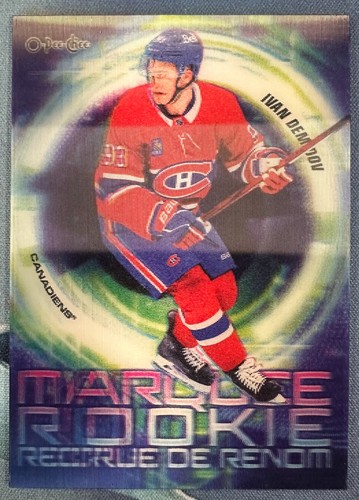 |
Ivan Demidov #3D-ID 2025 O-Pee-Chee 3-D Marquee Rookie |
$235.29 | $1,050 | 4.5× |
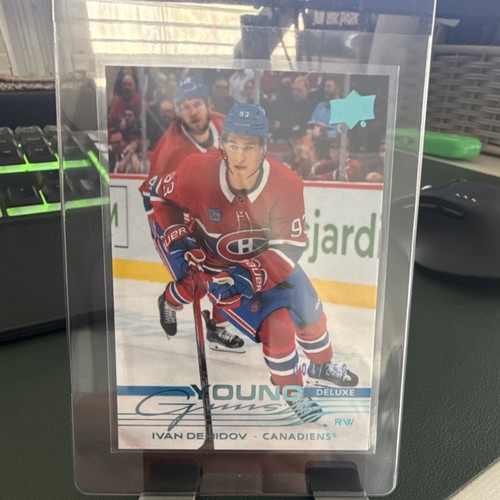 |
Ivan Demidov [Deluxe] #205 2025 Upper Deck |
$419.95 | $1,025 | 2.4× |
 |
Ivan Demidov #BL-16 2025 Upper Deck Bootleg |
$210.00 | $909.36 | 4.3× |
 |
Ivan Demidov [Blue Line] #110 2025 Upper Deck Allure |
$203.73 | $904.82 | 4.4× |
Look up any card's current raw and graded value in Midpoint — and get an estimated grade before you pay to submit.
Table of Contents
- Section 1: Understanding Ivan Demidov Rookie Cards and Their Value
- Section 2: Raw vs PSA 10 Pricing: What Drives Value?
- Section 3: Key Parallel Variants and Their Market Impact
- Section 4: Autograph and Numbered Insert Cards: Scarcity and Premiums
- Section 5: Set-by-Set Checklist: Upper Deck, MVP, Artifacts, and More
- Section 6: Grading Companies and Price Tiers for Ivan Demidov Cards
- Section 7: Recent Market Trends and Which Cards to Grade Now
Conclusion
FAQ
Section 1: Understanding Ivan Demidov Rookie Cards and Their Value
The Significance of Ivan Demidov's Young Guns Rookie Cards
Ivan Demidov's Young Guns rookie cards are a central focus for collectors interested in his hockey card market. Released primarily by Upper Deck, the Young Guns set captures the early stages of Demidov's professional hockey career and is generally considered desirable due to its association with rookie status. Collectors often seek these rookie cards because they can represent potential long-term value if the player’s career develops positively.
The "Young Guns" label has become a recognized term for rookie cards in hockey card collecting, similar to "Topps Rookie Cards" in baseball. This branding adds to their appeal. Market interest in Ivan Demidov’s Young Guns cards tends to remain steady, especially for cards in mint condition.
Identifying Base vs Parallel Rookie Cards
Understanding the different versions of Demidov’s rookie cards is important for collectors. The base rookie card is the most common variant, often mass-produced and widely available. Parallel versions typically have lower print runs and unique design features, which can increase their value.
Key parallel variants include:
- Base Rookie Card: The standard issue, usually the largest print run and lowest price point. Collectors should note that base cards may have condition challenges such as off-centering and surface wear.
- Outburst Red Parallel: Characterized by red foil accents and a more limited print run, often under 500 copies. These cards are sought after, especially when graded PSA 10.
- Clear Cut Parallel: Featuring transparent sections in the card design, these cards offer a unique look and are typically numbered, which can enhance collectibility.
- Deluxe and Exclusive Parallels: These variants often have additional foil stamping, numbering, or textural differences. They are usually produced in smaller quantities than base cards and can include serial numbering under 100, which may increase value.
Collectors should check print run numbers and serial numbers on the card backs, as these provide information about scarcity.
Ivan Demidov Rookie Card Value Overview
As of mid-2026, the average raw market value for the base Ivan Demidov Young Guns rookie card is approximately $25. This price varies depending on condition factors such as centering, surface quality, and corner sharpness. Cards with visible flaws tend to sell for less, while near-mint specimens with excellent centering can command higher prices in raw sales.
When professionally graded, particularly at PSA 10, the card’s value generally increases, often fetching around $125 or more. This premium reflects collector preference for top-tier condition and confidence in PSA’s grading standards.
To improve the chances of receiving a high grade and achieving top resale value, collectors should assess their cards carefully before submission. Important factors include:
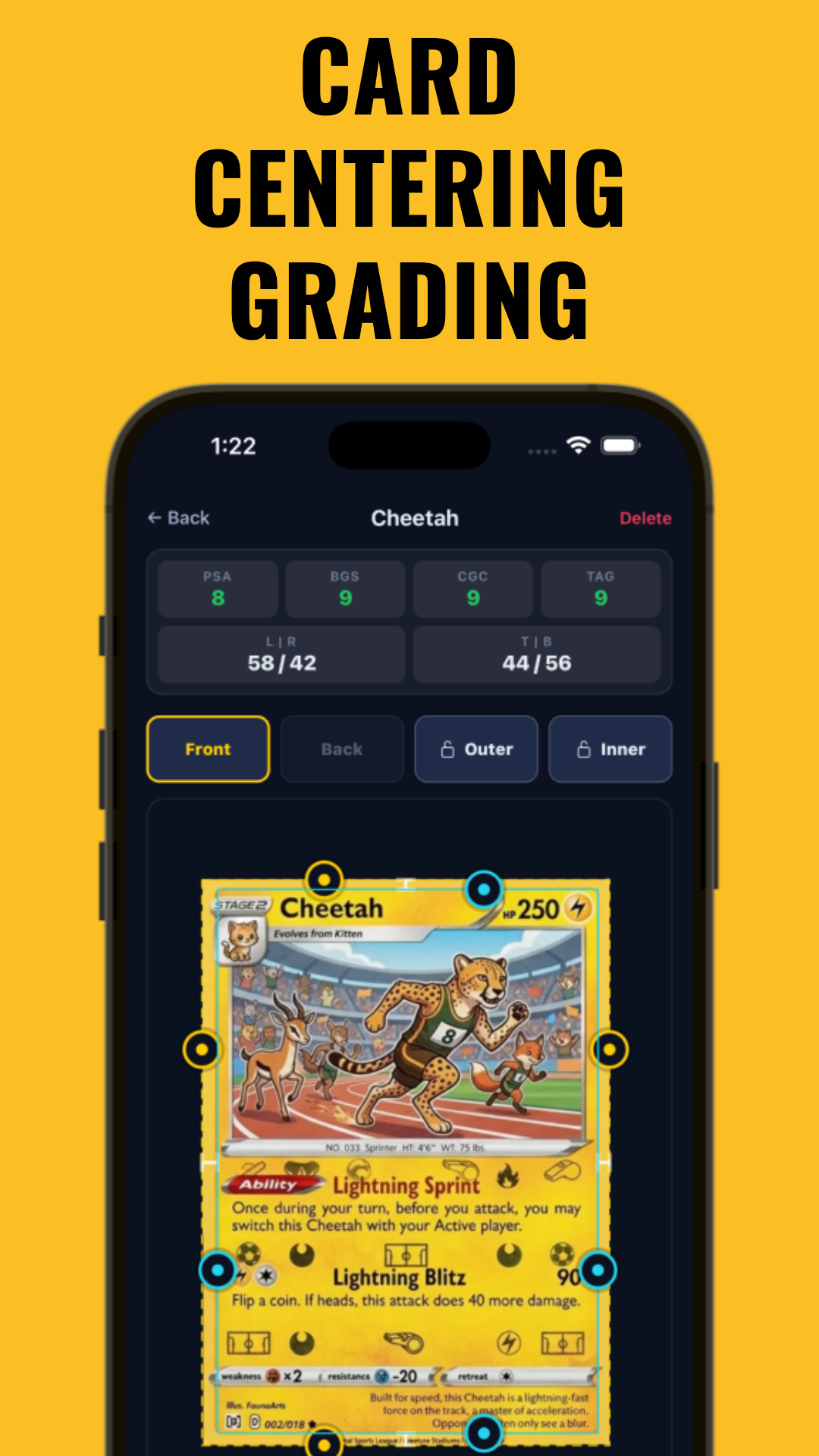
- Centering: Ideally, card borders should be centered within a 55/45 split or better. Tools like Midpoint’s AI can measure centering precisely, helping avoid submissions likely to grade below 10 due to poor centering.
- Surface Quality: Look for absence of scratches, print defects, or staining, as surface issues often reduce grades.
- Edges and Corners: Sharp, crisp edges and corners without dings or fraying are important for achieving PSA 10.
The Midpoint app offers a user-friendly interface to evaluate these factors objectively, providing a pre-grade estimate that can save time and money.
Section 2: Raw vs PSA 10 Pricing: What Drives Value?
Understanding Raw Card Pricing
Raw Ivan Demidov cards are those sold without professional grading. Their prices vary widely based on visual and physical condition. Factors influencing raw pricing include:
- Centering: Cards with off-center images or asymmetric borders generally have lower prices.
- Surface Condition: Scratches, print defects, or staining reduce value.
- Edges and Corners: Visible wear decreases desirability.
- Supply and Demand: Base rookie cards have a larger supply, which can suppress raw prices, while rare parallels often maintain higher raw values.
Typically, raw base rookie cards in good condition sell between $25 and $50, with higher prices for cards exhibiting excellent centering and flawless surfaces. Raw rare parallels can start at $50 and increase depending on scarcity.
The PSA 10 Premium Explained
PSA 10 grading indicates a nearly perfect card, with sharp corners, flawless surface, and good centering (usually 55/45 or better). Achieving this grade can be challenging, especially for older cards or those with printing inconsistencies.
Because PSA 10 cards are relatively scarce compared to the total number produced, the market often rewards them with significant price premiums. For Ivan Demidov, a PSA 10 Young Guns rookie card generally sells for around $125, which can be multiple times the raw market value. This premium reflects both scarcity and buyer confidence in card quality.
Other Grading Companies and Their Impact
While PSA is a leading hockey card grading company, alternatives like Beckett Grading Services (BGS), Sportscard Guaranty Corporation (SGC), and Certified Guaranty Company (CGC) offer options with varying standards and market perceptions.
- PSA 10: Highest demand and price premiums, widely regarded as the industry standard.
- BGS 9.5 Gem Mint: Comparable in quality to PSA 10 but often priced somewhat lower; BGS’s subgrading system provides detailed condition insight.
- SGC 10: Increasingly respected but generally trades below PSA 10 pricing; favored by some collectors for their black label aesthetics.
- CGC: Newer to sports cards but growing; pricing tends to be conservative relative to PSA.
Consulting detailed grading scale guides, such as the grading scale guide, can help collectors choose the best grading company for their Ivan Demidov cards. The choice often balances cost, turnaround time, and resale value.
Section 3: Key Parallel Variants and Their Market Impact
Outburst Red and High Gloss Parallels
The Outburst Red parallel is a notable variant within Ivan Demidov’s card portfolio. Featuring red foil accents and a limited print run—commonly estimated under 500 copies—these cards have collector appeal. Raw Outburst Red parallels often sell for higher prices than base rookie cards, while PSA 10 examples can command significant premiums, sometimes several times base PSA 10 prices.
High Gloss parallels, though more common than Outburst Red, also command premiums. Their reflective finish enhances visual appeal and typically leads to a price increase over base cards. Collectors appreciate these for their aesthetic quality and relative scarcity within a set.
Clear Cut, Deluxe, and Exclusive Variants
- Clear Cut Parallels: Featuring transparent card elements, these inserts have a distinctive look. Their rarity is often reinforced by numbering, sometimes under 250 copies, making them collectible. PSA 10 Clear Cut cards have sold in a range depending on set and demand.
- Deluxe Parallels: With enhanced design features such as foil borders and numbering, Deluxe parallels are usually limited to 100-200 copies. Their scarcity and design appeal to collectors, often leading to prices multiple times base rookie cards.
- Exclusive Parallels: Typically ultra-limited releases, sometimes fewer than 50 copies, and may be tied to special events or retail exclusives. Their market prices can be high in PSA 10 condition due to scarcity.
Numbered Inserts and Population Count Effects
Numbered inserts like Golden Treasures and Emerald Quad are among the more valuable Ivan Demidov cards. Golden Treasures, known for intricate designs and low print runs often below 100, command higher market prices. PSA 10 graded Golden Treasures inserts have sold within a range depending on specific numbering and condition.
Population counts—the number of cards graded at a particular level—can influence market value. Cards with fewer PSA 10 copies graded tend to command premiums due to scarcity. For example, if only a small number of Golden Treasures inserts have been graded PSA 10, collectors may bid more aggressively, pushing prices upward.
Conversely, parallels with higher population counts and more readily available PSA 10 copies tend to have more moderate price premiums. Monitoring population reports on grading company websites or third-party sites is useful for informed collecting and grading decisions.
Section 4: Autograph and Numbered Insert Cards: Scarcity and Premiums
Autograph Card Values
Autographed Ivan Demidov cards are among the rarer and more valuable items in his collection. These cards are limited in production and often feature on-card or sticker autographs authenticated by PSA or other grading companies. Autographed cards graded PSA 9 or PSA 10 can sell for prices multiple times those of non-autographed rookies or parallels.
For example, a PSA 10 autographed Outburst Red rookie parallel might sell for several hundred dollars, reflecting both autograph scarcity and demand. The autograph’s authenticity, clarity, and card condition all contribute to the premium.
Numbered Insert Cards and Their Market Dynamics
Numbered inserts such as Emerald Quad, Golden Treasures, and Population Count cards are prized for their low print runs and unique designs. Emerald Quad inserts, characterized by green foil and numbering, often have print runs below 100, enhancing their appeal.
- Golden Treasures: Known for intricate designs, often jewel-toned foils, and numbering typically under 100.
- Emerald Quad: Limited green foiling with numbering, often under 100 copies, boosting collector interest.
- Population Count: Cards that graph demographic statistics or player stats and are generally rare, sometimes limited to single digits.
Prices for these numbered inserts in PSA 10 condition have varied depending on the variant and demand. Scarcity is a key factor, with serious collectors willing to pay premiums for completing sets or securing rare parallels.
Section 5: Set-by-Set Checklist: Upper Deck, MVP, Artifacts, and More
Upper Deck Sets
Upper Deck is the primary manufacturer of Ivan Demidov cards, producing several key sets:
- Young Guns: This flagship rookie card set includes base and multiple parallels and remains a focus for Demidov collectors.
- Outburst: A premium set known for its glossy finish, vibrant colors, and numerous parallels including Outburst Red and autographed inserts.
- Artifacts: A high-end set featuring rare parallels and autograph variants, often with serial-numbered cards under 100 copies.
- Allure & Dazzlers: Sets focused on unique aesthetics, including refractors and parallels with specialty finishes.
MVP and O-Pee-Chee Sets
MVP offers a mid-tier card line with a mix of base and rookie cards, generally more affordable and widely available. O-Pee-Chee releases are notable for their classic design appeal, attracting vintage-style collectors. These sets include base cards, parallels, and numbered inserts that add collectible value.
Checklist Coverage and Tracking
Comprehensive collecting requires detailed checklists covering all base cards, parallels, and autographed inserts across these sets. Tracking serial numbers, print runs, and population counts is important for informed acquisition and grading decisions.
Digital tools like Midpoint help collectors maintain portfolios, monitor card values, and plan grading submissions effectively. Using such tools can help collectors capitalize on market opportunities and stay aware of emerging trends.
Section 6: Grading Companies and Price Tiers for Ivan Demidov Cards
PSA Grading and Market Leadership
Professional Sports Authenticator (PSA) is a leading hockey card grading company, and its grades are highly regarded among collectors and investors. PSA 10 graded Ivan Demidov cards generally command the highest prices, reflecting trust in PSA’s grading accuracy and consistency.
PSA 9 graded cards also have strong premiums over raw cards, although the value gap between PSA 9 and PSA 10 can be significant, sometimes 30-50% or more depending on demand.
BGS and SGC: Alternative Grading Options
Beckett Grading Services (BGS) is known for detailed subgrades covering centering, edges, corners, and surface. BGS 9.5 Gem Mint grades are comparable to PSA 10 but often sell for slightly less, reflecting market preference for PSA. SGC’s grading, while gaining popularity, is less common for Ivan Demidov cards and typically trades at a discount compared to PSA and BGS.
Grading Price Tiers Overview
- Raw cards: Usually priced between $20 and $50 based on condition.
- PSA 9: Strong demand with prices around $80 to $100.
- PSA 10: Top-tier prices ranging from $120 to $150 for base and rare parallels.
- BGS 9.5: Competitive but generally $90 to $110, slightly below PSA 10.
- Autographed PSA 10: Premium tier, often exceeding $300, influenced by autograph rarity and card condition.
Understanding these tiers is helpful for collectors deciding which cards to submit for grading and which grading company aligns best with their goals.
Pre-grading tools like Midpoint’s AI-based centering and condition analysis can improve submission strategies. By estimating grading outcomes, collectors can avoid costly submission fees for cards unlikely to achieve desired grades.
For more information on grading differences, see our detailed grading scale guide.
Section 7: Recent Market Trends and Which Cards to Grade Now
Trending Ivan Demidov Cards
As of 2026, market interest has focused on limited parallels and autograph inserts, with PSA 10 graded Outburst Red and Golden Treasures cards among the more sought-after. The rarity and distinctive designs of these cards attract both new collectors and seasoned investors.
Raw base rookie cards maintain relatively stable pricing but generally offer lower upside potential compared to scarce parallels and numbered inserts, which may appreciate more in favorable market conditions.
Best Ivan Demidov Cards to Grade for Investment
- Young Guns Rookie Base Card: Good candidates for grading when in near-mint condition with excellent centering, as PSA 10 premiums can be substantial.
- Outburst Red Parallel: High rarity and premium resale potential make them strong grading candidates.
- Golden Treasures Insert Cards: Numbered and scarce, these inserts have collector appeal and can fetch higher prices post-grading.
- Autographed Cards: Often worthwhile to grade due to autograph authentication and rarity, especially in PSA 10 condition.
Leveraging Technology for Grading Decisions
Before submitting cards for professional grading, which can cost $30 or more per card, collectors are advised to use digital pre-grading tools like Midpoint. This app uses AI to measure centering precisely and evaluate surface and edge condition, providing a reliable estimate of grading outcomes.
Using such technology can reduce the risk of low grades that diminish resale value and help collectors focus on cards with genuine top-grade potential. This approach supports cost-effective grading and maximizes investment returns in a changing market.
Conclusion
Ivan Demidov cards with notable market value primarily include his Young Guns rookie cards and the rare parallels and inserts associated with them. PSA 10 graded versions generally command higher prices than raw cards, with Outburst Red and Golden Treasures inserts among the premium segments. Autographed cards and numbered parallels further enhance value through scarcity and collector interest.
Collectors should prioritize condition and rarity when selecting cards to grade, and consider using advanced pre-grading tools like Midpoint to assess centering, surface, and edges before submission. Staying informed about population counts, grading company differences, and current market trends is important for making informed investment and collecting decisions.
For those building or refining an Ivan Demidov collection, understanding grading nuances, parallel variants, and set coverage is key to capturing value over time and navigating the evolving hockey card marketplace.
FAQ
Q: What is the most valuable Ivan Demidov card?
A: Some of the most valuable Ivan Demidov cards are PSA 10 graded Outburst Red and Golden Treasures numbered insert parallels, which have sold for $200 or more as of 2026. Autographed PSA 10 cards in these parallel sets can command higher premiums, sometimes exceeding several hundred dollars depending on rarity and condition.
Q: How much is an Ivan Demidov Young Guns rookie card worth?
A: A raw Ivan Demidov Young Guns rookie card averages around $25, with prices ranging from lower amounts for lower-grade examples to higher amounts for near-mint raw cards. A PSA 10 graded version typically sells for a premium, often around $125, reflecting higher value for top condition.
Q: Are Ivan Demidov cards worth grading?
A: Grading can increase value, especially for rookie cards and rare parallels. Cards graded PSA 10 or equivalent often sell for multiple times the value of raw cards. Using pre-grading tools can help identify cards with the best chance of achieving high grades and maximizing returns.
Q: Which Ivan Demidov parallels are rarest or most expensive?
A: Parallels such as Outburst Red, Golden Treasures, Emerald Quad, Clear Cut, and Exclusive numbered inserts are among the rarer and more valuable variants. Their limited print runs and unique designs contribute to collector demand and higher prices.
Q: What is the difference between Ivan Demidov base, Young Guns, and parallel cards?
A: Base cards are standard issues with the largest print runs and generally lower value. Young Guns are rookie cards associated with a player’s first year and often have higher value due to perceived potential. Parallels are variations with limited print runs featuring unique foil, numbering, or design elements that can increase rarity and value.
Q: How much did the first Ivan Demidov PSA 10 Young Guns sell for?
A: Early known Ivan Demidov PSA 10 Young Guns cards reportedly sold for around $120-$130, establishing a benchmark for top-grade rookie card pricing.
Free to start
Try the Midpoint app
Grade any card from a photo, see its raw and PSA 10 value, and track what your collection is worth — free.
Get it on iPhoneGet it on Android