Grading Scale Differences by Company: PSA, BGS, CGC & the True Meaning of Top Grades
Unpack grading scale differences by company: PSA, BGS, CGC. Compare Gem Mint vs Pristine, Black Label, and how centering shapes card grades. The ultimate collector's guide.

Estimated reading time: 14 min
Key Takeaways
- Grading scale differences by company can affect a card's value and collector appeal.
- Top grades like Gem Mint and Pristine have strict, documented requirements—especially for centering.
- PSA, BGS, and CGC each use distinct grading scales and subgrade systems, which can lead to varied outcomes for the same card.
- Understanding centering criteria is important for pre-grading and submission success.
- Tools like Midpoint can help collectors estimate centering before investing in grading fees.
Table of Contents
- Section 1: What Are Card Grading Scales?
- Section 2: PSA vs BGS vs CGC — Grading Scale Structures
- Section 3: The Top Grades — Gem Mint vs Pristine vs Black Label
- Section 4: Centering’s Role in Card Grading Differences
- Section 5: Subgrades, Labels, and the Path to a 10
- Section 6: How to Pre-Grade and Assess Your Card
- Conclusion
- FAQ
Section 1: What Are Card Grading Scales?
Defining Grading Scales
Trading card grading scales are numerical or descriptive systems used by professional grading companies to assess the physical condition of collectible cards. Most leading companies, including PSA, BGS, and CGC, use a 10-point scale (with sub-steps), but each organization defines its levels and criteria differently. Grading scales guide collectors, buyers, and sellers to evaluate a card’s condition and market value more objectively.
- PSA (Professional Sports Authenticator): Uses whole numbers 1–10, with half-point increments for some modern grades.
- BGS (Beckett Grading Services): Uses subgrades and half-point steps, enabling grades like 9.5 (Gem Mint), 10 (Pristine), and the rare Black Label 10.
- CGC (Certified Guaranty Company): Employs a 10-point scale, with both Gem Mint 10 and Pristine 10 (introduced in 2023), and subgrades similar to BGS.
Why Scales Differ by Company
Each grading company sets its own standards for what constitutes a particular grade. For example, PSA’s criteria for a “10” are different from BGS’s or CGC’s, notably in how they judge centering, corners, edges, and surface. This leads to grading scale differences by company that collectors should understand before submitting cards—or comparing values across slabs.
Impact on Collectors and Investors
The grade on the label isn’t just a number—it can directly influence value. A PSA 10 often sells for a premium over a BGS 9.5, but a BGS Black Label 10 can command higher prices than a PSA 10. Navigating these differences is important for maximizing returns and making informed buying, selling, or grading decisions.
Section 2: PSA vs BGS vs CGC — Grading Scale Structures
PSA’s Grading Approach
PSA uses a straightforward 1-to-10 scale, with 10 as Gem Mint and 9 as Mint. Half-point grades (e.g., 9.5) are used in newer submissions but are relatively rare. PSA does not provide subgrades. Their criteria for each level are documented and focus on centering, corners, edges, and surface, but centering is often a decisive factor for modern cards aiming for a 10.
- PSA 10 (Gem Mint): Virtually perfect; centering must be 55/45 or better on the front, 75/25 or better on the back.
- PSA 9: Minor flaws or slightly off-center.
BGS’s Grading Approach
BGS (Beckett) uses a 10-point scale with half-point increments and assigns four subgrades: centering, corners, edges, and surface. The final grade is calculated from these subgrades, which allows for greater granularity—and explains why a BGS 9.5 (Gem Mint) and BGS 10 (Pristine) can exist independently. BGS also offers the Black Label 10 for cards that score 10 in all subgrades.
- BGS 9.5 (Gem Mint): Centering 50/50 one way, 55/45 the other; essentially flawless.
- BGS 10 (Pristine): Must have three subgrades at 10 and one at 9.5 or better.
- Black Label 10: All four subgrades are perfect 10s.
CGC’s Grading Approach
CGC, a major player especially in Pokémon and TCG grading, uses a 10-point scale and now distinguishes between Gem Mint 10 and Pristine 10 (introduced in 2023). CGC offers subgrades as well. Their centering standards are strict and published, and their scale aligns more closely with BGS than with PSA.
- CGC 10 (Gem Mint): Comparable to BGS 9.5–10; centering must be at least 55/45 on the front, 75/25 on the back.
- CGC Pristine 10: Even stricter, with near-perfect centering and no visible flaws.
Company Differences in Practice
The same card can receive a PSA 10, BGS 9.5, and CGC 9.5, depending on how each company weighs flaws and centering. This makes it important to understand not just the number, but the standards behind it—especially for high-value submissions.
Section 3: The Top Grades — Gem Mint vs Pristine vs Black Label
Gem Mint vs Pristine: What’s the Difference?
The distinction between Gem Mint and Pristine is one of the most discussed topics in card collecting. "Gem Mint" denotes a card that is virtually perfect, yet allows for microscopic imperfections. "Pristine," however, is reserved for cards that are as close to flawless as physically possible.
- Gem Mint 10: Permits a single, extremely minor flaw visible only under magnification. Centering is strict but not always perfect.
- Pristine 10: No visible flaws, even under magnification; centering must be nearly perfect—often 50/50 or 55/45 at worst.
CGC Pristine 10 vs Gem Mint 10
CGC’s Pristine 10 is a step above their Gem Mint 10 and is harder to achieve. Pristine requires flawless corners, edges, and surface, plus tighter centering tolerances. Many cards that are Gem Mint at CGC or PSA would not reach Pristine.
- CGC Pristine 10: All subgrades 10, including centering at 50/50 or 55/45 max.
- CGC Gem Mint 10: Slightly softer criteria, but still demanding.
BGS Black Label vs Gold Label
BGS awards a "Black Label" 10 only if all four subgrades—centering, corners, edges, surface—are perfect 10s. This is considered the hardest grade to achieve in the hobby. The standard BGS 10 (Gold Label) allows for one subgrade as low as 9.5.
- BGS Black Label 10: The highest BGS grade; population is very low.
- BGS Gold Label 10: Three subgrades at 10, one at 9.5; still highly valued.
Which Grade Is Hardest to Get?
In practice, the Black Label 10 from BGS and the Pristine 10 from CGC are among the hardest to achieve, due to their strict standards for every subgrade, especially centering. PSA 10 is more attainable but still represents a small percentage of submissions. For more on how AI is reshaping these standards, see our AI-focused comparison of card centering analysis.
Section 4: Centering’s Role in Card Grading Differences
Why Centering Matters Most
Among all grading criteria, centering is often the most influential—and the most misunderstood. Centering refers to how evenly the card’s artwork is positioned within its borders. Even a pristine card with perfect corners and surface can be downgraded if centering is off.
- Centering is an objective measure—typically percentage-based (e.g., 55/45 means one border is 55% the size of the other).
- Each company publishes its own centering tolerances for each grade, with top grades requiring near-perfect alignment.
Documented Centering Standards
- PSA 10: 55/45 or better on the front, 75/25 or better on the back.
- BGS 10: 50/50 one way, 55/45 the other.
- CGC Pristine 10: 50/50 or 55/45 maximum deviation.
How Centering Decides the Top Grades
The difference between a PSA 10 and PSA 9 is frequently just a percent or two in centering. The same applies for BGS and CGC. Automated measurement with apps like Midpoint can quantify centering before you submit, helping avoid surprises.
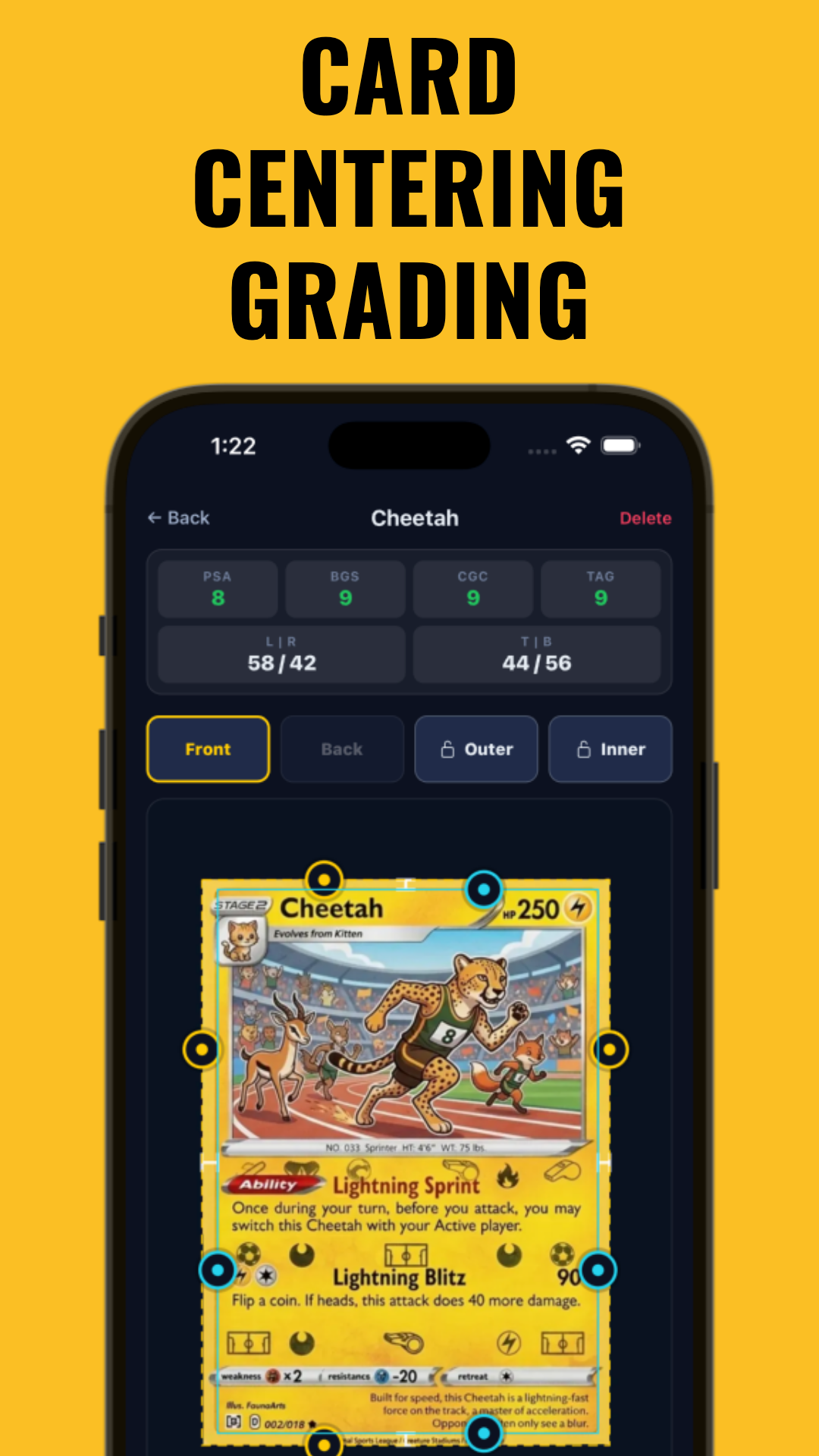
For a step-by-step breakdown on how to measure centering yourself, see our precision guide to card centering.
Section 5: Subgrades, Labels, and the Path to a 10
Understanding Subgrades
BGS and CGC provide subgrades for four categories: centering, corners, edges, and surface. Each subgrade is scored from 1–10. The overall grade is determined by a formula that weighs these subgrades, often with the lowest subgrade affecting the final result. PSA, in contrast, does not offer subgrades—so a single number must represent all flaws.
- Subgrades: Provide more transparency and allow for fine-tuned assessment.
- PSA’s single grade: Easier for market comparison, but less granular.
How Overall Grades Are Calculated
For BGS and CGC:
- If three subgrades are at or above a given level and one is .5 lower, the overall grade rounds down. E.g., 10/10/10/9.5 = 10; 10/9.5/9.5/9.5 = 9.5.
This makes it especially hard to achieve a pristine or Black Label grade, as even a single subgrade at 9.5 will drop a card to Gold Label or Gem Mint status.
Labels and Their Impact
- PSA 10 vs BGS 10: Not directly equivalent; BGS 10 is generally considered stricter, especially for centering.
- PSA 10 vs PSA 9: The price gap can be significant, making centering a key factor for value.
- BGS Black Label vs Gold Label: Black Label is much rarer—and more valuable—because all four subgrades must be perfect 10s.
Section 6: How to Pre-Grade and Assess Your Card
The Value of Pre-Grading
Pre-grading your card before submitting to PSA, BGS, or CGC can help you avoid unnecessary expenses and disappointment. Since grading fees can range from $20 to $100+ per card, and value can swing by hundreds or thousands of dollars depending on the grade, assessing your card’s true potential is important. Centering is the easiest to quantify and often the most limiting factor.
- Use a digital card centering tool like Midpoint to measure centering.
- Assess corners, edges, and surface visually and under magnification.
- Compare your findings to published company standards to estimate your likely grade.
Step-by-Step Pre-Grading Process
- Measure centering: Use a ruler, digital caliper, or centering app. Record the left/right and top/bottom percentages.
- Inspect corners: Look for nicks or whitening with a loupe.
- Check edges: Run a fingertip lightly along each edge for roughness or dings.
- Examine surface: Hold under angled light; look for scratches, print lines, or dents.
- Consult grading standards: Compare your results to PSA, BGS, or CGC documentation.
For hands-on guidance, check our step-by-step guide to pre-grading and our deep dive on card centering tools.
Estimating Outcomes and Making Decisions
- Submit only cards likely to achieve a grade that boosts value beyond grading fees.
- Use pre-grading results to decide which company’s scale best suits your card’s strengths (e.g., if centering is perfect but a corner is soft, BGS or CGC subgrades may be more forgiving than PSA).
Conclusion
Understanding grading scale differences by company is important for every serious card collector or investor. PSA, BGS, and CGC each have unique grading structures, centering standards, and definitions for Gem Mint, Pristine, and Black Label grades. Centering is often the deciding factor between a top grade and a downgrade, and differences between companies can lead to significant value gaps.
Use pre-grading methods and digital tools like Midpoint to measure your card’s centering and estimate its likely grade before submitting. Doing so can help you make more informed decisions for your collection. For more detailed explanations on how centering impacts value, see our detailed guide to centering and card value.
FAQ
Q: What does a job grade mean in a company?
A: In the card grading context, a "grade" is the score given to a card's condition by a grading company. Each company—PSA, BGS, CGC—defines its own grading scale, which collectors use to judge value and quality.
Q: Why do different companies use different grading scales?
A: Each grading company has developed proprietary standards and criteria for assessing cards, leading to differences in how grades are assigned and what each numerical grade represents. This enables competition and differentiation but can cause confusion when comparing grades cross-company.
Q: How is a pay grade different from a job grade?
A: In trading card grading, a "grade" refers specifically to the card's condition. "Pay grade" does not apply—however, grading companies do assign "tiers" or "labels" that represent the difficulty or value of achieving certain grades, much like job grades in a company structure.
Q: How many job grades do companies usually have?
A: PSA, BGS, and CGC all use roughly 10 numerical grades (1–10), with half-point increments in some cases. However, the meaning of each grade and the number of premium labels (like Black Label or Pristine) differ by company.
Q: How do job grades affect salary and promotions?
A: In card grading, the grade directly affects a card’s market value—higher grades (especially PSA 10, BGS 10, or Black Label) can command premium prices and may be considered the “promotion” for a card’s value in the collector marketplace.
Q: What is the difference between grading and performance rating scales?
A: In trading cards, a grading scale measures the physical condition of cards, while a performance rating scale would apply to employee evaluation. Card grading is about objective, published standards for condition, not subjective performance.
Free to start
Try the Midpoint app
Grade any card from a photo, see its raw and PSA 10 value, and track what your collection is worth — free.
Get it on iPhoneGet it on Android