Alliances MTG Cards Value: Complete Price Guide & Grading Insights
Discover the full Alliances MTG cards value guide with grading tips, top rares, PSA 10 prices, and which cards are worth grading or collecting.

Estimated reading time: 18 min
Key Takeaways
- Alliances MTG cards value varies widely by rarity, condition, and grading status, with nuances in market demand affecting pricing.
- Lake of the Dead and Force of Will are among the most valuable Alliances cards, often commanding premiums especially when graded.
- PSA 10 and other graded versions often command significant premiums over raw cards, sometimes 3-5x, but grading success depends heavily on centering and surface quality.
- Centering and condition critically impact Alliances price guide estimates, with millimeter-level precision influencing final grade and value.
- Use AI grading tools like Midpoint to pre-grade before submitting for costly professional grading, optimizing chances for high grades and avoiding unnecessary fees.
Card values — live data from Midpoint's card database, as of 2026-08-09. Prices move; Midpoint refreshes these daily.
| Card | Raw | PSA 10 | Gem premium | |
|---|---|---|---|---|
 |
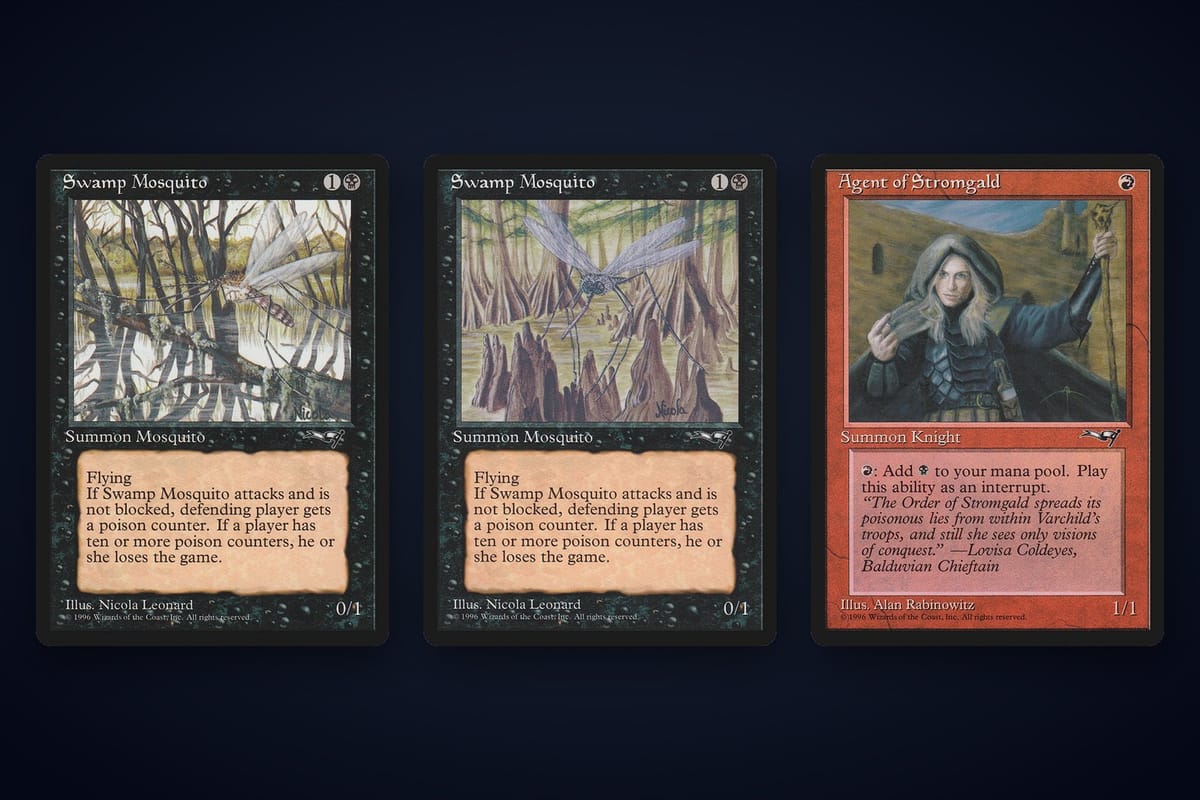
Swamp Mosquito #63a Alliances (1996) |
$0.14 | — | — |
 |
Swamp Mosquito #63b Alliances (1996) |
$0.13 | — | — |
 |
Agent of Stromgald #64a Alliances (1996) |
$0.22 | — | — |
 |
Agent of Stromgald #64b Alliances (1996) |
$0.15 | — | — |
 |
Balduvian Horde #65 Alliances (1996) |
$0.97 | — | — |
 |
Balduvian War-Makers #66a Alliances (1996) |
$0.12 | — | — |
 |
Balduvian War-Makers #66b Alliances (1996) |
$0.14 | — | — |
 |
Bestial Fury #67a Alliances (1996) |
$0.18 | — | — |
 |
Bestial Fury #67b Alliances (1996) |
$0.17 | — | — |
 |
Death Spark #70 Alliances (1996) |
$0.29 | — | — |
 |
Enslaved Scout #71a Alliances (1996) |
$0.15 | — | — |
 |
Enslaved Scout #71b Alliances (1996) |
$0.15 | — | — |
Look up any card's current raw and graded value in Midpoint — and get an estimated grade before you pay to submit.
Table of Contents
- Section 1: Overview of the Alliances MTG Set and Its Market
- Section 2: Most Valuable Alliances Cards and Their Price Dynamics
- Section 3: Graded vs Raw Values: Understanding the Gem Premium
- Section 4: Which Alliances Cards Are Worth Grading?
- Section 5: How Condition, Centering, and Print Variations Affect Value
- Section 6: Selling and Appraising Alliances MTG Cards Effectively
- Conclusion
- FAQ
Section 1: Overview of the Alliances MTG Set and Its Market
Historical Context and Set Details
Released in June 1996, Alliances is the second expansion in Magic: The Gathering's Ice Age block, following the Ice Age core set. With exactly 199 cards, it is considered a relatively modest-sized set compared to modern expansions which often exceed 300 cards. The set was designed to complement Ice Age's mechanics, introducing new cards that synergize with snow-covered lands and the concept of 'cumulative upkeep'.
Notably, Alliances includes mechanics such as 'Threshold' and 'Cumulative Upkeep' that were innovative at the time. The set also features artwork and design elements emblematic of the mid-90s Magic era, making it particularly attractive to vintage collectors. Several cards from Alliances are on the Reserved List, a policy by Wizards of the Coast intended to ensure that these cards will not be reprinted, which can affect their collectibility and value.
Market Landscape and Price Trends
The secondary market for Alliances cards is active but nuanced, with prices influenced by several factors including card rarity, condition, and grading status. Platforms such as TCGplayer and eBay provide a retail-focused marketplace where collectors and players can purchase cards at or near market value. On these platforms, prices tend to reflect final consumer willingness to pay.
Conversely, buylist prices—offered by dealers who purchase cards in bulk—are typically lower than retail listings to account for dealer overhead and resale risk. Hobby stores may offer intermediate prices, especially for high-demand cards. Market prices for Alliances cards have generally shown growth over time, particularly for Reserved List cards, driven by interest in vintage Magic and limited supply.
Set Composition by Rarity
- Rare: 65 cards, including notable staples like Force of Will, Lake of the Dead, and Dystopia.
- Uncommon: 60 cards which contain a mix of competitive and casual playables.
- Common: 74 cards, mostly bulk but with a handful of commons that see niche play or collector interest.
Understanding the rarity breakdown is important for collectors and sellers. For example, rares tend to hold most of the set’s monetary value due to scarcity and demand, while uncommons and commons typically have much lower prices unless part of specific decks or foil versions.
| Card Name | Rarity | Raw NM Price | PSA 10 Price |
|---|---|---|---|
| Lake of the Dead | Rare | $85 | $300 |
| Force of Will | Rare | $190 | $800 |
| Dystopia | Rare | $25 | $100 |
| Phyrexian Devourer | Rare | $15 | $60 |
Section 2: Most Valuable Alliances Cards and Their Price Dynamics
Top-Tier Rares Driving Set Value
The most valuable cards from Alliances are concentrated among its rare slot, with iconic cards such as Force of Will, Lake of the Dead, Dystopia, and Phyrexian Devourer leading the pack. These cards have competitive play relevance and historical significance, and some are on the Reserved List, which limits supply and can bolster their value.
As of mid-2024, raw near-mint (NM) copies of Force of Will are often priced around $190, making it one of the most valuable cards in the set by raw market price. When professionally graded to PSA 10, prices can be significantly higher, reflecting the premium collectors place on pristine condition and verified authenticity. This can represent a multiple increase over raw prices, underlining the importance of grading for high-end cards.
Price Behavior of Iconic Cards
- Lake of the Dead: This land card is sought after due to its Reserved List status and gameplay utility in certain deck archetypes. Raw NM copies usually sell for around $85, but PSA 10 copies can fetch higher prices. The supply of well-centered, flawless copies is limited, which can drive premiums.
- Dystopia: A powerful control card in black decks, Dystopia commands a raw NM price near $25. Grading can increase value for PSA 10 copies, demonstrating a premium. The card's appeal comes from both playability and its scarcity in top condition.
- Phyrexian Devourer: Though less expensive, this card also benefits from grading. Raw prices hover around $15, while PSA 10 copies can command higher prices. While a niche card, its value is stable due to its unique abilities and appeal among certain deckbuilders.
Value by Rarity Categories
While rares dominate the value spectrum, select uncommons and commons occasionally have market demand, especially if they are staples in popular decks or have limited print runs. For example, some uncommons that see tournament play may be valued between $5-$15 in raw NM condition. However, it is uncommon for uncommons or commons to justify grading expense unless they are near flawless and part of a sought-after collection.
Foil versions of cards can command higher prices, but Alliances did not include foil printings, limiting this avenue of value enhancement.
Section 3: Graded vs Raw Values: Understanding the Gem Premium
What Is the Gem Premium?
The term "gem premium" describes the price increase a card commands once it has been professionally graded and receives a top-tier grade, usually PSA 10, BGS 9.5/10, or CGC 10. This premium arises because collectors and investors place a higher value on cards with verified authenticity, condition, and centering, which reduces the risk of damage or misrepresentation.
For Alliances cards, the gem premium can be pronounced due to the set's age, rarity, and Reserved List status. The premium typically ranges from about 3 to 5 times the raw near-mint price, depending on the card and its demand.
PSA 10 Value Examples
- Force of Will: Raw NM price around $190 versus PSA 10 price near $800, approximately a 4x premium.
- Lake of the Dead: Raw NM $85 versus PSA 10 approximately $300, roughly a 3.5x premium.
Achieving PSA 10 is challenging, especially for older cards like those from Alliances. Grading companies scrutinize centering, surface wear, edges, corners, and potential alterations. Many cards receive sub-10 grades due to minor defects that may not be detectable without expert tools.
Using AI Grading Tools to Estimate Gem Potential
Because professional grading fees can range from $20 to over $100 per card depending on declared value and turnaround time, it's important to assess the likelihood of achieving a gem grade before submission. AI-powered tools such as Midpoint leverage computer vision and machine learning to analyze card images for centering accuracy, surface condition, and edge wear.
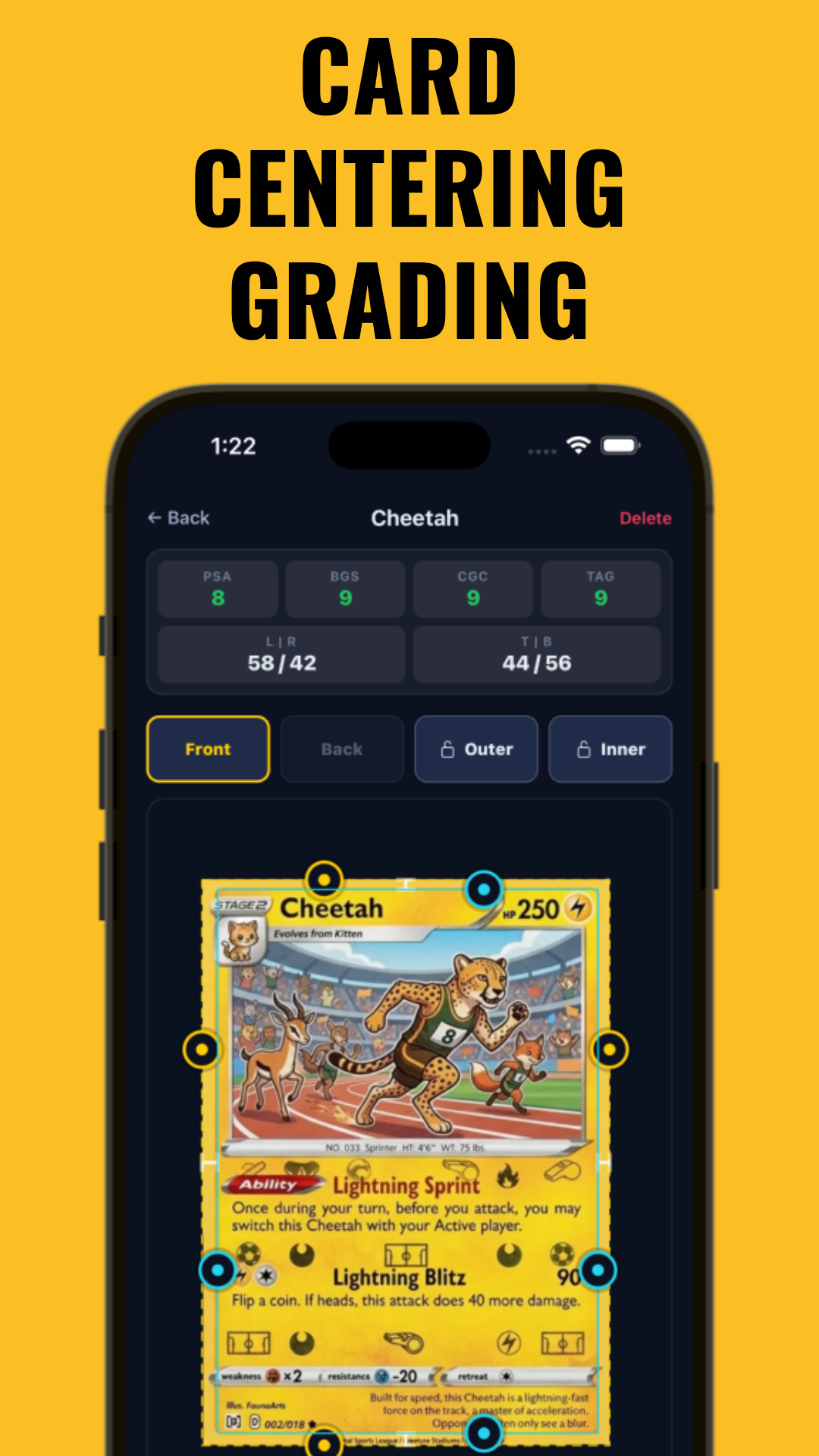
Midpoint's detailed centering measurement provides millimeter-level precision, allowing collectors to quantify whether their card's centering falls within the acceptable range for PSA 10 grades (generally under 5% offset on any side). Additionally, AI surface and edge analysis highlight potential scuffing, whitening, or scratches that could reduce grade. By pre-grading with Midpoint, users can avoid sending cards unlikely to reach gem mint status, saving grading fees and focusing on cards with the best value potential.
Section 4: Which Alliances Cards Are Worth Grading?
Criteria for Grading Investment
- Raw near-mint price above $20: Grading fees and shipping costs typically require a minimum raw value to make financial sense.
- Historical relevance or Reserved List status: Cards like Lake of the Dead retain value due to limited supply and collector interest.
- High demand and consistent price appreciation: Cards with stable or rising prices provide better return on grading investment.
- Good centering and minimal surface flaws: Cards that preliminarily appear well-centered and free from visible wear have higher chances of gem grades.
Cards Most Worth Submitting for Grading
- Force of Will: Given its raw value and strong gem premium, it is often worth grading, especially if the card is well-centered and has minimal surface wear.
- Lake of the Dead: Its Reserved List status and steady demand justify grading, particularly for copies that look visually flawless.
- Dystopia and Phyrexian Devourer: These cards can be profitable grading candidates if centering and condition are strong. Their gem premiums often exceed 3x raw value, making grading a reasonable investment.
When to Skip Grading
Commons and uncommons rarely justify grading unless they are part of a historically significant collection or in exceptional condition. For example, a common card with a raw value under $5 is unlikely to recoup grading fees even if graded PSA 10.
Poorly centered cards or those exhibiting visible surface scratches, whitening, or edge wear should generally be avoided for grading submissions. Grading companies often downgrade such cards, resulting in low grades that may not add value and could reduce resale price compared to raw.
For those interested in a step-by-step approach to pre-grading their cards, our How to Pre-Grade Your Card guide offers detailed techniques using AI tools and manual inspection methods.
Section 5: How Condition, Centering, and Print Variations Affect Value
The Role of Condition in Alliances Card Pricing
Condition is paramount in assessing card value. Near-mint (NM) cards, which show minimal wear and no visible damage, command the highest raw prices. Cards graded below NM, such as lightly played (LP) or moderately played (MP), can see value reductions of 30-50% or more. For example, a raw NM Force of Will might sell for around $190, whereas an LP copy could be closer to $120.
Even slight edge whitening, corner dings, or surface scratches can significantly reduce desirability among collectors focused on high-grade cards. This is why accurate condition assessment before sale or grading is critical.
Centering Impact Explained
Centering refers to the alignment of the card’s printed image within its borders, expressed as a percentage or millimeter offset. Grading companies prioritize centering heavily in their evaluation, as poor centering is one of the main reasons cards fail to achieve gem grades.
For Alliances cards, ideal centering is generally considered to be within 5% offset on all sides. Cards with centering outside this range typically receive a PSA 9 or lower grade, which reduces value compared to PSA 10. Midpoint's centering calculator uses AI to measure the exact offset on each side of the card, giving collectors objective data to help decide whether to submit for grading.
For example, a card with 2 mm offset on the left and 4 mm offset on the right is more likely to achieve PSA 10 than a card with 7 mm offset on one side. Even differences of 1-2 mm can influence grading outcomes.
Print Variations and Language Effects
Alliances cards were primarily printed in English, but some foreign language printings exist, including German and French versions. These foreign printings sometimes have collector interest in specific markets, potentially affecting value. However, English printings generally command the highest prices globally.
Additionally, verifying print authenticity and variant details is important. Misprints or printing errors can occasionally increase value but are rare in the Alliances set. Collectors should seek expert opinions or authentication services if unusual print characteristics are observed.
For an in-depth discussion on how centering influences card value and grading, refer to our specialized guide How Centering Impacts Card Value.
Section 6: Selling and Appraising Alliances MTG Cards Effectively
Appraisal Best Practices
Accurately appraising Alliances cards requires combining raw price data, grading status, and condition specifics. AI-powered tools like Midpoint provide instant grading estimates, centering analysis, and access to up-to-date pricing data from marketplaces such as TCGplayer and eBay. This data-driven approach allows sellers to set realistic prices and avoid underpricing or overpricing cards.
For example, a seller with a raw NM Lake of the Dead can use Midpoint to check centering and surface condition, then compare current PSA 10 auction prices to decide if grading or direct sale is preferable.
Choosing Where to Sell
- TCGplayer and eBay: These platforms are ideal for reaching collectors willing to pay premium prices. Sellers should factor in listing fees (typically 5-12%) and shipping costs.
- Buylist or Hobby Stores: Offer quicker sales with less hassle but often pay less than retail. This option suits sellers prioritizing speed over maximum value.
- Graded Cards Market: PSA 10 or BGS 9.5 graded cards often sell at a premium on specialized marketplaces such as PWCC or Goldin Auctions. However, sellers should be aware of grading and marketplace fees.
Packaging and Shipping Tips
When selling valuable Alliances cards, proper packaging is crucial. Use penny sleeves, top loaders or semi-rigid holders, and bubble mailers to protect cards during transit. Including tracking and insurance for high-value shipments reduces the risk of loss or damage and helps resolve disputes.
For detailed advice on protecting card value post-purchase, see our comprehensive How to Store Valuable Cards article, which covers temperature control, light exposure, and physical storage techniques.
Finally, Midpoint’s portfolio tracking feature helps sellers and collectors monitor value fluctuations over time, providing insights into optimal sale timing and collection management.
Conclusion
The Alliances MTG cards value landscape is nuanced, with top rares like Force of Will and Lake of the Dead driving much of the set’s worth. Understanding raw versus graded pricing, the gem premium, and the essential role of condition and centering can improve buying, selling, and grading decisions. Collectors who carefully evaluate centering and condition before investing in grading may maximize their returns.
Leveraging AI-powered tools such as Midpoint to pre-grade and track your collection’s value offers precise insights and confidence in market decisions. This empowers collectors and sellers to make informed choices and maximize returns from this historic 1996 set, preserving the legacy and value of Magic: The Gathering's Alliances expansion.
FAQ
Q: What is the most valuable card in Alliances?
A: Force of Will is among the most valuable Alliances cards, with raw near-mint prices around $190 and PSA 10 graded copies reaching higher prices as of mid-2024.
Q: How much is an Alliances Force of Will worth?
A: Raw near-mint Force of Will cards are often worth about $190, while PSA 10 graded versions can command significantly higher prices, reflecting a notable gem premium.
Q: How much is Lake of the Dead from Alliances worth?
A: Lake of the Dead typically sells for around $85 in raw near-mint condition and higher for PSA 10 graded copies, benefiting from Reserved List scarcity.
Q: How many cards are in the Alliances MTG set?
A: The Alliances set contains exactly 199 cards, including rares, uncommons, and commons.
Q: Are any Alliances Magic cards on the Reserved List?
A: Yes, several Alliances rares such as Lake of the Dead are on the Reserved List, which restricts reprints and supports value retention.
Q: What are the best Alliances cards to sell or collect?
A: The best cards to sell or collect are the higher-value rares like Force of Will, Lake of the Dead, Dystopia, and Phyrexian Devourer, especially in graded or gem mint condition.
Free to start
Try the Midpoint app
Grade any card from a photo, see its raw and PSA 10 value, and track what your collection is worth — free.
Get it on iPhoneGet it on Android