Limited Edition Beta MTG Cards Value: Ultimate Collector’s Guide
Explore the true value of Limited Edition Beta MTG cards, top collectibles, grading impacts, and price tips for raw vs graded cards.

Estimated reading time: 15 min
Key Takeaways
- Limited Edition Beta MTG cards have distinct value tiers influenced by rarity, condition, grading, and market dynamics.
- The most valuable Beta cards include Black Lotus, Moxen, dual lands, and Power Nine staples, each with unique demand drivers.
- Grading can significantly increase value, especially PSA 10 condition, but raw cards with strong centering and surface quality can also command premiums.
- Understanding print runs, card variations, and identifying genuine Beta cards is important for accurate valuation and avoiding counterfeits.
- Midpoint’s AI-based grading and centering tools provide useful pre-grade estimates to help maximize your investment and minimize grading submission risks.
Card values — live data from Midpoint's card database, as of 2026-07-11. Prices move; Midpoint refreshes these daily.
| Card | Raw | PSA 10 | Gem premium | |
|---|---|---|---|---|
 |
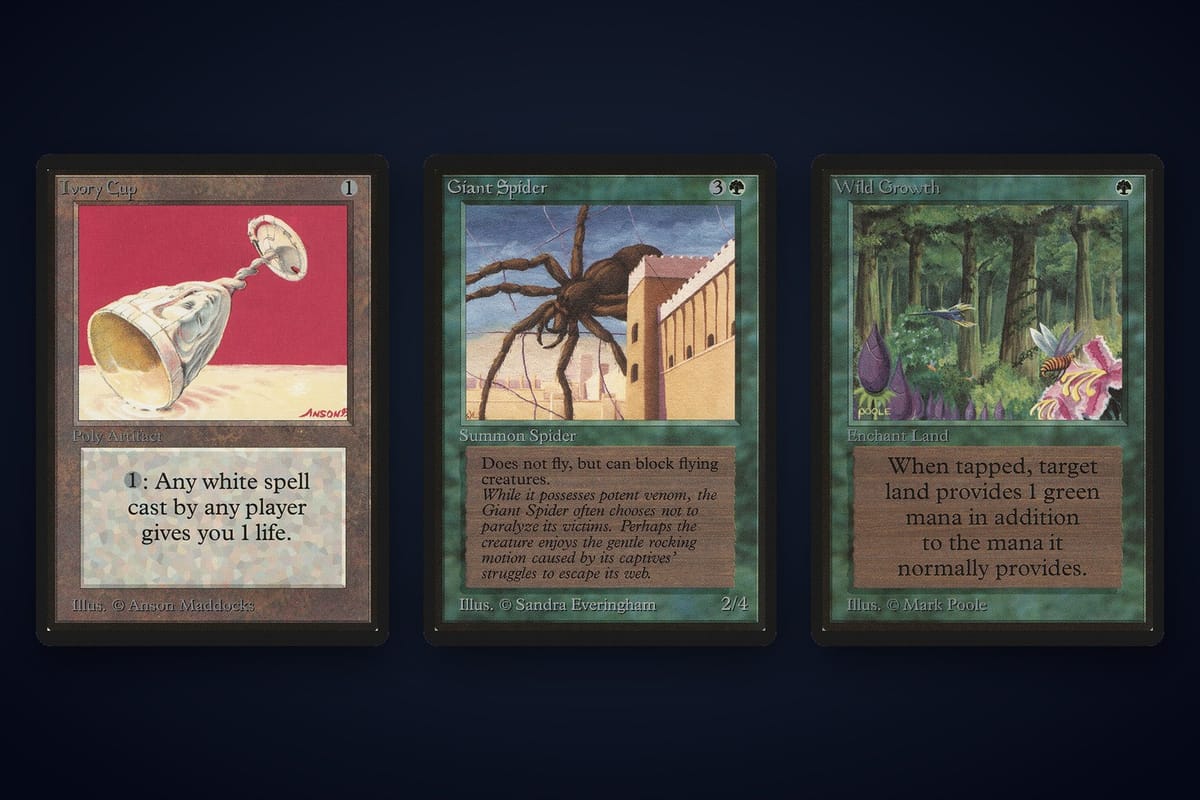
Ivory Cup #252 Limited Edition Beta (1993) |
$11.14 | — | — |
 |
Giant Spider #199 Limited Edition Beta (1993) |
$9.39 | — | — |
 |
Wild Growth #230 Limited Edition Beta (1993) |
$35.13 | — | — |
 |
Juggernaut #256 Limited Edition Beta (1993) |
$150.00 | — | — |
 |
Deathlace #102 Limited Edition Beta (1993) |
$74.98 | — | — |
 |
Crystal Rod #240 Limited Edition Beta (1993) |
$9.99 | — | — |
 |
Plains #288 Limited Edition Beta (1993) |
$23.83 | — | — |
 |
Power Leak #72 Limited Edition Beta (1993) |
$4.92 | — | — |
 |
Dragon Whelp #142 Limited Edition Beta (1993) |
$82.00 | — | — |
 |
Scavenging Ghoul #127 Limited Edition Beta (1993) |
$14.49 | — | — |
 |
Holy Strength #25 Limited Edition Beta (1993) |
$4.89 | — | — |
 |
Shatter #174 Limited Edition Beta (1993) |
$17.23 | — | — |
Look up any card's current raw and graded value in Midpoint — and get an estimated grade before you pay to submit.
Table of Contents
- Section 1: Understanding Limited Edition Beta MTG Cards Value
- Section 2: Most Valuable Limited Edition Beta Cards Explained
- Section 3: Grading Impact on Limited Edition Beta Cards Worth
- Section 4: Price Guide and Market Trends for Beta Singles
- Section 5: Comparing Beta with Alpha and Unlimited Editions
- Section 6: Identifying and Authenticating Limited Edition Beta Cards
Conclusion
FAQ
Section 1: Understanding Limited Edition Beta MTG Cards Value
The Historical Context of Beta MTG Cards
Limited Edition Beta cards, released in 1993 as Magic: The Gathering’s second print run, represent a critical era in collectible card history. Following the Alpha release, Beta was printed to meet demand and correct print errors, resulting in a much larger print run of approximately 300,000 copies per card, compared to Alpha’s estimated 1 million cards total but fewer per individual card due to smaller print runs. Beta retained many of Alpha’s iconic features, such as the black border and original card layout, but fixed issues like missing cards and card text errors, making it a more complete and accessible edition.
The "Limited Edition" label denotes the scarcity and early print nature, which influences the value collectors assign. Unlike later core or expansion sets, Beta's limited print run and historic significance have made it a cornerstone for collectors and investors alike, representing the earliest days of the game’s commercial success.
Why Beta Cards Command High Value
Several factors drive the limited edition beta mtg cards value upward, making these cards sought after in the secondary market:
- Print Run Scarcity: Beta had approximately 300,000 cards printed per card, which, while more than Alpha’s estimated 1 million total cards, is still small compared to later MTG sets often printed in the millions. This scarcity, combined with the passage of nearly three decades, means many cards have been lost, damaged, or remain in poor condition.
- Iconic Card Roster: The set includes some of the most sought-after cards like Black Lotus, Moxen, Time Walk, and the complete Power Nine—cards that have shaped competitive play and collector interest for decades.
- Condition Sensitivity: Cards from the early 1990s were printed on lower-quality cardboard stock compared to modern standards, making them prone to wear, edge chipping, and surface blemishes. This makes high-grade specimens relatively rare and valuable.
- Collector Demand and Nostalgia: As the second-ever MTG print run, Beta represents the formative years of the game. Collectors, investors, and nostalgic players prioritize these cards for their historical importance and gameplay impact.
- Market Dynamics: The secondary market has seen increasing prices over the years, influenced by the growth of MTG’s player base, the rise of graded card collecting, and the entry of institutional investors.
Raw vs Graded Value Dynamics
Understanding the price gap between raw (ungraded) and professionally graded cards is important for collectors and investors. Raw Beta cards with excellent centering, sharp corners, and minimal surface wear can fetch solid prices, often making them attractive to budget-conscious collectors. However, professional grading—especially PSA 10, which denotes gem mint condition—can multiply the card’s value by several times, depending on the card’s popularity and rarity.
For example, a raw Beta Black Lotus in near-mint condition might sell for tens of thousands of dollars, but a PSA 10 graded example can command significantly higher prices. This premium results from the grading company’s guarantee of authenticity and condition, which increases buyer confidence in high-value transactions.
Tools like Midpoint enable collectors to estimate grading outcomes by precisely measuring centering, edges, corners, and surface condition before investing in costly submissions. This can save both money and time by identifying which cards are likely to achieve higher grades and therefore justify grading fees.
| Card | Raw Value | PSA 10 Value | Value Increase Factor |
|---|---|---|---|
| Black Lotus | $50,000 | $250,000 | 5x |
| Mox Sapphire | $5,000 | $40,000 | 8x |
| Dual Land - Underground Sea | $1,500 | $12,000 | 8x |
| Time Walk | $4,000 | $35,000 | 8.75x |
Section 2: Most Valuable Limited Edition Beta Cards Explained
Black Lotus – The Crown Jewel
Black Lotus remains among the most valuable Beta cards and a centerpiece of collector interest. Its rarity, combined with its unique gameplay effect—providing three mana of any color for zero cost—makes it highly coveted. As of mid-2026, raw Beta Black Lotus cards typically retail around $50,000, but a PSA 10 graded card can command significantly higher prices, reflecting the condition premium due to the card’s fragility and iconic status.
Black Lotus has multiple variants, with the Beta edition particularly prized for its early print run and visual characteristics, such as its thicker black border and slightly different font weight. Due to the card’s age and high demand, PSA grading population reports indicate relatively few PSA 10 Beta Black Lotus cards exist, driving scarcity premiums.
The Power Nine: Moxen and Time Walk
The other Power Nine cards—Mox Sapphire, Mox Jet, Mox Pearl, Mox Ruby, and Mox Emerald—are among the most valuable Beta cards, prized for their gameplay utility and scarcity. PSA 10 values for these cards typically range from tens of thousands of dollars, with raw prices generally lower depending on condition.
For example, Mox Sapphire’s raw price is about $5,000, but grading can increase that by several times. Time Walk, another Power Nine staple, similarly shows a significant premium when graded, with raw values around $4,000 and PSA 10 values much higher. These cards' high value is sustained by their limited print run, strong demand from collectors and players, and the difficulty of finding pristine specimens.
Dual Lands and Other High-Value Beta Cards
Beta dual lands like Underground Sea, Volcanic Island, Tropical Island, Bayou, and Taiga are also highly sought after due to their utility in competitive play and limited availability. Raw copies generally start near $1,000 to $2,000, but PSA 10 examples often exceed $10,000, with certain lands like Underground Sea commanding premiums due to their demand in Legacy and Vintage formats.
Other notable Beta cards include Lightning Bolt, Wrath of God, and Serra Angel, which have solid value but less than the Power Nine. Collectors prioritize condition and centering, making these cards prime candidates for grading. Additionally, certain Beta misprints or error cards, such as cards with incorrect text or foiling, may command higher prices among niche collectors.
Section 3: Grading Impact on Limited Edition Beta Cards Worth
Why PSA 10 Is the Gold Standard
PSA 10 graded Beta cards represent near-perfect condition, which is exceptionally rare given the age and production standards of the early 1990s. Achieving PSA 10 requires flawless centering (typically within 55/45 to 60/40 ratio), sharp corners, clean edges, no surface scratches, and no staining or discoloration. This condition grade commands significant premiums because it guarantees collectors a pristine, investment-grade card.
For example, the PSA 10 value of Beta Black Lotus is over several times its raw counterpart, as collectors and investors prefer the encapsulation and grading company’s guarantee, which also protects against counterfeits and damage.
Other grading companies, such as Beckett Grading Services (BGS), Certified Guaranty Company (CGC), and Third-Party Authentication Group (TAG), also offer grading services, but PSA remains the most widely recognized and influential in the MTG marketplace.
Limited Edition Beta Cards Worth Grading
Not every Beta card benefits equally from grading. Generally, cards worth grading include:
- Power Nine and iconic staples: Black Lotus, Moxen, Time Walk, Ancestral Recall.
- High-demand dual lands: Underground Sea, Tropical Island, Volcanic Island, Bayou, and Taiga.
- Cards with visible centering or surface flaws raw collectors might overlook: grading certifies quality and can unlock higher market prices.
For lower-tier Beta cards, grading may not produce sufficient value uplift to justify the $30+ submission cost unless the card is truly pristine and has collectible appeal. Additionally, collectors should consider submission timing around grading company backlogs and market demand to maximize return on investment.
Using Midpoint for Pre-Grading Assessment
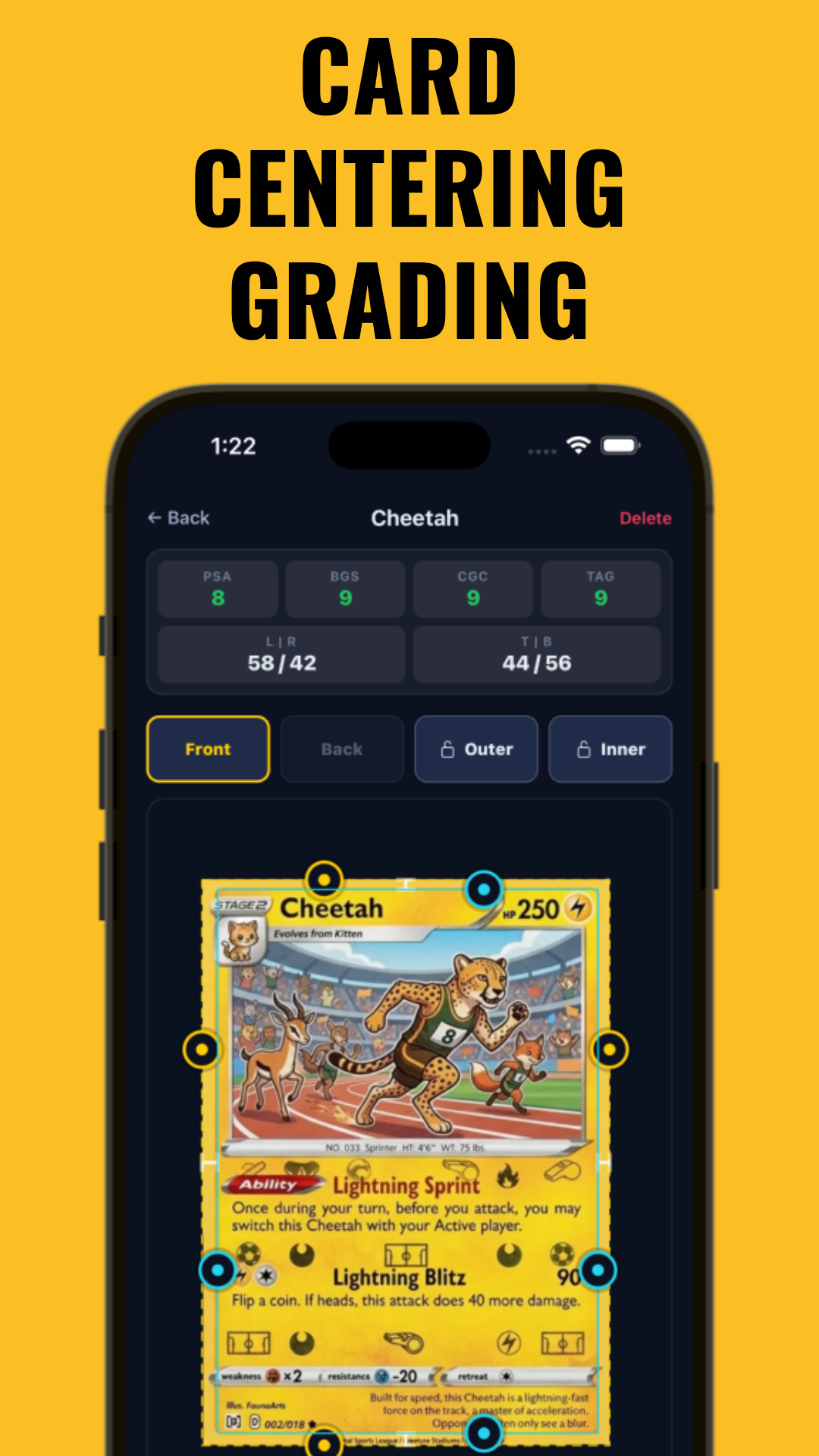
Midpoint’s AI-driven digital grading tool can measure card centering to the millimeter and analyze corners, edges, and surface wear to estimate PSA, BGS, CGC, and TAG grades instantly. This pre-grade insight helps collectors decide which Beta cards to submit, avoiding unnecessary fees on cards unlikely to reach top grades.
Midpoint applies advanced image recognition and machine learning algorithms trained on thousands of graded card images, enabling it to identify subtle flaws often missed by the naked eye. By uploading high-resolution scans or photos, users receive a detailed report including centering percentages, corner sharpness scores, edge wear indices, and surface condition assessments.
Learn more about how to pre-grade your card for smarter investments and how leveraging Midpoint’s tools can reduce grading risks and maximize returns.
Section 4: Price Guide and Market Trends for Beta Singles
Current Market Values as of 2026-07-11
Midpoint’s comprehensive database tracks over 250,000 cards, including detailed market prices for Beta singles sourced from auction results, private sales, and grading population reports. Here are some key figures to consider:
- Black Lotus: Raw $50,000, PSA 10 $250,000
- Mox Sapphire: Raw $5,000, PSA 10 $40,000
- Dual Land - Underground Sea: Raw $1,500, PSA 10 $12,000
- Time Walk: Raw $4,000, PSA 10 $35,000
These prices fluctuate with market demand, auction dynamics, and the condition spectrum, but the trend generally favors well-preserved, graded Beta cards. For instance, a PSA 9 Black Lotus might range between $120,000 and $160,000, reflecting a steep increase as cards approach gem mint condition.
Factors Influencing Price Changes
- Condition and Centering: Cards with better centering (e.g., 55/45 or better), sharp corners, and minimal surface wear command higher prices, often increasing substantially as grades improve.
- Grading Population Reports: Lower population of PSA 10 Beta cards increases scarcity premium. For example, the PSA population report shows relatively few PSA 10 Beta Black Lotus cards exist, making each sale a notable event that influences price.
- Sealed Product and Provenance: Sealed Beta booster boxes or packs, as well as cards with documented provenance or signatures from game designers or notable players, often fetch higher prices.
- Economic Factors and Market Sentiment: Broader economic conditions, MTG tournament popularity, and collector sentiment can impact prices, sometimes causing short-term volatility.
Using Price Guides and Market Trackers
Collectors are advised to use reliable price guides and market trackers like Midpoint’s app for real-time valuations and portfolio tracking. This helps in making informed buying, selling, and grading decisions by providing up-to-date sales data, historical price trends, and grading population insights. Setting alerts for key cards and monitoring market activity can help collectors time purchases or sales to optimize outcomes.
Section 5: Comparing Beta with Alpha and Unlimited Editions
Beta vs Alpha: Print Runs and Rarity
Alpha cards are the rarest, with approximately 1.1 million cards printed across the entire set but fewer copies per individual card due to smaller print runs and early production constraints. Alpha cards are distinguished by their truncated corners and slightly smaller size, making them physically unique and highly collectible.
Beta increased the print run to roughly 300,000 copies per card and fixed many of Alpha’s production errors, resulting in a more complete and accessible set. However, Beta cards maintain a significant premium over Unlimited cards due to earlier print date, higher demand, and historical significance.
For example, Alpha Black Lotus PSA 10 graded cards can sell for between $350,000 and $500,000, whereas Beta PSA 10 Black Lotus ranges between $200,000 and $300,000, and Unlimited PSA 10 versions typically fall between $50,000 and $100,000.
Why Beta Cards Are More Expensive Than Unlimited
- Card Border Thickness: Beta cards have unique thick black borders, prized by collectors for their visual appeal and rarity compared to the thinner black borders of Unlimited cards.
- Print Quality and Ink Differences: Beta cards exhibit distinct shading, ink saturation, and font weight due to different printing presses and processes used in 1993.
- Historical Significance: Beta represents the formative stage following Alpha’s experimental print run, and many collectors view Beta as the first "stable" print run, further enhancing its desirability.
- Physical Card Dimensions: Alpha cards have slightly smaller dimensions and rounded corners, while Beta cards have standard dimensions. Unlimited cards have thinner borders and a white set symbol, making Beta visually distinct and collectible.
Value Differences by Edition and Condition
While Unlimited cards can be valuable, Beta cards in raw mint or PSA 10 condition routinely sell for multiples of their Unlimited counterparts. For example, a Beta Black Lotus PSA 10 can be several times the value of an Unlimited Black Lotus in similar condition.
Condition plays a critical role: Unlimited cards are often found in poorer condition due to mass production and circulation, whereas Beta cards, being older and scarcer, often command higher prices even when raw. Grading further amplifies these differences, as PSA 10 Beta cards are significantly rarer than PSA 10 Unlimited cards.
Section 6: Identifying and Authenticating Limited Edition Beta Cards
How to Spot Genuine Beta Cards
Collectors must confirm Beta status by checking specific card features to avoid confusion or counterfeit risks. Key indicators include:
- Card Borders: Beta cards have black borders that are slightly thicker than Unlimited, approximately 2.5 mm instead of 1.8 mm, giving them a distinct visual weight.
- Set Symbol: Beta cards have no set symbol, while Unlimited cards feature a white circle set symbol on the right-hand side of the card’s type line.
- Card Text and Fonts: Beta uses the original 1993 typeface and wording, which can be compared to known authentic cards. Beta also uses the wording "Summon" instead of "Creature" on some cards, a telltale sign.
- Corner Rounding: Unlike Alpha cards which have more rounded corners, Beta cards have standard corner rounding similar to Unlimited but with thicker borders.
- Print Quality: The ink saturation and texture differ slightly from Unlimited, with Beta cards often appearing slightly darker and with richer colors.
Common Confusions and How to Avoid Them
Unlimited and other reprints can be mistaken for Beta cards, especially by inexperienced collectors. To avoid errors:
- Use trusted databases like Midpoint, which provide detailed images, measurements, and comparison tools.
- Consult professional grading services for authentication, especially if buying or selling high-value Beta cards.
- Use Midpoint’s precise centering calculator to identify genuine Beta centering characteristics, as Beta printing tolerances differ from Unlimited, often resulting in more consistent centering.
- Beware of counterfeit cards, which may have incorrect thickness, font differences, or altered borders. Comparing suspected cards to verified authentic Beta cards can reveal discrepancies.
Provenance and Signed Cards
Signed Beta cards or those with verified provenance may increase in value but require authentication to avoid fraud. Documentation such as certificates of authenticity, photos from signing events, or grading encapsulation with signature verification are key to maintaining value.
Collectors should also be aware that signatures can affect grading outcomes; some grading companies offer signature verification and will grade the card separately or with a "Signed" label, which can influence market value positively or negatively depending on the signer’s notoriety.
Conclusion
Understanding the limited edition beta mtg cards value requires a deep dive into rarity, condition, grading, and current market trends. The most valuable Beta cards like Black Lotus and the Power Nine command significant premiums, especially when graded PSA 10. Raw cards with solid centering and minimal wear also hold strong value, but grading amplifies collector confidence and price substantially.
Tools like Midpoint empower collectors to measure card centering and estimate grading outcomes accurately, helping them make informed investment decisions and avoid costly grading mistakes. Whether you’re buying, selling, or submitting Beta cards for grading, leveraging up-to-date price guides and pre-grade tools can help maximize returns while preserving these iconic pieces of Magic history for future generations.
FAQ
Q: How much is a complete Limited Edition Beta set worth?
A: As of mid-2026, a complete Limited Edition Beta set in raw condition can be valued in the hundreds of thousands of dollars depending on card condition, but fully graded PSA 10 sets can exceed $1 million given the premium on top-grade cards like Black Lotus and Moxen. Complete graded sets are extremely rare and highly prized due to the difficulty of grading every card at PSA 10.
Q: What is the most valuable Beta Magic card?
A: The Beta Black Lotus is among the most valuable cards, with raw copies around $50,000 and PSA 10 graded examples reaching significantly higher prices. Its gameplay impact and rarity make it the centerpiece of many Beta collections.
Q: Are Beta cards worth more graded or raw?
A: Beta cards are generally worth more graded, especially in PSA 10 condition, which can multiply raw values by several times for key cards. However, some raw cards with exceptional centering and surface quality may still command premiums in secondary markets.
Q: Why are Beta cards so expensive compared with Unlimited?
A: Beta cards have thicker black borders, earlier print runs, unique print quality, and historical significance that make them scarcer and more collectible than Unlimited cards, thus increasing their value.
Q: How can I tell if my Magic card is Beta?
A: Check for thick black borders, absence of a set symbol, and original 1993 font and text. Using Midpoint’s tools and consulting professional guides can help confirm authenticity. Additionally, comparing card dimensions and corner rounding can help distinguish Beta from Alpha and Unlimited.
Q: What is the value of a Beta Black Lotus?
A: As of mid-2026, raw Beta Black Lotus cards typically sell for around $50,000, while PSA 10 graded cards can command significantly higher prices, with values influenced by grading company population reports and auction results.
Free to start
Try the Midpoint app
Grade any card from a photo, see its raw and PSA 10 value, and track what your collection is worth — free.
Get it on iPhoneGet it on Android