How to Pre-Grade Your Card: A Step-by-Step Guide
Learn how to pre-grade your card accurately before grading submission. Get expert tips on measuring centering, estimating grades, and saving money.

Estimated reading time: 7 min
Key Takeaways
- Pre-grading your card helps avoid costly grading fees for lower-value cards.
- Card centering is a vital factor in PSA, BGS, CGC, and TAG grades.
- Accurate measurement tools, like Midpoint, improve your grading estimates.
- Knowing how to pre-grade gives you confidence and better submission choices.
Table of Contents
- Section 1: Why Pre-Grading Matters
- Section 2: Key Grading Criteria Explained
- Section 3: Step-by-Step: How to Pre-Grade Your Card
- Section 4: Tools and Techniques for Accurate Centering
- Section 5: Estimating Your Card's Grade
- Conclusion
- FAQ
Section 1: Why Pre-Grading Matters
Save Money and Make Informed Decisions
Learning how to pre-grade your card can save you from spending $30 or more on professional grading fees for cards unlikely to get a high grade. By evaluating your cards yourself, you make smarter decisions about which cards to submit for grading.
- Reduce wasted grading fees by filtering out cards with visible flaws.
- Prioritize your best cards for submission, maximizing ROI.
- Increase confidence in your collection’s value and authenticity.
Grading Standards Are Strict
Major grading companies like PSA, BGS, CGC, and TAG have strict standards. Subtle flaws in centering, corners, or surface can mean the difference between a 9 and a 10. Proper pre-grading helps you anticipate the likely outcome.
Section 2: Key Grading Criteria Explained
What Do Graders Look For?
Before learning how to pre-grade your card, it’s important to understand the main grading criteria:
- Centering: Are the card’s borders evenly spaced?
- Corners: Are they sharp or worn down?
- Edges: Are there chips, nicks, or whitening?
- Surface: Any scratches, print lines, or stains?
Centering: The Most Critical Factor
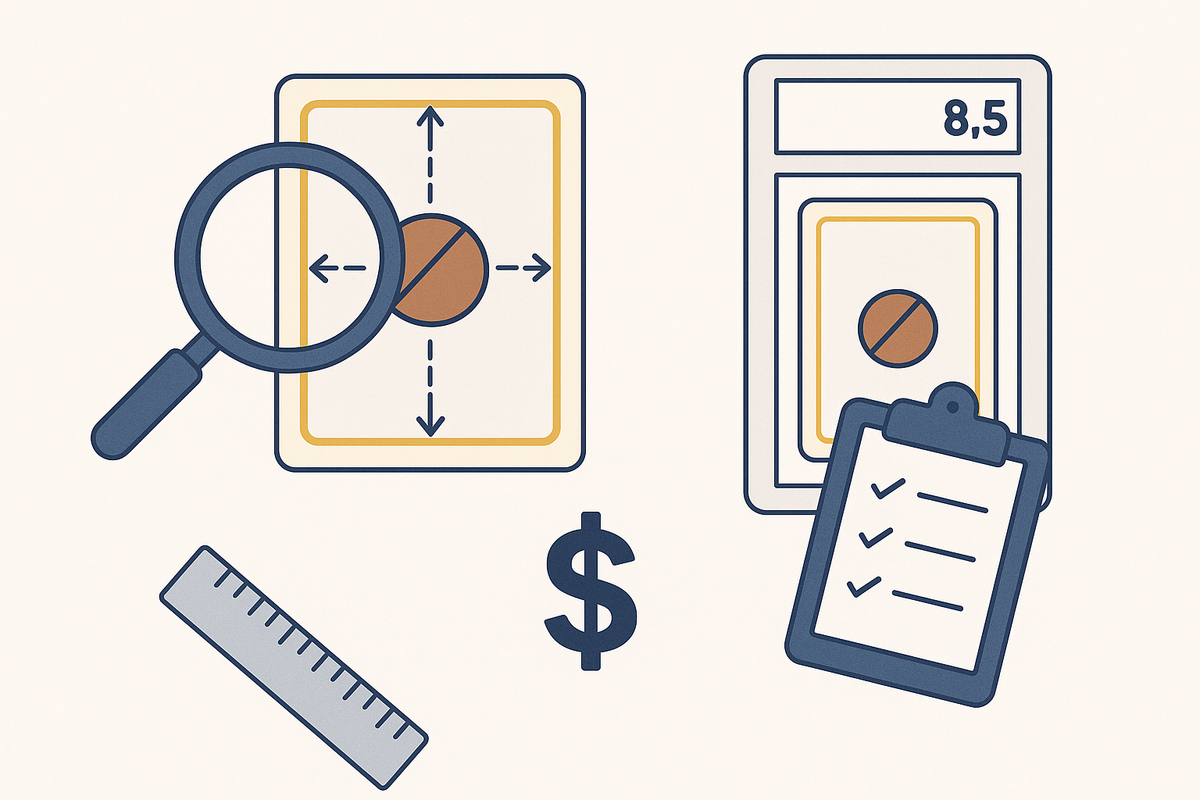
Centering is often the first thing graders check. Even small misalignments can significantly impact your grade. Most grading companies specify acceptable centering ratios for each grade level (for example, PSA 10 allows up to 55/45 centering on the front).
For a deeper look, read Card Centering Tool: Accurate Card Grading Estimates to learn how technology helps measure centering for more precise pre-grading.
Section 3: Step-by-Step: How to Pre-Grade Your Card
1. Inspect Your Card Under Good Lighting
Use a bright, natural light source and a magnifying glass. Look for surface scratches, print defects, or other imperfections.
- Hold the card at different angles to catch flaws.
- Check both the front and back thoroughly.
2. Evaluate Corners and Edges
Examine corners for any signs of whitening or dings. Inspect the edges for chips or wear, especially on older cards.
3. Measure Centering Accurately
Centering is best measured using millimeter-precise tools. Manual methods (rulers, calipers) can be tricky and error-prone. Digital tools like Midpoint let you upload a scan or photo and instantly analyze centering for PSA, BGS, CGC, and TAG standards.
- Upload your image to a card centering tool.
- Review the centering percentages and ratios for both front and back.
- Compare results against grading company guidelines.
4. Assign Preliminary Grades
Based on your inspection, assign a likely grade (e.g., PSA 9, BGS 9.5). Be conservative—professional graders rarely round up.
Section 4: Tools and Techniques for Accurate Centering
Manual vs. Digital Centering Checks
Traditional tools (rulers, calipers) can help, but require steady hands and precise alignment. Digital apps like Midpoint measure centering down to the millimeter and output instant grading estimates. This reduces human error and saves time.
Benefits of Using a Card Centering App
- Instant results – no need for guesswork.
- Multi-grader estimates – see how PSA, BGS, CGC, and TAG would assess your card's centering.
- Objective analysis – removes personal bias from the process.
If you want to understand how AI is transforming card centering analysis, check out this detailed comparison of AI-powered grading tools.
Section 5: Estimating Your Card's Grade
Compare Against Grading Standards
Once you’ve inspected your card and measured centering, compare your findings against the published standards for each grading company. Pay special attention to centering ratios, as even a minor deviation can mean a lower grade.
- PSA 10: Centering must be 55/45 or better on the front.
- BGS 9.5: Centering must be 50/50 one way and 55/45 the other.
- CGC: Similar strict standards for both front and back.
Make Your Submission Decision
If your card meets or exceeds the standards for your target grade, it’s likely worth submitting. Otherwise, consider keeping it raw or selling it as-is.
Using a tool like Midpoint gives you instant feedback and helps you make the most informed decision before spending on grading.
Conclusion
Knowing how to pre-grade your card is essential for any serious collector or seller. By carefully inspecting your card’s condition, measuring centering with precision, and comparing your findings to grading standards, you can avoid unnecessary grading fees and maximize your collection's value. Consider incorporating digital tools like Midpoint for fast, objective, and millimeter-accurate centering analysis to further improve your pre-grading process.
FAQ
Q: What is the most important factor when pre-grading a card?
A: Centering is often the most critical factor, as it heavily influences the final grade from companies like PSA and BGS.
Q: Can I pre-grade my card without any special tools?
A: While manual inspection is possible, using a digital tool like Midpoint ensures accurate centering measurements and helps estimate grades more reliably.
Q: How close are pre-grades to actual grader results?
A: Pre-grades are estimates, but with precise measurements and careful inspection, they can closely match professional grades—especially when using advanced tools.
Free to start
Try the Midpoint app
Grade any card from a photo, see its raw and PSA 10 value, and track what your collection is worth — free.
Get it on iPhoneGet it on Android