Manufacturing Variances in Card Centering: Causes, Impacts, and Control Strategies
Explore the causes, impacts, and control strategies for manufacturing variances in card centering to improve consistency and reduce scrap.

Estimated reading time: 8 minutes
Key Takeaways
- Card centering ensures border equality for aesthetic quality and functional reliability.
- Variances arise from equipment misregistration, material inconsistencies, and environmental factors.
- Off-center cards can lower grades, increase scrap, and harm brand reputation.
- Implementing SPC, preventive maintenance, and vision systems can minimize miscentering.
- Advanced alignment tools and operator training are critical for consistent yields.
Table of Contents
- Introduction
- Background on Card Centering
- Manufacturing Variances Defined
- Impact of Variances
- Control Strategies and Technologies
- Practical Implications
- Conclusion
Introduction
Manufacturing variances in card centering represent the subtle shifts in printing and cutting that misalign images relative to a card’s edges. Whether it’s artwork, text, or a magnetic stripe, perfect centering delivers equal borders and a polished result. Yet small deviations can lead to off-center borders—and significant downstream issues.
Why centering matters:
- Aesthetic quality: Uniform visuals across batches enhance perceived value.
- Grading outcomes: Off-center trading cards often receive lower third-party grades.
- Functional reliability: Payment and ID cards require precise chip and stripe placement.
- Brand perception: Misaligned logos erode consumer trust.
Background on Card Centering
At its core, card centering measures border equality around a printed or functional feature. Grading ratios—from 50/50 ideal to 60/40 visible shifts—define tolerance bands in the industry. Key production steps impacting centering include:
- Printing registration on large sheets.
- Sheet alignment in cutting equipment.
- Die-cutting or shearing to final dimensions.
- Post-processing like embossing and foil stamping.
For a step-by-step guide on measuring centering, collectors and manufacturers can refer to this resource.
Manufacturing Variances Defined
Variances occur when actual output diverges from design specs. In card centering, these manifest as misregistration during printing, drift in cutting, or material distortions:
- Dimensional variances: Changes in length, width, or thickness.
- Positional variances: Print-to-cut registration errors.
- Process drift: Tool wear and thermal expansion over time.
- Material inconsistencies: Warping or moisture-induced shrinkage.
- Tolerance stack-up: Accumulated deviations across steps.
Factors such as equipment calibration, material quality, operator setup, and environmental conditions all contribute to centering variance.
Impact of Variances
Even a 0.2 mm shift in printing plus 0.2 mm in cutting yields a 0.4 mm offset, turning a perfect 50/50 card into a visible 60/40 misalignment. Real-world data confirms centering as the #1 grade-limiting factor in trading cards. Consequences include:
- Reduced yield of premium-grade cards beyond 55/45 thresholds.
- Increased scrap and rework costs—cards cannot be recut.
- Lower brand perception and collector dissatisfaction.
- Functional failures in payment/ID cards when encoded elements misalign.
Control Strategies and Technologies
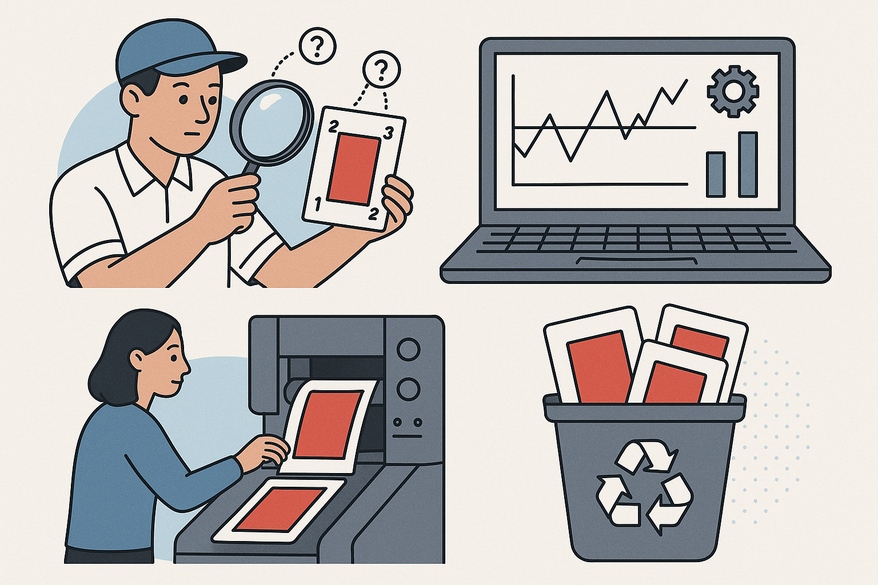
Manufacturers minimize variances by combining process discipline with advanced technology:
- Standardized setup using optical alignment tools and test sheets.
- Preventive maintenance of bearings, dies, and cutting blades.
- Defined centering specifications (e.g., ±0.2 mm or ≥55/45 ratio).
- Operator training on interpreting registration marks.
- Incoming material checks for squareness and flatness.
- In-process sampling with digital vision systems.
- SPC charts to track centering metrics and trigger adjustments.
Watch the Card Centering Tool in action below:
Practical Implications
Across industries, centering standards ensure consistency:
- Trading card producers aim for ≥55/45 thresholds with inline vision inspection.
- Payment/ID manufacturers use precision punching and camera feedback for chip alignment.
- Emerging AI-driven analysis moves centering QA from labs to production floors.
- Tighter grading criteria (e.g., PSA 55/45–60/40 front) increase demand for closed-loop controls.
Tips for manufacturers:
- Document centering specs aligned with grading or performance standards.
- Invest in maintenance schedules and calibration.
- Implement SPC and automated vision for early detection.
- Train operators with visual examples of acceptable vs. unacceptable centering.
- Use tiered quality classifications to optimize yield and pricing.
Conclusion
In summary, manufacturing variances arise from equipment, process, material, and human factors. These shifts impact card centering ratios, directly affecting grading, functionality, and brand image. By setting clear specifications, maintaining equipment, applying in-process inspection (including AI vision), and training operators, manufacturers can significantly improve yield and quality.
Call to Action: Compare your internal centering specs to grading guidelines like 55/45 and 60/40. Adopt standardized alignment, SPC monitoring, and advanced inspection tools to boost quality and reduce scrap.
FAQ
What is an acceptable centering ratio for trading cards?
Top grades usually require centering within 55/45 or better on the front and around 75/25 on the back. Ratios beyond 60/40 generally see lower premium.
How often should equipment calibration be performed?
Preventive maintenance and calibration are recommended at regular intervals—often weekly or after significant run changes—to prevent drift in registration and cutting accuracy.
Can automated vision systems replace manual inspection?
Yes, automated vision and AI-driven solutions provide consistent, real-time centering analysis, reducing reliance on manual checks and improving throughput.
What materials tend to cause the most centering issues?
Materials prone to warping or moisture absorption, such as certain PVC or composite cards, can introduce unpredictability in both printing and cutting alignment.
Free to start
Try the Midpoint app
Grade any card from a photo, see its raw and PSA 10 value, and track what your collection is worth — free.
Get it on iPhoneGet it on Android