Mastering High-Volume Grading Centering Strategies for Precise Card Centering
Explore advanced high-volume grading centering strategies to achieve precise card centering and optimize grading efficiency with cutting-edge techniques.

Estimated reading time: 8 minutes
Key Takeaways
- Precise centering measurement directly caps a card’s maximum grade and impacts its market value.
- Advanced methods—digital pixel-based measurement, centering apps, and AI scanners—boost accuracy and throughput.
- Implementing standardized protocols, proper tools, and continuous QC ensures consistent grading at scale.
Table of Contents
- 1. Understanding Card Centering in High-Volume Grading
- 2. Overview of High-Volume Grading Centering Strategies
- 3. Advanced Methods for Precise Card Centering
- 4. Implementation Best Practices
- 5. Case Studies and Examples
- FAQ
1. Understanding Card Centering in High-Volume Grading
What is card centering?
Card centering—also called image positioning or border alignment—is the ratio of the printed image’s distance from two opposite borders. Grading companies express each axis as a sum-to-100 ratio: for example, 60/40 means one side is 60% of the total width and the opposite side is 40%. Perfectly centered is 50/50. For more, see how to read centering ratios for PSA grades and A Guide to Centering.
Why precise centering matters
- Caps the highest possible grade: PSA 10 front requires roughly 55/45 to 60/40 or better; back must meet about 75/25.
- Off-center cards receive qualifiers like OC (Off-Center) or MC (Miscut), reducing value.
- Influences submission strategy—pre-screening ensures you send only cards with a shot at top grades.
Common high-volume challenges
- Visual fatigue from endless eyeballing of millimeter differences.
- Inconsistent judgments among graders without clear reference tools.
- Speed vs. accuracy trade-off when using rulers or eyeballing.
- Variability in card designs, border colors, and print breaks.
- Spot-checking and quality control difficulties at scale.
2. Overview of High-Volume Grading Centering Strategies
Standard methods:
- Visual guides with 55/45, 60/40, 70/30 templates for rough estimation.
- Manual rulers or calipers to measure border widths, then convert to ratios.
- Plastic overlay centering tools with gridlines to compare symmetry.
Advanced methods:
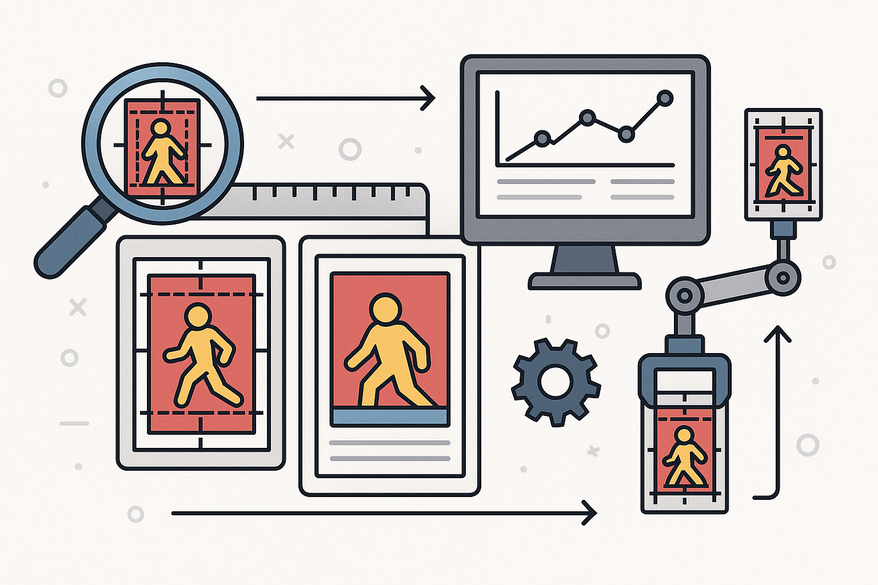
- Digital measurement: scanning cards at fixed resolution and measuring in pixels. See optimizing centering accuracy.
- Centering apps with automatic detection and ratio output.
- AI-powered scanners that flag cards below predefined centering thresholds.
3. Advanced Methods for Precise Card Centering
Technique A: Digital pixel-based measurement
- Scan cards at a fixed dpi or use a high-res camera under controlled lighting.
- Detect card edges and artwork boundaries using software.
- Compute ratios: Left ratio = left_border / (left_border + right_border) × 100; Top ratio = top_border / (top_border + bottom_border) × 100.
Technique B: Dedicated centering calculators/apps
- Apps auto-detect edges and output centering ratios. For more, see automated card-centering analysis.
- Map ratios to PSA-equivalent grade caps.
Technique C: Professional centering templates/tools
- Physical overlay templates with marked percent lines.
- Align on the worst axis, read ratio, cross-reference grading limits.
Technique D: AI/computer-vision systems
- Train AI on labeled card images to learn border measurements.
- Deploy scanners that flag cards below target ratios.
- Integrate with pre-screening to route rejects before manual grading.
4. Implementation Best Practices
Step 1: Define centering standards
- Reference PSA’s official thresholds by grade.
- Decide internal tiers (e.g., premium submissions require ≥ 60/40 front).
Step 2: Standardize measurement protocol
- Measure each side at two points, record the worst value per axis.
- Use the worst axis for final centering caps.
Step 3: Select and validate tools
- Physical tools: train graders on consistent use of templates and overlays.
- Digital tools: calibrate apps/software against expert-measured cards.
Step 4: Integrate into grading workflow
- Pre-screen obvious off-center cards automatically or with junior staff.
- Escalate borderline cases to senior graders.
- Require centering data input before final grade issuance.
Step 5: Train graders with visual references
- Provide side-by-side images of cards at 55/45, 60/40, 70/30, labeled with max grades.
Step 6: Establish QC and continuous feedback
- Randomly re-measure a sample of graded cards to check consistency.
- Track inter-grader and grader–software variance.
- Retrain or recalibrate when drift exceeds tolerance.
5. Case Studies and Examples
Case Study 1: Mobile app pre-screening
- A large submitter uses the Card Centering Calculator app at intake; cards below 60/40 front or 75/25 back are auto-rejected.
- Result: submission pool quality improved and grader time dropped by 30%.
Case Study 2: Internal centering tool at a grading house
- A firm builds a web tool to ingest scans, run pixel-based measurements, and compute ratios.
- Result: inter-grader disagreement fell from 15% to under 3%, and throughput rose 20%.
FAQ
- What centering ratio qualifies for a PSA 10?
A front centering of roughly 55/45 to 60/40 or better, with the back around 75/25. - How can I automate centering measurements?
Use digital solutions like pixel-based scanning or centering apps that auto-detect edges and output ratios. - How often should I recalibrate tools?
Perform quality checks regularly and recalibrate whenever inter-grader variance exceeds tolerance.
Free to start
Try the Midpoint app
Grade any card from a photo, see its raw and PSA 10 value, and track what your collection is worth — free.
Get it on iPhoneGet it on Android