Optimize Card Centering Accuracy: Advanced Methods for Precision
Learn advanced methods to optimize card centering accuracy using digital tools, AI analysis, and more to achieve perfect card alignment and grading precision.


Estimated reading time: 7 minutes
Key Takeaways
- Embrace digital and AI-driven tools for sub-millimeter centering precision
- Standardize workflows and calibrate equipment to ensure consistent results
- Automate border detection and scoring based on PSA, BGS, or CGC standards
- Integrate centering checks into broader quality control processes
- Leverage real-world case studies to optimize operations and reduce grading disputes
Table of Contents
- Understanding Card Centering Accuracy
- Advanced Techniques to Optimize Card Centering Accuracy
- Traditional vs. Advanced Methods
- Digital Microscopy & Measurement Systems
- AI-Powered Centering Tools
- Dedicated Centering Calculator Apps
- Internal Software & Scoring Systems
- Step-by-Step Implementation
- Best Practices and Tips
- Case Studies and Real-World Applications
- Professional grading operation
- Collector pre-grading with AI tools
- Three-border design handling
- Conclusion & Additional Resources
- FAQ
Understanding Card Centering Accuracy
- Define “card centering accuracy”
– Comparison of opposite edge margins (left vs right, top vs bottom)
– Expressed in centering ratios (e.g., 50/50, 55/45, 60/40) (See A Step-by-Step Guide for Collectors) - Why precision matters
– Visual quality & brand consistency
– Grading & monetary value for trading cards
– Production efficiency & waste reduction - Common challenges
– Printing inconsistencies & variable frame widths
– Human visual limitations
– Card rotation and skew
– Camera and lens distortion
– Partial-border and bleed-edge designs
Advanced Techniques to Optimize Card Centering Accuracy
Traditional vs. Advanced Methods
- Traditional methods
– Eyeballing by sight; highly subjective
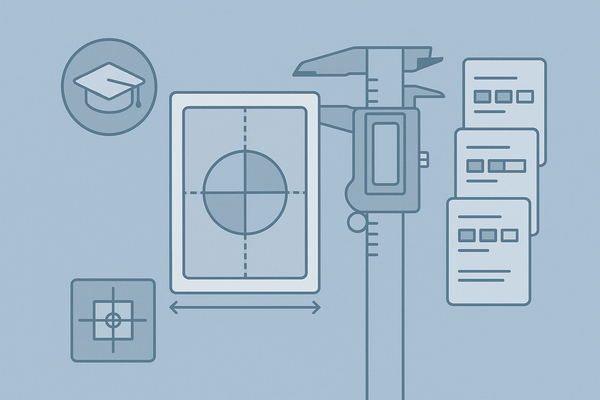
– Rulers/calipers for manual border measurement
– Printed or acrylic overlay templates
Limitations: poor repeatability, hard to see small deviations - Advanced methods
– Digital measurement with microscopes or scanners
– AI-driven image analysis for border detection (Learn how AI card centering technology works: AI Card Centering Technology Guide)
– Software corrections and automated scoring
Digital Microscopy & Measurement Systems
- Process overview
– Capture high-resolution images via digital microscope or scanner
– Measure border distances to 0.001 mm precision
– Compute centering ratios automatically - Benefits
– Objective and reproducible measurements
– Detects minute edge-margin differences
– Easy integration with QC software
AI-Powered Centering Tools
- Workflow
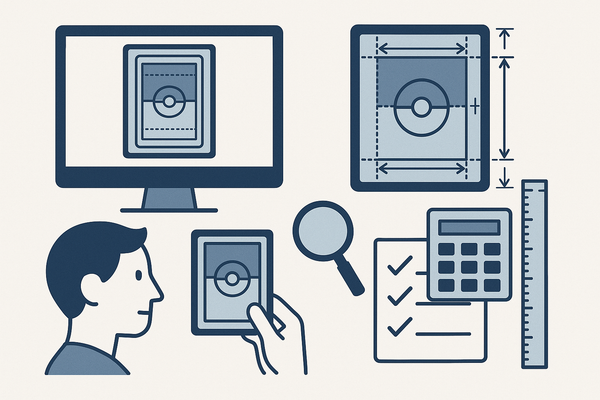
1. Upload or photograph the card.
2. AI detects outer card edges and inner printed borders.
3. System computes centering ratios for top/bottom and left/right.
Dive into automated analysis: Automated Card Centering Analysis - Advantages
– Rapid, batch-screening of many cards
– Instant centering percentages for grading decisions
– Reduced human error in initial checks
Dedicated Centering Calculator Apps
- Key features
– Automated border detection with manual override
– Front and back side support
– Outputs aligned to PSA, BGS, CGC grading standards - Use cases
– Field-ready checks at card shows or hobby shops
– Quick QC between print runs
Internal Software & Scoring Systems
- Professional workflows
– Measure eight edges (four on front, four on back) via digital capture
– Compute percentage ratios for each edge pair
– Map ratios to centering scores (e.g., Gem Mint 10 = better than 60/40) - Benefits
– Consistent, defendable grading decisions
– Standardized pass/fail or grade assignment
Step-by-Step Implementation
- Define centering standards/tolerances (e.g., ±0.5 mm or ratio thresholds).
- Set up calibrated image capture (scanner, camera, microscope).
- Implement digital/AI tools for automatic border detection and ratio calculation.
- Account for rotation, skew, and partial-border designs.
- Automate scoring and reporting against your thresholds.
- Train staff and codify the workflow for repeatability.
Best Practices and Tips
- Standardize measurement workflow
– Consistent capture setup: same lighting, camera angle, guides
– Use an alignment checklist: placement, no shadows, rotation check - Regular calibration routines
– Validate microscopes/scanners against known references
– Check pixel-to-mm conversion accuracy - Error-checking mechanisms
– Double-measure high-value cards
– Manual review near critical thresholds (e.g., 59/41 vs. 61/39) - Integrate into broader QC
– Combine centering with color, registration, and surface defect checks
– Sample print runs at start, middle, and end - Adapt to different environments
– Re-calibrate per machine or site; adjust for known bias
– Use mobile apps with manual tweak features at shows - Document and refine
– Log failures and near misses
– Analyze patterns by design, sheet position, or machine
– Update templates and cutting marks to reduce systematic errors
Case Studies and Real-World Applications
Professional grading operation
- Workflow
– Check rotation and skew first
– Digital microscopy measures all eight edges at 0.001 mm resolution
– Internal software computes centering percentages and scores
– Apply thresholds (e.g., Gem Mint 10 = better than 60/40 on front and back) - Impact
– Consistent, defensible grades
– Fewer grading disputes and increased trust
Collector pre-grading with AI tools
- Workflow
– Photo upload to AI tool
– Instant centering percentage results
– Smart submission decisions to grading houses - Impact
– Lower grading fees on off-center cards
– Objective screening at scale
Three-border design handling
- Workflow
– Measure two known borders with digital tools
– Infer third border size by calculation
– Compute centering ratios despite partial borders - Impact
– Consistent centering decisions on non-standard layouts
Conclusion & Additional Resources
Shifting from manual checks to precise digital and AI workflows helps optimize card centering accuracy. Clear centering standards, calibrated capture hardware, automated border detection, and software scoring deliver consistent results. Benefits include higher grading outcomes, reduced waste, uniform production, and trusted quality for trading cards, packaging, ID badges, and more. Embrace advanced centering methods in your workflow today to achieve perfect card alignment.
- How to Measure Card Centering: A Step-by-Step Guide for Collectors
- AI Card Centering Technology Works: A Comprehensive Guide
- Automated Card Centering Analysis: Precision, Speed & Consistency Explained
FAQ
- What is card centering accuracy?
Card centering accuracy measures how evenly the printed image on a card is positioned by comparing opposite edge margins and expressing the result as centering ratios. - How do digital tools improve centering checks?
Digital microscopes, scanners, and AI software detect borders with sub-millimeter precision, automate ratio calculations, and eliminate subjective eyeballing. - Which grading standards are supported?
Most centering tools output results aligned to PSA, BGS, and CGC grading thresholds (e.g., 50/50 to 60/40 ratios for Gem Mint). - Can I integrate centering into broader QC?
Yes—combine centering data with color, registration, and surface checks for a holistic quality control workflow. - What’s the first step to implement?
Define your centering tolerances, set up calibrated image capture, then deploy digital or AI-driven border detection and scoring.