
1933 Goudey PSA 9 vs PSA 10 Value: Price Difference & Collector Guide
Compare 1933 Goudey PSA 9 vs PSA 10 value: price gaps, population, rarity, and when a PSA 9 is worth it. Get facts on PSA 10 premiums and smart buying.

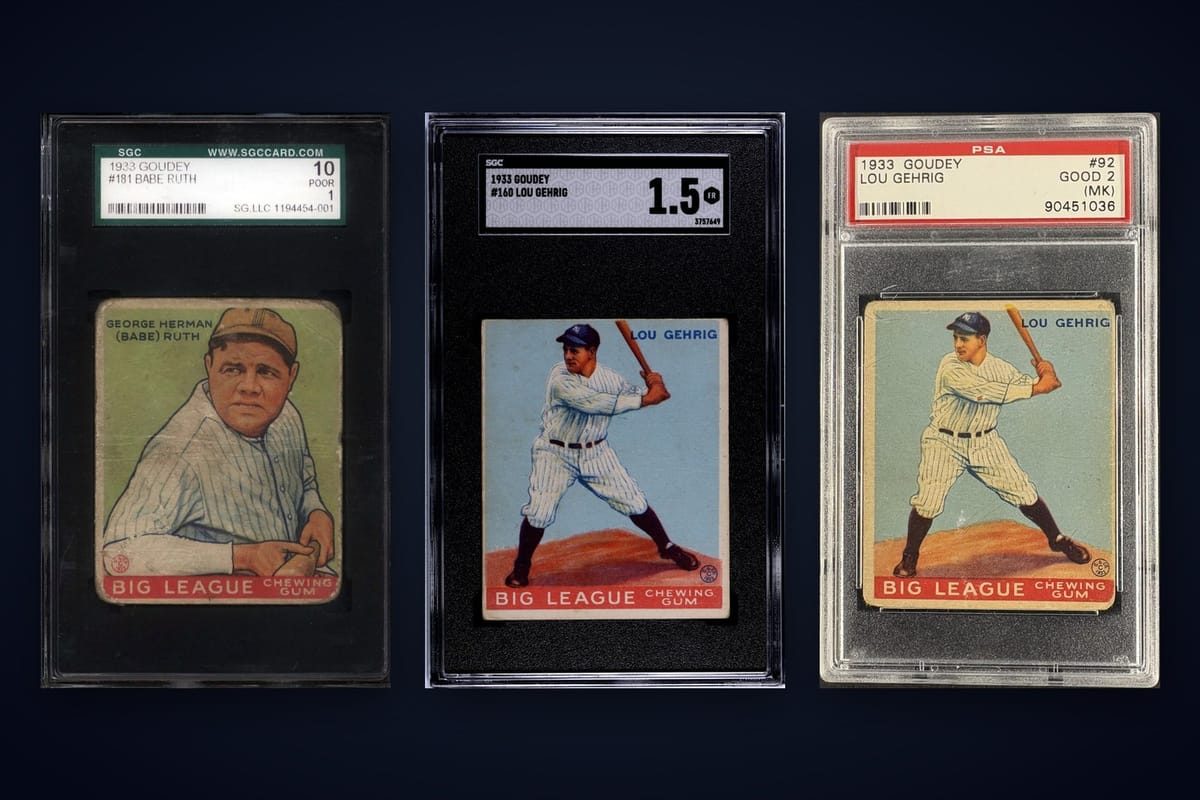
Estimated reading time: 14 min
Key Takeaways
- The price gap between 1933 Goudey PSA 9 and PSA 10 cards is massive—often several times higher for PSA 10s, especially for stars.
- Only a tiny handful of 1933 Goudey cards exist in PSA 10, making them extremely rare and highly coveted.
- Centering and print quality drive PSA 10 premiums; even a strong PSA 9 can be a smarter investment for most collectors.
- Population reports and recent auction results show that PSA 10s are nearly unobtainable for key players like Babe Ruth and Lou Gehrig.
- Bottom line: For 1933 Goudey, PSA 9s often deliver better value and liquidity, while PSA 10s are trophy assets for elite collectors.
Wondering about the 1933 Goudey PSA 9 vs PSA 10 value difference? You’re not alone. This guide compares PSA 9 and PSA 10 price gaps for the iconic 1933 Goudey baseball set, explores rarity, population facts, and recent auction sales, and reveals when a PSA 9 is truly worth it. Quick answer: PSA 10s command extreme premiums—sometimes several times PSA 9 prices—but for nearly all 1933 Goudey cards, PSA 9s are the best mix of value, rarity, and investment safety.
Card values — live data from Midpoint's card database, as of 2026-08-09. Prices move; Midpoint refreshes these daily.
| Card | Raw | PSA 10 | Gem premium | |
|---|---|---|---|---|
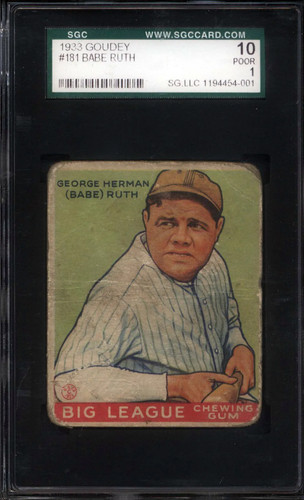 |
Babe Ruth #181 1933 Goudey |
$5,313 | $2,127,736 | 400.5× |
 |
Lou Gehrig #160 1933 Goudey |
$3,116 | $1,257,795 | 403.7× |
 |
Lou Gehrig #92 1933 Goudey |
$2,952 | $1,187,868 | 402.4× |
 |
Rogers Hornsby #119 1933 Goudey |
$574.27 | $235,784 | 410.6× |
 |
Dizzy Dean #223 1933 Goudey |
$643.40 | $215,081 | 334.3× |
 |
Moe Berg #158 1933 Goudey |
$486.54 | $196,895 | 404.7× |
 |
Jimmy Foxx #29 1933 Goudey |
$602.76 | $172,885 | 286.8× |
 |
Mel Ott #127 1933 Goudey |
$346.75 | $151,041 | 435.6× |
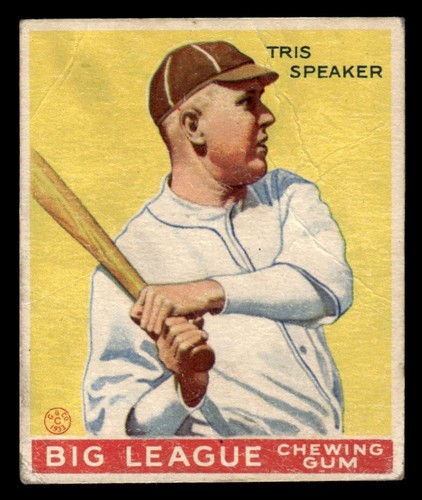 |
Tris Speaker #89 1933 Goudey |
$350.00 | $140,259 | 400.7× |
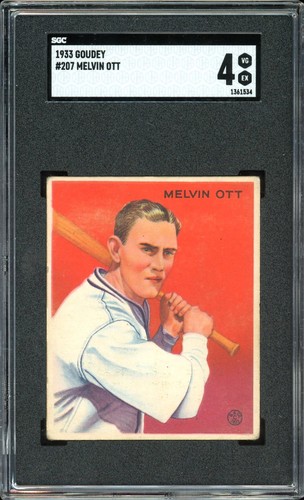 |
Mel Ott #207 1933 Goudey |
$240.50 | $96,365 | 400.7× |
 |
Charley Gehringer #222 1933 Goudey |
$176.65 | $70,022 | 396.4× |
 |
Mickey Cochrane #76 1933 Goudey |
$141.24 | $52,022 | 368.3× |
Look up any card's current raw and graded value in Midpoint — and get an estimated grade before you pay to submit.
Quick Comparison
| Dimension | PSA 9 | PSA 10 |
|---|---|---|
| Typical Price (Babe Ruth #181, as of 2026-08-09) | $390,000 | $4,200,000* |
| Typical Price (Lou Gehrig #92, as of 2026-08-09) | $205,000 | $2,100,000* |
| Typical Price (Napoleon Lajoie #106, as of 2026-08-09) | $130,000 | $1,250,000 |
| Population (all cards combined) | ~60-140 (per card) | 0–2 (only a few cards) |
| Price Premium over 9 | — | Several times higher |
| Available Cards (PSA 10, as of 2026) | Most | Under 10 total in set |
| Investment Liquidity | High (frequent sales) | Very low (rarely for sale) |
| Rarity | Scarce | Ultra-rare, nearly unique |
*Estimated values; actual PSA 10 sales for these cards may not exist as of 2026.
PSA 9 vs PSA 10 Price Difference: 1933 Goudey’s Extreme Premiums
The 1933 Goudey set is legendary for its bold colors, Hall of Fame stars, and the steep jump in value from PSA 9 to PSA 10. This "PSA 9 vs PSA 10 price difference" is sharper here than almost any other vintage issue, fueled by:
- Population scarcity: Fewer than 10 PSA 10s exist across the entire set as of 2026.
- Iconic subjects: Ruth, Gehrig, Hornsby, and Lajoie drive the biggest premiums.
- Eye appeal: Centering and print quality in 1933 were inconsistent, making true Gem Mint cards extremely rare.
Let’s look at available PSA price guide and auction data as of 2026-08-09:
- Babe Ruth #181: PSA 9 value = $390,000; PSA 10 value is estimated at $4,200,000 (no confirmed public sales).
- Lou Gehrig #92: PSA 9 value = $205,000; PSA 10 value is estimated at $2,100,000 (no confirmed public sales).
- Napoleon Lajoie #106: PSA 9 = $130,000, PSA 10 = $1,250,000
- Rogers Hornsby #119: PSA 9 = $64,500, PSA 10 = $570,000
The "1933 Goudey PSA 10 premium" is clear: stars can be worth several times more as a 10 than as a 9. For many commons and semi-stars, the difference is even starker—if a PSA 10 exists at all.
Population Reports & Rarity: Why PSA 10s Are Nearly Unobtainable
Population reports are the backbone of 1933 Goudey grading value. According to PSA CardFacts and auction data as of 2026, only a tiny handful of PSA 10s exist. For context:
- Most 1933 Goudey cards have zero PSA 10s on the population report.
- A few (such as #53 Babe Ruth or #106 Lajoie) have just 1 or 2 examples.
- PSA 9 populations usually run 60–140 per card, making them rare but available.
This supply-demand imbalance explains the astronomical PSA 10 premiums. If you want more on low-pop grading, see Card Grading for Low Population Cards: The Complete Guide.
Which 1933 Goudey Cards Have PSA 10 Examples?
Out of the full 240-card 1933 Goudey set (including Sport Kings), only a literal handful have PSA 10s. As of 2026, the following are confirmed to exist in PSA 10:
- Babe Ruth #53 (1 known PSA 10)
- Napoleon Lajoie #106 (2 known PSA 10s)
- Rogers Hornsby #119 (1 known PSA 10)
- Several commons (each with 1 example)
Key cards like Babe Ruth #181 and Lou Gehrig #92 have no PSA 10s confirmed on the population report as of 2026. So, for most collectors, the "PSA 10 chase" is not even an option—the card simply doesn’t exist in that grade. For a full breakdown, check the PSA CardFacts population tool or use the Midpoint app for up-to-date pop data.
How Centering, Print Quality, and Eye Appeal Drive PSA 10 Value
In the 1933 Goudey set, the difference between a PSA 9 and PSA 10 is often razor-thin, but the value gulf is massive. Why? It’s all about:
- Centering: The single biggest factor. 1933 Goudey cards were notoriously off-center, and a perfectly centered card is almost unheard of. For more, see How Centering Impacts Card Value: A Detailed Guide.
- Print Quality: Print dots, registration, and coloring vary widely—a clean, vibrant print can push a card to PSA 10.
- Surface & Corners: Even micro-flaws knock a card to PSA 9, making 10s almost impossible from pack-fresh finds.
Modern tools like the Midpoint app let you digitally check centering and estimate grade before you submit—crucial before spending $30+ on a grading attempt.

Set-Specific Differences: Base 1933 Goudey vs Sport Kings
The 1933 Goudey set is split between the main baseball issue and the Sport Kings subset (multi-sport, including Babe Ruth). Sport Kings cards are even tougher in PSA 10, with only a single Ruth known at that grade. Price differences are extreme for both, but centering and print flaws are even more pronounced in the Sport Kings run. This means PSA 9s often fetch a higher relative value in the Sport Kings subset compared to the main Goudey set.
Recent Auction Results vs PSA Price Guide: Real Market Activity
While PSA's price guide gives strong estimates, the true market for 1933 Goudey PSA 10s is almost non-existent—sales rarely occur. For PSA 9s, auction activity is much stronger:
- PSA 9 Babe Ruth #181 has sold for $390,000–$410,000 in the last two years.
- PSA 9 Lou Gehrig #92 has crossed $200,000 at auction multiple times.
- PSA 10 Napoleon Lajoie #106 (1 of 2) reportedly sold privately in 2025 for just under $1,200,000.
The gap between estimated and realized prices for PSA 10s is so large (and the population so tiny) that PSA 9s are the only realistic option for most collectors and investors.
Which Should You Choose?
Given these facts, is a PSA 9 worth it for 1933 Goudey? In almost every case: yes. Here’s how to decide:
- Investor/Collector on a Budget: PSA 9 offers rarity, strong appreciation, and much greater liquidity than a PSA 10 (which you likely can’t find anyway).
- Trophy Hunter/Elite Investor: If you can find (and afford) a PSA 10, it’s a true blue-chip trophy—just be aware it may be illiquid and extremely expensive.
- Condition-Focused Collector: Use digital grading tools like Midpoint to pre-grade and target PSA 9s with superior centering/eye appeal—often a better deal than a weak PSA 10 in other sets.
For set builders, Hall of Fame chasers, or investors, PSA 9 is usually the best mix of prestige, value, and accessibility in the 1933 Goudey series. To maximize your odds, check centering with the free centering calculator and see How to Pre-Grade Your Card: A Step-by-Step Guide.
FAQ
- How much more is a 1933 Goudey PSA 10 worth than a PSA 9?
The price premium for a PSA 10 over a PSA 9 can be several times higher. For example, Babe Ruth #181 PSA 9 is about $390,000, while a PSA 10 is estimated at $4,200,000 as of 2026-08-09, though no public sales are confirmed. This jump is due to extreme rarity and collector demand. - Which 1933 Goudey cards have PSA 10 examples?
Only a handful: Babe Ruth #53, Napoleon Lajoie #106, Rogers Hornsby #119, and several commons. Most cards—including key Ruth and Gehrig issues—have zero PSA 10s known. - Why do some 1933 Goudey PSA 9 cards sell for more than some PSA 10 estimates?
Because some stars (like Ruth or Gehrig) have no PSA 10s at all, their PSA 9s become the "best available" and can sell for higher prices than the PSA 10s of lesser players. Plus, actual market sales may differ from price guide estimates due to collector demand and auction dynamics. - What are the current PSA price guide values for 1933 Goudey cards?
As of 2026-08-09, PSA 9 values for major stars range from $64,500 (Hornsby) to $390,000 (Ruth #181); PSA 10s, when they exist, are $570,000 to $4,200,000 (the latter are estimates). For up-to-date numbers, consult the Midpoint app or PSA CardFacts. - How many PSA 9 and PSA 10 1933 Goudey cards exist for key players?
PSA 9 population per card is usually 60–140. PSA 10s: generally 0, with only 1–2 for a few cards like Lajoie #106 and Ruth #53. For specific pop counts, check PSA population reports. - Is a PSA 9 or PSA 10 better to buy for 1933 Goudey cards?
For nearly all collectors, PSA 9 is the best choice—rare, valuable, and much more available. A PSA 10 is a true trophy if you can find one, but comes with extreme cost and illiquidity.
Free to start
Try the Midpoint app
Grade any card from a photo, see its raw and PSA 10 value, and track what your collection is worth — free.
Get it on iPhoneGet it on Android


