Card Grading for Low Population Cards: The Complete Guide
Discover expert strategies for card grading low population cards. Compare PSA, BGS, CGC grades, and learn how centering impacts rarity and value.

Estimated reading time: 14 min
Key Takeaways
- 'Low population' cards are defined by grading company population reports—understanding these reports is crucial before grading.
- Gem Mint vs Pristine vs Black Label grades: how each grader's top tier differs and why centering is often the key deciding factor.
- Low pop does not always mean high value—demand, set era, and submission trends matter as much as rarity.
- Accurate centering measurement can tilt grading odds for low population cards; tools like Midpoint provide instant pre-grade estimates.
- Population status changes over time—learn when to submit, what to grade, and how to avoid common pitfalls.
Table of Contents
- Section 1: Understanding Low Population Cards and Population Reports
- Section 2: How to Read and Interpret Population Reports
- Section 3: What Counts as 'Low Pop'—Era, Print Run, and Set Factors
- Section 4: Card Grading Scales—Gem Mint vs Pristine, PSA vs BGS vs CGC
- Section 5: Why Centering is the Deciding Factor in Top Grades
- Section 6: Population, Value, and Grading Strategy for Low-Pop Cards
- Section 7: Pitfalls and Best Practices for Low Population Card Grading
- Section 8: Practical Tools—Measuring Centering and Estimating Grade
- Conclusion
- FAQ
Section 1: Understanding Low Population Cards and Population Reports
What is a Low Population Card?
In the world of card collecting, a "low population card" (often called "low pop") refers to a trading card that has very few examples graded at a particular grade (or overall) by a major grading company. This population is tracked in the company's population report, a public record of how many times each card, by set and grade, has been graded.
- PSA (Professional Sports Authenticator): Publishes a detailed population report for every card, broken down by grade from PSA 1 to PSA 10.
- BGS (Beckett Grading Services): Offers similar pop reports, including subgrades and 'Black Label' counts.
- SGC (Sportscard Guaranty Corporation) and CGC (Certified Guaranty Company): Provide their own population data, though with different grading scales and terminology.
Low population can mean "rare in high grade" (e.g., only a handful of PSA 10s), or "rare in any grade" (such as a trophy card or an obscure parallel).
Why Pop Reports Matter
Population reports are critical for:
- Understanding how rare a card is in a specific grade
- Identifying market scarcity—true rarity vs under-submitted cards
- Contextualizing sales prices and value trends
A low pop card is often seen as more desirable and valuable, but this is not always the case. Rarity, demand, and grading trends all play a role.
Section 2: How to Read and Interpret Population Reports
Population Report Basics
Each grading company lists how many of each card have been graded at each grade. For example:
- PSA 10: 18
- PSA 9: 56
- PSA 8: 72
- Total graded: 156
This lets collectors see how tough a card is to find in top condition. A card with 5 PSA 10s and 500 total graded is much lower pop in Gem Mint than a card with 100 PSA 10s and 200 total graded.
Grade Distribution and PSA 10 Rate
The "PSA 10 rate" (or similar for other graders) is the percentage of submissions that achieve the top grade. A low 10-rate typically signals a condition-sensitive card or tough grading standards for that issue.
- Card A: 10 PSA 10s / 100 graded = 10% Gem Mint rate
- Card B: 90 PSA 10s / 100 graded = 90% Gem Mint rate
Collectors prize low-pop, low-10-rate cards, but be mindful: sometimes a low rate reflects limited submissions, not true scarcity.
Finding and Using Population Reports
Check official population reports at:
- PSA: psacard.com/pop
- BGS: beckett.com/pop-report
- CGC: cgccards.com/population
Search by set, card number, and variation to get accurate data. Always confirm the exact card—errors here cause costly mistakes.
Section 3: What Counts as 'Low Pop'—Era, Print Run, and Set Factors
The Relative Nature of 'Low Pop'
What is considered a low-population card depends on context. For vintage cards, a "pop 10" might be extremely rare; for modern cards, hundreds of PSA 10s might still be low due to massive print runs.
- Vintage (Pre-1980): Lower print runs, lower survival rates, tougher grading. PSA 10s in the single digits are common.
- Modern Base Cards: Print runs in the tens or hundreds of thousands. Even 500+ PSA 10s can be considered low.
- Parallels/Inserts: Serial-numbered or short-printed cards almost always have low populations by design.
Unopened Supply and Submission Trends
Unopened product left in the market means populations can rise as new 'fresh' cards are submitted. Conversely, dead sets with little unopened supply have more stable pop reports.
Condition Sensitivity
Some cards are naturally hard to grade due to centering, print defects, or chipping. These often have very low high-grade populations, even if lots are submitted.
- 1986 Fleer Michael Jordan: known for centering issues, making PSA 10s relatively scarce
- 1999 Pokémon 1st Edition Charizard: print and holo defects can make Gem Mint difficult
For more on how centering specifically impacts value, see this detailed guide to centering and card value.
Section 4: Card Grading Scales—Gem Mint vs Pristine, PSA vs BGS vs CGC
Grade Tiers: Gem Mint, Pristine, Black Label
Grading companies use different terms for their highest grades:
- PSA 10 Gem Mint: PSA's top grade. Allows very tiny flaws.
- BGS 10 Pristine: Higher standard than Gem Mint; requires near-perfect subgrades.
- BGS 10 Black Label: All four subgrades (centering, corners, edges, surface) are perfect 10s. Considered extremely rare.
- CGC Pristine 10: Similar to BGS Pristine. CGC also offers a "Perfect 10" (even stricter).
Gem Mint vs Pristine: Which Is Hardest?
Generally, Pristine (BGS 10 or CGC 10) is harder to obtain than Gem Mint (PSA 10). Black Label BGS 10 is considered the most difficult. For example, the ratio of PSA 10s to BGS Black Labels for the same card is often much higher for PSA 10s, though exact ratios vary by card and set.
Learn more about grading scale differences in our detailed comparison of grading standards.
PSA vs BGS vs CGC: What Matters for Low Pop Cards?
- PSA: Most widely recognized; highest "pop culture" value.
- BGS: Valued for subgrades and Pristine/Black Label tiers.
- CGC: Especially popular for Pokémon and TCG; Pristine 10 is very tough.
Comparing PSA 10 vs BGS 10 or CGC Pristine 10 vs Gem Mint 10 is a core debate—each has its own market. For many cards, a BGS Black Label or CGC Pristine 10 can command a premium over even a PSA 10.
Section 5: Why Centering is the Deciding Factor in Top Grades
What is Centering and Why Does It Matter?
Centering describes how evenly the card's border frames the artwork. Grading companies have strict standards for centering—often the single biggest hurdle for Gem Mint, Pristine, or Black Label grades.
- PSA 10: Centering must be within 55/45 front, 75/25 back
- BGS 10: 50/50 one way, no worse than 55/45 the other
- CGC Pristine 10: About 50/50 with minimal variance
For a full breakdown of how to measure centering, see this precision centering guide.
Centering as a Deciding Subgrade
For BGS and CGC, centering is one of four subgrades (along with corners, edges, and surface). The lowest subgrade sets the ceiling for the final grade. This means even a flawless card with 60/40 centering cannot achieve Pristine or Black Label.
Measuring Centering Before Submission
Because grading is expensive, measuring centering accurately before submitting is crucial—especially for low pop cards where every top grade counts.
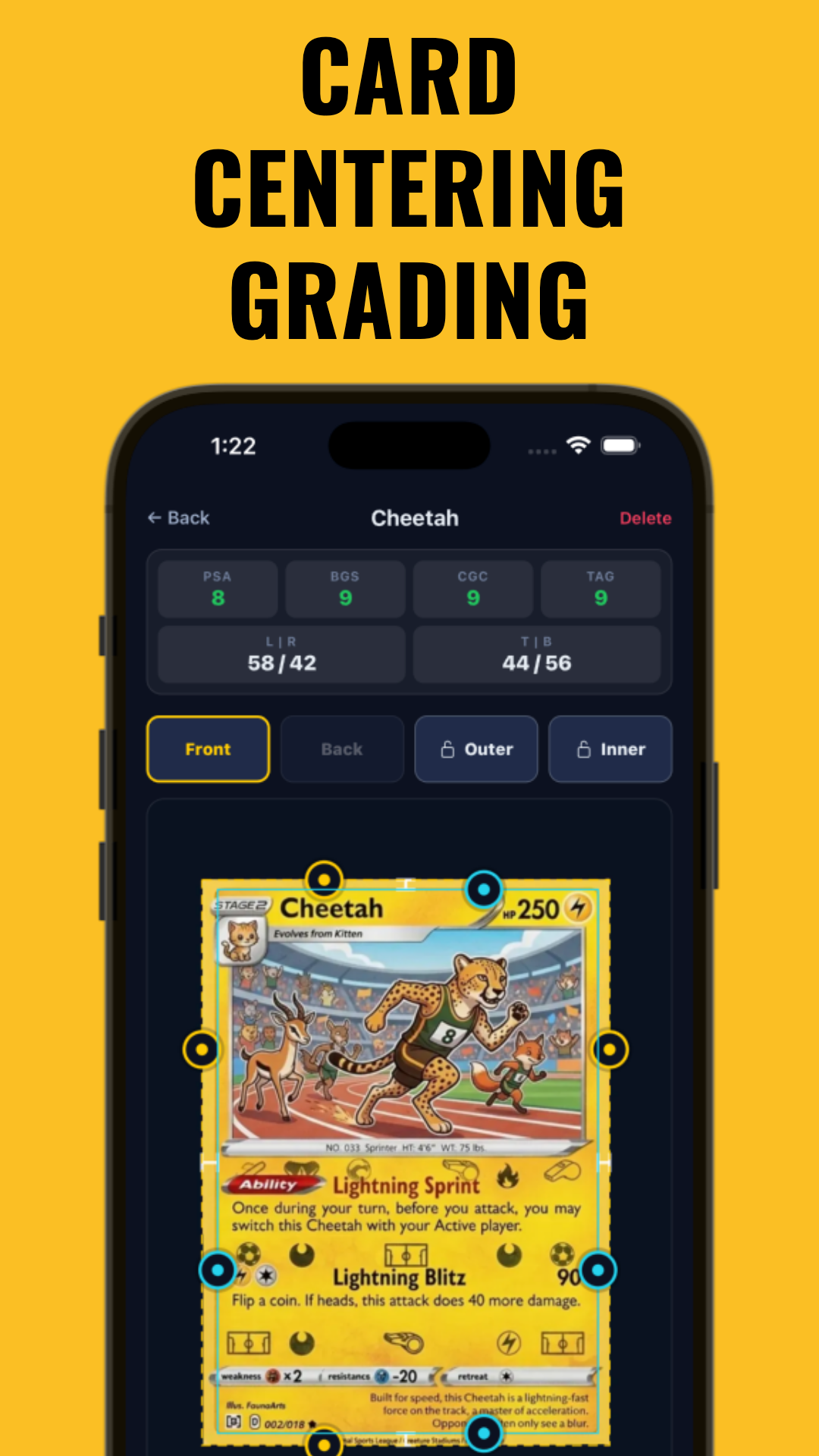
Apps like Midpoint let you upload a scan or photo to get millimeter-precise centering ratios and instant grade estimates for PSA, BGS, CGC, and TAG. This can help you avoid costly submissions that have little chance at Gem Mint or Pristine.
Section 6: Population, Value, and Grading Strategy for Low-Pop Cards
Does Low Population Equal High Value?
Not always. A low population may reflect:
- True rarity: Very few exist or survive in high grade (e.g., 1952 Topps Mantle, trophy Pokémon cards)
- Under-submission: Cards that are not highly sought after, so few have been graded
- Condition sensitivity: Cards that are almost impossible to grade Gem Mint due to manufacturing flaws
High value only comes when low pop meets high demand. Many low pop cards remain inexpensive because collectors do not chase them.
Comparing Cards: Population vs. Recent Sales
Population reports tell you supply, but not demand. Always check recent eBay or auction house sales to see what buyers are actually paying. Sometimes, a "pop 1" card sells for less than a much higher pop card because collectors value the latter more.
When to Grade a Low-Pop Card
- When your card is likely to achieve the highest possible grade (Gem Mint, Pristine, Black Label)
- When the card is highly sought after, and a low pop will command a premium
- If you have strong evidence the pop will remain low (e.g., vintage, rare parallel)
For a step-by-step process on pre-grading and estimating your card's grade, see our comprehensive pre-grading guide.
Section 7: Pitfalls and Best Practices for Low Population Card Grading
Common Pitfalls
- Misreading Population Reports: Confusing different card variations, years, or parallels; always double-check you are looking at the right listing.
- Ignoring Grader Differences: A PSA 10 is not always comparable to a CGC Pristine 10 or a BGS Black Label.
- Population Growth: Today's "pop 1" can become "pop 10" overnight if a new hoard is submitted, especially for modern cards.
- Overpaying for Scarcity: Sometimes low pop is a mirage—look for demand first, then rarity.
Best Practices
- Always verify the exact card, year, set, and variation before relying on population data.
- Check all major graders—sometimes a card is low pop at PSA, but common at BGS or CGC (and vice versa).
- Measure centering and other condition factors before investing in grading—use digital tools for millimeter accuracy.
- Stay informed: population reports update regularly, especially after big hobby events or grading specials.
Grade Comparison Cautions
Be careful comparing psa 10 vs bgs 10 or psa 10 vs psa 9 values without factoring in population and demand. For some cards, the difference is significant; for others, it may be minimal.
Section 8: Practical Tools—Measuring Centering and Estimating Grade
Why Use a Centering Tool?
Centering is the most common reason cards miss top grades. Manual measuring with a ruler is error-prone. Modern apps provide:
- Fast and precise centering ratios (down to 0.1mm)
- Instant grade estimates for PSA, BGS, CGC, and TAG
- Bulk upload for large collections
- Visual overlays and digital measuring
How Midpoint Works
Midpoint lets you upload scans or photos, automatically detects borders, and gives you centering ratios and projected grades for all major grading companies. It estimates how likely your card is to achieve Gem Mint, Pristine, or Black Label—helping you avoid unnecessary grading fees.
Integrating Centering Into Your Grading Strategy
- Screen your low pop cards before sending to PSA, BGS, or CGC
- Use centering data to pick the best grading company for each card
- Track population report changes and update your grading targets accordingly
See also our practical guide to estimating your card before grading and how AI is transforming centering analysis.
Conclusion
Grading low population cards is as much an art as a science. Understanding population reports, recognizing what truly counts as "low pop" for your card's era and set, and knowing the difference between Gem Mint and Pristine (or Black Label) grades are essential. Centering is often the deciding factor—especially as grading standards tighten at the top. Use digital tools like Midpoint to measure and pre-grade your cards with confidence before investing in submission fees. Remember, low population does not always equal high value—always consider demand, recent sales, and the ever-changing nature of the card grading landscape.
FAQ
Q: What is considered a low-pop card in sports cards or Pokémon cards?
A: It depends on the set and era. For vintage cards, even a "pop 10" in PSA 10 may be low. For modern cards, low pop usually means a small percentage of total graded reach the top grade, or under 100 examples in Gem Mint or Pristine. Always compare to total graded and check demand.
Q: Does low population actually increase card value?
A: Only if there is collector demand. Low population can add scarcity value, but many low pop cards are not valuable if few people collect them. High value comes when low pop meets high demand.
Q: How do I check the population report for my card?
A: Visit the grading company's population report (like PSA, BGS, or CGC), search by set, card number, and variation. Double-check you have the correct card details—variation errors are common.
Q: Is a low-pop card always rare, or can it just be undergraded?
A: Sometimes low population means few have been graded, not that the card is truly rare. Modern cards and unpopular sets often have low pops simply from lack of submission. Always check recent sales and unopened supply before assuming rarity.
Q: What PSA 10 population is considered low?
A: For vintage cards, fewer than 10-20 PSA 10s is typically very low. For modern cards, under 100 can be low, but context matters—compare to total graded and print run.
Q: Should I grade a low-pop card or keep it raw?
A: Grade if your card is in top condition and likely to achieve a high grade, especially if demand is strong. If not, keeping it raw may be best to avoid grading fees.
Free to start
Try the Midpoint app
Grade any card from a photo, see its raw and PSA 10 value, and track what your collection is worth — free.
Get it on iPhoneGet it on Android