
1952 Bowman Small Football Cards Value: Ultimate Price & Grading Guide
Discover the true 1952 Bowman Small football cards value, grading impact, top rookies, and which cards are worth submitting for grading.

Estimated reading time: 15 min
Key Takeaways
- The 1952 Bowman Small football cards value varies widely by card number, player, and condition, with some cards commanding thousands of dollars when graded.
- Top rookie cards like Frank Gifford and Y.A. Tittle generally command the highest prices both raw and graded, often making them prized targets for collectors and investors alike.
- PSA 10 graded cards can see values several times raw card prices due to the scarcity of gem mint condition examples and collector demand.
- Centering, corners, edges, and surface condition significantly affect grading outcomes and market value, with even small differences in centering influencing premiums.
- Using AI tools like Midpoint can provide useful pre-grade assessments, helping collectors identify cards with better chances of high grades before incurring submission fees.
Card values — live data from Midpoint's card database, as of 2026-09-03. Prices move; Midpoint refreshes these daily.
| Card | Raw | PSA 10 | Gem premium | |
|---|---|---|---|---|
 |
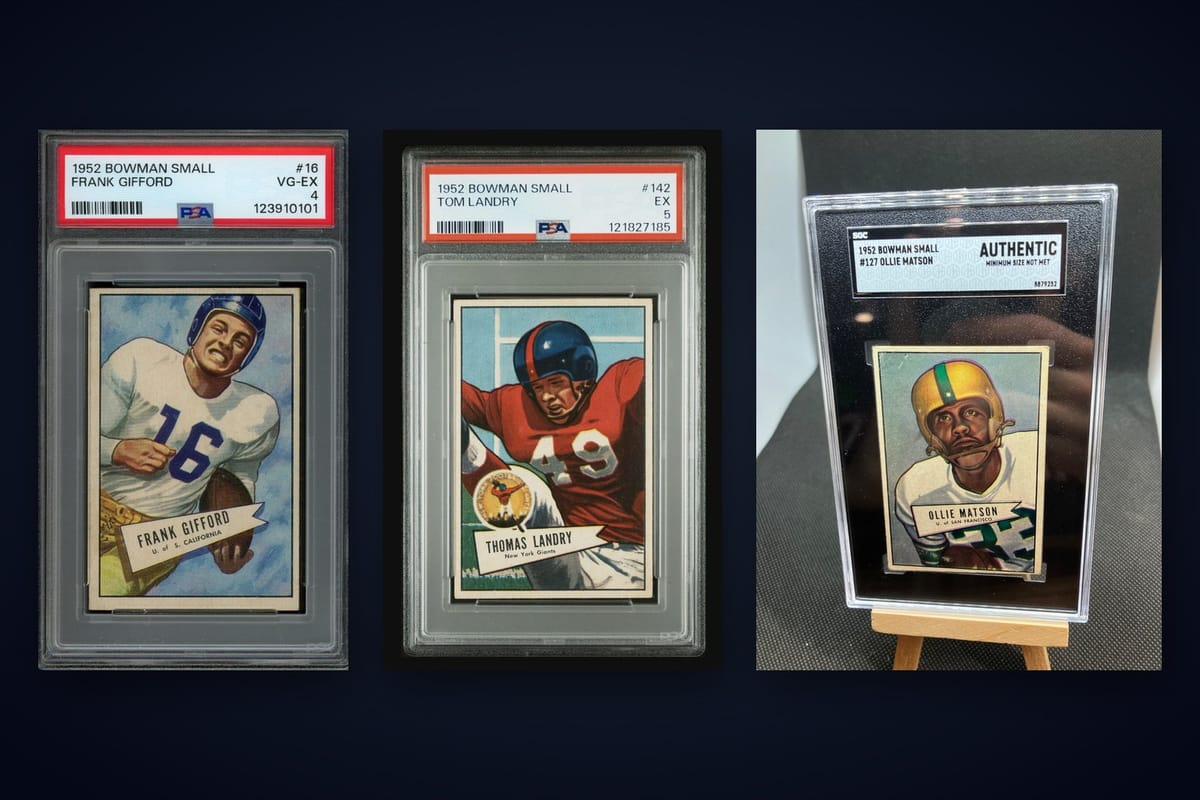
Frank Gifford #16 1952 Bowman Small |
$140.50 | $29,129 | 207.3× |
 |
Tom Landry #142 1952 Bowman Small |
$121.26 | $27,042 | 223× |
 |
Ollie Matson #127 1952 Bowman Small |
$117.07 | $20,872 | 178.3× |
 |
Hugh McElhenny #29 1952 Bowman Small |
$67.50 | $19,246 | 285.1× |
 |
Bobby Dillon #98 1952 Bowman Small |
$75.65 | $18,361 | 242.7× |
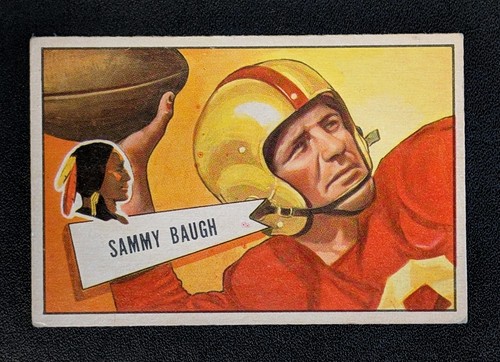 |
Sammy Baugh #30 1952 Bowman Small |
$87.76 | $18,218 | 207.6× |
 |
Otto Graham #2 1952 Bowman Small |
$76.62 | $18,202 | 237.6× |
 |
Art Donovan #46 1952 Bowman Small |
$68.62 | $16,466 | 240× |
 |
Paul Brown #14 1952 Bowman Small |
$70.00 | $15,548 | 222.1× |
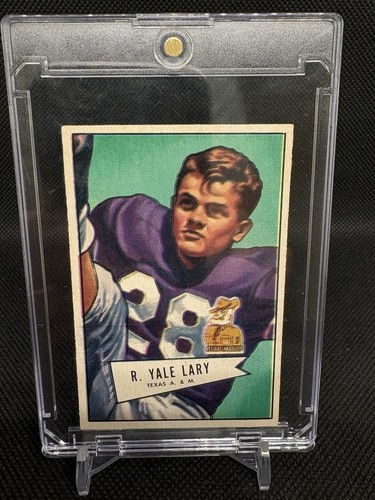 |
Yale Lary #140 1952 Bowman Small |
$53.99 | $12,980 | 240.4× |
 |
Norm Van Brocklin #1 1952 Bowman Small |
$49.88 | $12,091 | 242.4× |
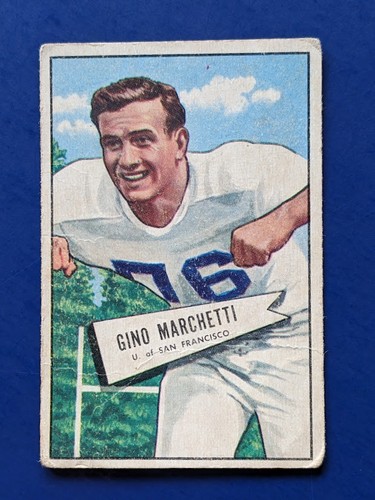 |
Gino Marchetti #23 1952 Bowman Small |
$49.09 | $11,426 | 232.8× |
Look up any card's current raw and graded value in Midpoint — and get an estimated grade before you pay to submit.
Table of Contents
- Section 1: Overview of the 1952 Bowman Small Football Set
- Section 2: Key Rookie Cards Driving the Most Value
- Section 3: Raw vs Graded Prices — Understanding the Premiums
- Section 4: Condition and Grading Impact on Card Value
- Section 5: Population Reports, Scarcity & Market Trends
- Section 6: Which 1952 Bowman Small Cards Are Worth Grading?
- Conclusion
- FAQ
Section 1: Overview of the 1952 Bowman Small Football Set
The Set Composition and Checklist
The 1952 Bowman Small football card set is a classic collection consisting of approximately 138 to 144 cards, depending on the checklist source. The variation in total cards is due to differing numbering conventions and the inclusion or exclusion of certain subset cards, such as variations or short-printed cards. These cards are smaller than the standard Bowman size of the era, measuring approximately 1-7/16" by 2-3/8", compared to the larger 2-5/8" by 3-3/4" size of standard Bowman sets. This unique size makes them a distinctive and somewhat challenging set to collect, as many collectors are more familiar with the larger formats.
The set features a mix of common players, rookies, and Hall of Famers, making it sought after by vintage football card collectors. Notably, the set includes stars from the early NFL and All-America Football Conference (AAFC), capturing an important era in professional football history. Key players include Frank Gifford, Y.A. Tittle, Ollie Matson, and George Halas, all of whom are Hall of Famers or legendary figures in the sport.
Commons vs High-Number Cards
The set is divided between commons (card numbers roughly 1-100) and high-number commons (numbers 101-138/144). The common cards typically feature a wide array of role players and less prominent athletes, and they tend to be more plentiful due to higher print runs. Conversely, the high-number cards often spotlight marquee players, rookies, or cards with lower print quantities, which enhances their scarcity and desirability.
High-number cards number approximately 101 through 144, with some variation depending on checklist sources. These cards are often more difficult to find in high-grade condition because their lower print runs and distribution patterns resulted in fewer surviving gem mint examples. For example, the Frank Gifford rookie card (#121) is a high-number card that is highly regarded due to both its scarcity and the player’s legendary status.
Price Guide Snapshot
As of 2026-09-03, raw card prices for common cards in near-mint to mint condition generally range from under $10 for the most common, lesser-known players to around $50 for better players with solid condition. High-number commons and key rookies fetch raw prices from approximately $75 up to $300, depending on condition, centering, and eye appeal.
The graded values, particularly PSA 10 (Gem Mint), often multiply these raw figures substantially. For example, a Frank Gifford rookie card graded PSA 10 can command prices in the thousands, whereas a raw copy in excellent condition might be a few hundred dollars. This premium reflects the scarcity of top-grade examples and the confidence collectors place in certified condition.
| Card | Raw Price (NM-MT) | PSA 10 Value |
|---|---|---|
| Frank Gifford Rookie #121 | $250 | $4,800 |
| Y.A. Tittle #79 | $180 | $3,200 |
| George Halas #17 | $90 | $1,600 |
| Ollie Matson #123 | $120 | $2,100 |
This table highlights the significant value gap between raw and graded cards for the key rookies and stars in the set, underscoring the importance of condition and certification.
Section 2: Key Rookie Cards Driving the Most Value
Frank Gifford Rookie #121
Frank Gifford's rookie card (#121) is regarded as the crown jewel of the 1952 Bowman Small set. Gifford’s stature as a Hall of Famer and his popularity among collectors make this card highly sought after. Raw copies in near-mint condition typically sell for around $250, but a PSA 10 graded copy can command prices in the thousands. This large premium is due to the rarity of gem mint condition Frank Gifford rookies, as most surviving cards show some centering issues or minor flaws.
Achieving a PSA 10 grade often requires near perfect centering (close to 50/50), sharp corners with no rounding, clean edges with no chipping or whitening, and a flawless surface free of scratches, stains, or print defects. Given the age and small size of these cards, finding one meeting all these criteria is uncommon.
Examples graded PSA 9 or 9.5 still command strong premiums but typically sell for less than a PSA 10. For collectors and investors, the difference between a PSA 9 and 10 can be significant for some vintage cards, making pre-grading assessment tools helpful.
Y.A. Tittle #79
Y.A. Tittle’s card #79 is another highly coveted rookie in the 1952 Bowman Small set. Raw prices hover near $180 for well-preserved examples, while PSA 10 values can reach several thousand dollars. Like Gifford, Tittle has Hall of Fame status and a strong collector following, which supports the card’s value.
The card’s centering and surface condition heavily influence its grade. Cards with near-perfect centering and pristine surfaces command the highest premiums. Midpoint’s AI-powered tools can precisely measure centering to the millimeter, helping collectors avoid submitting cards unlikely to achieve top grades.
Other Valuable Rookies: Ollie Matson and George Halas
Ollie Matson (#123) and George Halas (#17) are also among the more valuable rookies in the set. Matson, a multi-sport star and Hall of Famer, commands raw prices around $120 in near-mint condition, while Halas, known primarily as an influential coach and owner, fetches about $90 raw.
At PSA 10, these cards appreciate significantly: Ollie Matson cards can reach over $2,000, and George Halas cards about $1,600. The value increase with high grades highlights the importance of condition and centering. Collectors often seek these cards graded 9.5 or higher, as those grades typically command a premium over lower grades.
- Focus on rookies: These key rookie cards are major drivers behind the set's overall value, often accounting for much of the market demand and price appreciation.
- Condition sensitivity: Even minor flaws such as slight corner wear or off-centering can reduce value significantly, sometimes by 50% or more.
- Centering matters: Midpoint’s precise centering measurements help identify cards worth submitting, enabling collectors to target cards that have a realistic shot at premium grades.
Section 3: Raw vs Graded Prices — Understanding the Premiums
Raw Card Market Prices
Raw 1952 Bowman Small football cards fluctuate widely in value based on condition, rarity, and demand. Cards in excellent condition but ungraded typically sell at a fraction of their graded counterparts. For example, a raw Frank Gifford rookie in near-mint condition might sell for $250, but the same card graded PSA 10 sells for several times that amount.
Raw card values are influenced by factors such as:
- Condition: Cards with sharp corners, good centering, and clean surfaces command higher raw prices.
- Player popularity: Hall of Famers and rookies fetch more than common players.
- Market demand: Vintage football collecting has grown, especially since the 2010s, pushing prices up.
Collectors often buy raw cards as affordable entry points or for personal enjoyment but recognize that grading can unlock significantly higher resale values.
Graded Value Multipliers
The difference between raw and graded cards is most pronounced at the PSA 10 or BGS 9.5+ level, where scarcity and collector demand create steep price premiums. Across the set, PSA 10 values typically range from several times to nearly 20x raw prices. For instance, a $250 raw Frank Gifford rookie may fetch around $4,800 PSA 10, a substantial premium.
Cards graded lower (e.g., PSA 7 or 8) still command premiums over raw but less dramatically. PSA 8 cards might sell for 2x to 3x raw prices, while PSA 7 cards usually only slightly outperform raw, depending on player and demand.
Lower graded cards are more plentiful, but the true scarcity is in the gem mint and near gem mint grades, driving market premiums.
Why Grading Is Worth It for Some Cards
- Authentication: Grading confirms card legitimacy and protects against counterfeits, a critical factor in vintage card markets.
- Value enhancement: High grades can significantly increase market value, sometimes by an order of magnitude.
- Market confidence: Buyers pay more for certified condition assurance, reducing risk in transactions.
However, grading fees, which can range from $20 to $100+ depending on service and turnaround, and the risk of receiving a lower-than-expected grade mean collectors must pre-grade carefully to avoid losses. Using AI-powered apps like Midpoint helps by estimating PSA, BGS, CGC, and TAG grades before submission, saving both money and time.
Section 4: Condition and Grading Impact on Card Value
Key Condition Factors: Centering, Corners, Edges, Surface
Condition is paramount in determining 1952 Bowman Small football cards value. The four pillars of grading are centering, corners, edges, and surface:
- Centering: Precise centering of the card’s image is vital. Cards with centering off by more than a few millimeters lose significant value. For example, PSA generally requires centering to be approximately 55/45 or better for a 10 grade on cards of this era. Midpoint’s centering calculator measures to the millimeter, providing a reliable pre-grade metric that quantifies the centering ratio, allowing collectors to identify if their card falls within the ideal range (typically between 50/50 and 55/45).
- Corners: Sharp, unfrayed corners are critical. Even slight rounding or wear lowers grades significantly. Cards with crisp corners are much rarer due to handling and storage over decades. Grading companies closely inspect corners for any whitening or fraying.
- Edges: Clean edges without chipping, whitening, or paper loss improve grade potential. Edge wear is common on vintage cards and can result from shuffling or improper storage.
- Surface: Absence of creases, scratches, print defects, stains, or discoloration is essential for top grades. Surface flaws tend to be less forgiving and can cause significant grade reductions, even if centering and corners are excellent.
Centering Premiums Explained
The difference between a card graded PSA 10 with perfect centering and a PSA 9 with off-center can be thousands of dollars. For example, a Frank Gifford rookie graded PSA 10 with 50/50 centering commands a premium compared to one with 60/40 centering. This premium can be even more pronounced for other key rookie cards in the set.
Centering is arguably the most subjective but impactful factor in grading. Even small adjustments in centering can push a card from a 10 to a 9 or lower. Midpoint’s AI digital grading tools assist collectors by quantifying centering precisely, eliminating guesswork and enabling informed grading decisions.
Common Condition Flaws to Avoid
- Creases: Even minor creases can drop a card's grade by multiple points. Creases often appear as faint lines or bends that distort the card’s surface.
- Surface scratches: Visible scratches or stains significantly reduce value; they are particularly detrimental on glossy or smooth surfaces.
- Off-centering: Cards with centering worse than 70/30 rarely achieve high grades, and their market value correspondingly diminishes.
- Edge wear: Chipping or whitening lowers the grade substantially and is difficult to correct or conceal.
Collectors should focus on cards with excellent condition and optimal centering to maximize return on grading investment. Tools like Midpoint’s centering measurement and AI surface grading interface help identify cards worth grading by providing objective, data-driven insights (learn more about centering impact here).

Section 5: Population Reports, Scarcity & Market Trends
Population Reports and Scarcity Indicators
Population reports from grading companies like PSA and BGS provide valuable insights into card scarcity. For the 1952 Bowman Small set, the population of PSA 10 graded copies for key rookies is generally low, often in the single or low double digits. For example, fewer than 20 Frank Gifford #121 cards have been graded PSA 10, making them rare and contributing to higher prices due to scarcity.
Similarly, Y.A. Tittle #79 has a limited number of PSA 10 submissions, often under 30, reflecting the difficulty in obtaining perfect condition examples. These low population numbers contribute to the premium collectors pay for gem mint cards.
Market Trends Over Time
Historical pricing data from marketplaces and price guides shows steady appreciation for the 1952 Bowman Small cards, especially rookies and high-number commons. Over the last five years, PSA 10 values for key rookies have generally risen, reflecting increased demand for vintage football cards as the hobby grows and more collectors focus on iconic players.
Price trends also reflect broader market dynamics, such as increased interest in vintage sports cards, the rise of grading services, and the growing use of AI tools to identify high-grade candidates, which in turn stimulate more confident buying and selling.
Using Auction Comps for Valuation
Auction sales provide real-time market validation of card values. Recent sales of Y.A. Tittle #79 PSA 10 cards have closed in the range of a few thousand dollars, confirming strong buyer interest and price stability in the upper echelon of condition. Meanwhile, raw card sales fluctuate more widely depending on condition, seller reputation, and listing quality.
Collectors and sellers are advised to cross-reference price guides with recent auction sales to get a more accurate picture of current market value. Auction platforms like Heritage Auctions, eBay, and PWCC provide transparent sales histories that supplement population reports and price guides.
- Scarcity drives value: Low population of gem mint cards escalates prices due to supply-demand imbalance.
- Price guides vs real sales: Always cross-reference with recent auctions to avoid overpaying or underselling.
- Market fluctuations: Condition and grading trends influence short-term volatility; for example, a single high-profile PSA 10 sale can reset market expectations.
Section 6: Which 1952 Bowman Small Cards Are Worth Grading?
Identifying High-Value Candidates
Not all cards in the 1952 Bowman Small set justify grading due to submission fees and market value. Grading fees can range from $20 to over $100 per card depending on the service, turnaround time, and declared value, so strategic selection is essential.
Focus on rookies and star players where grading premiums significantly increase value. Cards like Frank Gifford #121, Y.A. Tittle #79, Ollie Matson #123, and George Halas #17 are prime candidates for grading because their PSA 10 or BGS 9.5+ grades push prices into the thousands.
Lower value commons or cards with obvious condition issues typically do not return enough premium value to justify grading fees and turnaround time.
Pre-Grading Using AI Tools
Before submitting, use AI grading apps like Midpoint to estimate your card’s grade based on centering, corners, edges, and surface condition. This step reduces risk by filtering out low-grade submissions and maximizing return on grading investment. Midpoint’s technology analyzes high-resolution images and provides detailed scores and centering measurements that correlate with PSA, BGS, CGC, and TAG grades.
By pre-screening with Midpoint, collectors avoid paying for submissions unlikely to yield premium grades. This approach saves money, time, and frustration, especially given the lengthy turnaround times common with popular grading services.
When to Avoid Grading
- Cards with obvious defects such as creases, heavy whitening, or poor centering, which almost always receive low grades and low market value.
- Commons with low market value, where grading fees exceed or nearly equal expected sale price, making grading economically unviable.
- Cards with uncertain authenticity or altered surfaces, which risk rejection or significantly reduced grades.
By selectively grading high-potential cards, collectors can preserve capital and enhance their collection’s overall value. For a detailed walkthrough of pre-grading your cards, check out our step-by-step guide.
Conclusion
The 1952 Bowman Small football cards value landscape is shaped by key rookies, condition grading, and market scarcity. Collectors seeking to maximize returns should focus on top cards like Frank Gifford and Y.A. Tittle, understanding the wide gap between raw and PSA 10 prices.
The centering and condition premiums are substantial, often multiplying card values several times over. Advanced AI-powered pre-grading tools like Midpoint can be valuable for identifying cards worth grading before paying submission fees, reducing financial risk and optimizing investment.
Knowing which cards to grade and how condition affects value helps collectors maximize their 1952 Bowman Small collection’s market potential and positions them to participate in the growing vintage football card market.
FAQ
Q: What is a 1952 Bowman Small football card worth?
A: Values vary widely based on player and condition. Raw common cards can be under $10, while key rookies like Frank Gifford in raw near-mint condition fetch around $250. Graded PSA 10 cards can reach thousands of dollars, with the highest-grade examples commanding a premium over raw.
Q: Which cards in the 1952 Bowman Small set are the most valuable?
A: The most valuable include rookie cards of Frank Gifford (#121), Y.A. Tittle (#79), Ollie Matson (#123), and George Halas (#17). These cards command the highest prices both raw and graded due to their scarcity and player significance.
Q: How much is a Frank Gifford 1952 Bowman Small rookie card worth?
A: As of 2026-09-03, raw near-mint Frank Gifford rookie cards are worth about $250, while PSA 10 graded copies can sell for several thousand dollars, reflecting a strong premium for gem mint condition.
Q: How much is a Y.A. Tittle 1952 Bowman Small card worth?
A: Raw Y.A. Tittle #79 cards in near-mint condition are valued around $180, whereas PSA 10 graded examples can command prices in the thousands depending on centering and surface quality.
Q: Are 1952 Bowman Small football cards worth more graded or raw?
A: Graded cards, especially in PSA 10 condition, are generally worth significantly more—often several times the raw card price—due to rarity and collector confidence in certified condition and authenticity.
Q: How does condition affect the value of 1952 Bowman Small football cards?
A: Condition factors like centering, corners, edges, and surface quality significantly impact value. Near-perfect centering and flaw-free surfaces can multiply a card's price compared to cards with visible wear, off-centering, or surface flaws.
Free to start
Try the Midpoint app
Grade any card from a photo, see its raw and PSA 10 value, and track what your collection is worth — free.
Get it on iPhoneGet it on Android


