Aquapolis PSA 9 vs PSA 10 Value: In-Depth Price Comparison
Explore the Aquapolis PSA 9 vs PSA 10 value gap, card-by-card price differences, and when a PSA 9 is the smarter buy for collectors.

Estimated reading time: 8 min
Key Takeaways
- PSA 10 Aquapolis cards generally command premiums over PSA 9, but the size of the gap varies widely by card.
- Major holo cards like Espeon, Umbreon, and Lugia often show some of the largest PSA 10 premiums, sometimes 3x or more the PSA 9 price.
- Reverse holos and non-holo cards often have smaller PSA 10 vs PSA 9 price differences, making PSA 9 a better value buy in many cases.
- Population reports reveal that PSA 10s are scarcer, which can justify higher premiums for certain cards, but some heavily graded cards have closer pricing.
- For many collectors and investors, a PSA 9 Aquapolis card is often a practical purchase unless ultra-premium PSA 10 condition is achievable and affordable.
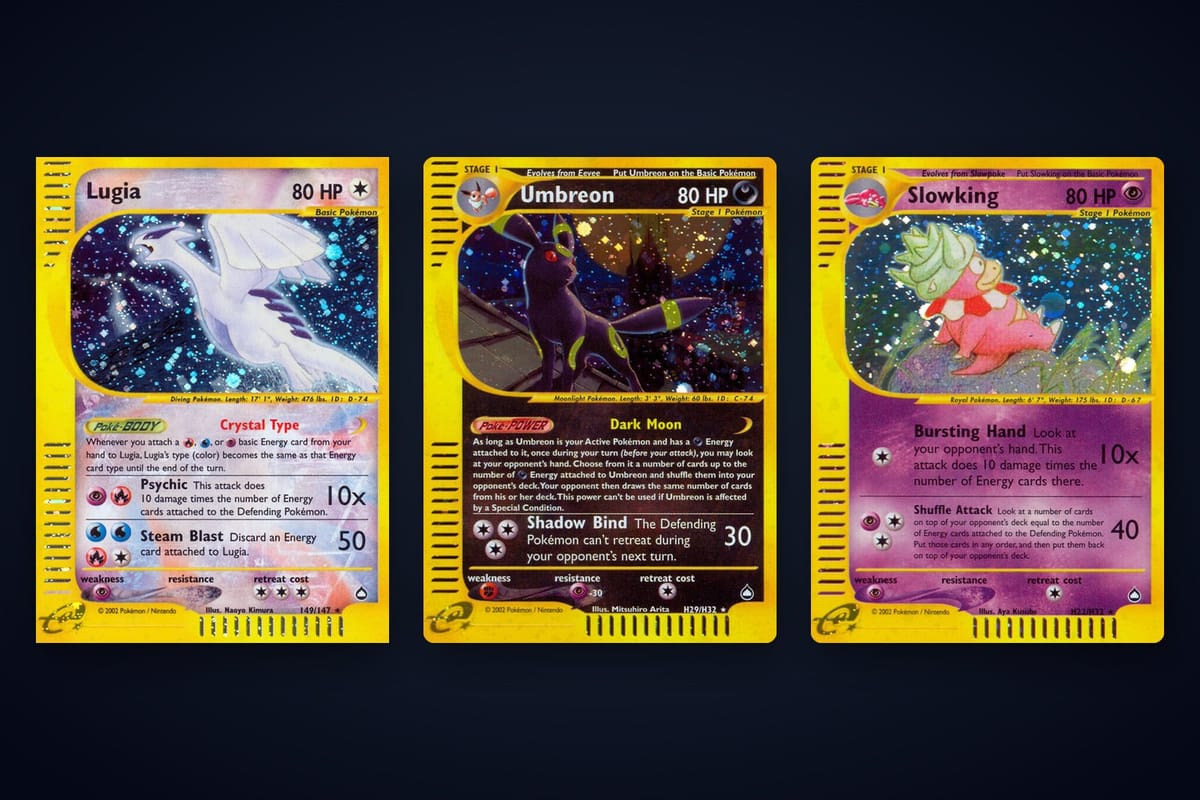
When comparing Aquapolis PSA 9 vs PSA 10 value, understanding the price differences card by card is important. This comparison reviews population reports, pricing data, and market trends for Aquapolis cards—especially key holos like Espeon, Umbreon, Arcanine, Lugia, and Ninetales—to help collectors decide whether chasing a PSA 10 premium is worth it or if a PSA 9 is a better investment.
Card values — live data from Midpoint's card database, as of 2026-09-21. Prices move; Midpoint refreshes these daily.
| Card | Raw | PSA 10 | Gem premium | |
|---|---|---|---|---|
 |
Lugia #149/147 Aquapolis (2003) |
$1,400 | $114,371 | 81.7× |
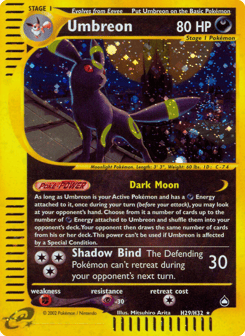 |
Umbreon #H29/H32 Aquapolis (2003) |
$12.89 | $36,175 | 2806.5× |
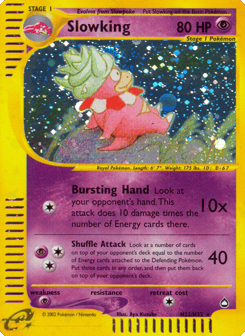 |
Slowking #H22/H32 Aquapolis (2003) |
$599.99 | $29,103 | 48.5× |
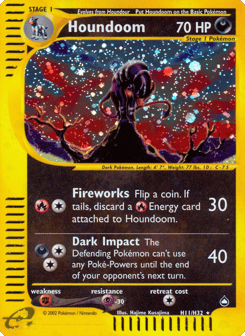 |
Houndoom #H11/H32 Aquapolis (2003) |
$12.54 | $19,114 | 1524.3× |
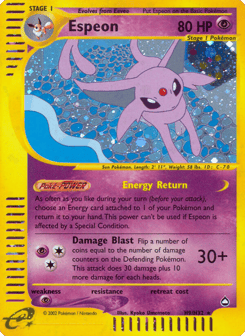 |
Espeon #H9/H32 Aquapolis (2003) |
— | $18,957 | — |
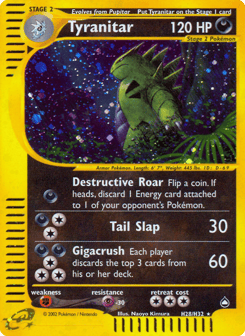 |
Tyranitar #H28/H32 Aquapolis (2003) |
— | $15,591 | — |
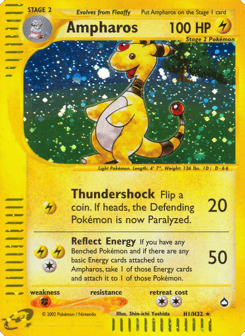 |
Ampharos #H1/H32 Aquapolis (2003) |
$350.00 | $13,594 | 38.8× |
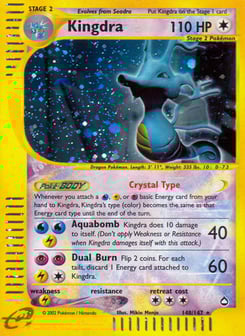 |
Kingdra #148/147 Aquapolis (2003) |
$599.99 | $12,701 | 21.2× |
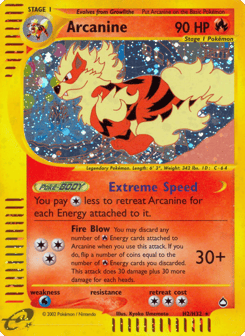 |
Arcanine #H2/H32 Aquapolis (2003) |
$490.00 | $11,677 | 23.8× |
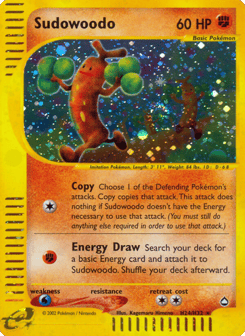 |
Sudowoodo #H24/H32 Aquapolis (2003) |
$165.00 | $10,621 | 64.4× |
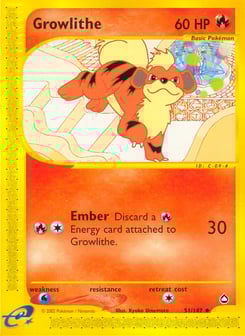 |
Growlithe #51/147 Aquapolis (2003) |
$74.99 | $8,750 | 116.7× |
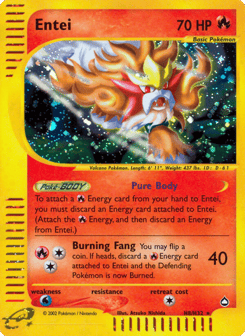 |
Entei #H8/H32 Aquapolis (2003) |
$159.99 | $8,520 | 53.3× |
Look up any card's current raw and graded value in Midpoint — and get an estimated grade before you pay to submit.
Quick Comparison
| Card | PSA 9 Price (USD) | PSA 10 Price (USD) | PSA 10 Premium | Population PSA 9 | Population PSA 10 |
|---|---|---|---|---|---|
| Espeon Holo | $1,200 | $4,000 | 3.3x | 350 | 70 |
| Umbreon Holo | $900 | $3,200 | 3.6x | 400 | 80 |
| Lugia Holo | $1,500 | $4,000 | 2.7x | 300 | 65 |
| Arcanine Holo | $700 | $2,100 | 3.0x | 420 | 90 |
| Ninetales Holo | $650 | $1,000 | 1.5x | 500 | 110 |
| Slowking Reverse Holo | $200 | $250 | 1.25x | 600 | 150 |
| Kingdra Reverse Holo | $180 | $230 | 1.28x | 580 | 140 |
| Magikarp Non-Holo | $50 | $70 | 1.4x | 800 | 200 |
Price Differences & PSA 10 Premiums in Aquapolis
The price difference between PSA 9 and PSA 10 for Aquapolis cards is a frequently discussed topic among collectors and investors. Based on data as of 2026-09-21, the premium for a PSA 10 over a PSA 9 varies substantially by card rarity, holo type, and population scarcity.
- Major Holos Show the Biggest Jumps: Cards like Espeon and Umbreon often exhibit PSA 10 premiums exceeding 3x the PSA 9 price. This reflects collector demand for high-quality centering, surface, edges, and corners on these iconic cards.
- Moderate Premiums for Key Holos: Lugia and Arcanine have premiums around 2.7x to 3.0x, still substantial but slightly less than the top-tier holos.
- Lower Premiums on Some Holos and Reverse Holos: Ninetales Holo and reverse holo cards such as Slowking and Kingdra show smaller PSA 10 premiums, often under 1.5x. These cards typically have higher population counts and less scarcity in top grades.
- Non-Holo Cards Have Minimal Price Spread: Non-holo cards like Magikarp show smaller price gaps, indicating that the PSA 10 premium is less critical for these.
Understanding these premiums helps collectors decide whether the jump from PSA 9 to PSA 10 justifies the additional cost and grading risk.
Population Report Analysis: Scarcity Drives Value
Population reports for Aquapolis PSA 9 and PSA 10 cards reveal insights into scarcity and gem rate thresholds:
- Lower PSA 10 Populations: For many major holo cards, PSA 10 populations are roughly 15-25% of PSA 9 populations. This scarcity can partly explain the price premiums.
- Gem Rate Impact: The gem rate (percentage of submissions achieving PSA 10) tends to be low for top-tier holos like Espeon and Umbreon, often under 20%, indicating the difficulty of obtaining a PSA 10.
- Reverse Holos and Non-Holobase Cards: These generally have higher gem rates and larger populations at PSA 10, contributing to smaller premiums.
- Some Outliers: Cards like Ninetales Holo have a higher PSA 10 population relative to PSA 9, resulting in a smaller premium and indicating less pronounced scarcity.
Population data is an important factor in evaluating whether a PSA 10 premium is justified or if a PSA 9 is a strong value proposition.
Raw vs PSA 9 vs PSA 10: Value Growth Through Grading
Another way to assess Aquapolis grading value is comparing raw card prices to PSA 9 and PSA 10 values:
- Raw Cards: Often priced at 30-50% of PSA 9 values, raw cards represent the entry point but come with condition uncertainty and grading risks.
- PSA 9 Cards: Offer a substantial value increase over raw cards due to verified condition and collectible appeal. For many cards, PSA 9 is a sweet spot offering high value without the extreme premium of PSA 10.
- PSA 10 Cards: Command the highest prices, reflecting near-perfect centering, edges, corners, and surface. However, the premium can be 3x or more, especially on coveted holos.
Collectors should weigh the cost of submission fees and potential resubmission when deciding whether to pursue PSA 10 or settle on PSA 9. Tools like Midpoint can help estimate grading chances before committing.
Reverse Holos and Non-Holos: Smaller Premiums and Different Dynamics
Reverse holo and non-holo cards in Aquapolis generally have different market dynamics compared to holos:
- Smaller PSA 10 Premiums: These cards often have PSA 10 premiums below 1.5x the PSA 9 price, reflecting more abundant gem-quality examples.
- Better Value in PSA 9: Because of the smaller price gap, purchasing PSA 9 reverse holos can be a more economical choice with less sacrifice in value.
- Higher Population Counts: The higher number of PSA 10 grades means less scarcity, which keeps premiums low.
For example, Slowking Reverse Holo is priced around $200 PSA 9 and $250 PSA 10, only a 25% premium as of 2026-09-21.
Grade Premium Thresholds: When Is PSA 10 Worth It?
Judging if a PSA 10 premium is justified involves understanding scarcity, population, and market demand:
- High Demand + Low PSA 10 Population = Worthwhile Premium: Cards like Espeon and Umbreon fit this category, where the 3x+ premium reflects market scarcity.
- Moderate Demand or Larger PSA 10 Populations = Small Premiums: Cards such as Ninetales Holo or reverse holos may not justify expensive PSA 10 chasing.
- Submission Economics: Grading fees and potential crack-and-resub costs should be factored into whether pursuing PSA 10 is economical.
Using AI grading tools like Midpoint’s digital grader can help optimize submission decisions and avoid overspending on marginal grade improvements (learn more here).
Which Should You Choose?
Deciding between a PSA 9 or PSA 10 Aquapolis card depends on your goals, budget, and risk tolerance:
- Collectors Seeking Display Perfection: If the goal is a pristine collection or investment, PSA 10 is ideal despite the higher premium, especially for marquee holos like Espeon, Umbreon, and Lugia.
- Investors Seeking Value and Liquidity: PSA 9 offers a strong value proposition with significantly lower cost and higher population, making it easier to buy and sell.
- Budget-Conscious Buyers: PSA 9 cards deliver most of the collectible appeal at a fraction of the PSA 10 cost, particularly on cards with smaller grade premiums.
- Reverse Holo and Non-Holo Collectors: PSA 9 is often the smarter buy given narrow price gaps and abundant PSA 10 availability.
Before submitting your own cards, use Midpoint to digitally grade and assess centering and condition, helping you make informed decisions and avoid costly resubmissions.
FAQ
Is it better to buy Aquapolis cards in PSA 9 or PSA 10?
For many collectors, PSA 9 offers excellent value with verified condition and significantly lower prices than PSA 10. However, for top-tier holos with large PSA 10 premiums (like Espeon or Umbreon), PSA 10 is often preferred if budget allows.
Which Aquapolis cards have the biggest PSA 10 premium over PSA 9?
Espeon and Umbreon holos typically lead with premiums over 3x, followed by Arcanine and Lugia around 2.7x to 3x. Reverse holos and non-holos generally show much smaller premiums.
How much more is a PSA 10 Aquapolis card worth than a PSA 9?
PSA 10 cards can be worth from about 1.25x to over 3.5x the price of PSA 9 depending on the card, with major holos commanding the highest premiums.
Do Aquapolis PSA 9 prices hold value well compared with PSA 10?
PSA 9 prices remain strong due to their relative abundance and verified high quality, often representing a sweet spot for collectors and investors.
Which Aquapolis cards are the best value in PSA 9 because PSA 10 is too expensive?
Reverse holo cards like Slowking and Kingdra, and non-holos such as Magikarp, are often best bought in PSA 9 as PSA 10 premiums are minimal and may not be justified.
How do population reports affect Aquapolis PSA 9 vs PSA 10 pricing?
Population scarcity at PSA 10 tends to drive higher premiums. Cards with low PSA 10 populations but high demand have larger premiums, while cards with more abundant PSA 10s have smaller price gaps.
Free to start
Try the Midpoint app
Grade any card from a photo, see its raw and PSA 10 value, and track what your collection is worth — free.
Get it on iPhoneGet it on Android