1954 Bowman Baseball Cards Value: Prices & Grading
See 1954 Bowman baseball cards value, key rookie cards, variations, graded premiums, and which cards are worth submitting.

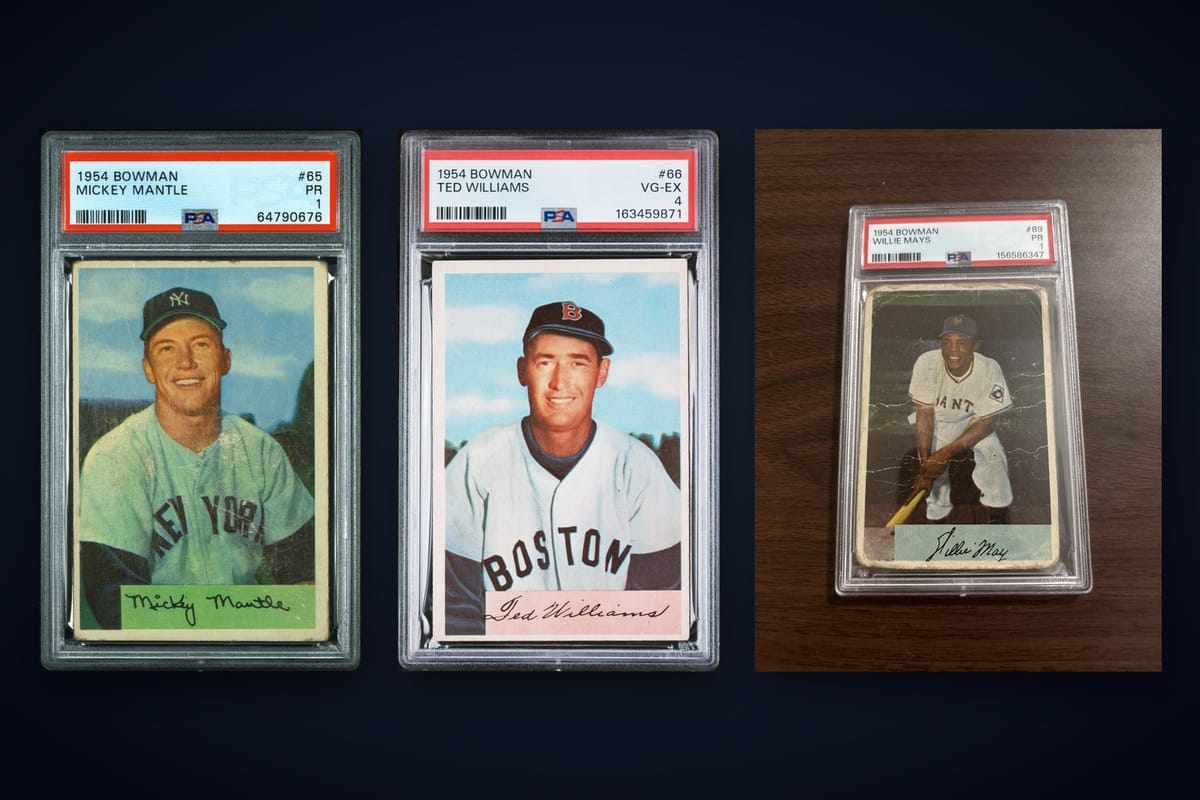
Estimated reading time: 16 min
Key Takeaways
- 1954 Bowman baseball cards value is driven by star power, scarcity, centering, and whether a card is a key variation or short print.
- The set has 224 cards in a 2½" × 3¾" format, and original packaging and handling affect survival rates and collector demand.
- The biggest names in the set include Mickey Mantle #65, Ted Williams #66, Willie Mays #89, Yogi Berra #161, and Phil Rizzuto #1.
- Condition matters a lot: raw cards, PSA-graded cards, and SGC-graded cards can diverge sharply, especially for Hall of Famers and high-grade examples.
- Some 1954 Bowman cards are worth grading, but only if the centering, corners, edges, and surface justify the submission cost.
Card values — live data from Midpoint's card database, as of 2026-11-08. Prices move; Midpoint refreshes these daily.
| Card | Raw | PSA 10 | Gem premium | |
|---|---|---|---|---|
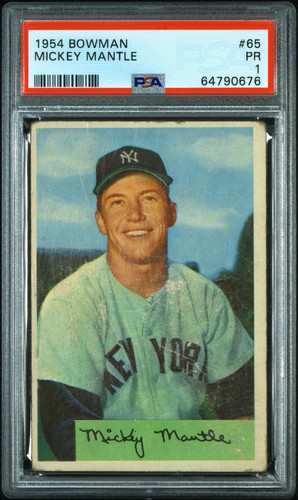 |
Mickey Mantle #65 1954 Bowman |
$933.31 | $472,952 | 506.8× |
 |
Ted Williams #66 1954 Bowman |
$2,008 | $460,502 | 229.3× |
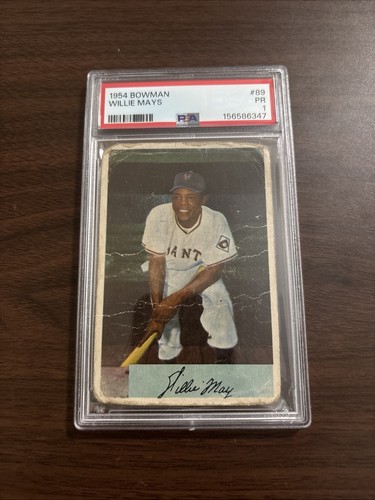 |
Willie Mays #89 1954 Bowman |
$262.26 | $60,181 | 229.5× |
 |
Pee Wee Reese #58 1954 Bowman |
$39.24 | $30,000 | 764.5× |
 |
Whitey Ford #177 1954 Bowman |
$33.00 | $21,600 | 654.6× |
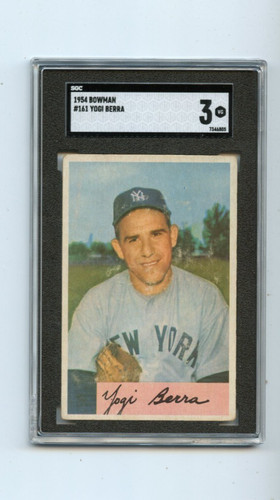 |
Yogi Berra #161 1954 Bowman |
$72.41 | $13,492 | 186.3× |
 |
Duke Snider #170 1954 Bowman |
$48.47 | $11,106 | 229.1× |
 |
Ed Mathews #64 1954 Bowman |
$46.96 | $10,477 | 223.1× |
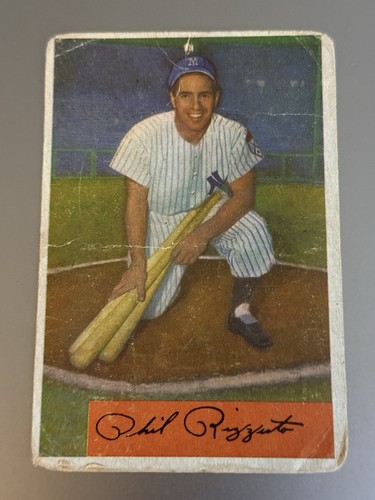 |
Phil Rizzuto #1 1954 Bowman |
$42.22 | $9,474 | 224.4× |
 |
Bob Feller #132 1954 Bowman |
$38.50 | $8,836 | 229.5× |
 |
Roy Campanella #90 1954 Bowman |
$28.52 | $8,629 | 302.6× |
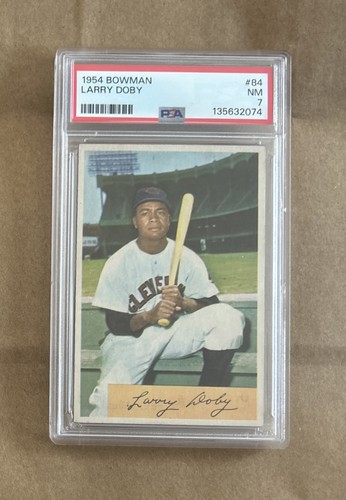 |
Larry Doby #84 1954 Bowman |
$31.16 | $7,138 | 229.1× |
Look up any card's current raw and graded value in Midpoint — and get an estimated grade before you pay to submit.
Table of Contents
- Section 1: Set overview and checklist basics
- Section 2: The most valuable cards in the set
- Section 3: Ted Williams #66 and the production withdrawal story
- Section 4: Card values by condition and grading company
- Section 5: Which cards are worth grading
- Section 6: Variations, errors, and rookie cards
- Section 7: Authentication, set value, and buying smart
Section 1: Set overview and checklist basics
What the 1954 Bowman set includes
The 1954 Bowman baseball cards value conversation starts with the set itself. Bowman’s 1954 issue contains 224 cards in a 2½" × 3¾" format, which is slightly narrower than the contemporary Topps issues. The color-photo design gives the cards a bold, display-friendly look, but the thin cardboard also makes them vulnerable to edge wear, corner softness, and centering problems.
Original packaging and distribution also shaped survival rates, because cards handled, stored, and traded in different ways often show different wear patterns. That matters for collectors assembling a complete run and for investors looking for tougher-to-find names.
Collectors value 1954 Bowman for a mix of design appeal and star power. The checklist includes Hall of Famers, superstar veterans, and notable first-year cards, so it is not just a “commons set.” It is a true mid-1950s baseball landmark.
Checklist structure and what collectors chase
The checklist is attractive because it spreads value across several tiers. At the top, you have icons like Mantle, Williams, and Mays. In the middle, you have strong Hall of Fame names and desirable stars. At the lower end, commons can still matter when they are clean, sharply centered, or needed to complete a high-grade set.
- Star cards: the biggest value drivers.
- Rookies and first-year cards: important to team collectors and player collectors.
- Variations: often underappreciated, but sometimes premium-worthy.
- Condition-sensitive commons: valuable for set builders seeking superior eye appeal.
If you are building the set, use a checklist that tracks card number, variation status, and grade potential. That becomes especially important when comparing raw cards to graded copies.
Pack format and survival reality
Because 1954 Bowman cards are thin vintage cardboard, they were easy to nick and misalign during storage. That means eye appeal can separate similar raw cards dramatically. A card with strong centering and clean corners can beat a technically “higher” card with poor presentation.
Before buying, many collectors use a centering-first approach. A tool like Midpoint helps evaluate whether a card is even a candidate for grading before you spend money on submission fees. If you are new to pre-screening, the process is explained well in How to Pre-Grade Your Card: A Step-by-Step Guide.

Section 2: The most valuable cards in the set
The headline names that drive the market
The most valuable 1954 Bowman cards are the stars every collector recognizes immediately. The market tends to reward the same core names repeatedly: Mickey Mantle #65, Ted Williams #66, Willie Mays #89, Yogi Berra #161, and Phil Rizzuto #1. These cards anchor the set’s upper end, and when they appear in strong condition, the gap versus commons is enormous.
That premium comes from several forces at once: player demand, Hall of Fame status, set completion demand, and scarcity in nice shape. For many collectors, these are not just cards. They are the reasons to buy the set in the first place.
Why the key cards trade differently
1954 Bowman baseball cards value is not only about the player name. It is also about how many copies survive with acceptable centering and intact surface gloss. Vintage cards are hard to keep clean, so truly attractive examples are fewer than raw counts might suggest.
- Mickey Mantle #65: one of the first cards most buyers search for.
- Willie Mays #89: perennial blue-chip demand.
- Ted Williams #66: historically complicated and highly watched.
- Yogi Berra #161: strong Hall of Fame and Yankees demand.
- Phil Rizzuto #1: a set-opening card with strong collector attention.
The market also rewards visual quality. Two raw cards can look similar in photos, but a sharper, better-centered example often commands more interest. If you are comparing raw versus slabbed inventory, a grading estimate can help separate cards that deserve submission from those that are better sold raw.
Hall of Famers and secondary stars
Beyond the headline names, the set includes many other Hall of Famers and notable players who keep demand broad. That matters for collectors who cannot afford Mantle or Williams but still want a premium piece of the checklist. A well-chosen Hall of Famer in very good or excellent condition can be a smarter buy than a beat-up star.
Use that logic when shopping the set as a whole. The cards with the best blend of fame, rarity, and eye appeal tend to hold demand best, especially in high grade. For deeper insight into how grading impacts resale and protection, see Card Grade Impact on Insurance Value: The Ultimate Guide.
Section 3: Ted Williams #66 and the production withdrawal story
Why #66 is the set’s most discussed card
If one card defines 1954 Bowman baseball cards value, it may be Ted Williams #66. The card is famous not just because Williams is an all-time great, but because of the production story surrounding it. Williams was under an exclusive contract with Topps, so Bowman pulled his card from production and replaced #66 with Jim Piersall. Collectors have long focused on the Williams card’s scarcity as a result.
The result is that #66 carries a reputation that extends beyond simple player demand. It is a conversation piece, a checklist centerpiece, and a card many collectors intentionally target first when building the set.
Scarcity, replacement, and market impact
Bowman’s decision to pull Williams and substitute Piersall created a story that collectors remember. The card’s scarcity narrative increases attention from both set builders and type-card buyers. When a card is known for production complications, demand often becomes concentrated because collectors know it is one of the tougher cards to source in clean, presentable condition.
This is why #66 often behaves like a true key card rather than just another Hall of Fame issue. The combination of history and demand pushes price sensitivity higher in all grades, and especially in strong-looking raw examples.
What buyers should watch for
When evaluating Ted Williams #66, buyers should focus on:
- Centering on both front and back
- Corner shape, especially on vintage cardboard
- Surface gloss and print clarity
- Any signs of trimming or recoloring
Because this card is so famous, it is also heavily scrutinized. A card that looks too sharp for its grade range should be checked carefully. That is where precise pre-grading can help. A card that is off-center or shows edge wear may still be collectible, but it may not justify grading unless the raw-to-slab premium is likely to outweigh the fee.
For buyers who want to cross-check the centering component before submission, the Free Centering Calculator can help quantify the visual balance instead of relying only on eyeballing the borders.
Section 4: Card values by condition and grading company
Raw condition tiers and why they matter
The most useful way to think about 1954 Bowman price guide data is by condition. Raw cards in poor condition, good, very good, excellent, EX-MT, and NM can vary dramatically. The jump from a worn example to a sharp one is often bigger than new collectors expect, because this set is heavily affected by centering and preservation.
As of 2026-11-08, the app’s database shows separate raw-card and graded-card values for individual entries, which is the right way to think about the market. A raw card’s value is not just the card number; it is the card number plus what condition the market believes it will grade. That is why some cards are worth buying raw and others are only worth paying up for if already slabbed.
PSA, SGC, and raw-card differences
Ungraded versus graded pricing is one of the biggest levers in vintage baseball. PSA examples often command the widest premium when the card is truly high grade. SGC can also perform strongly, especially for vintage collectors who prefer its slab style and consistent presentation. Raw cards can be a bargain, but only when the buyer is confident about authenticity and condition.
For 1954 Bowman baseball cards value, the spread between raw and graded can be meaningful because these cards are hard to center and hard to keep crisp. The market rewards cards that look strong under the light, not just cards that are technically intact.
How to think about PSA 10 value
Searchers often look for 1954 Bowman PSA 10 value, but PSA 10 examples are exceptionally rare in vintage material and should be treated as outlier premiums rather than normal comps. The practical takeaway is simpler: if a card looks like it could support a top-end grade, it deserves a careful review of corners, edges, surface, and centering before submission.
For collectors comparing companies, it helps to understand top-grade standards and how they differ. This overview is useful: Grading Scale Differences by Company: PSA, BGS, CGC & the True Meaning of Top Grades.
When grading is part of the plan, use data and not hope. That is especially true for cards near the submission threshold, where a borderline centering profile can erase profit.
Section 5: Which cards are worth grading
The best grading candidates in the set
Not every 1954 Bowman card should be graded. The best candidates are the cards where the potential slab premium is large enough to cover the fee, shipping, and waiting time. That usually means high-end stars, strong Hall of Famers, and select rookies or variations in clean condition.
The cards most likely to be worth grading are the big names in top raw condition, especially if the centering and surface are clean. A card with strong gloss, sharp print, and minimal border wear can justify submission much more easily than a low-end common.
Practical grading checklist
Before sending a card in, review the four pillars of visual quality:
- Centering: border balance front and back
- Corners: no major fraying or rounding
- Edges: no chips, dings, or rough cuts
- Surface: no paper loss, stains, scratches, or print issues
That is why collectors increasingly pre-grade digitally. Midpoint is useful here because it combines centering measurement with AI-based estimates so you can screen cards before you pay to submit them. If you are trying to decide whether a vintage card is slab-worthy, start with Card Centering Tool: Accurate Card Grading Estimates and then compare the visual result against the card’s market premium.
When raw is better than graded
Sometimes a raw card is the better sale. If a card has obvious wear, weak corners, or centering problems, paying for grading can destroy margin. In those cases, the card should be priced as a solid raw collectible rather than a speculative slab candidate.
On the other hand, if you own a strong Mantle, Mays, or Williams with excellent presentation, grading can unlock a better buyer pool. That is especially true for collectors who prefer registry sets or authenticated high-end vintage. For storage after purchase, the handling advice in How to Store Valuable Cards: The Ultimate Collector's Guide is worth following because vintage paper is unforgiving.
Section 6: Variations, errors, and rookie cards
The role of variations in value
One reason collectors chase 1954 Bowman baseball cards value so aggressively is the set’s variation landscape. The best-known example is the Williams/Piersall #66 situation, and collectors also catalog other printing differences, such as statistical or printed-name changes, that can affect desirability. Some collectors ignore them, but advanced set builders often pay premiums for the right variation in the right condition.
Variations matter because they create scarcity within a set that is already famous. A common card can become a much more interesting buy if it is one of the recognized printing differences.
Notable rookie and first-year cards
The set also contains notable rookie and first-year cards that broaden demand beyond the biggest stars. The best-known example is Al Kaline #8, which is his rookie card. Check a reliable checklist before assuming any other card in the set is a true rookie, since several players often described that way had earlier cards. These cards matter because team collectors, player collectors, and vintage rookie collectors all pursue them for different reasons.
- Al Kaline #8: a Hall of Fame rookie card that is important to Tigers and vintage rookie collectors.
Rookies can outperform expectation when they are clean and well-centered. A strong rookie in a high grade may not reach the same dollar level as Mantle or Williams, but it can still be one of the smartest value purchases in the set.
How collectors should weigh error cards
Not every variation is a must-buy. Some differences are minor and only matter to deep specialists. The right approach is to identify which variations are recognized, desirable, and visually obvious enough to have a market. When in doubt, compare recent sales of the exact variation rather than assuming every difference adds value.
Because these cards can be difficult to sort correctly, a precise checklist and image review process helps prevent expensive mistakes. That is another place where digital pre-grading and centering measurement save time.
Section 7: Authentication, set value, and buying smart
How to identify authentic 1954 Bowman cards
Authenticating 1954 Bowman cards means checking more than the front image. Start with the overall look: print quality, card stock feel, border consistency, and the sharpness of the image. Then examine the corners, edges, and surface under strong light. Authentic vintage cards often show natural aging, but they should still have consistent texture and printing characteristics.
Watch for trimming, recoloring, fake aging, and suspiciously clean edges. Vintage cards with wide borders are especially vulnerable to alteration because a trimmed border can be disguised fairly easily.
What drives complete-set and partial-set values
Complete-set values depend on more than just 224 card slots. The market considers how many key cards are included, whether variations are present, the condition distribution, and how many duplicates are in the lot. A set with sharp stars and strong centering can outperform a technically complete set that is full of mixed, heavily worn commons.
Partial sets are priced similarly. Buyers care about whether the group includes Mantle, Williams, Mays, Berra, or other premium names. A partial run with the right stars may be more desirable than a larger but weaker group of low-end cards.
- Card count: completeness matters.
- Duplicates: may add or subtract value depending on the cards.
- Condition spread: one rough card can drag down the lot.
- Centering: especially important for premium buyers.
As of 2026-11-08, the app’s card database helps compare raw and graded values side by side, which is exactly what you want before buying a set or a single key card. If you want a broader overview of how value and condition interact, Midpoint’s grading workflow can be a helpful shortcut to faster decisions.
For collectors who want to inspect cards efficiently, the app at Midpoint gives a practical way to estimate a grade, compare raw vs graded values, and measure centering down to the millimeter. That is especially useful when you are deciding whether a 1954 Bowman card is a hold, a flip, or a grading submission.
Conclusion
The 1954 Bowman set remains one of the most compelling vintage baseball issues because it combines star power, a distinctive color-photo design, important rookie and first-year cards, and meaningful variation-driven scarcity. If you are researching 1954 bowman baseball cards value, focus first on the key names, then on condition, centering, and whether the card should be graded.
In practice, the market rewards clean examples of Mantle, Williams, Mays, Berra, and Rizzuto most aggressively, while the rest of the set rewards careful eye appeal and smart checklist building. The smartest collectors do not guess. They compare raw and slabbed values, verify authenticity, and only submit cards that have a real chance to return more than the grading cost.
For that process, a reliable pre-grading workflow can save money and time. Midpoint offers a practical way to measure centering and estimate grades before you commit to submission, which is especially useful for vintage cards where margins matter.
FAQ
Q: What is the most valuable 1954 Bowman baseball card?
A: The most valuable card is typically one of the set’s big-name stars, with Mickey Mantle #65 and Ted Williams #66 among the most watched cards in the market. Final value depends on condition, grading, and eye appeal.
Q: How much is a 1954 Bowman Mickey Mantle #65 worth?
A: Its value depends heavily on raw condition and graded level. As of 2026-11-08, buyers should compare the app’s raw and graded entries for the exact card rather than relying on a single blanket estimate.
Q: How much is a 1954 Bowman Willie Mays #89 worth?
A: Like Mantle, the value varies by condition, centering, and whether the card is raw or slabbed. High-grade examples can carry a major premium over worn raw copies.
Q: What is a 1954 Bowman Ted Williams card worth?
A: Ted Williams #66 is one of the set’s marquee cards and is especially sensitive to condition and scarcity. Its market value should be checked against current raw and graded listings for the exact grade tier.
Q: How much is a complete 1954 Bowman baseball card set worth?
A: It depends on whether the set is complete, how strong the key cards are, the condition spread, centering, and whether duplicates or variations are included. A cleaner set with premium stars can be worth significantly more than a worn complete run.
Q: Are 1954 Bowman baseball card variations worth more?
A: Some are, especially recognized statistical or printed-name differences. The premium depends on how desirable the variation is and how strong the card is in hand.
Free to start
Try the Midpoint app
Grade any card from a photo, see its raw and PSA 10 value, and track what your collection is worth — free.
Get it on iPhoneGet it on Android