1959 Topps Football Cards Value: Stars, Rookies & Grades
1959 Topps football cards value explained: most valuable cards, rookies, PSA 10 gem premiums, set values, and which cards are worth grading before you submit.

Estimated reading time: 11 min
Key Takeaways
- 1959 Topps football cards value is driven by three things: the player (Hall of Famers like Unitas, Brown, and Starr lead), the card's condition, and the grading company's label.
- The set is 176 cards, and the Hall of Fame names in the checklist carry most of the price weight.
- The gap between a raw, off-center copy and a sharp, well-centered graded copy is where the money is. Gem-grade copies of vintage cards are scarce, so the premium is steep.
- Not every card is worth grading. Stars and key rookies usually justify the fee. Commons usually do not, unless they are very clean.
- Pre-check centering and surface before you submit. It costs nothing and prevents wasted grading fees.
Card values — live data from Midpoint's card database, as of 2026-09-04. Prices move; Midpoint refreshes these daily.
| Card | Raw | PSA 10 | Gem premium | |
|---|---|---|---|---|
 |
Johnny Unitas #1 1959 Topps |
$36.92 | $19,032 | 515.5× |
 |
Bobby Mitchell #140 1959 Topps |
$14.65 | $11,495 | 784.6× |
 |
Frank Gifford #20 1959 Topps |
$13.29 | $11,400 | 857.8× |
 |
Bobby Layne #40 1959 Topps |
$9.47 | $8,400 | 887× |
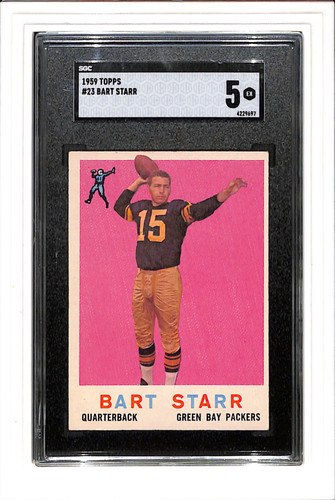 |
Bart Starr #23 1959 Topps |
$37.99 | $7,700 | 202.7× |
 |
Joe Perry #80 1959 Topps |
$5.50 | $6,086 | 1106.5× |
 |
Jerry Kramer #116 1959 Topps |
$31.54 | $5,940 | 188.3× |
 |
Alex Karras #103 1959 Topps |
$16.95 | $5,760 | 339.8× |
 |
Jerry Norton #79 1959 Topps |
$2.34 | $4,320 | 1846.2× |
 |
Hugh McElhenny #5 1959 Topps |
$5.63 | $3,928 | 697.7× |
 |
Paul Hornung #82 1959 Topps |
$19.99 | $3,906 | 195.4× |
 |
Sam Huff #51 1959 Topps |
$15.63 | $3,208 | 205.2× |
Look up any card's current raw and graded value in Midpoint — and get an estimated grade before you pay to submit.
Table of Contents
- Section 1: The 1959 Topps Football Set and How to Read a Price Guide
- Section 2: Most Valuable 1959 Topps Cards
- Section 3: Key Rookies and Hall of Famers Beyond the Top Names
- Section 4: How Condition Changes Value
- Section 5: PSA 10 Value and the Gem Premium Gap
- Section 6: Team Cards, Pennants, Complete Sets, and Wax
- Section 7: Authenticating, Grading Decisions, and Selling
Section 1: The 1959 Topps Football Set and How to Read a Price Guide
Before you can judge 1959 Topps football cards value, you need to know what you are looking at. The 1959 Topps football issue is a 176-card set. It uses the standard 2-1/2" x 3-1/2" size and features player cards with a checklist-style back. Check a reliable checklist for the exact layout of fronts and backs.
What is in the set
- Player cards: The bulk of the checklist, including many future Hall of Famers.
- Team cards: If a card you are looking at is a team card, collectors price it separately from player cards. Confirm against the checklist.
- Pennants: Be careful with pennant-style items sold alongside vintage Topps cards. Verify against the checklist that the item is actually part of this set.
- Card backs: Check the back for any printed panels or trivia. If a panel has been scratched or rubbed, that can hurt the grade.
How to use a 1959 Topps price guide
A 1959 Topps price guide is a starting point, not a quote. Guides list ranges by grade, and real sales often land above or below them depending on centering, eye appeal, and timing.
Use a price guide to compare raw and graded values for the same card, and check current sold listings before you buy or sell.
Raw versus graded values
A raw card is ungraded. Its price depends entirely on how convincing the photos and your own inspection are. A graded card has a third-party grade from PSA, SGC, or another company, which removes much of the doubt and usually widens the price range between grades.
- Raw prices are lower and more variable, because buyers discount for unknown flaws.
- Graded prices climb with the number on the slab, and the climb accelerates near the top.
- A card with a visible flaw can sell for far less than a clean copy with the same printed grade.
Keep this raw-versus-graded gap in mind through the rest of this guide. It decides which cards are worth submitting.
Section 2: Most Valuable 1959 Topps Cards
The most valuable 1959 Topps cards are generally the biggest Hall of Fame names. Check current raw and graded sales for each before you buy or sell.
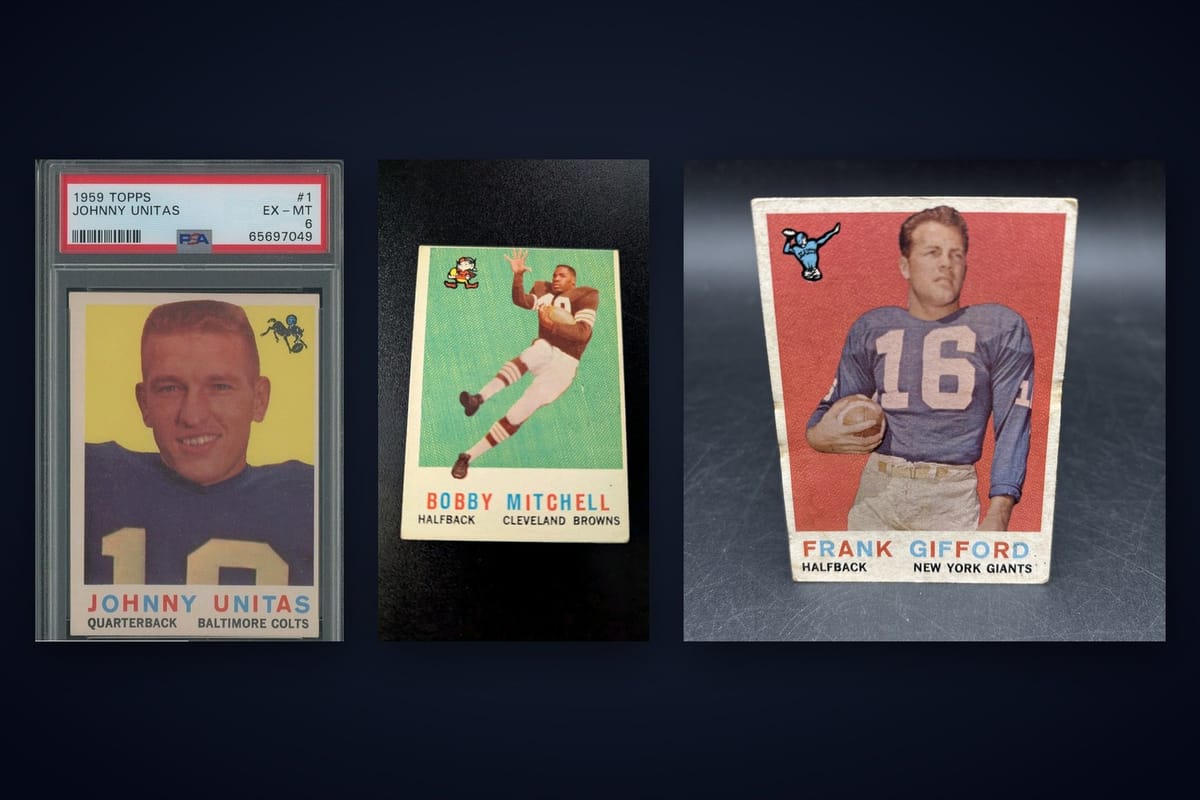
Johnny Unitas #1
Card #1 in any vintage set gets handled more than the rest. It sat on top of stacks, took the most corner wear, and often got rubber-banded. A Johnny Unitas #1 in sharp condition is therefore harder to find than the name alone suggests. His status as the face of the Baltimore Colts makes this a perennial top-tier card.
Jim Brown #10
Jim Brown is one of the most important names in football collecting. His #10 in this set is a core card for anyone building a 1950s Topps collection. Note that Brown's true rookie card is from 1958 Topps, so the 1959 is a second-year card. It still draws strong demand because of the player's legacy.
Bart Starr #23, Frank Gifford #20, Y.A. Tittle #130
- Bart Starr #23: Starr's Packers legacy keeps demand steady across grades.
- Frank Gifford #20: A Giants icon, with crossover appeal from his broadcasting career.
- Y.A. Tittle #130: A Hall of Fame quarterback with a strong collector following.
Why these five lead
Value is a mix of fame, demand, and survivability. Players who are household names pull the widest buyer pool. Cards that are tough to find in clean condition push graded prices up further.
Condition of individual copies also varies with how a card was printed, cut, and stored. Check current population and sales data for the specific card instead of assuming that one card is tougher than another.
Section 3: Key Rookies and Hall of Famers Beyond the Top Names
The headline stars are not the only cards to watch. Several other Hall of Famers and rookie-era cards carry real demand, and some can be better entry points for new collectors.
Rookie-era cards to know
- Jim Taylor #155: The Packers fullback and Hall of Famer's 1959 Topps card is a key rookie-era card for the set.
- Alex Karras #103: A Lions defensive lineman with a recognizable name outside football (he is not in the Pro Football Hall of Fame), which helps demand.
- Jim Parker #132: A Colts offensive lineman. Linemen sometimes sell at friendlier prices than quarterbacks, but Hall of Fame status supports the card.
- Jerry Kramer #166: A Packers guard with a devoted fan base, who was elected to the Hall of Fame in 2018.
- Bobby Mitchell #140: A Browns back and Hall of Famer, and another strong rookie-era target.
Other Hall of Famers
Sam Huff #51 is a defensive star of the Giants and a very recognizable name. He is a good example of a defensive Hall of Famer who typically sits well below the quarterbacks in price but above commons.
Finding value below the top tier
If you want vintage football without the highest price tags, build around these second-tier names. A cleanly centered copy of a lower-priced star often looks better in a binder than a heavily worn top-tier card, and may be a better value per dollar.
When comparing, ask three questions:
- Is the player a Hall of Famer, or just a good player of the era?
- Is this a rookie or second-year card? Rookies command a premium.
- Is the specific copy sharp, or does the price reflect real flaws?
For rarer slabs, see this guide on grading low population cards, which matters when only a handful of high grades exist for a vintage card.
Section 4: How Condition Changes Value
Vintage Topps cards from 1959 were not made with modern quality control. Cards were cut and printed with era-typical methods and sold in wax packs, so centering and print quality vary a lot. That makes condition the biggest swing factor in 1959 Topps football cards value.
Centering
Centering is the most common reason a good-looking card misses a high grade. Cards from this era are frequently off-center, so a well-centered example stands out and earns a premium. For the full picture, read how centering impacts card value.

You can measure the border ratios yourself with a tool like Midpoint before deciding whether a card is worth sending in.
Corners, edges, and surface
- Corners: Soft or rounded corners are the first sign of handling. Sharp corners on a 1959 card are noteworthy.
- Edges: Chipping along the border is easy to spot and lowers the grade.
- Surface: Look for scratches, print dots, gloss loss, wax stains, and staining from storage.
- Creases: Even a light crease usually caps the grade sharply, and it is a major value hit.
Print defects and the back of the card
Print defects such as fuzzy images, ink spots, and registration issues are common on vintage cardboard. They are usually considered part of the era, but severe ones still reduce the grade.
The back of the card deserves as much attention as the front. If any printed panel has been scratched or rubbed, the damage is visible and graders note it. Many sellers show only the front in listings, so ask for back photos.
Good storage also protects what value you have. See this guide on how to store valuable cards.
Section 5: PSA 10 Value and the Gem Premium Gap
Searchers often look for 1959 Topps PSA 10 value. The honest answer is that a PSA 10 on a 1959 Topps football card would be extremely rare, and sales of top-grade vintage are infrequent enough that a single result can move the number. Treat any specific figure as a snapshot, not a rule, and check it against recent sold listings and the population report.
Why the gem premium is so steep
A card from the 1950s has had over six decades to pick up flaws. The share that survives with sharp corners, clean surface, and strong centering is tiny. Buyers who want the best example available compete for very few copies, which widens the gap between grades.
- The step from a mid-grade to a high grade often brings a bigger percentage jump than the step from low to mid.
- The step into the top grade tends to be the largest of all.
- Population reports matter. A grade with only a few copies behaves differently from a grade with dozens.
PSA, SGC, and other graders
PSA slabs tend to be the benchmark for vintage football, and PSA grades often fetch higher prices than comparable grades from other companies. SGC is also well regarded for vintage and is popular with collectors who like its look and pricing. Always compare like with like: a PSA 8 and an SGC 8 are not interchangeable in the market. For the scale details, see grading scale differences by company.
Which 1959 Topps cards are worth grading
Here is a practical filter for 1959 Topps cards worth grading:
- Worth it: Hall of Famers and key rookies that look clean, with good centering and sharp corners. The raw-to-graded gap can more than cover the grading fee, which varies by company and service level.
- Maybe: Mid-tier stars with minor flaws. Grade only if the numbers work at your realistic expected grade.
- Usually not: Commons and heavily worn cards, where the slab fee can exceed the added value.
Be realistic. Estimate the grade you will actually get, not the one you hope for.
Section 6: Team Cards, Pennants, Complete Sets, and Wax
Beyond single player cards, collectors may price other categories on their own terms. Check the checklist to confirm what is actually part of the set.
Team cards and pennants
Team cards and pennants, where they exist, are not player cards, so they sit in their own pricing lane. Teams tied to a championship run, such as the Baltimore Colts and New York Giants, may attract extra interest because of the era's famous title games and the stars who played for them. The premium varies by condition and by buyer demand, so compare against recent sales instead of assuming a fixed markup.
- Team cards often have large flat areas, so surface flaws and creases are easy to spot.
- Pennants can be confused with team cards, so verify the item against the checklist.
Complete-set and partial-set value
A complete 176-card set is worth more than the sum of its parts only when the cards are consistently graded. Complete sets are valued by condition tier:
- Poor to fair: Display-quality sets with creases and wear. Lower price, but achievable for collectors who want the full checklist.
- Excellent: Cards show light wear but still look nice. This is a popular target range.
- Near-mint and graded: Very difficult to assemble. A set made of graded cards is priced on the combined grades, and the stars dominate the total.
Partial sets, such as a run of Hall of Famers or a team set, can be a smarter buy. You get the cards that matter without paying for every common in high grade.
Unopened packs, boxes, and display boxes
Sealed wax from 1959 is very scarce. Unopened packs, boxes, and display boxes trade at prices that depend on authentication, condition of the wrapper, and who is selling. Because tampered or resealed wax exists, buy only with clear provenance or third-party authentication, and treat any figure you see as a sold-listing snapshot.
Section 7: Authenticating, Grading Decisions, and Selling
Value only matters if the card is real and you sell it well. This section covers verification, pre-grading, and marketplace choices.
How to identify an authentic 1959 Topps football card
- Check the card number: Match the number on the card to the checklist. The set runs to #176.
- Confirm the type: Distinguish regular player cards from team cards and any other item that is not on the checklist.
- Inspect the print: Genuine vintage cards show a dot or rosette pattern under magnification. Modern reprints and counterfeits often look too clean or have mismatched stock.
- Check size and card stock: Compare to a known genuine card of the same set.
- Check the back: Look at the text for the correct layout, color, and wear that matches the front.
For high-value cards, third-party authentication is worth it, because a slab gives buyers confidence.
Pre-grade before you submit
Before you pay for grading, check centering, corners, edges, and surface. Midpoint offers AI digital grading with estimated PSA, BGS, CGC, and TAG grades, plus precise centering measurement, so you can see likely outcomes first. You can also use the free centering calculator, and follow this walkthrough on how to pre-grade your card. Midpoint also looks up raw and graded values across over 1.5 million cards, which helps you decide whether a grade is worth the fee.
Where to sell and what affects your net
- Auction sites and marketplaces: Wide reach, but fees come off your realized price.
- Auction houses: Better for high-end stars and sets, but with commissions and longer timelines.
- Local shops and shows: Faster, but usually at a discount to retail.
Your realized price depends on four things: card condition, whether it is graded, marketplace demand at the time, and total fees. Grade the cards that justify it, photograph front and back clearly, and list during a period of strong demand.
Conclusion
The 1959 Topps football cards value story is simple at the top and nuanced everywhere else. Unitas #1, Jim Brown #10, Starr #23, Gifford #20, and Tittle #130 lead the set, while rookie-era cards and Hall of Famers like Taylor, Parker, Kramer, Mitchell, and Huff, along with fan favorite Karras, offer strong secondary targets.
Condition drives everything. Centering, corners, surface, creases, and scratched or rubbed panels separate a cheap raw card from an expensive graded one, and the gem premium at the top is steep because high grades are so scarce.
Before you submit anything, estimate the grade honestly, compare the raw and graded figures, and make sure the fee makes sense. Midpoint can help you measure centering and estimate grades before you spend a dollar on submission.
FAQ
Q: How much are 1959 Topps football cards worth?
A: It depends on the player and condition. Commons in low grades are inexpensive, while Hall of Famers in high grades are worth far more. Check recent sold listings for the exact card and grade.
Q: What is the most valuable 1959 Topps football card?
A: The biggest values cluster around the top Hall of Fame names, including Johnny Unitas #1, Jim Brown #10, Bart Starr #23, Frank Gifford #20, and Y.A. Tittle #130. The exact ranking shifts with grade and recent sales.
Q: How much is a 1959 Topps Jim Brown #10 worth?
A: It varies widely by condition. A worn raw copy sells for far less than a high-grade PSA example. Look up the current raw and graded figures for #10 and compare them to recent sales before you buy or sell.
Q: What are the key rookie cards in the 1959 Topps football set?
A: Key rookie-era cards include Jim Taylor #155, Alex Karras #103, Jim Parker #132, Jerry Kramer #166, and Bobby Mitchell #140. Sam Huff #51 is another important Hall of Famer in the set.
Q: How much is a complete 1959 Topps football card set worth?
A: A complete 176-card set ranges widely based on condition, from poor-grade display sets to near-mint or graded sets. The stars account for most of the total, so the value depends heavily on the condition of the Hall of Famers.
Q: How does condition and PSA grading affect the value of 1959 Topps football cards?
A: Condition is the biggest value driver. Centering, corners, surface, creases, and scratched panels all lower grades, and the price gap grows steeply toward the top grades because high-grade copies are scarce.
Free to start
Try the Midpoint app
Grade any card from a photo, see its raw and PSA 10 value, and track what your collection is worth — free.
Get it on iPhoneGet it on Android