1940 Play Ball PSA 9 vs PSA 10 Value: Is a 10 Worth It?
1940 Play Ball PSA 9 vs PSA 10 value: how the 10 premium works, why centering decides it, and when a PSA 9 is the smarter buy for Williams, DiMaggio and more.

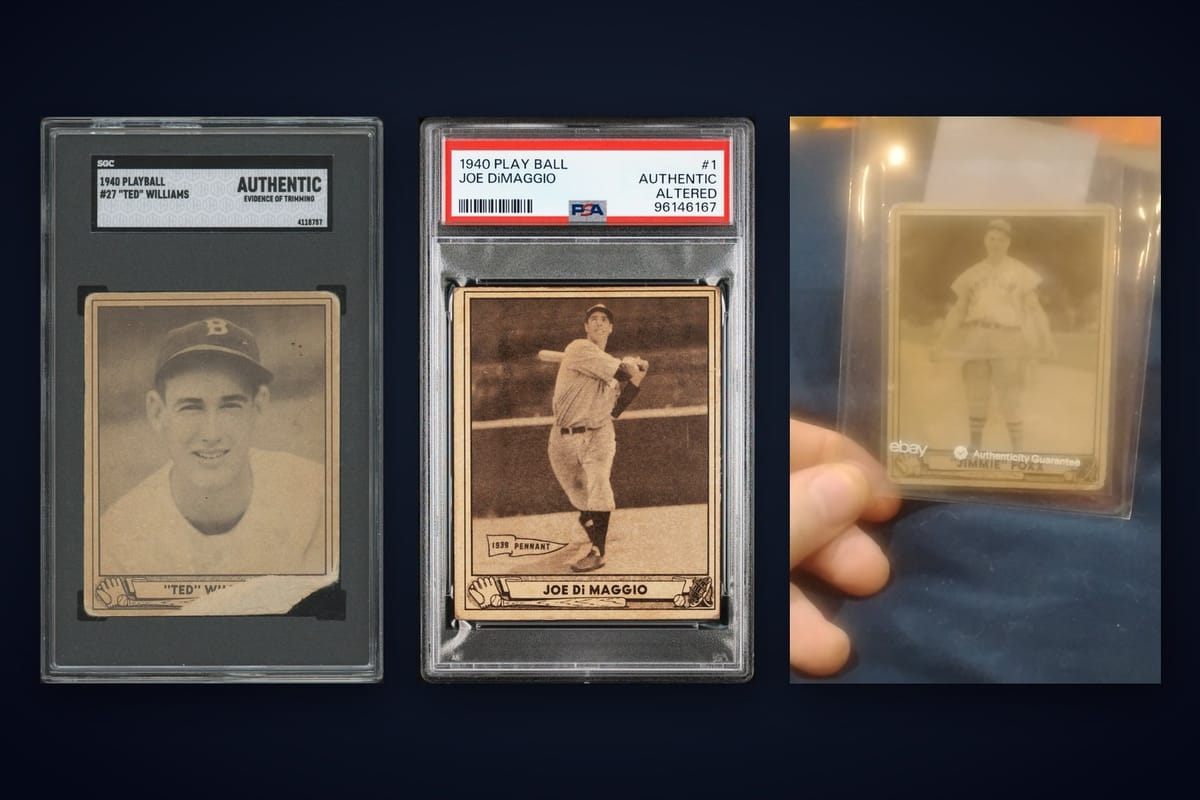
Estimated reading time: 8 min
Key Takeaways
- The 1940 Play Ball PSA 10 premium is often far larger than the gap on many modern cards, because vintage gem-mint copies are extremely scarce and often have no recent public sales.
- Centering, print registration and corner wear on these tinted vintage cards are what separate a 9 from a 10.
- Our card-by-card PSA 9 and PSA 10 values (as of 2026-11-08) are in the data table in this post. Check the multiple between the two columns before you decide.
- Bottom line: for most collectors a PSA 9 is the smarter buy. A PSA 10 is worth chasing only if you are building a registry-level set, have a long horizon, or can verify the card sells at its price.
This guide compares 1940 Play Ball PSA 9 vs PSA 10 value across the key cards: Ted Williams #27, Joe DiMaggio #1, Christy Mathewson #175 and Chuck Klein #102. The quick answer is that the 10 carries a steep premium, but a premium is not the same as a good return. For most buyers, a PSA 9 delivers most of the eye appeal at a fraction of the risk.
Card values — live data from Midpoint's card database, as of 2026-11-08. Prices move; Midpoint refreshes these daily.
| Card | Raw | PSA 10 | Gem premium | |
|---|---|---|---|---|
 |
Ted Williams #27 1940 Play Ball |
$1,210 | $410,784 | 339.6× |
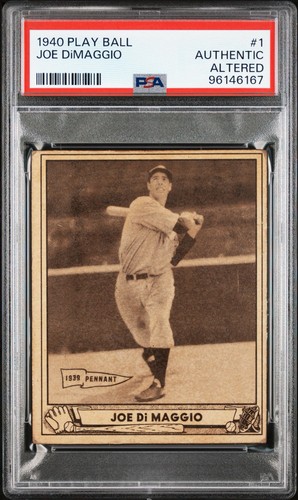 |
Joe DiMaggio #1 1940 Play Ball |
$777.76 | $270,316 | 347.6× |
 |
Jimmie Foxx #133 1940 Play Ball |
$244.84 | $83,318 | 340.3× |
 |
Christy Mathewson #175 1940 Play Ball |
$213.89 | $72,321 | 338.1× |
 |
Hank Greenberg #40 1940 Play Ball |
$217.50 | $68,328 | 314.2× |
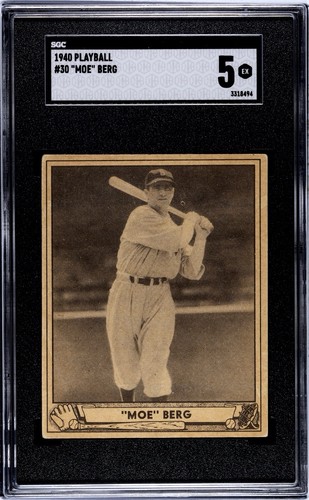 |
Moe Berg #30 1940 Play Ball |
$192.22 | $65,471 | 340.6× |
 |
Mel Ott #88 1940 Play Ball |
$153.16 | $52,887 | 345.3× |
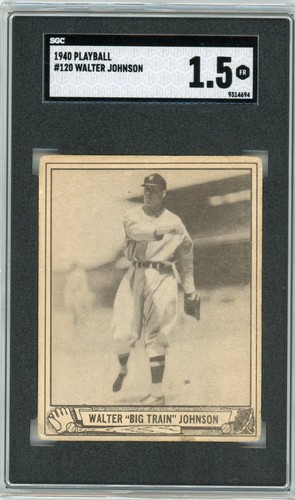 |
Walter Johnson #120 1940 Play Ball |
$187.26 | $50,245 | 268.3× |
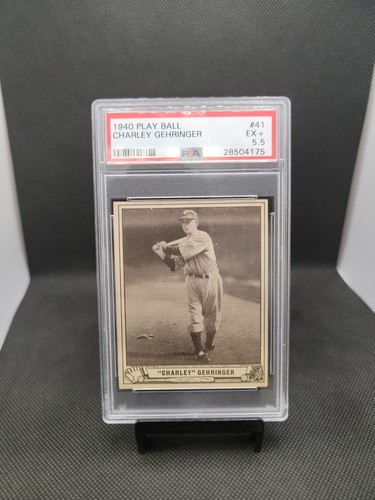 |
Charley Gehringer #41 1940 Play Ball |
$104.50 | $35,358 | 338.4× |
 |
Goose Goslin #232 1940 Play Ball |
$90.01 | $30,459 | 338.4× |
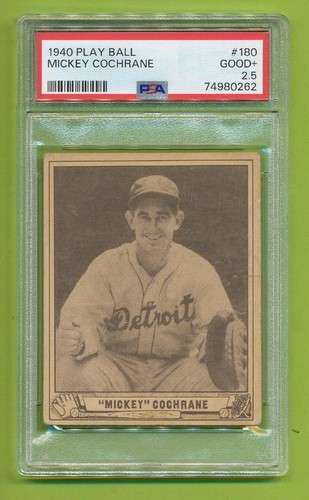 |
Mickey Cochrane #180 1940 Play Ball |
$86.24 | $30,452 | 353.1× |
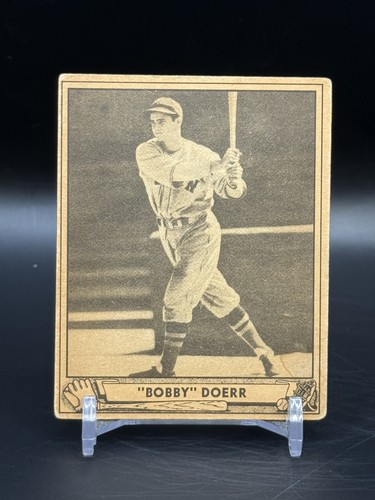 |
Bobby Doerr #38 1940 Play Ball |
$100.15 | $30,104 | 300.6× |
Look up any card's current raw and graded value in Midpoint — and get an estimated grade before you pay to submit.
Quick Comparison: PSA 9 vs PSA 10 for 1940 Play Ball
| Dimension | PSA 9 (Mint) | PSA 10 (Gem Mint) |
|---|---|---|
| Price level | Strong, but within reach of serious collectors | Typically a large multiple of the 9; see the data table (as of 2026-11-08) |
| Centering standard (PSA guidelines) | Roughly 60/40 front tolerance | Roughly 55/45 front tolerance |
| Supply | Scarce for the era, but findable | Extremely thin; some cards may have no known PSA 10 |
| Liquidity | Sales appear periodically | Often few or no recent public sales |
| Price discovery | Auction comps usually exist | Guide estimates can differ sharply from real auction results |
| Eye appeal difference | Very high; tiny flaws visible only up close | Near-flawless for the issue |
| Upside if upgraded | Limited unless resubmitted | Already at the top of the scale |
| Best for | Collectors and value-focused buyers | Registry builders and long-horizon investors |
Why the 1940 Play Ball PSA 10 Premium Is So Large
The PSA 9 vs PSA 10 price difference for 1940 Play Ball comes down to supply and demand at the very top of the scale. Gum Inc. printed these cards over 80 years ago. They were cut from sheets, stored in shoeboxes and handled by kids. Surviving copies that are sharp, clean and well centered are rare.
That rarity creates a bidding dynamic you do not always see in modern sets:
- Registry competition. A few buyers want the single best example of a card and may pay a steep premium for it.
- Tiny supply at the top. When only a handful of copies sit at the top grade, each sale can reprice the whole tier.
- No substitute. A PSA 9 cannot become a 10 without resubmission, and resubmitting a high-grade vintage card is rarely a good bet.
The result is that the 1940 Play Ball PSA 10 premium reflects scarcity and competition among a few bidders, not a proportional step in card quality. A 10 is not necessarily ten times better looking than a 9, but it can be priced that way.
Card by Card: Where the 9→10 Jump Matters Most
Our database lists PSA 9 and PSA 10 values for the cards below as of 2026-11-08. Use the data table in this post for the exact figures, then work out the multiple yourself by dividing the PSA 10 value by the PSA 9 value. That multiple is the number that matters, not the headline price.
Ted Williams #27
Williams is the biggest name in the set for many collectors. This is his 1940 issue, not his rookie card, but a Hall of Famer with a huge following drives demand at every grade. Because so many collectors want one, the gap between a 9 and a 10 tends to reflect how few top-grade copies exist, not just how popular he is.
Joe DiMaggio #1
As card number one in the set, DiMaggio may be exposed to a problem often cited for first cards in vintage sets: top-of-the-stack wear. Edges and corners on the lead card may have been more likely to be rubbed, which can make high grades harder to find than a mid-set card of similar fame. Compare the 9 and 10 values in the table to see how the market prices that difficulty.
Christy Mathewson #175
Mathewson was a long-retired legend by 1940, which adds Hall of Fame appeal and a following beyond the typical player card. Condition-sensitive scarcity can stack on top of that appeal. Check how the 10 premium compares with the other stars.
Chuck Klein #102
Klein is a Hall of Famer, but he likely draws less modern demand than Williams or DiMaggio. This is a useful test case. When a card has lower name-brand pull, a big PSA 10 premium is more likely to come from thin supply than from a bidding war. That can make it a riskier place to pay up.
When you compare the four, look for two things: the size of the multiple, and whether it makes sense given the player's popularity. A huge multiple on a less popular player is a warning sign.
What Separates a PSA 9 From a PSA 10 on These Cards
On 1940 Play Ball, the grade usually turns on a few specific traits. Knowing them helps you judge whether a 9 is a genuine 9 or a borderline 10, and vice versa.
- Centering. PSA's published standards allow tighter front centering at 10 than at 9. On vintage cards, borders can be uneven from the factory, so many otherwise clean cards fall short here. Our guide on how centering impacts card value explains why this single trait moves prices so much.
- Corners. Slight softness or fraying is enough to cap a card at 9.
- Print defects and registration. The color tinting over black-and-white photos can be off-register, and print dots or snow can appear. These are factory issues, not damage, but they can still affect the grade.
- Surface wear and staining. Gloss loss, light scratches and gum or wax staining are common on cards this old.
- Edges. Rough cuts and chipping are easy to spot on cards this old.
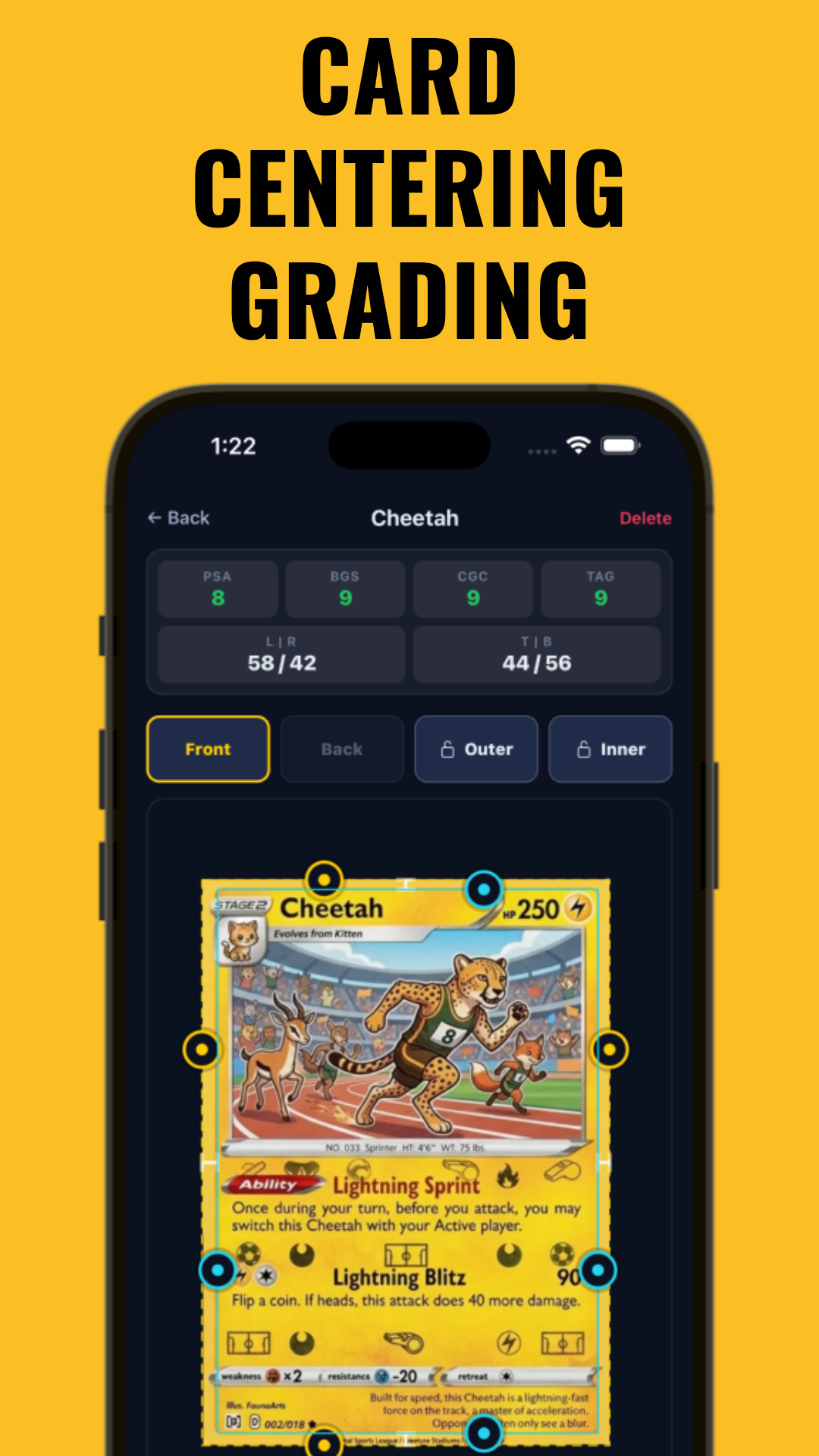
Centering is the trait you can check before spending anything. Midpoint's free centering calculator measures your borders, so you can see whether a card is even close to the 10 range.
Population Reports, Auctions and the Limits of PSA 10 Pricing
Before you pay a 10 premium, check the PSA population report for each card. You want three data points: total graded copies, the count at PSA 9, and the count at PSA 10. For some 1940 Play Ball cards, the PSA 10 count may be zero or close to it. Our guide to low population cards covers how to read those numbers.
Be aware of what a PSA 10 value really means when there are few or no sales:
- Price guides estimate; auctions decide. A guide value for a rarely traded PSA 10 may be an extrapolation, not a transaction.
- One sale can set the market. With so few copies, a single result can swing the apparent value.
- Check the details. Look at the auction house, sale date and fees on any comp you use. Do not rely on a number without a date attached.
- Bidders matter. Two determined buyers can push a result above what the card would normally bring.
If a card has no known PSA 10, any PSA 10 price is hypothetical. In that case the PSA 9 is effectively the top of the market, and its value is the real benchmark.
Is a PSA 9 Worth It? How to Compare Against Raw, PSA 7 and PSA 8
For most buyers, the question is not 9 versus 10 but whether a 9 is a sensible place to stop. To judge 1940 Play Ball grading value, line up the whole price ladder: raw, PSA 7, PSA 8, PSA 9 and PSA 10.
- Look at each step. If the jump from 8 to 9 is modest but 9 to 10 is enormous, the 9 is the efficient purchase.
- Estimate your grading odds. A raw card that might grade 9 on a good day and 7 on a bad day is a gamble. Our pre-grading guide walks through how to judge that before you submit.
- Subtract costs. Grading fees, shipping, insurance and selling fees all reduce your margin.
- Check the downside. Compare the value at the grade you realistically expect, not the grade you hope for.
A PSA 9 is worth it when you want the card, not just the label. It gives you a sharp, authentic example of a Hall of Famer without paying a scarcity premium for the last small step. It also tends to have more sales history, so you can usually price it with more confidence. Understanding how grading scales differ by company helps you compare a PSA 9 to equivalents from other graders.
Which Should You Choose?
- Collector who wants a great-looking card: buy the PSA 9. You get most of the visual quality and a more liquid asset.
- Budget-conscious buyer or value hunter: a PSA 9, or even a PSA 8, offers a better price per unit of eye appeal. Check the 8-to-9 step first.
- Registry set builder: a PSA 10 may be the only way to compete. Verify the population, buy from a reputable auction house, and expect to hold.
- Investor: be cautious. Thin PSA 10 markets mean wide spreads and uncertain exits. A 9 is easier to sell.
- Owner of a raw card: measure centering first. If it is far from the 10 range, do not count on a 10 payout. Run the card through Midpoint for an AI grade estimate and raw versus graded values before you pay to submit.
- Anyone holding a high-grade card: protect it. See our guide to storing valuable cards.
Verdict: the 1940 Play Ball PSA 10 premium is real, but it rewards scarcity, not a proportional jump in quality. Buy the 10 only when you have a clear reason. Otherwise, the PSA 9 is the smarter buy.
FAQ
How much is a 1940 Play Ball Ted Williams PSA 9 worth compared with a PSA 10?
The exact figures for Williams #27 are in the data table in this post (as of 2026-11-08). The PSA 10 is priced at a substantial multiple of the PSA 9. Divide one by the other to see the premium, and check recent auction sales rather than relying only on guide estimates.
What is the value of a 1940 Play Ball Joe DiMaggio #1 in PSA 9 and PSA 10?
See the table for the PSA 9 and PSA 10 values for DiMaggio #1 as of 2026-11-08. As the first card in the set, high-grade copies may be harder to find because of possible wear at the top of the stack, which could support the 10 premium.
Are there any PSA 10 copies of the 1940 Play Ball cards?
It varies by card. Some may have a handful of PSA 10s and others may have none. Check the current PSA population report for the specific card, since counts change as cards are graded.
Why is a PSA 10 1940 Play Ball card worth so much more than a PSA 9?
Because gem-mint survivors are extremely scarce, and registry collectors compete for the best example. Centering, corners, print registration and surface all have to be strong at once, and few 80-year-old cards manage that.
What are the most valuable cards in the 1940 Play Ball set?
Star Hall of Famers lead the way, including Ted Williams #27, Joe DiMaggio #1, Christy Mathewson #175 and Chuck Klein #102. Condition and scarcity of the individual card also matter. Compare their PSA 9 and PSA 10 values in the data table.
How many 1940 Play Ball cards have been graded PSA 9 or PSA 10?
Counts change over time and differ by card, so check the live PSA population report for the card you are considering. PSA 9 populations are generally expected to be small and PSA 10 populations smaller still, in some cases zero.
Free to start
Try the Midpoint app
Grade any card from a photo, see its raw and PSA 10 value, and track what your collection is worth — free.
Get it on iPhoneGet it on Android