BGS 9 Centering: The Definitive Guide to Beckett's Centering Standards
Discover the exact BGS 9 centering requirements, how Beckett measures centering, and tips to estimate and improve your card's centering before grading.


Estimated reading time: 15 min
Key Takeaways
- BGS 9 centering generally requires a minimum 60/40 ratio on front and back borders measured according to Beckett’s standards, aiming for balanced border widths horizontally and vertically.
- Centering is measured horizontally and vertically by comparing border widths from edge to edge, using precise tools and consistent methodology across graders.
- Subtle differences distinguish BGS 9, 9.5, and 10 centering grades, with each step representing tighter tolerances that can impact a card's overall grade and market value.
- Tools like Midpoint leverage AI and image analysis to help collectors estimate centering down to the millimeter before paying for grading services, potentially reducing costly mistakes and guesswork.
- Centering expectations differ between card types: vintage cards often have more lenient standards due to historical production methods, modern cards generally demand tighter centering, and TCG cards require nuanced evaluation because of asymmetrical designs.
Table of Contents
- Section 1: Understanding BGS 9 Centering Standards
- Section 2: How Beckett Measures Card Centering
- Section 3: Differences Between BGS 9, 9.5, and 10 Centering
- Section 4: BGS Centering Subgrades and Their Impact
- Section 5: Centering Expectations for Modern, Vintage, and TCG Cards
- Section 6: Using Tools and Techniques to Measure Centering Accurately
- Section 7: Common Centering Issues and How They Affect Grading
- Section 8: Comparing BGS Centering to PSA and CGC Standards
- Conclusion
- FAQ
Section 1: Understanding BGS 9 Centering Standards
The 60/40 Minimum Ratio Explained
Beckett Grading Services (BGS) uses a centering standard that is an important factor in overall card grading. To earn a BGS 9 "Mint" grade, a card generally must meet a minimum centering ratio of approximately 60/40 on its borders. This ratio applies independently to both the horizontal (left-right) and vertical (top-bottom) dimensions.
In practical terms, this means that when measuring the widths of the card’s borders on opposite sides (e.g., left and right), the narrower border should be at least 40% of the total combined border width in that dimension. For example, if the left border measures 3 mm and the right border measures 2 mm, the total width is 5 mm. The narrower border (2 mm) represents exactly 40% of that total, meeting the approximate minimum centering ratio.
This 60/40 guideline helps ensure the card’s artwork is reasonably centered, providing visual balance and aesthetic appeal. Cards that fall significantly outside this range typically cannot achieve a BGS 9 centering subgrade.
Both the front and back of the card are evaluated separately under this standard, and both generally must meet the minimum ratio for the card to earn a 9 centering grade overall.
Front vs. Back Centering Requirements
While both sides of the card are evaluated to ensure consistent quality, the front centering usually has a greater influence on the overall centering subgrade. The visual impact of the front of the card primarily determines collector desirability, so even if the back is slightly off, a card with near-perfect front centering can still earn a BGS 9.
However, significant off-centering on the back can negatively affect the centering subgrade. For example, a card with perfect 60/40 front centering but a back centering ratio below 40% would likely receive a centering subgrade below 9.
Beckett also considers balanced centering vertically as well as horizontally. For example, if the top border is 4 mm and the bottom border is 2.5 mm, the narrower bottom border (2.5 mm) is about 38.5% of the total 6.5 mm height, which would not meet the approximate 40% minimum requirement for a BGS 9 grade.
Why Centering Matters
Centering is one of the most important visual characteristics that collectors consider when evaluating cards. Off-centered cards often appear unbalanced, detracting from the card’s aesthetic and potentially lowering its perceived quality. This can impact market value, particularly for high-grade collectibles.
A BGS 9 centering grade indicates that a card has near-perfect alignment, contributing to its desirability and often commanding a premium in the secondary market. Cards with poor centering may be graded lower or be less desirable for submission by collectors who understand the impact of centering.
Furthermore, centering affects other aspects of grading, such as the visibility of artwork and borders, which can influence the overall grade and subgrades assigned by BGS.
Section 2: How Beckett Measures Card Centering
Measurement Process
Beckett graders use a standardized process to measure card centering. Using magnification tools such as microscopes and precision calipers, graders measure the border widths on all four edges of the card: left, right, top, and bottom.
- Horizontal centering: Graders measure the left and right border widths (in millimeters) and calculate the centering ratio by dividing the narrower border width by the total horizontal border width (left + right).
- Vertical centering: Similarly, the top and bottom borders are measured and the ratio is calculated by dividing the narrower border width by the total vertical border width (top + bottom).
The resulting ratios are expressed as percentages. The centering score is based on the lesser percentage between horizontal and vertical ratios, ensuring the card is well balanced on both axes.
For example, if a card’s left border is 3 mm, right border is 2.5 mm, top border is 4 mm, and bottom border is 3 mm, the horizontal ratio is 2.5 / (3 + 2.5) = 45.5%, and the vertical ratio is 3 / (4 + 3) = 42.9%. The centering score would be 42.9%, which meets the approximate 40% minimum for BGS 9 centering.
Minimum Border Widths
In addition to ratio requirements, BGS enforces minimum border widths to prevent cards with excessive cropping from achieving high grades. For example, a card with a very thin left border of 0.5 mm and a right border of 3 mm may technically pass a 60/40 ratio but fail due to the left border being below a minimum visible threshold.
Cards with diamond cuts — where artwork extends almost to the edge on one or more sides — often fail these minimum border width requirements, making them unlikely to earn a BGS 9 centering grade regardless of ratio.
These minimum border widths help ensure cards maintain a certain aesthetic integrity, preserving the artwork within a visible frame.
Technology and Human Expertise
While the grading process is fundamentally a human-driven evaluation, precision tools assist Beckett graders in achieving consistent, repeatable measurements. This combination of technology and expert judgment helps ensure fairness and accuracy in centering assessment.
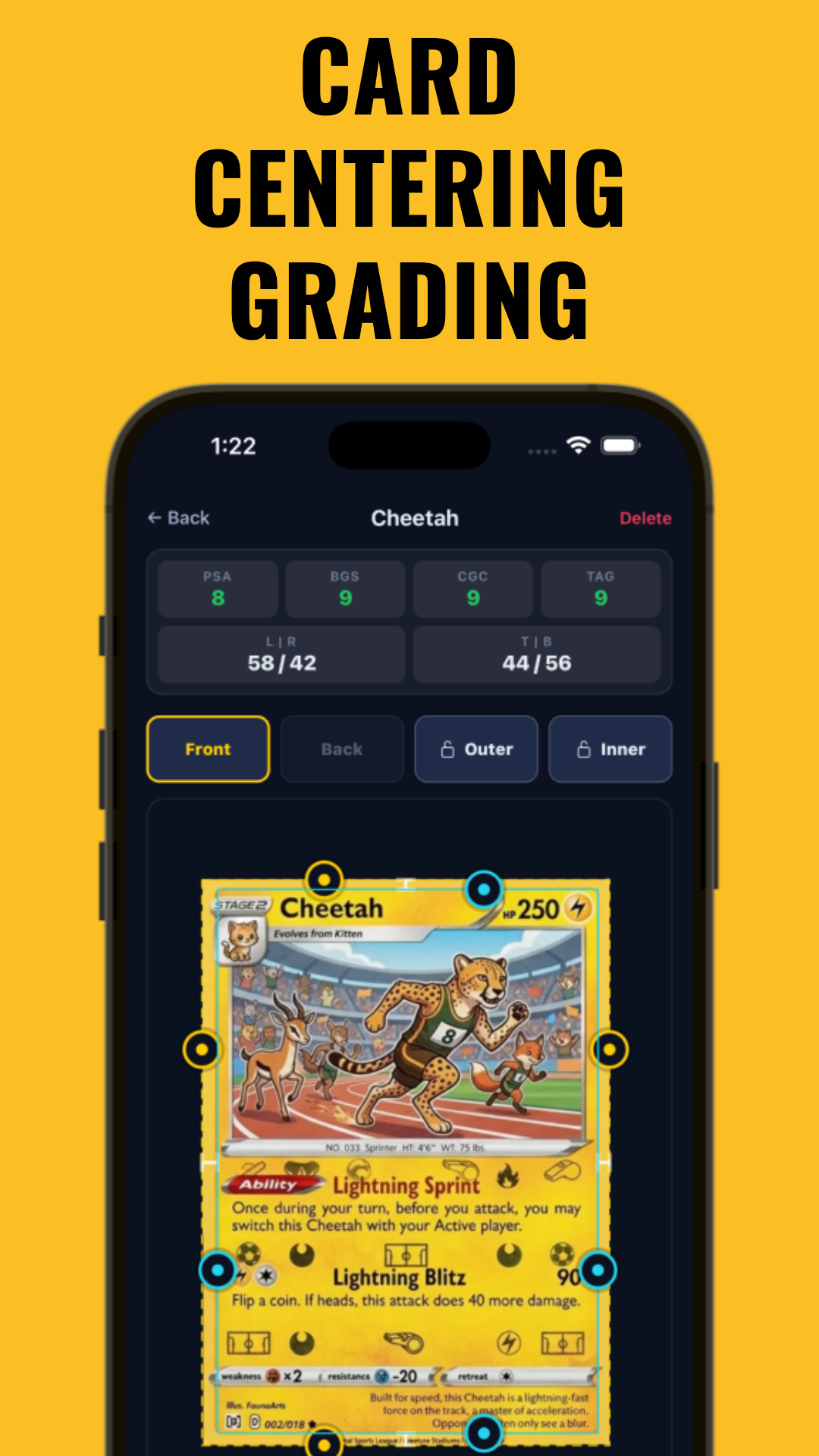
In recent years, AI-powered applications like Midpoint have emerged, utilizing image recognition and machine learning to estimate Beckett’s centering measurement process. Midpoint analyzes card images to calculate border widths and centering ratios with millimeter-level precision, providing collectors with instant feedback before submitting cards for grading.
This technology acts as a valuable pre-grading tool, helping collectors avoid fees on cards unlikely to achieve high centering grades and improving submission strategies.
Section 3: Differences Between BGS 9, 9.5, and 10 Centering
BGS 9 Centering Criteria
A BGS 9 centering grade generally requires the card to meet the approximate 60/40 minimum ratio on both front and back borders, horizontally and vertically. Minor imperfections and slight variances are tolerated as long as the narrower border is close to at least 40% of the total border width.
For example, a card with front borders measuring 3 mm and 2 mm (40%) and back borders measuring 4 mm and 2.5 mm (approximately 38.5%, slightly under but sometimes within tolerance for back) might still earn a 9 centering grade.
This grade represents very good centering that is visually balanced and acceptable to most collectors and graders, though not perfect.
BGS 9.5 Centering Criteria
The BGS 9.5 centering standard is more stringent. Cards earning this grade typically have border ratios tighter than 60/40, often around 65/35 or better, meaning the narrower border should be at least about 35% of the total width. This tighter tolerance demands a higher degree of visual symmetry.
For instance, a card with borders of 3 mm and 1.5 mm (33%) would not qualify, but borders of 3 mm and 1.7 mm (36%) might meet the 9.5 criteria.
Achieving a 9.5 centering grade often requires near-flawless cutting and printing precision, and cards with this grade generally command higher market values.
BGS 10 Centering Criteria
The highest centering grade, BGS 10, requires near-perfect alignment, typically a 70/30 or better ratio on front and back borders, both horizontally and vertically. The borders must be visually indistinguishable in width, and any off-centering must be negligible or imperceptible.
For example, a card with borders measuring 3 mm and 1.2 mm (29.9%) would likely not qualify, whereas a card with 3 mm and 1.3 mm (30.2%) might, provided the visual alignment is flawless.
Cards achieving BGS 10 centering are rare and highly coveted, often fetching premium prices, particularly among vintage or limited-edition cards.
Visual and Market Impact
The difference between a 9 and a 9.5 or 10 centering grade can affect a card’s desirability and market price. For example, a vintage 1952 Topps Mickey Mantle with a BGS 9 centering might sell for thousands of dollars, while a 9.5 or 10 centering grade on the same card could command significantly higher prices.
Collectors understand that higher centering grades reflect superior production quality and rarity, which can drive demand and value.
Section 4: BGS Centering Subgrades and Their Impact
What Are Centering Subgrades?
In addition to an overall grade, BGS provides detailed subgrades for four key aspects of card condition: centering, corners, edges, and surface. Each subgrade ranges from 1 to 10 and reflects the quality of that specific attribute.
The centering subgrade specifically quantifies how well-centered the card is, independent of other factors. This transparency allows collectors to better understand the card’s strengths and weaknesses.
How Centering Subgrades Affect Overall Grade
The overall BGS grade is a weighted average of these four subgrades, with centering often carrying significant influence, especially for high-grade cards (9 and above). A low centering subgrade can cap the overall grade, even if the card’s corners, edges, and surface are near perfect.
For example, a card graded 9 overall with a centering subgrade of 8.5 may have near-perfect corners (9.5), edges (9.5), and surface (9.5), but the off-centering reduces its overall grade from a potential 9.5 or 10 to 9.
Understanding subgrades helps collectors identify whether a card’s visual appeal is limited by centering or other condition issues, guiding purchase decisions and resale expectations.
Using Subgrades to Evaluate Card Condition
Subgrades provide a granular view of card condition that can explain discrepancies between similar overall grades. For instance, two cards graded 9 overall might differ significantly in market value if one has a 9.5 centering subgrade and the other an 8.5 centering subgrade.
Collectors and sellers often highlight strong centering subgrades in listings, as centered cards are more visually appealing and attract higher bids.
Section 5: Centering Expectations for Modern, Vintage, and TCG Cards
Modern Sports Cards
Modern cards, typically dating from the last 20 years, benefit from advanced printing and cutting technology, allowing for tighter centering tolerances. BGS generally expects near-perfect centering on these cards, and even slight off-centering can reduce grades.
For example, a 2015 Panini basketball card with a 60/40 centering ratio might meet BGS 9, but collectors often prefer 65/35 or better for top-tier submissions to maximize value.
Manufacturers are more consistent today, so off-centered modern cards are less common and often reflect manufacturing errors or handling damage.
Vintage Cards
Vintage cards, such as those from the 1950s to 1980s, were produced with less precise printing and cutting methods, resulting in natural centering variance. BGS grading tends to apply more lenient centering standards for vintage cards, allowing some off-centering while still awarding a 9 centering subgrade.
For example, a 1965 Topps baseball card with a 58/42 front centering ratio might still earn a 9 centering subgrade, reflecting historical production realities. This leniency acknowledges collector expectations and the card’s era.
Collectors of vintage cards often accept slight centering imperfections as part of the card’s character, but extremely off-centered vintage cards still receive lower grades.
Trading Card Games (TCGs)
Trading Card Games like Pokémon, Magic: The Gathering, and Yu-Gi-Oh present unique challenges in centering evaluation. Many TCG cards have asymmetrical artwork or decorative borders, complicating traditional centering measurement.
BGS applies the same approximate 60/40 centering standard to TCG cards; however, graders consider the design layout. For instance, if the artwork is intentionally shifted for design reasons, graders focus on the borders rather than artwork centering alone.
Centering impacts TCG card value similarly to sports cards, with better-centered cards generally fetching higher prices, particularly for rare or first-edition prints.
For more comprehensive coverage of these nuances, see How Centering Impacts Card Value: A Detailed Guide.
Section 6: Using Tools and Techniques to Measure Centering Accurately
Traditional Methods: Rulers and Visual Inspection
Many collectors begin by measuring card borders manually using clear rulers or digital calipers. This method requires a steady hand, good lighting, and patience to obtain reasonably accurate measurements.
Steps to follow include:
- Place the card on a flat surface with good lighting.
- Use a clear ruler or calipers to measure the widths of the left, right, top, and bottom borders in millimeters.
- Calculate the ratios by dividing the narrower border by the sum of both borders for each axis.
- Compare results to the approximate 60/40 minimum threshold for BGS 9 centering.
While manual, this method can give a basic sense of centering but is prone to human error and lacks the precision of digital tools.
Digital Measurement with Image Software
Using high-resolution scans or photographs, collectors can employ image editing or analysis software (like Photoshop, GIMP, or specialized measuring tools) to measure pixel distances between borders. This enhances accuracy by providing precise pixel counts instead of relying on physical measurements.
Steps include:
- Scan or photograph the card at high resolution, ensuring the image is square and undistorted.
- Use the software's measurement tools to measure the pixel width of each border.
- Calculate pixel ratios and convert to percentage centering.
This approach reduces measurement variability, but requires familiarity with image editing software and access to quality scans.
AI-Powered Apps Like Midpoint
Apps such as Midpoint automate centering measurement by using artificial intelligence to detect card edges and borders, then calculate precise ratios quickly.
Key features of Midpoint include:
- Support for multiple card types and grading companies, allowing tailored centering estimates.
- Real-time feedback on the card’s front and back centering, highlighting potential issues before submission.
- User-friendly interface that requires only a photo of the card from a smartphone or camera.
- Accurate millimeter-level measurements that approximate Beckett’s grading standards.
Using Midpoint helps collectors avoid costly grading fees by screening cards unlikely to meet desired centering standards, improving submission success rates and investment confidence.
Section 7: Common Centering Issues and How They Affect Grading
Diamond Cuts and Cropped Corners
One frequent centering problem is the diamond cut, where the card’s artwork extends too close to one edge, resulting in borders that are uneven or nearly nonexistent on one side. This condition often results from manufacturing errors or trimming during production.
Such cards often fail minimum border width requirements and are unlikely to earn a BGS 9 centering grade. Even if the ratio superficially meets thresholds, the visual imbalance and cropped artwork reduce the card’s attractiveness and grade.
Cropped corners, where the card’s edges are unevenly cut or damaged, can exacerbate off-centering issues by altering border widths and visual balance.
Shifted Artwork and Unequal Borders
Cards with shifted artwork—where the image is not centered within the borders—exhibit unequal border widths that may fail centering requirements. Slight shifts might still meet the approximate 60/40 ratio and earn a BGS 9 centering subgrade, but larger deviations reduce centering subgrades and can impact the overall grade.
For example, a card with borders measuring 3 mm and 1.9 mm (39%) is slightly off the 40% minimum and would not earn a 9 centering subgrade.
Collectors should be vigilant for shifted artwork when evaluating cards for grading or purchase.
Can Off-Center Cards Still Receive a BGS 9?
Yes. Cards with off-centering that remains within the approximate acceptable 60/40 ratio on front and back borders can still receive a BGS 9 centering subgrade. The grading process allows some tolerance for minor imperfections.
However, if the off-centering falls below the threshold, the centering subgrade drops below 9, and the overall grade may also be affected.
Therefore, a card barely meeting 60/40 on both sides is considered borderline and may have a centering subgrade of exactly 9, but any further off-centering reduces the grade.
Section 8: Comparing BGS Centering to PSA and CGC Standards
BGS vs. PSA Centering Standards
PSA (Professional Sports Authenticator) generally applies stricter centering standards than BGS. PSA often requires a 65/35 ratio or better for a 9 grade on modern cards, whereas BGS’s approximate 60/40 is somewhat more lenient.
On vintage cards, PSA’s standards are also stringent but sometimes less forgiving than BGS, which accounts for historical manufacturing variances. PSA primarily emphasizes front centering, occasionally placing less emphasis on back centering in grading decisions.
Collectors targeting PSA grading should expect tighter centering requirements and potentially lower grades for cards with borderline centering.
BGS vs. CGC Centering Criteria
CGC (Certified Guaranty Company) centering standards align more closely with BGS, especially for modern cards. CGC also considers overall eye appeal and may weigh the visual impact of centering alongside numerical ratio measurements.
CGC’s grading tends to be more holistic, incorporating factors like artwork alignment within the card design, which can sometimes result in different centering subgrades compared to BGS.
Understanding CGC’s nuanced approach helps collectors choose the grading company that best suits their cards and collecting goals.
Implications for Collectors
Knowing the differences between grading companies’ centering standards allows collectors to strategize submissions better. For example, a card with 62/38 front centering might earn a BGS 9 but could fall short of PSA’s 9 centering requirement.
Utilizing tools like Midpoint to simulate grading standards for BGS, PSA, and CGC helps collectors set realistic expectations, avoid costly grading fees, and maximize the value of their card investments.
Conclusion
Mastering BGS 9 centering standards is important for collectors who want to maximize their card’s grade and market value. The cornerstone is understanding the approximate 60/40 minimum border ratio, how Beckett measures centering carefully on all sides, and the subtle but meaningful distinctions between 9, 9.5, and 10 centering grades.
By appreciating the impact of centering on overall grade and value, and recognizing differences in vintage, modern, and TCG card expectations, collectors can make informed decisions. Leveraging modern tools like Midpoint empowers collectors to measure centering more precisely and confidently before grading submissions.
Applying these insights can reduce the risk of disappointing grading outcomes, save money, and enhance collecting as a rewarding investment and hobby.
FAQ
Q: What centering does a card need to get a BGS 9?
A: A card generally needs at least an approximate 60/40 centering ratio on both front and back borders, meaning the narrower border should be about 40% or more of the total border width in each dimension (horizontally and vertically). This helps ensure a balanced, visually appealing appearance qualifying for BGS 9 centering.
Q: Can a card get a BGS 9 with 60/40 centering?
A: Yes, approximately 60/40 is the minimum acceptable centering ratio for a BGS 9. Cards meeting this ratio on both front and back borders can earn a BGS 9 centering subgrade, though higher ratios often improve the grade.
Q: How does Beckett measure centering on a card?
A: Beckett measures the width of the borders on all four sides of the card, calculates the centering ratios by dividing the narrower border by the sum of both borders horizontally and vertically, and uses the lesser ratio to determine the centering score.
Q: What is the difference between BGS 9 and BGS 9.5 centering?
A: BGS 9 generally requires an approximate 60/40 ratio on borders, while BGS 9.5 demands tighter centering, generally around 65/35 or better. The 9.5 grade indicates a higher level of visual balance and precision, which can increase the card’s value.
Q: Can off-center cards still receive a BGS 9 overall?
A: Yes, if the off-centering remains within BGS's approximate acceptable 60/40 ratio limits on both front and back, the card can still receive a BGS 9 overall grade. More extreme off-centering will reduce the centering subgrade and may negatively affect the overall grade.
Free to start
Try the Midpoint app
Grade any card from a photo, see its raw and PSA 10 value, and track what your collection is worth — free.
Get it on iPhoneGet it on Android