
Deoxys Pokemon Cards Value: Ultimate Guide to Prices & Grading
Discover Deoxys Pokemon cards value, top cards worth grading, PSA 10 prices, and expert tips for collectors and investors.

Estimated reading time: 18 min
Key Takeaways
- Deoxys Pokemon cards value varies widely from bulk commons to rare Gold Stars and LEGEND cards, with some cards reported to reach over $1,000 in PSA 10 condition.
- Top Deoxys cards worth grading include Deoxys ex, Gold Star variants, and LEGEND cards; PSA 10 graded copies can command premium prices that often exceed raw values by multiple times.
- Card condition factors such as centering, surface wear, holo bleed, edge whitening, and scratches significantly impact value and grading outcomes.
- Sets like EX Deoxys, POP Series, Call of Legends, and Holon Phantoms host many valuable Deoxys cards collectors seek, with certain promos and language variations adding niche appeal.
- Using tools like Midpoint can help estimate grading value before costly submissions, providing AI-based centering and surface condition analysis to predict PSA, BGS, CGC, and TAG grades.
Card values — live data from Midpoint's card database, as of 2026-10-06. Prices move; Midpoint refreshes these daily.
| Card | Raw | PSA 10 | Gem premium | |
|---|---|---|---|---|
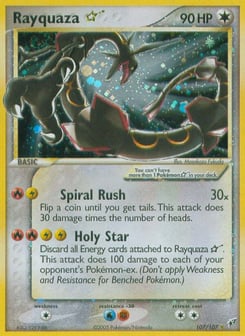 |
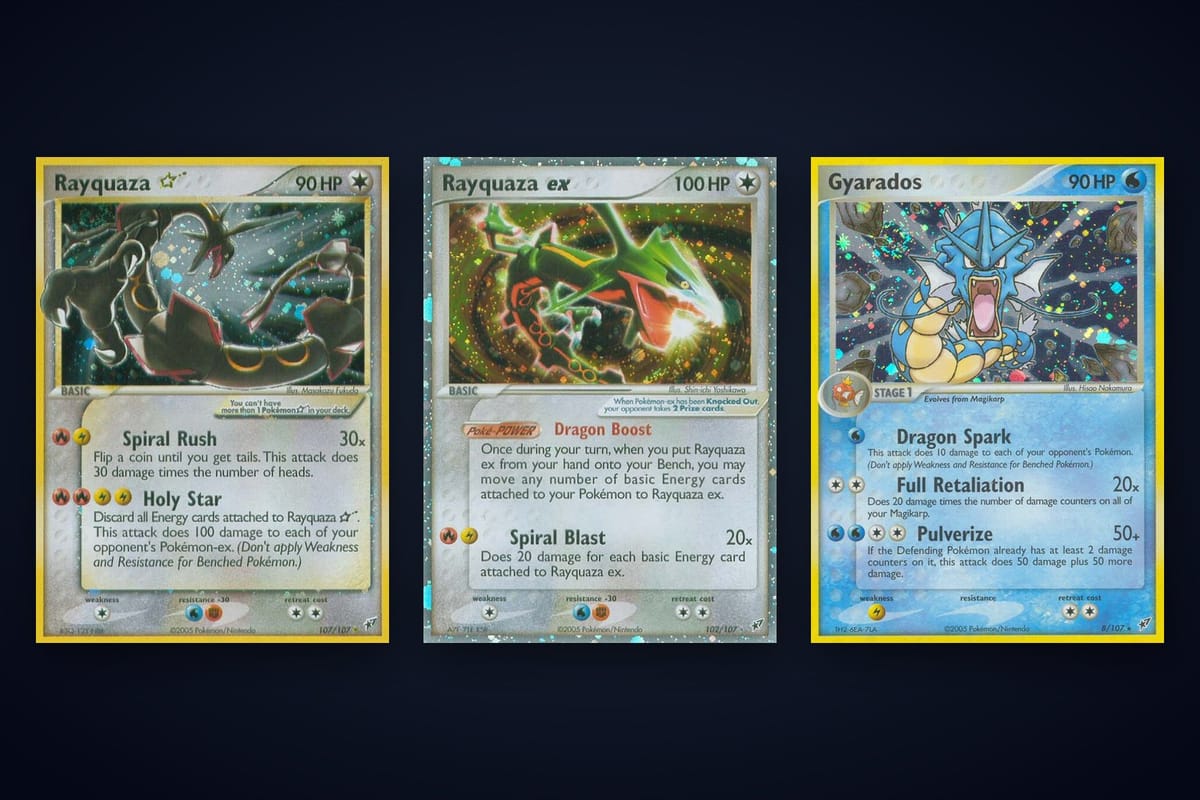
Rayquaza ☆ #107/107 Deoxys (2005) |
— | $485,123 | — |
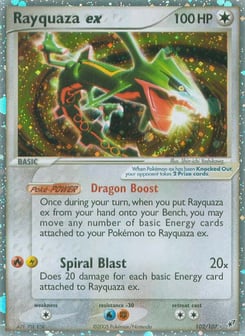 |
Rayquaza ex #102/107 Deoxys (2005) |
$999.00 | $35,000 | 35× |
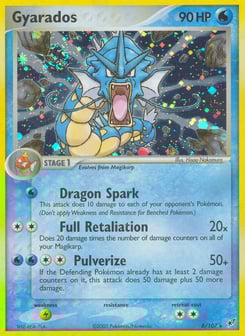 |
Gyarados #8/107 Deoxys (2005) |
$300.00 | $27,184 | 90.6× |
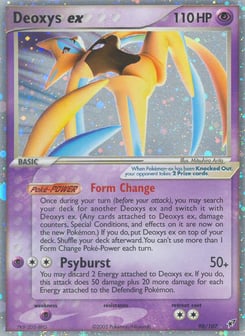 |
Deoxys ex #98/107 Deoxys (2005) |
$300.00 | $25,454 | 84.9× |
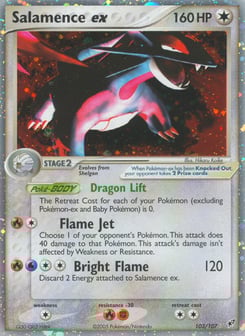 |
Salamence ex #103/107 Deoxys (2005) |
$168.61 | $22,848 | 135.5× |
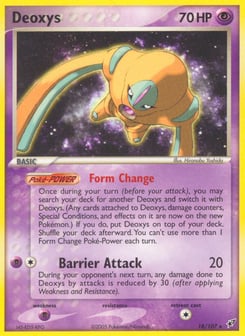 |
Deoxys #18/107 Deoxys (2005) |
— | $21,019 | — |
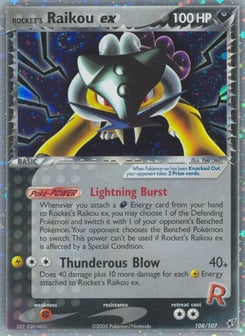 |
Rocket's Raikou ex #108/107 Deoxys (2005) |
$284.99 | $19,215 | 67.4× |
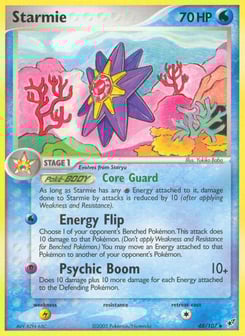 |
Starmie #48/107 Deoxys (2005) |
$35.11 | $16,988 | 483.9× |
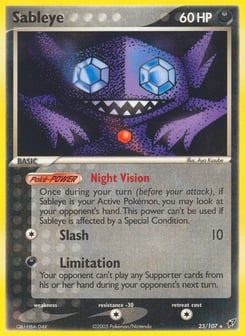 |
Sableye #23/107 Deoxys (2005) |
$79.97 | $16,123 | 201.6× |
 |
Latios ☆ #106/107 Deoxys (2005) |
— | $14,065 | — |
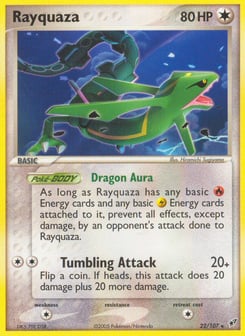 |
Rayquaza #22/107 Deoxys (2005) |
$1,193 | $13,668 | 11.5× |
 |
Magikarp #64/107 Deoxys (2005) |
$84.17 | $9,394 | 111.6× |
Look up any card's current raw and graded value in Midpoint — and get an estimated grade before you pay to submit.
Table of Contents
- Section 1: Understanding Deoxys Pokemon Cards and Their Value Range
- Section 2: Most Valuable Deoxys Cards and Their Price Insights
- Section 3: Complete Deoxys Card List and Identification Tips
- Section 4: Raw vs. Graded Deoxys Cards – Price Differences Explored
- Section 5: Factors Affecting Deoxys Card Condition and Value
- Section 6: Which Deoxys Cards Are Worth Grading and Investing In?
- Conclusion
- FAQ
Section 1: Understanding Deoxys Pokemon Cards and Their Value Range
The Deoxys Pokemon Card Phenomenon
Deoxys, introduced in 2005 within the Pokémon trading card game (TCG) during the EX Deoxys expansion, quickly became a fan-favorite due to its extraterrestrial, shape-shifting design and compelling lore. Over time, Deoxys cards have appeared in numerous sets and promotional runs, resulting in a diverse range of printings and rarities. Collectors are drawn not only to the character’s popularity but also to the scarcity and unique artwork of certain cards.
The Deoxys Pokemon cards value depends on several factors, including the specific card edition, rarity level, and card condition. For example, the original EX Deoxys set released in 2005 includes multiple holo and non-holo versions of Deoxys as well as powerful EX cards, while later sets introduced Gold Star variants and LEGEND cards that are prized for their limited print runs and distinctive foil treatments.
Value Spectrum: From Commons to Rarities
The value range for Deoxys cards is broad, spanning from bulk commons typically valued between $1 and $5, to highly sought-after chase cards reported to exceed $1,000 in mint, graded condition. As of mid-2024, raw Deoxys cards that are common or reverse holo tend to sell between $2 and $10 depending on set and condition. However, rare cards like Deoxys ex from the EX Deoxys set or Gold Star Deoxys variants can command substantially higher prices.
For instance, a raw Deoxys ex (#101/107) from EX Deoxys may be found for roughly $85, but once graded a PSA 10, which certifies near-flawless condition, its value can increase significantly. This premium reflects both rarity and collector confidence in card quality. Similarly, Gold Star Deoxys cards from POP Series 5, known for their distinctive star next to the Pokémon’s name and unique artwork, have been reported to reach raw values around $300, with PSA 10 copies potentially exceeding $1,000.
How Market Trends Influence Prices
Market demand for Deoxys cards fluctuates with collector interest, Pokémon franchise popularity surges, and grading population reports released by PSA, BGS, and CGC. For example, announcements of new Pokémon games or anniversaries often renew interest in vintage cards, potentially pushing prices higher temporarily or over longer periods.
Online auction sites like eBay, TCGPlayer, and dedicated Pokémon forums provide real-time sales data. Tracking recent sales, median prices, and population reports helps identify price trends. For example, between 2024 and 2026, the Deoxys ex PSA 10 population has remained relatively low, which may help maintain higher prices due to scarcity.
Tools such as Midpoint simplify this tracking by aggregating sales data and applying AI to estimate card grading outcomes, providing collectors with faster, more informed valuations before investing in grading services.
| Card | Set | Raw Value | PSA 10 Value |
|---|---|---|---|
| Deoxys ex | EX Deoxys | ~$85 | Up to ~$420 |
| Deoxys Gold Star | POP Series 5 | ~$300 | Up to ~$1,200 |
| Rayquaza ☆ | EX Deoxys | ~$120 | Up to ~$650 |
| Latias ☆ | EX Deoxys | ~$100 | Up to ~$550 |
Section 2: Most Valuable Deoxys Cards and Their Price Insights
Top-Tier Cards: Gold Stars and LEGEND Variants
The most valuable Deoxys cards are often those with limited print runs or unique foil patterns. The Deoxys Gold Star (POP Series 5 #106/110) is a standout example, featuring a black star next to the Pokémon name and a striking holofoil background that differs from typical holo cards. These Gold Star cards were produced in relatively low quantities, which, combined with Deoxys’ popularity, can drive prices upward.
As of mid-2024, raw Gold Star Deoxys cards generally trade near $300, but PSA 10 graded examples have been known to command prices north of $1,000. This premium reflects not only the card’s rarity but also the difficulty in obtaining a perfect-condition copy, as the holofoil surface is prone to scratches and wear.
LEGEND cards, which are typically double-sided or split across two cards forming a complete image, also hold notable value. For example, the Deoxys LEGEND card combines with another Pokémon to create a full artwork, attracting collectors interested in completing the set. These cards, due to their split nature and limited printing, can fetch higher prices and are more challenging to grade perfectly.
EX Deoxys Set Highlights
The 2005 EX Deoxys expansion is a core set for Deoxys collectors. It includes several chase cards that have appreciated in value:
- Deoxys ex (#101/107): A powerful EX card with raw values around $85, rising to approximately $420 for PSA 10 copies. Its dynamic artwork and competitive play relevance make it highly sought after.
- Rayquaza ☆ (#100/107): Another Gold Star card, with raw prices near $120 and PSA 10 values close to $650. Rayquaza’s popularity enhances this card’s desirability.
- Latias ☆ and Latios ☆: Both Gold Star cards with raw prices between $100 and $110, and PSA 10 grades ranging from $500 to $550. Their unique foil coloring and rarity add to their appeal.
Collectors often target these cards for investment or to complete their EX Deoxys sets, driving steady demand.
Modern Rarities and Legacy Appeal
While vintage cards dominate top prices, modern sets and promos featuring Deoxys such as Plasma Freeze (2013) or Crown Zenith (2023) have niche appeal. These newer cards typically trade under $100 raw unless they are secret rares or graded at PSA 10.
However, certain promos, especially limited-edition event cards or Japanese-exclusive releases, can command moderate premiums. For example, a Japanese-language event promo Deoxys holofoil card may sell for 20-30% more than an English counterpart due to collector preference or scarcity outside Japan.
Collectors should monitor market trends for these modern rarities, as their values can appreciate with increased interest or if they become tournament-legal staples.
Section 3: Complete Deoxys Card List and Identification Tips
Organizing Cards by Set, Number, and Variant
Deoxys cards have been printed across multiple sets spanning nearly two decades. For effective collection management and valuation, cataloging cards by the following criteria is helpful:
- Set Name: Key sets include EX Deoxys (2005), POP Series 5 (2007), Holon Phantoms (2006), Call of Legends (2011), Plasma Freeze (2013), and Crown Zenith (2023). Each set features unique artwork, card numbering, and rarity distributions.
- Card Number vs. Set Total: For example, Deoxys ex is card #101 out of 107 cards in the EX Deoxys set. This helps identify print position and verify authenticity.
- Variants: Cards often have holofoil, reverse holofoil, Gold Star, LEGEND, promo editions, and language variations. Each variant differs in rarity and value.
How to Identify Genuine Deoxys Cards
Authenticity is important to avoid counterfeits or reprints. Identification features include:
- Set Symbol: For EX Deoxys, a meteor or star icon near the card number indicates the set.
- Collector Number and Rarity Symbol: A star (★) denotes rare cards, while a star with "GS" indicates Gold Star status.
- Holo Patterns: Genuine cards have distinct holofoil textures and patterns that can be cross-referenced with official images.
- Language and Printing Details: Language printing affects card backs and font styles. Japanese cards typically have Japanese text and different rarity marks.
Using a magnifying glass or jeweler’s loupe helps inspect print quality and foil patterns. Comparing against trusted online databases or official Pokémon TCG resources supports accurate identification.
Recognizing Valuable Subtypes
Collectors should familiarize themselves with valuable Deoxys subtypes to accurately assess worth:
- Gold Star Cards: Characterized by a shiny gold star next to the Pokémon’s name and a unique holofoil background, these cards are highly prized. Examples include Deoxys Gold Star and Rayquaza Gold Star.
- LEGEND Cards: These cards are printed as two halves that combine to form a complete image when placed side by side. The Deoxys LEGEND card pairs with another card (e.g., Mew LEGEND) and are more difficult to obtain in perfect condition.
- Promo Cards: Event-exclusive or promotional cards often have unique stamps or markings such as “Promo” or special symbols, indicating limited distribution.
- Reverse Holo and Holofoil: Reverse holo cards feature holofoil on the card background except the artwork, while holofoil cards have the artwork itself holofoil. Collectors value holo and reverse holo versions differently based on rarity and condition.
Section 4: Raw vs. Graded Deoxys Cards – Price Differences Explored
Why Graded Cards Command Premiums
Raw cards, meaning ungraded cards sold as-is, have values highly dependent on subjective condition assessment. Grading companies like PSA (Professional Sports Authenticator), BGS (Beckett Grading Services), CGC (Certified Guaranty Company), and TAG provide professional, standardized grading that certifies card authenticity and quality.
Graded cards, especially those achieving PSA 9 (Mint) or PSA 10 (Gem Mint), typically command premiums ranging from 3 to 5 times the raw value. This is because buyers gain confidence in the card’s condition, centering, surface, corners, and edges. For example, a raw Deoxys ex card priced at $85 might sell for $300-$420 when graded PSA 10.
High-grade cards also benefit from encapsulation in tamper-evident holders, preserving condition and making them more attractive to collectors and investors alike.
Understanding the Gem Premium Gap
The "gem premium" refers to the significant price increase between a card graded PSA 10 and an otherwise identical raw card in near-mint condition. This premium is driven by scarcity; PSA 10 grades are difficult to achieve due to stringent criteria including near-perfect centering (typically 55/45 to 50/50), flawless surfaces, and sharp corners.
For Gold Star Deoxys cards, this premium can exceed 400%, meaning a raw card valued at $300 might fetch $1,200 or more in PSA 10 condition. This gap incentivizes collectors to submit high-quality raw cards for grading but also necessitates accurate pre-submission evaluation to avoid costly grading fees on low-grade results.
Using Midpoint to Estimate Grading Value
Midpoint is an AI-powered digital grading tool that analyzes card images for centering, corner sharpness, edge wear, and surface condition. By comparing these factors to large databases of graded cards, it predicts likely grades across PSA, BGS, CGC, and TAG systems.
Before submitting cards, collectors can upload photos to Midpoint’s interface to receive an estimated grade and value range. This helps prioritize which cards to grade, maximizing return on investment and minimizing grading fees on lower-value or damaged cards.
For example, Midpoint can detect centering issues down to millimeter accuracy and flag surface scuffs or print defects. This feedback allows sellers to correct photo angles or identify cards unlikely to reach top grades.
Learn more in the Card Centering Tool accurate grading estimates post.

Section 5: Factors Affecting Deoxys Card Condition and Value
Centering and Its Impact
Centering refers to the alignment of the Pokémon image relative to the card’s borders. Perfect centering is generally considered 50/50 balance, though PSA allows minor variations, for example, 55/45 or 60/40 ratios can still achieve high grades depending on other factors.
Cards with poor centering, where the image is noticeably shifted toward one side, lose significant value. This is especially true for high-demand chase cards like Deoxys Gold Star or EX Deoxys ex, where collectors seek perfection.
Midpoint measures centering precisely by calculating border widths in millimeters on all sides, providing an objective score. Cards with centering outside the acceptable range are less likely to receive PSA 9 or 10 grades, often limiting price potential.
Surface Wear and Edge Quality
Surface condition encompasses scratches, scuffs, print defects, holofoil wear, and stains. Holo bleed—where the holographic foil extends beyond intended areas or shows discoloration—is a common issue that reduces value.
Edge whitening occurs when the card edges show color loss due to handling or shuffling, which is highly penalized in grading. Creases and bends are generally fatal flaws for high grades.
For example, even a minor scratch on the holo area of a Gold Star Deoxys can downgrade a card from PSA 10 to PSA 8 or lower, reducing value by hundreds of dollars. Thus, careful handling, storage, and inspection for surface defects are critical.
Other Considerations: Language and Printing Errors
Language variations affect demand and value. English-language cards are most common, but Japanese versions can command premiums ranging from 10%-50% depending on rarity and collector interest. Spanish, German, and French versions typically trade closer to English prices but may have niche demand.
Printing errors such as miscuts, color misalignment, or inverted images can either decrease value due to perceived defects or increase it if the error is rare and sought after. However, for Deoxys cards, most printing errors reduce value unless documented as officially recognized anomalies.
Proper storage — including top loaders, sleeves, and temperature-controlled environments — preserves card condition. For detailed guidance, see our ultimate collector’s storage guide.
Section 6: Which Deoxys Cards Are Worth Grading and Investing In?
Cards Worth Submitting for Grading
Investors and serious collectors should focus grading resources on cards with both strong raw market prices and high collector demand. These typically include:
- Deoxys ex (EX Deoxys #101/107): Its combination of playability, rarity, and nostalgic appeal results in raw prices around $85 and substantial PSA 10 premiums near $420, making grading cost-effective.
- Deoxys Gold Star (POP Series 5 #106/110): The ultimate chase card in the Deoxys lineup, with raw prices near $300 and PSA 10 prices reported to surpass $1,000. Grading can significantly enhance value if the card is in near-perfect condition.
- Rayquaza ☆, Latias ☆, Latios ☆: Gold Star and holo variants from EX Deoxys and related sets, often valued $100+ raw and $500+ PSA 10. These cards appreciate with condition and grading.
- LEGEND Cards: Due to their unique split design and scarcity, LEGEND cards featuring Deoxys also merit grading if in excellent condition.
When Not to Grade
Cards with low raw value (under $20-$30), heavy damage, or poor centering generally do not recoup grading fees. Grading companies charge around $20-$50 per card, plus shipping and optional insurance, so submitting cards unlikely to earn high grades or value increases is financially unwise.
Using Midpoint’s AI pre-grade tool before submission helps avoid these costly mistakes by filtering out cards with low grading potential. This strategic approach optimizes grading investments and preserves budget for high-value cards.
Long-Term Investment Potential
Deoxys cards from early 2000s sets have demonstrated steady appreciation over the past decade, particularly in PSA 9 and PSA 10 grades. Population reports showing limited PSA 10 submissions and increasing collector interest suggest continued growth potential.
Collecting and grading a diverse portfolio of Deoxys cards, including Gold Stars, EX chase cards, and LEGEND variants, can help balance risk and capitalize on market trends. Staying informed on grading population changes, recent sales, and franchise developments is important for maximizing investment returns.
For comprehensive insights on grading impact and insurance valuation, see our detailed guide on the impact of grading on card value and insurance.
Conclusion
The deoxys pokemon cards value landscape offers opportunities for collectors and investors alike. From affordable bulk commons to rare Gold Star and LEGEND cards, understanding card condition, grading premiums, and market demand is essential to navigate this complex market successfully.
Leveraging advanced tools like Midpoint empowers collectors to better assess card centering, surface condition, and grading prospects, maximizing returns while avoiding costly grading mistakes. Whether starting a collection or refining an investment portfolio, this comprehensive price guide and grading insight serve as a useful resource to make informed decisions.
By focusing on key chase cards like Deoxys ex, Gold Star Deoxys, and LEGEND variants, and carefully managing grading submissions, collectors can potentially capitalize on the gem premium and demand for these iconic Pokémon cards.
FAQ
Q: How much is a Deoxys Pokémon card worth?
A: Deoxys card values vary widely. Common cards may be worth $2–$10 raw, while rare cards like Deoxys ex or Gold Star variants can range from around $85 to over $1,000 in PSA 10 condition, as of mid-2024. Condition, grading, and rarity heavily influence prices.
Q: What is the rarest and most valuable Deoxys card?
A: The Deoxys Gold Star card from POP Series 5 is considered among the rarest and most valuable, with PSA 10 copies reported to fetch upwards of $1,000 due to limited print runs and collector demand. LEGEND cards and select EX Deoxys chase cards also rank highly in value.
Q: Which Deoxys cards are worth money?
A: Cards worth money include Deoxys ex, Gold Star Deoxys, Rayquaza ☆, Latias ☆, Latios ☆, and LEGEND cards. Cards with strong condition and high grades command the best prices, while commons typically hold minimal value.
Q: How much is a Deoxys ex card worth?
A: A raw Deoxys ex card typically sells for about $85, while a PSA 10 graded copy can reach around $420, demonstrating the significant grading premium that can be achieved.
Q: How much is a Deoxys Gold Star card worth?
A: As of mid-2024, raw Deoxys Gold Star cards are valued near $300, with PSA 10 examples reported to exceed $1,000 due to rarity, collector demand, and the difficulty of achieving perfect condition.
Q: Should I get my Deoxys card graded?
A: Grading is generally recommended for high-value or near-mint condition cards to maximize resale value and buyer confidence. Using tools like Midpoint to estimate grading potential before submission helps avoid unnecessary grading fees and focuses investment on cards with grading upside.
Free to start
Try the Midpoint app
Grade any card from a photo, see its raw and PSA 10 value, and track what your collection is worth — free.
Get it on iPhoneGet it on Android


