Expedition Base Set Pokemon Cards Value: Ultimate Price Guide
Explore the Expedition Base Set Pokemon cards value, top chase cards, grading tips, and sealed product prices in this comprehensive 2026 price guide.

Estimated reading time: 15 min
Key Takeaways
- The Expedition Base Set includes 165 cards, featuring rare holo, reverse holo, and non-holo variants, each with distinct collectibility factors.
- Charizard, Raichu, and Mewtwo are among the most valuable Expedition Base Set cards, especially in high grades like PSA 10, often commanding premium prices.
- Graded cards, especially PSA 9 and PSA 10, generally command a significant premium over raw cards, sometimes several times the ungraded value.
- Condition factors such as centering, surface, edges, and corners heavily influence value and grading outcomes.
- Sealed booster boxes and packs remain sought after with rising market prices, reflecting growing nostalgia and investment interest.
Card values — live data from Midpoint's card database, as of 2026-08-28. Prices move; Midpoint refreshes these daily.
| Card | Raw | PSA 10 | Gem premium | |
|---|---|---|---|---|
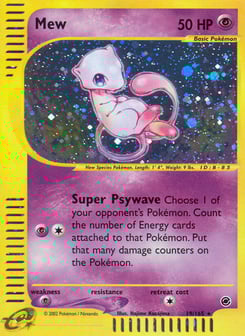 |
Mew #19/165 Expedition Base Set (2002) |
$790.00 | $200,000 | 253.2× |
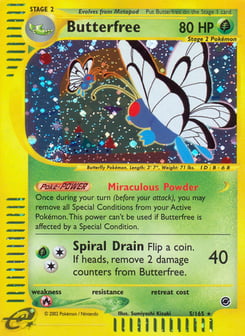 |
Butterfree #5/165 Expedition Base Set (2002) |
$159.97 | $48,013 | 300.1× |
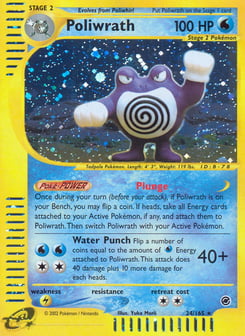 |
Poliwrath #24/165 Expedition Base Set (2002) |
$72.49 | $42,500 | 586.3× |
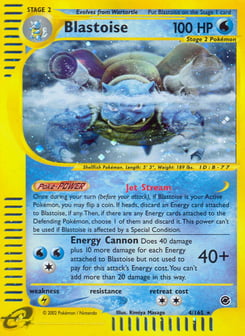 |
Blastoise #4/165 Expedition Base Set (2002) |
$499.95 | $13,551 | 27.1× |
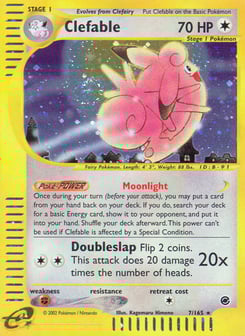 |
Clefable #7/165 Expedition Base Set (2002) |
$157.65 | $13,518 | 85.8× |
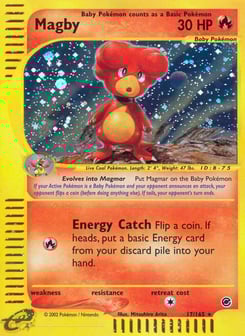 |
Magby #17/165 Expedition Base Set (2002) |
$85.00 | $12,103 | 142.4× |
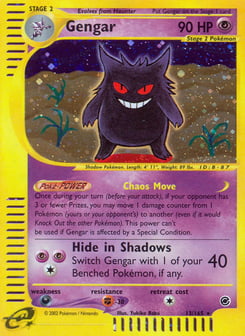 |
Gengar #13/165 Expedition Base Set (2002) |
$799.98 | $10,046 | 12.6× |
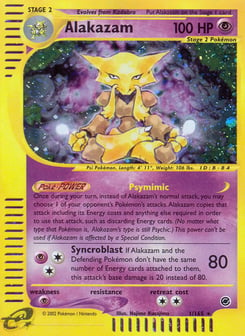 |
Alakazam #1/165 Expedition Base Set (2002) |
$238.79 | $9,856 | 41.3× |
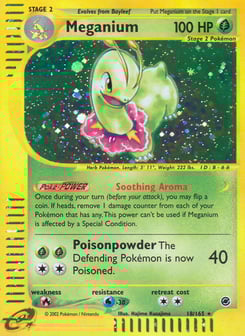 |
Meganium #18/165 Expedition Base Set (2002) |
$180.01 | $9,763 | 54.2× |
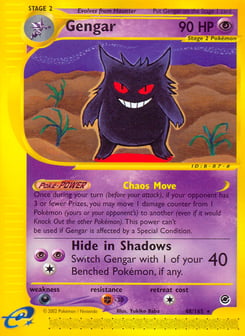 |
Gengar #48/165 Expedition Base Set (2002) |
$170.07 | $6,417 | 37.7× |
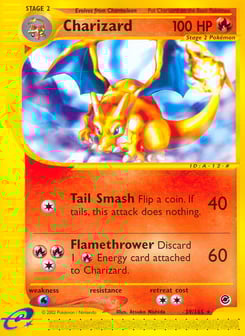 |
Charizard #39/165 Expedition Base Set (2002) |
$270.47 | $6,231 | 23× |
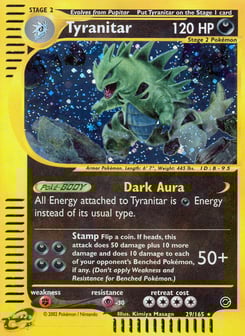 |
Tyranitar #29/165 Expedition Base Set (2002) |
$300.00 | $6,127 | 20.4× |
Look up any card's current raw and graded value in Midpoint — and get an estimated grade before you pay to submit.
Table of Contents
- Section 1: Expedition Base Set Overview and Composition
- Section 2: Most Valuable Expedition Base Set Cards
- Section 3: Graded vs Ungraded Expedition Cards Value Comparison
- Section 4: Condition and Its Impact on Expedition Card Value
- Section 5: Variants – Holo, Reverse Holo, and Non-Holo Explained
- Section 6: Sealed Products and Their Market Value
- Conclusion
- FAQ
Section 1: Expedition Base Set Overview and Composition
Set Size and Card Breakdown
The Expedition Base Set, released in 2002 as part of the Wizards of the Coast era of Pokémon TCG, comprises 165 cards. This set includes a variety of card types that cater to collectors and players alike. The set was notable for introducing new holofoil technology and a fresh card frame design that distinguished it from previous sets.
- Commons and Uncommons: These cards make up the majority of the set, featuring a wide range of Pokémon from various evolutionary stages, Trainer cards, and items. They provide the foundational elements for deck-building and are generally more abundant, making them less valuable individually but essential for completing the set.
- Rare Holos: These cards feature holographic foil backgrounds behind the Pokémon artwork and are the primary chase cards. They tend to hold higher collectible value and include fan favorites and iconic Pokémon.
- Reverse Holos: Introduced to add rarity and variety, reverse holo cards have a holographic foil background with the Pokémon art remaining non-holo. This variant adds an extra layer of collectibility and can sometimes command premiums depending on card popularity.
- Energy Cards: Basic energy cards are included to support gameplay. While essential for deck construction, these cards typically have minimal secondary market value unless graded or sealed in large quantities.
Rarity and Collectibility
The Expedition Base Set’s rarity hierarchy is important for collectors seeking to maximize value. Rare holo cards are scarcer relative to common and uncommon cards, and their print runs were limited to enhance collectibility. Cards like Charizard (#4), Raichu (#14), and Mewtwo (#15) are not only rare but also represent some of the most beloved Pokémon, contributing to their desirability.
This set was pioneering in that it was among the first to apply holofoil directly on the Pokémon artwork itself instead of just the background, giving holo cards a distinctive, premium look that remains appealing to collectors. This innovation increased the visual appeal and made these cards stand out in collections.
Expedition Base Set Card List Highlights
While the full set comprises 165 cards, several stand out due to their combination of rarity, playability, and nostalgic value:
- Charizard (#4): The centerpiece of the set and arguably the most iconic card, Charizard’s holofoil version is known for commanding premium prices, especially in top condition. Its powerful artwork and nostalgic appeal make it a top target for collectors.
- Raichu (#14): An electric-type rare holo with solid demand, Raichu appeals both to collectors and competitive players, offering a blend of rarity and playability.
- Mewtwo (#15): This psychic-type holo card is a fan favorite, often sought after for its iconic status and rarity.
- Zapdos (#5), Gyarados (#7), and Blastoise (#1): These rare holo cards hold steady market interest due to their popularity and relative scarcity, with Zapdos and Gyarados often favored for their strong artwork and game utility.
Cards in pristine condition, particularly those graded PSA 9 or PSA 10, generally dominate the Expedition Base Set’s value landscape, frequently selling for multiples of raw card prices.
| Card Name | Set Number | Raw Price (Near Mint) | PSA 10 Value (as of 2026-08-28) |
|---|---|---|---|
| Charizard | #4 | $280 | $3,800 |
| Raichu | #14 | $80 | $1,100 |
| Mewtwo | #15 | $95 | $1,300 |
| Zapdos | #5 | $60 | $700 |
| Gyarados | #7 | $55 | $650 |
Section 2: Most Valuable Expedition Base Set Cards
Top Chase Cards by Market Value
The Expedition Base Set’s top chase cards reflect a combination of rarity, iconic status, and condition sensitivity. The clear standout is Charizard (#4), which commands a PSA 10 value of approximately $3,800. This premium reflects both the card’s limited print run and its cultural resonance as a symbol of the Pokémon brand.
Other marquee cards such as Raichu (#14) and Mewtwo (#15) maintain PSA 10 values exceeding $1,000. These cards benefit from collector interest due to their gameplay strength and nostalgic appeal. Their values have remained relatively stable with occasional fluctuations correlating with Pokémon media releases and anniversaries.
Value Rankings and Price Gaps
- Charizard (#4): Raw near mint cards typically sell around $280, but the grading premium is substantial — PSA 10 copies can sell for over 13 times that amount. Even PSA 9 graded cards often achieve prices above $1,500.
- Raichu (#14): A reliable second-tier valuable card, with PSA 10 grades near $1,100. Raw cards in near mint condition average around $80, highlighting the grading multiplier effect.
- Mewtwo (#15): PSA 10 copies hover around $1,300, with raw cards near $95. Its consistent demand helps maintain these values.
- Zapdos (#5) and Gyarados (#7): Both cards trade in the $600-$700 range for PSA 10, favored for their rarity and appealing artwork.
Other Valuable Cards to Watch
While Charizard, Raichu, and Mewtwo dominate, several other holo rares command meaningful attention. Blastoise (#1) and Venusaur (#2) are sought after, with PSA 10 values often around $500-$700 depending on market trends. Although the price gaps between raw and graded versions are less dramatic than Charizard, these cards remain notable within the set.
Collectible interest in reverse holo variants has increased, especially for iconic Pokémon. Some reverse holos, depending on print runs and grading, may sell for modest premiums compared to their non-reverse holo counterparts, particularly when in pristine condition.
Section 3: Graded vs Ungraded Expedition Cards Value Comparison
Understanding the Grading Premium
Professional grading services such as PSA (Professional Sports Authenticator), BGS (Beckett Grading Services), CGC, and TAG have become important in the collectible card market. Grading authenticates condition, protects cards with tamper-proof holders, and provides an objective standard that enhances buyer confidence.
For Expedition Base Set cards, grading can multiply raw card value by several times, depending on grade and demand. This increase is due to the rarity of high-grade examples and the assurance grading provides.
For example, a raw near mint Charizard card might sell for about $280, but a PSA 10 graded Charizard can command nearly $3,800 as of August 2026. This premium reflects both the rarity of Gem Mint condition and collector willingness to pay for guaranteed quality.
PSA 9 vs PSA 10 Values
- PSA 10 (Gem Mint): The highest possible grade, indicating virtually flawless condition. These cards attract serious collectors and investors and usually sell for the highest prices.
- PSA 9 (Mint): Still a very high grade representing minimal imperfections. PSA 9 cards generally sell for a significant percentage of PSA 10 values, varying by card.
For instance, a Raichu PSA 9 might fetch between $650 and $750, compared to around $1,100 for a PSA 10. This difference highlights the premium collectors place on perfection, though PSA 9 cards still offer strong value.
When Is Grading Worth It?
Grading is typically cost-effective when a card’s raw near mint value exceeds $50, as grading fees and potential shipping costs are justified by the expected value increase. Cards with strong centering, clean surfaces, sharp edges, and no visible flaws are prime candidates.
However, low-value or heavily damaged cards may not benefit from grading, as they are unlikely to receive high grades or command premiums.
Using tools like Midpoint, collectors can digitally assess centering and surface condition with precision before sending cards to grading companies. This step can help avoid costly grading fees on cards unlikely to achieve high grades, optimizing investment strategies.
Section 4: Condition and Its Impact on Expedition Card Value
Key Condition Factors
The condition of an Expedition Base Set card is paramount in determining its market value. Grading companies evaluate several key criteria, including:
- Centering: The alignment of the card’s printed image relative to its borders. Ideally, the image should be well centered, with equal borders on all sides. Even a slight off-center can reduce grade by one or two points, significantly impacting value.
- Corners: Corners should be sharp and free from whitening, bends, or dings. Corner damage is one of the most common grading deductions.
- Edges: Edges must be clean, without chipping, whitening, or fraying. Edge wear is especially common with older cards.
- Surface: The card’s front and back surfaces should be free from scratches, stains, print defects, and discoloration. Glossy surfaces with intact holofoil are highly prized.
Centering Measurement and Tools
Centering is often the most subjective grading factor but can be objectively measured using digital tools. The free Midpoint centering calculator allows collectors to measure exact millimeter offsets of card borders, providing a precise centering percentage.
Cards with centering close to 50/50% (equal margins on opposite sides) are favored by grading companies and buyers. For example, a card with 55/45 centering is generally more desirable than one with 65/35, even if other factors are equal.
This precise measurement aids collectors in predicting grading outcomes and deciding whether to invest in grading or seek restoration options.
Condition Grades and Value Tiers
- Near Mint (NM): Cards exhibit minor imperfections visible only upon close inspection and are the typical grade for raw cards sold as "near mint". These cards maintain strong value and are often candidates for grading.
- Light Played (LP): Visible but light wear such as slight edge whitening or minor surface scratches. Value decreases compared to NM.
- Excellent (EX) or Very Good (VG): Moderate wear including creases, heavy edge wear, or surface marks. Cards in these grades usually have substantially reduced market value.
- Gem Mint (GM), PSA 10: Perfect condition with flawless centering, sharp corners, clean edges, and pristine surfaces. These cards command the highest prices in the market.
Understanding these condition tiers helps collectors grade their own cards accurately and set realistic price expectations.
Section 5: Variants – Holo, Reverse Holo, and Non-Holo Explained
Holofoil Cards
Holofoil cards are characterized by a shiny, reflective background behind the Pokémon artwork, created using a holographic foil layer. In the Expedition Base Set, these holo cards were among the first to feature foil on the artwork itself, enhancing their visual appeal.
These cards are generally the most sought after and usually command the highest secondary market prices due to their rarity and distinct look. For example, the Charizard holofoil (#4) is the set’s most valuable card largely because of its holofoil status combined with its iconic status.
Reverse Holo Cards
Reverse holo cards invert the traditional holo concept by featuring a holographic foil on the card background while leaving the Pokémon art itself non-holo. This variant was introduced to add variety and rarity tiers within the set.
Reverse holos are often rarer than regular holo cards, with print runs sometimes more limited. Their popularity has grown among collectors, and certain reverse holo cards can fetch premiums, especially if they feature popular Pokémon and are in top condition.
Non-Holo Cards
Non-holo cards lack any holographic foil and generally include commons, uncommons, and some rare cards. While essential for gameplay and completing sets, they are typically less valuable than holo or reverse holo cards unless they are rare trainer or energy cards in perfect condition.
Collectors primarily focus on holo and reverse holo cards for investment purposes, though completing a full non-holo set also has its appeal to enthusiasts.
Section 6: Sealed Products and Their Market Value
Booster Packs and Boxes
Sealed Expedition Base Set booster packs and boxes represent a sought-after segment in the Pokémon card market. Since 2002, unopened products have become increasingly scarce, driving prices upward due to their potential to contain high-value cards like Charizard or rare holo variants.
As of 2026, sealed booster boxes typically trade in a broad range influenced by factors such as box condition, seal integrity, and provenance. Individual sealed booster packs also command premium prices, often ranging widely depending on their condition and packaging quality.
These sealed products attract investors and collectors who prefer the thrill of opening packs or securing cards in original factory condition, associating sealed products with the potential for high returns.
Sealed Set Items
Beyond booster packs and boxes, other sealed Expedition-era items include collector’s tins, promotional bundles, and theme decks. These sealed products can carry premiums, particularly if they remain unopened and show no signs of damage or tampering.
Collectors value these sealed items for their rarity and the possibility of containing exclusive or limited edition cards. Provenance and original packaging condition strongly influence their market value.
Historical Price Trends and Sales Data
Over recent years, the market for Expedition Base Set sealed products has generally appreciated, driven by rising nostalgia, the broader Pokémon collecting boom, and increased awareness of the set’s historical significance.
Sales data from 2026 indicate that sealed booster boxes have appreciated at a moderate rate, with some individual boxes fetching prices in the several thousands of dollars in premium condition. Booster packs similarly enjoy strong demand, with sealed pack prices rising as unopened stock becomes scarcer.
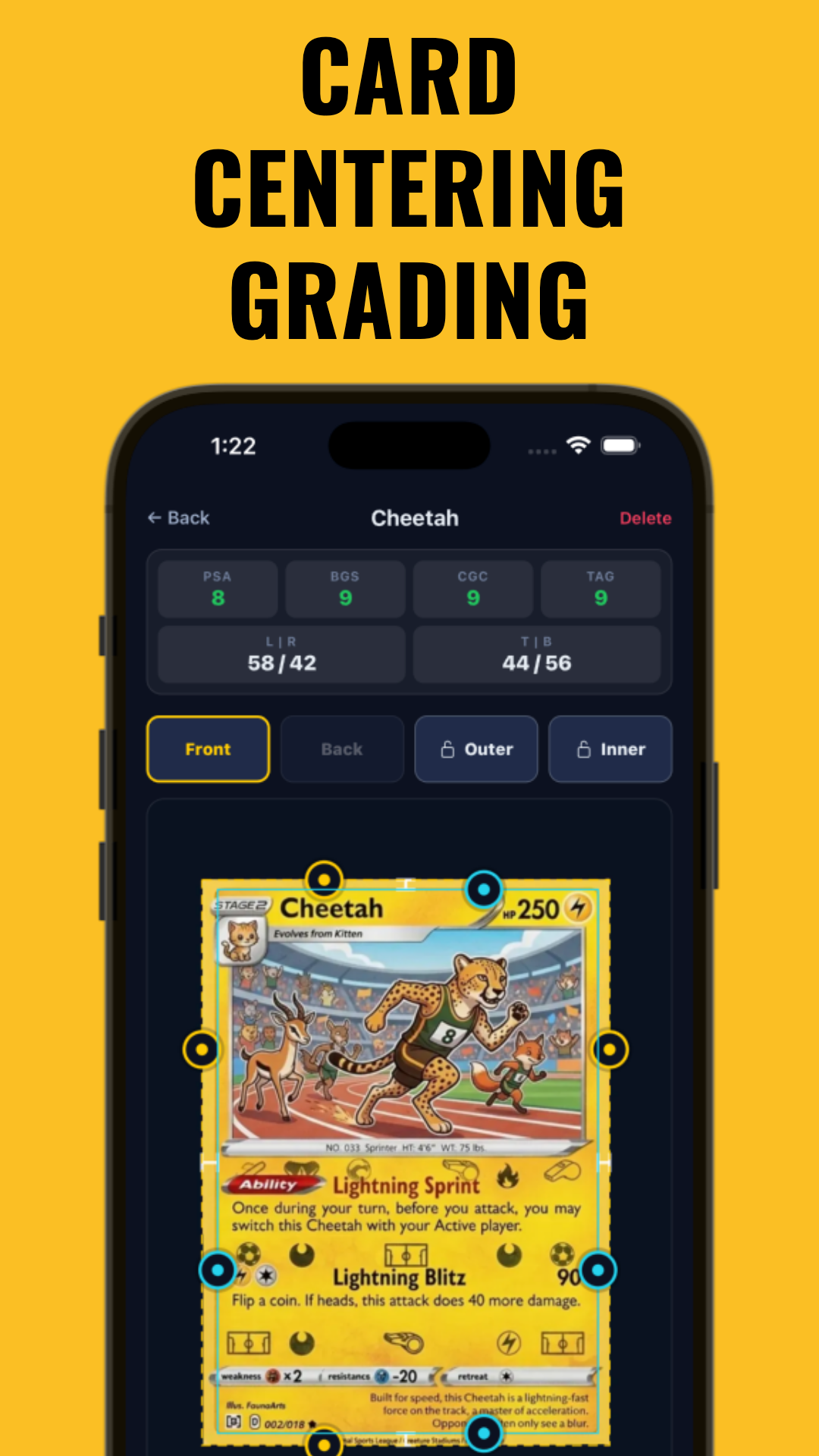
Tools like Midpoint provide collectors with real-time tracking of card centering and grading trends, enabling data-driven decisions about buying, selling, or grading Expedition Base Set cards and sealed products. This empowers collectors to time purchases and submissions strategically.
Conclusion
The Expedition Base Set Pokémon cards exhibit a broad value range shaped by rarity, condition, grading status, and variant types. Iconic chase cards such as Charizard, Raichu, and Mewtwo lead the high-value spectrum, with PSA 10 graded examples commanding premium prices.
While grading adds a significant premium, not all cards warrant the associated cost and effort. Utilizing digital tools like Midpoint to assess centering and condition before grading submissions can help safeguard investments and optimize returns.
Sealed products remain a notable market segment, with prices generally climbing due to scarcity and growing collector enthusiasm. Considering holo and reverse holo variants is essential when evaluating card values within the set.
For collectors and investors holding Expedition Base Set cards, a clear understanding of grading impacts, condition nuances, and evolving market trends is important for maximizing collection value and making informed decisions in this dynamic market.
FAQ
Q: How much is a complete Expedition Base Set worth?
A: As of 2026-08-28, a complete Expedition Base Set in near mint raw condition typically ranges broadly depending on individual card condition and the presence of holo or reverse holo variants. Graded complete sets, particularly those with multiple PSA 9 or PSA 10 cards, can be worth significantly more.
Q: What is the most valuable card in Expedition Base Set?
A: The most valuable card is generally considered to be the Charizard (#4) holofoil, with PSA 10 examples valued in the thousands of dollars. Its rarity, condition sensitivity, and iconic status contribute to it exceeding other cards in value.
Q: How much is a Charizard from Expedition Base Set worth?
A: A raw near mint Charizard card generally sells for several hundred dollars, while PSA 10 graded copies can command prices in the thousands as of 2026. PSA 9 cards often fetch prices between raw and PSA 10 values, depending on market conditions.
Q: Are Expedition Base Set cards worth more graded or ungraded?
A: Graded cards, especially those graded PSA 9 and PSA 10, typically fetch prices several times higher than raw cards. Grading is especially worthwhile for cards with raw values above $50 and those with strong centering and surface quality.
Q: What affects the value of Expedition Base Set Pokémon cards?
A: Several factors influence value, including condition elements such as centering, surface quality, corners, and edges. Grading status and card rarity (holo, reverse holo, and non-holo) also play major roles, as does market demand and provenance.
Q: How can I tell if my Expedition Base Set card is holographic or reverse holo?
A: Holo cards feature a shiny, reflective background behind the Pokémon illustration. Reverse holo cards have a holographic foil background with the Pokémon art itself remaining non-holo. Examining the card under direct light or using a magnifying loupe can help distinguish these variants by observing where the foil is applied.
Free to start
Try the Midpoint app
Grade any card from a photo, see its raw and PSA 10 value, and track what your collection is worth — free.
Get it on iPhoneGet it on Android