Football Card Prices Dropping August 2026: What Collectors Should Know
Explore why football card prices are dropping in August 2026 and how to buy the dip with smart grading and market insights.

Estimated reading time: 8 min
Key Takeaways
- Football card prices have shown declines in August 2026, influenced by new releases and increased supply.
- Raw and PSA 10 graded cards may experience different price impacts during market fluctuations.
- Rookie cards and star players' values can fluctuate with preseason hype and grading quality.
- Using digital tools like Midpoint can help identify undervalued cards by centering and condition.
- Buy-now or wait strategies depend on set-specific trends and secondary market signals.
Football card prices showing declines in August 2026 are creating both opportunities and challenges for collectors. As the preseason progresses, the market reacts to fresh card releases, shifting supply, and changing star-player valuations. Understanding these forces can help collectors decide when to buy, sell, or hold their football cards. This guide explores some key factors behind the football card market's recent dip, highlights which cards may be falling faster, and offers tips on leveraging grading tools like Midpoint to buy smart during this period.
30-day price movers — live data from Midpoint's card database, as of 2026-08-30. Prices move; Midpoint refreshes these daily.
| Card | Raw | PSA 10 | 30-day | |
|---|---|---|---|---|
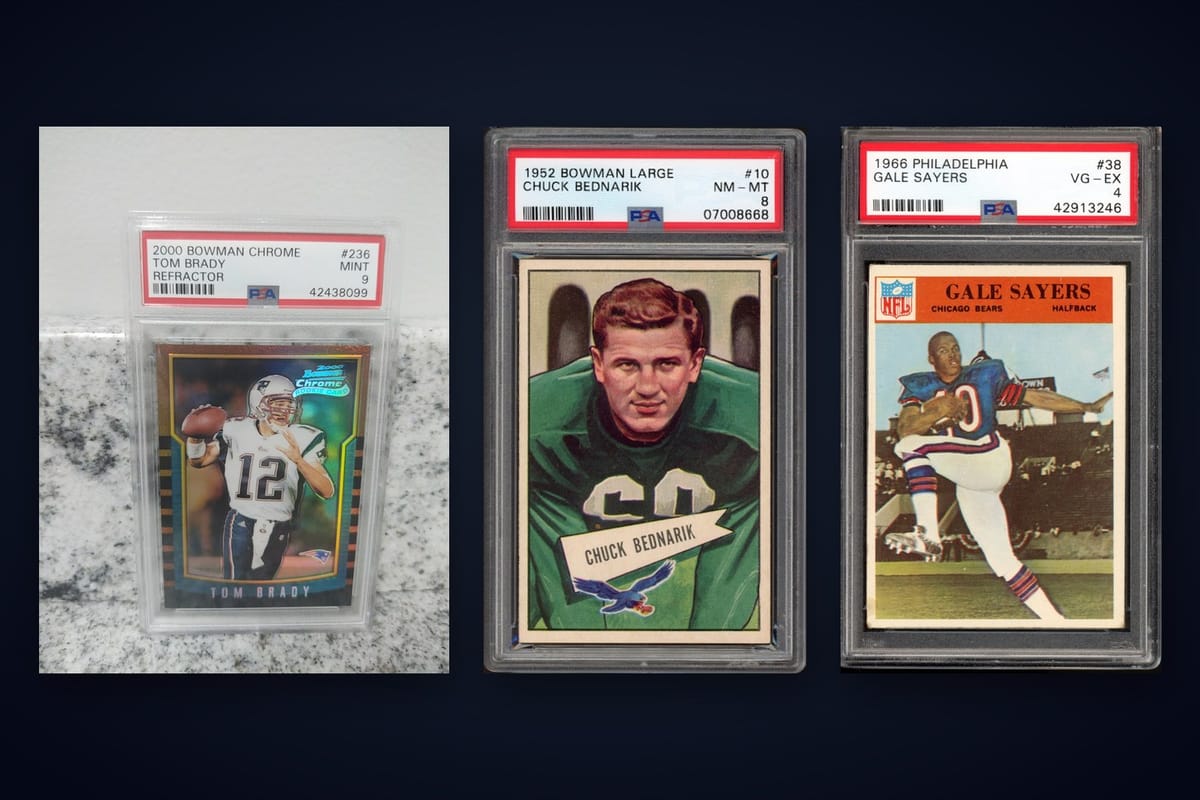
![Tom Brady [Refractor] #236 2000 Bowman Chrome card](https://i.ebayimg.com/images/g/IMsAAOSwhkFgUNLY/s-l500.jpg) |
Tom Brady [Refractor] #236 2000 Bowman Chrome |
$10,353 | $1,849,133 | -47.2% |
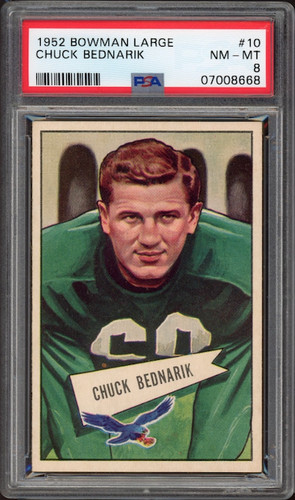 |
Chuck Bednarik #10 1952 Bowman Large |
$38.00 | $9,233 | -37.9% |
 |
Gale Sayers #38 1966 Philadelphia |
$150.26 | $20,022 | -35.3% |
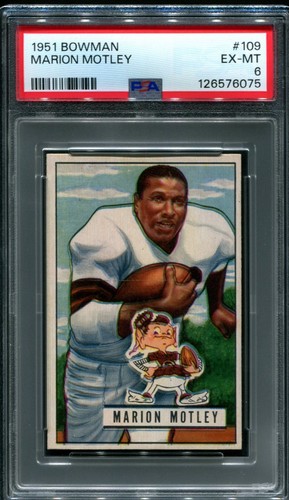 |
Marion Motley #109 1951 Bowman |
$62.04 | $16,062 | -35.3% |
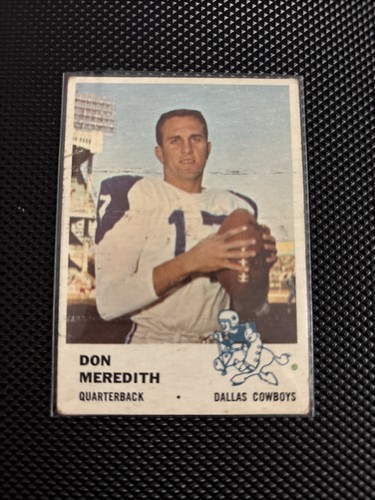 |
Don Meredith #41 1961 Fleer |
$97.50 | $17,674 | -34% |
 |
Sammy Baugh #26 1949 Leaf |
$169.62 | $44,895 | -30.9% |
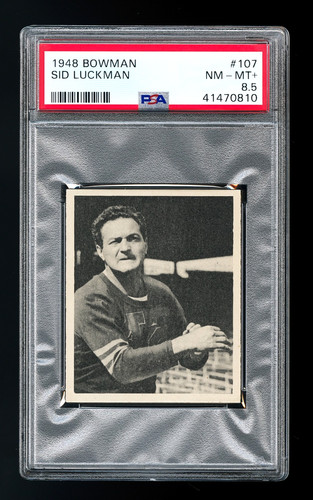 |
Sid Luckman #107 1948 Bowman |
$80.99 | $22,090 | -26.2% |
 |
Jim Brown #71 1961 Topps |
$131.47 | $20,013 | -21.4% |
 |
Otto Graham #2 1952 Bowman Small |
$73.02 | $17,835 | -18.4% |
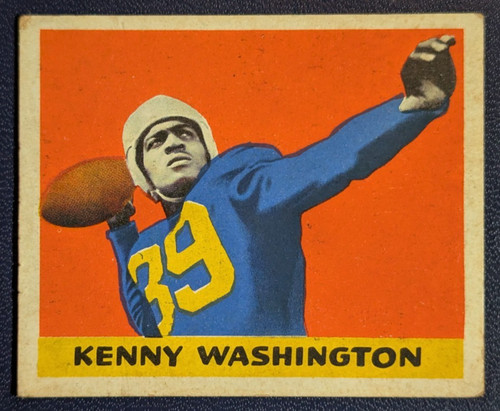 |
Kenny Washington #17 1948 Leaf |
$73.50 | $20,049 | -15.7% |
 |
Chuck Bednarik #132 1950 Bowman |
$69.22 | $25,744 | -14.5% |
 |
Joe Namath #122 1965 Topps |
$1,900 | $297,720 | -13.5% |
Look up any card's current raw and graded value in Midpoint — and get an estimated grade before you pay to submit.
1. August 2026 Football Card Market Overview
August often marks a transitional phase in the football card market. The arrival of new 2026 sets can lead to temporary sell-offs as collectors adjust their portfolios. This supply influx, combined with hype cooling after summer announcements, may contribute to price declines across many cards.
As of 2026-08-30, some football cards tracked by Midpoint have seen raw card prices drop by up to around 20% in certain sets, while graded PSA 10 cards have experienced milder declines, often closer to 10%. For example, the 2026 Panini Prizm Base Rookie cards reportedly fell approximately 15% in raw value but only about 8% in PSA 10 grade.
This divergence suggests that professional grading can cushion some cards against volatility during market dips.
2. Release-Driven Sell-Offs: Why Prices Are Falling
New 2026 football card sets from Topps, Panini, and Select have been released in August. This surge increases supply, which can temporarily saturate demand and lower prices, especially for base and lower-tier cards.
Additionally, overlapping sets with similar star players may cause set cannibalization, where collectors spread their budgets across multiple products, impacting prices. For instance, Topps Chrome and Panini Mosaic rookies often compete for attention, potentially leading to price softening in both sets.
Beyond supply, the hype cycle for football cards often cools after initial release excitement, which can result in fading buyer enthusiasm and lower prices.
3. Which Football Cards Are Falling Fastest?
Among the cards experiencing notable declines are raw rookie cards and mid-tier inserts from heavily produced sets. The 2026 Match Attax base rookies reportedly dropped about 18% in raw prices, reflecting oversupply and lower collector demand.
Star players in less popular sets have also seen sharper declines; for example, 2026 Panini Select wide receiver rookies reportedly lost nearly 20% raw value in August.
Conversely, some veteran star cards and limited-run inserts appear to maintain better stability, showing only minor dips or holding steady.
4. Rookie Cards and Star Player Comparisons
Quarterbacks and wide receivers remain key drivers of market movements. The 2026 Panini Prizm rookie quarterback cards of top prospects reportedly saw around a 12% drop in raw prices but only a 6% decrease in PSA 10 grades.
International stars entering the league have mixed results — some rookie cards fell sharply due to lower demand, while others with strong preseason buzz held value better.
Collectors should watch rookie card comps carefully, as small variations in centering and surface quality can significantly affect prices.
5. Grade-Sensitive Pricing: Raw vs PSA 10 and Others
During market dips, grade sensitivity may intensify. Raw football cards often show steeper price falls compared to those graded PSA 10, BGS 9.5, or CGC 10.
For instance, the 2026 Topps Chrome rookie wide receiver cards reportedly dropped 17% raw but only 9% in PSA 10. This price resilience highlights the potential value of investing in high-grade copies.
Using AI-powered tools like Midpoint to estimate probable grading outcomes before submission can help collectors avoid costly grading mistakes and target cards likely to fetch premium prices.
6. Set-Specific Market Movements
Topps, Panini Prizm, Match Attax, Select, Chrome, and Mosaic each display unique price trends. Panini Prizm rookies generally show moderate declines as the set matures, while Match Attax base cards face sharper drops due to oversaturation.
Topps Chrome and Mosaic tend to maintain better price floors thanks to their strong collector base and chase inserts. Select cards can be more volatile, reacting sharply to news and player performance.
7. Buy-Now or Wait Strategy During Preseason
August's price drop may offer a buy-the-dip window for savvy collectors. Buying now can secure rookies and stars at reduced prices before the season starts driving demand back up.
However, timing is important. Some sets may continue falling into early September, while others stabilize more quickly. Monitoring live pricing and auction signals on platforms like eBay and Midpoint’s card lookup tool can help collectors decide when to act.
Patience may pay for risk-averse buyers, but those seeking value might consider submitting well-centered cards for grading now, using Midpoint's AI digital grading to optimize submission choices.
8. Auction and Secondary Market Insights
Live auction data indicate increased listings but generally lower final sale prices in August 2026. Many sellers appear to be offloading excess inventory, contributing to the price dip.
eBay-style sales show raw cards selling closer to wholesale prices, while graded cards maintain stronger bidding competition, especially for high-grade rookie cards.
Collectors can leverage these signals to identify potentially undervalued cards and set realistic price targets during the downturn.
9. Factors Temporarily Depressing Values
Several factors may depress football card prices this month, including supply surges from new sets, hype cooling post-release, and set cannibalization among competing products.
Increased reprints and parallel variants can also dilute scarcity, reducing premiums on original base cards. This dynamic encourages collectors to focus on high-quality grading and centering to preserve value.
10. Football Cards Still Holding Value Despite the Dip
Despite the broad decline, some cards appear to maintain strong value. Limited population PSA 10 rookie cards of top quarterbacks and rare inserts from Mosaic and Chrome sets tend to hold price floors.
Veteran star cards with consistent performance and low print runs also seem to resist market pressure better than generic base cards.
11. How to Check Live Football Card Prices
To stay ahead, collectors should use real-time pricing tools like Midpoint’s card lookup and portfolio tracking features. Midpoint offers access to raw vs graded values across over 250,000 cards, helping identify which cards are most affected by the August dip.
Regularly reviewing this data supports informed buying, selling, and grading decisions, maximizing collector returns during volatile market phases.

Conclusion
The football card price declines observed in August 2026 reflect a market correction influenced by new supply, hype cycles, and set competition. Collectors who understand these dynamics and use AI-powered grading and market tracking tools like Midpoint can strategically buy the dip, grade wisely, and position their collections for potential gains as the season progresses.
FAQ
Q: Why are football card prices dropping in August 2026?
A: Prices are falling due to new 2026 set releases increasing supply, hype cooling after summer announcements, and set cannibalization competing for collector budgets.
Q: Which football cards are falling the fastest right now?
A: Raw rookie cards and mid-tier inserts from heavily produced sets like 2026 Match Attax and Panini Select wide receiver rookies are among those experiencing notable declines.
Q: Is August a good time to buy football cards before the season starts?
A: August’s price dip may offer a buy-the-dip opportunity, especially for well-centered rookie cards and graded cards that tend to recover value as the season begins.
Q: Do rookie cards usually drop when new sets release?
A: Often, yes. New releases increase supply and shift collector focus, causing temporary price declines in existing rookie cards until demand stabilizes.
Q: How do PSA 10 prices compare to raw football card prices during a market dip?
A: PSA 10 and other high-grade cards typically experience milder price drops than raw cards, benefiting from grade-based demand and scarcity.
Q: Which football card sets are most affected by the August 2026 price drop?
A: Sets like 2026 Match Attax, Panini Select, and some base rookie sets show steeper declines, while Panini Prizm, Topps Chrome, and Mosaic tend to be more resilient.
Free to start
Try the Midpoint app
Grade any card from a photo, see its raw and PSA 10 value, and track what your collection is worth — free.
Get it on iPhoneGet it on Android