Best 1959 Hockey Cards: Raw vs PSA 10 Value Guide
Best 1959 hockey cards ranked: Parkhurst vs Topps stars, raw vs PSA 10 gem premiums, rookie notes, and which cards are worth grading today.

Estimated reading time: 9 min
Key Takeaways
- The best 1959 hockey cards come mainly from two sets: Parkhurst and Topps. Stars like Howe, Hull, Plante, Richard and Béliveau drive demand.
- Punch Imlach, listed at card #15 in some Parkhurst checklists, is a key non-player card that serious set builders chase. Confirm the number and checklist size against a reputable source.
- The gap between raw and PSA 10 is the real story. Check the price table in this guide (values as of 2026-11-08) before you pay to grade.
- Centering, trimmed edges, creases and back stains decide whether a vintage card is worth submitting. Measure first.
Collectors hunting the best 1959 hockey cards are really asking one question: which cards from that year are worth real money, and which are worth grading? This guide ranks the standouts from the 1959-60 era Parkhurst and Topps releases, explains how raw and PSA 10 values differ, and shows what to check before you submit.
One note on naming: 1959 hockey sets are tied to the 1959-60 season, so listings use "1959" and "1959-60" interchangeably. Always confirm the set and card number before you buy.
Prices are not quoted in the text below. The table in this guide shows raw and graded values from Midpoint's database as of 2026-11-08. Use it alongside the card-by-card notes here.
Card values — live data from Midpoint's card database, as of 2026-11-08. Prices move; Midpoint refreshes these daily.
| Card | Raw | PSA 10 | Gem premium | |
|---|---|---|---|---|
 |
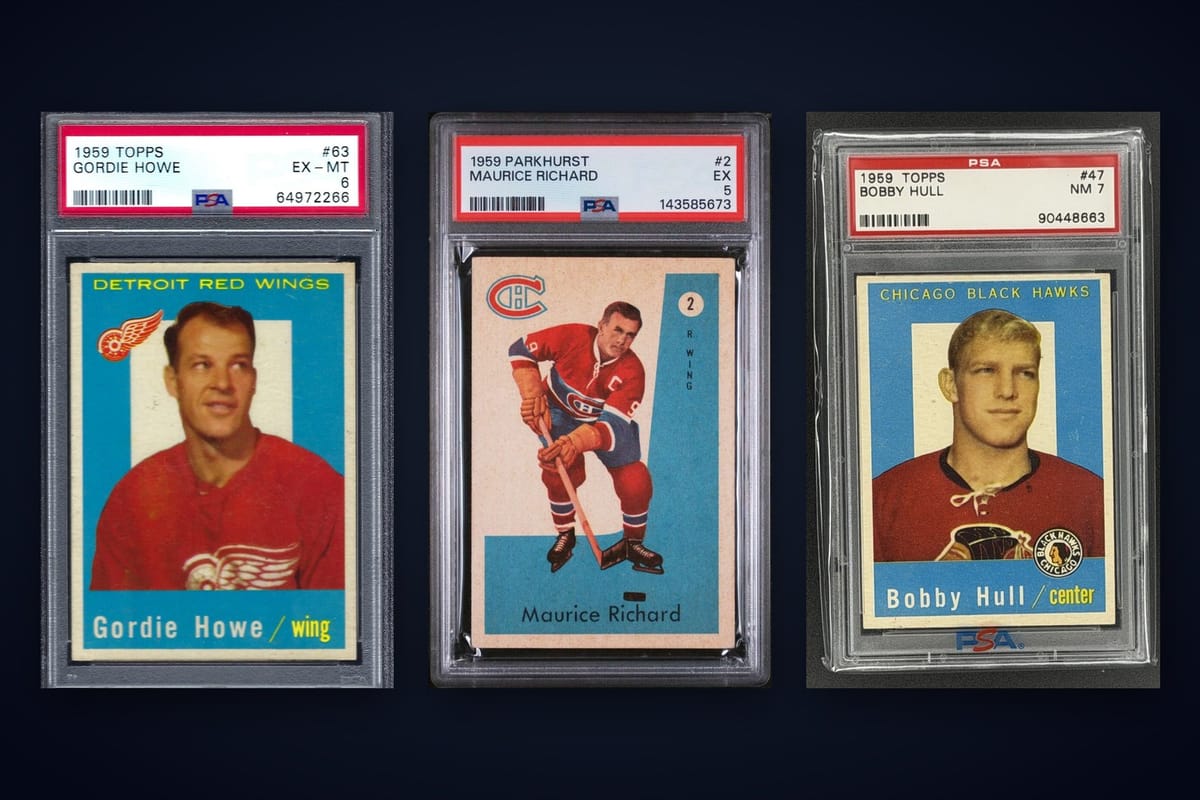
Gordie Howe #63 1959 Topps |
$105.29 | $23,809 | 226.1× |
 |
Maurice Richard #2 1959 Parkhurst |
$101.00 | $23,209 | 229.8× |
 |
Bobby Hull #47 1959 Topps |
$93.07 | $18,182 | 195.4× |
 |
Alex Delvecchio #8 1959 Topps |
$12.28 | $13,320 | 1084.7× |
 |
Jean Beliveau #6 1959 Parkhurst |
$39.59 | $8,416 | 212.6× |
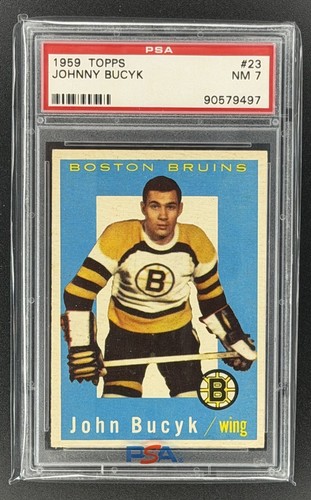 |
Johnny Bucyk #23 1959 Topps |
$32.99 | $6,430 | 194.9× |
 |
Doug Harvey #8 1959 Parkhurst |
$32.13 | $6,258 | 194.8× |
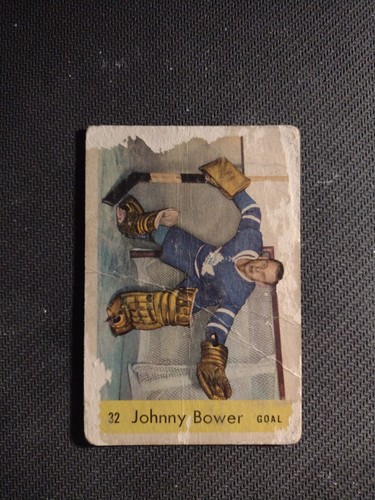 |
Johnny Bower #32 1959 Parkhurst |
$28.82 | $5,622 | 195.1× |
 |
Gump Worsley #15 1959 Topps |
$24.01 | $4,689 | 195.3× |
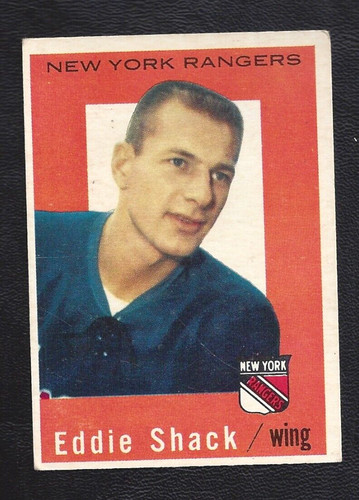 |
Eddie Shack #57 1959 Topps |
$20.34 | $4,662 | 229.2× |
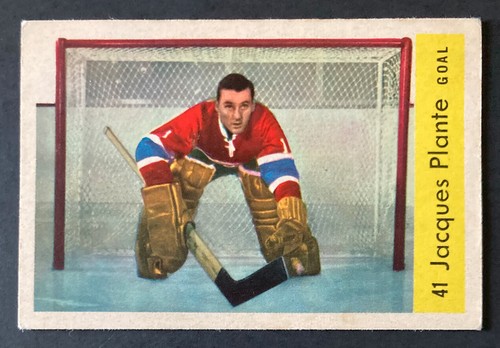 |
Jacques Plante #41 1959 Parkhurst |
$43.36 | $4,560 | 105.2× |
 |
Henri Richard #39 1959 Parkhurst |
$22.82 | $4,458 | 195.3× |
Look up any card's current raw and graded value in Midpoint — and get an estimated grade before you pay to submit.
1. Punch Imlach #15 (Parkhurst)
Imlach is the card that comes up first in any 1959 Parkhurst conversation. He was the Toronto Maple Leafs coach and general manager, and his card is listed at #15 in some Parkhurst checklists. Coach cards are a small slice of any vintage hockey set, which is part of the appeal.
Why it matters to collectors:
- Set completion: You cannot finish the Parkhurst set without it.
- Fewer chasers than star cards: It is a specialist's card, so values are driven by set builders more than by player fans.
- Condition sensitivity: Parkhurst stock is prone to soft corners and print-line edge wear, so clean copies stand out.
Check the table for the as-of-2026-11-08 raw and graded numbers. If the raw price is close to the graded price, grading may not pay off.
2. Bobby Hull
Hull is the Chicago Black Hawks' scoring star, and his cards anchor the most-valuable conversation for this era. Be precise when you shop: his true rookie card is from 1958-59, not 1959. His 1959-60 cards are early-career issues, not rookies. Sellers sometimes blur this line in titles.
- Look for sharp corners and clean borders. Dark or colored borders show wear fast.
- Compare the Hull entry in the table across raw and graded columns to see how much condition matters.
- Confirm the set (Parkhurst vs Topps) because the two trade at different levels.
3. Gordie Howe
Howe is the Detroit Red Wings legend and a pillar of any 1959 hockey cards worth money list. Demand is steady because he is a universal Hall of Famer whose cards appeal to player collectors, set builders and investors alike.
Practical points:
- Howe cards have been reproduced in reprint sets, so verify card stock, print dots and back text against known genuine examples.
- Surface issues such as gloss loss, print lines and wax stains matter more than a tiny corner ding on busy vintage designs.
- High-grade Howe copies are where the gem premium shows up most. See the table for his raw vs PSA 10 gap.
4. Jacques Plante
Plante, the Montreal Canadiens goalie, is a Hall of Famer whose cards are popular because he is tied to the era's most dominant team. He is also famously associated with the adoption of the goalie mask around this time, which adds appeal for display collectors.
- Centering: Parkhurst cards often show uneven borders. Measure left/right and top/bottom before buying.
- Value check: Compare the Plante row in the table to Howe and Hull to see where he sits.
For help with centering ratios, read how centering impacts card value.
5. Maurice "Rocket" Richard
Richard's cards carry cultural weight, especially in Canada. By 1959 he was near the end of his career, but collectors still treat his Canadiens cards as must-haves for any vintage hockey collection.
- Expect competition from both hockey and Canadiana collectors, which supports demand.
- Check the back for stains, pen marks and paper loss. Those are common on cards from kids' collections.
- Look up Richard in the table before bidding. Raw and PSA 10 values show how much a clean copy commands.
6. Jean Béliveau
Béliveau, the Canadiens captain-to-be, is a perennial favorite and a safe star pick for anyone building a best-of set. His cards tend to hold interest because he is both a Hall of Famer and a face of Montreal's dynasty.
What to inspect:
- Corners and edge chipping, which are common on vintage stock
- Crease lines visible only at an angle under light
- Back text clarity and any signs of trimming (compare card size with a known genuine copy)
7. Terry Sawchuk and Glenn Hall
Two elite goalies round out the core star group. Sawchuk (Detroit) and Hall (Chicago) are both Hall of Famers whose cards appeal to goalie specialists. They may sell below the biggest skater names, which can make them smart entry points.
- Budget angle: Check the table to see how their raw prices compare with Howe and Hull.
- Upside angle: If a raw copy has strong centering and sharp corners, a graded result may justify the fee.
8. Parkhurst vs Topps: Which Set Has the Best 1959 Hockey Cards?
Both sets feature the same era's stars, but they play differently in the market.
- Parkhurst: A smaller set that collectors associate with the Imlach card. It is generally considered the more approachable set to complete, and set builders know it well.
- Topps: Also features the era's stars and role players. Checklist sizes are described differently across sources, so confirm card numbers and totals against a reputable checklist before you pay.
- Design: Topps and Parkhurst use different borders, photo styles and card stock, so condition problems show up differently on each.
Rule of thumb: buy Parkhurst if you want a finishable set with a key coach card. Buy Topps if you want broader star coverage. In either case, compare like with like when looking at prices.
9. 1959 Hockey Rookie Cards: What to Know
People searching for 1959 hockey rookie cards are often disappointed. The biggest rookie names from this period, including Hull's 1958-59 issue, belong to neighboring years. Treat any "1959 rookie" listing with caution and verify the player's first card against a trusted checklist.
- Rookie status depends on the player's first mainstream card, not just the first card in a given set.
- Role players with a first card in 1959 sets exist, but they rarely approach star-card values.
- If a seller promises a "rookie" without a checklist reference, ask for one.
10. 1959 Hockey Cards PSA 10: The Gem Premium
The gem premium is the price jump between a raw or mid-grade card and a PSA 10. For 1959 hockey, it can be huge because vintage cards are rarely perfect. Print flaws, soft corners and off-center borders were common from the factory.
How to use the table:
- Compare raw and PSA 10 values for each card, as of 2026-11-08.
- Subtract a typical grading fee and shipping. If the net is small, skip grading.
- Remember that a PSA 10 outcome is the exception on vintage. A card that lands PSA 7 or 8 may sell closer to raw.
For a refresher on what each grade means, see this breakdown of grading scale differences by company.
How to Spot Authentic 1959 Hockey Cards
Reprints and altered cards exist, so check these points before spending real money:
- Centering: Measure borders on all sides. Extreme off-centering can cap grades.
- Backs: Look for even printing, correct fonts and no modern gloss.
- Stains and wax: Common on vintage, and they lower grades.
- Creases: Tilt the card under a light and look for lines.
- Trimming: Compare dimensions with a known genuine card. Sharp, too-clean edges can be a red flag.
Midpoint's AI scan helps with the first step by estimating centering, corners, edges and surface before you commit. Our pre-grading guide walks through the process.

Where to Buy and Sell 1959 Hockey Cards
- Auctions: Good for graded star cards with transparent bidding history.
- Dealers: Useful for raw cards you can inspect and for set-building help.
- Online marketplaces: Wide selection, but verify photos, return policy and seller feedback.
Once you own the cards, protect them. Vintage cardboard is fragile, and our guide to storing valuable cards covers sleeves, holders and humidity.
Conclusion
The best 1959 hockey cards combine star power, a clear set identity and condition that justifies the premium. Punch Imlach is the Parkhurst key for set builders. Howe, Hull, Plante, Richard and Béliveau lead on star power. The gem premium decides what is worth grading.
Before you submit anything, scan it with Midpoint to measure centering and get PSA, BGS, CGC and TAG estimates for free. Then compare the result with the price table.
FAQ
Q: What are the best 1959 hockey cards to collect?
A: Star cards of Gordie Howe, Bobby Hull, Jacques Plante, Maurice Richard and Jean Béliveau lead the list, along with the Punch Imlach Parkhurst card for set builders.
Q: What is the most valuable 1959 Parkhurst hockey card?
A: Value depends on condition and grade. Check the price table in this guide (as of 2026-11-08) to compare the stars and key cards such as Imlach side by side.
Q: How much are 1959 Parkhurst hockey cards worth?
A: It varies widely by player, card number and grade. Raw commons sit far below graded stars, and the gap between raw and PSA 10 can be large. See the table for current figures.
Q: How many cards are in the 1959 Parkhurst hockey set?
A: Sources describe the checklist differently, so confirm the total and card numbers (including Punch Imlach's) against a reputable checklist before buying.
Q: Are there any rookie cards in the 1959 Topps hockey set?
A: Few, if any, major ones. Bobby Hull's rookie card is from 1958-59, so verify any "rookie" claim against a checklist before paying a premium.
Q: What is the difference between 1959 Parkhurst and 1959 Topps hockey cards?
A: They differ in design, card stock and checklist. Both feature the era's stars but trade at different levels, so confirm the checklist for each before comparing prices.
Free to start
Try the Midpoint app
Grade any card from a photo, see its raw and PSA 10 value, and track what your collection is worth — free.
Get it on iPhoneGet it on Android