Lorcana Cards Worth More Graded: Top Picks & Premium Insights
Discover which Lorcana cards are worth more graded, PSA 10 premium values, raw vs graded comparisons, and how to pick the best Lorcana cards to grade for profit.

Estimated reading time: 9 min
Key Takeaways
- Only select Lorcana cards like Enchanted and Iconic variants tend to show stronger PSA 10 premiums that may justify grading.
- Raw vs graded Lorcana card prices suggest PSA 10 grades can increase values for key characters, though premiums vary widely.
- Grading costs and condition requirements mean not every card benefits from submission; centering and surface quality are important factors.
- PSA remains the dominant grading company for Lorcana, though CGC and BGS are alternatives with different fee structures and market recognition.
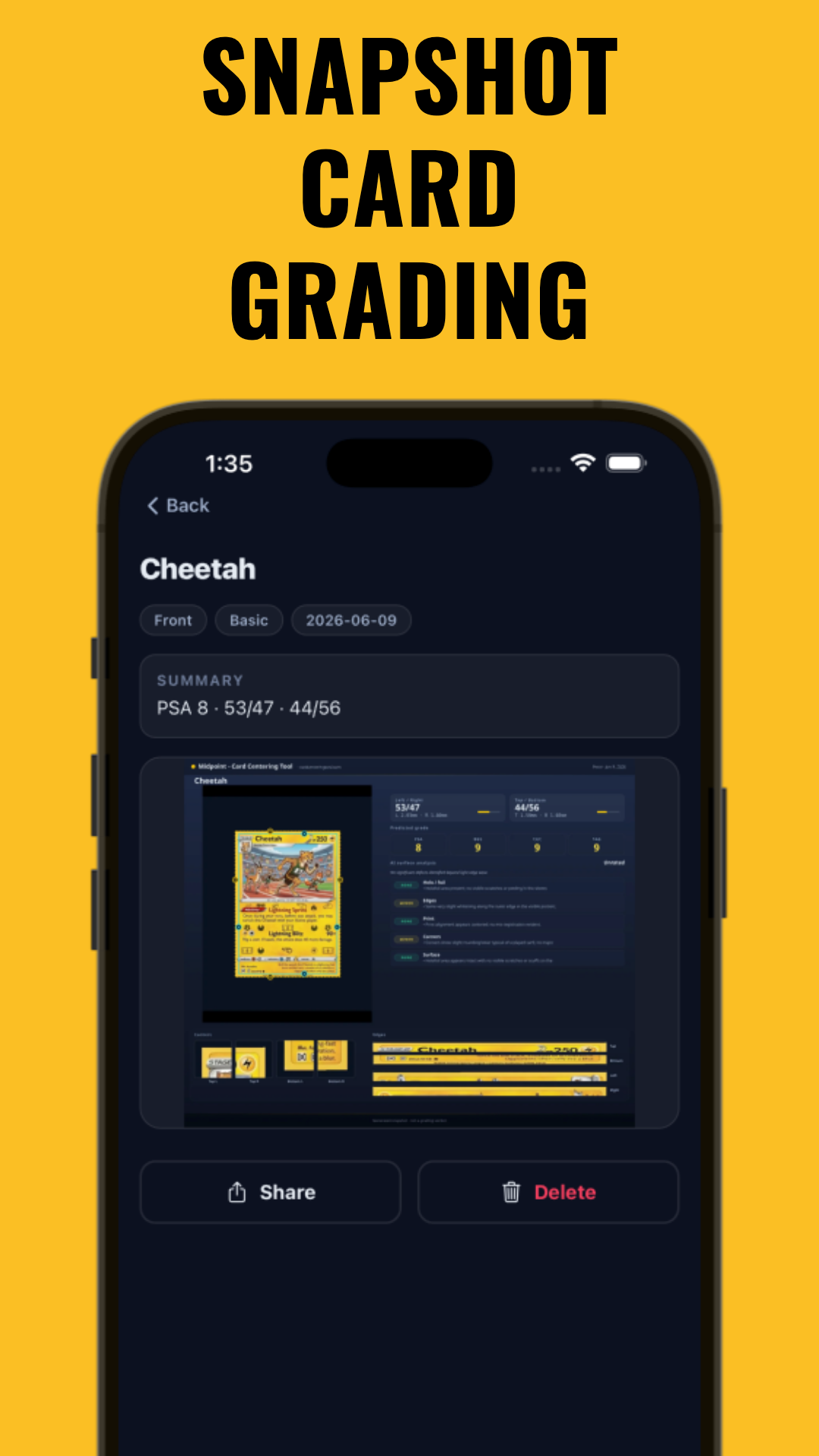
- Use tools like Midpoint’s AI grading estimates and centering measurements to help pre-assess Lorcana cards before costly submissions.
As Lorcana card collecting grows, many collectors wonder which Lorcana cards are worth grading and what premiums PSA 10 grades might command. Understanding raw vs graded Lorcana cards, grading cost math, and condition requirements is important for maximizing potential profit and avoiding grading pitfalls. This guide breaks down the best Lorcana cards to grade for potential profit, the rarity hierarchy, and how grading companies compare—all based on data available as of 2026-09-15.
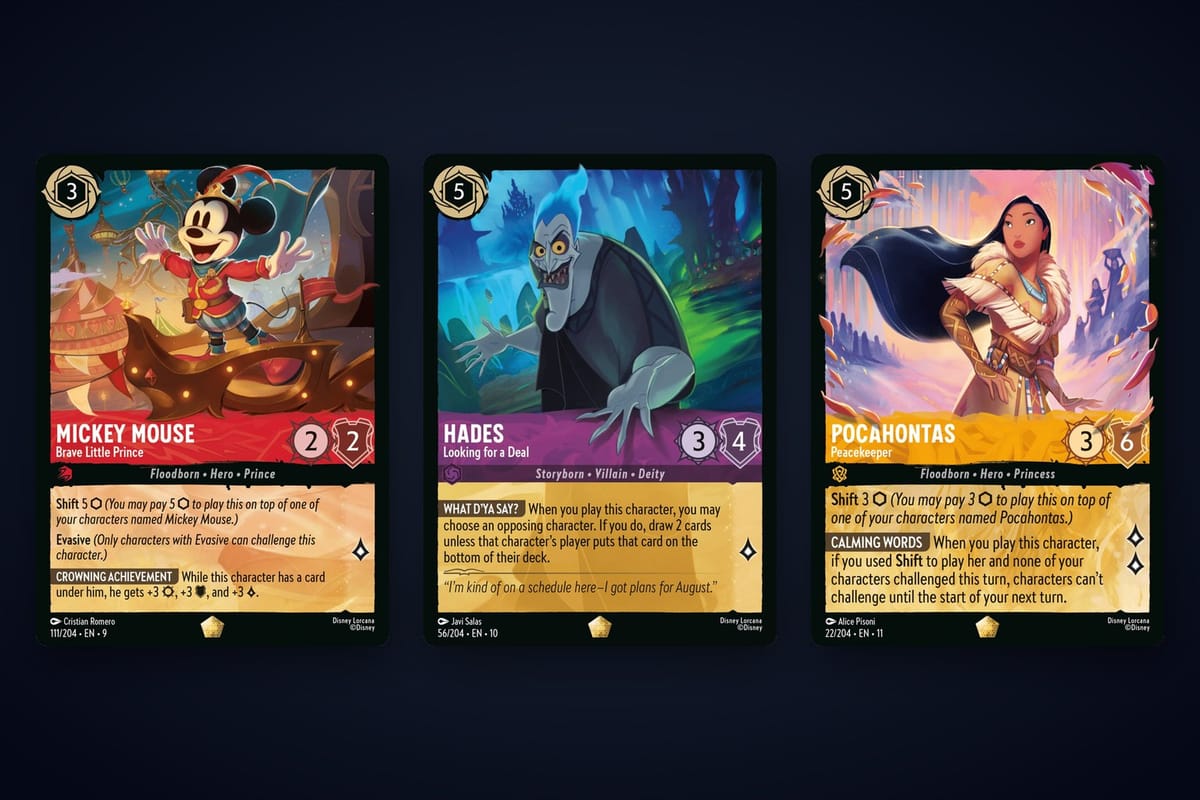
Raw vs PSA 10 value (biggest grading premium) — live data from Midpoint's card database, as of 2026-09-15. Prices move; Midpoint refreshes these daily.
| Card | Raw | PSA 10 | Gem premium | |
|---|---|---|---|---|
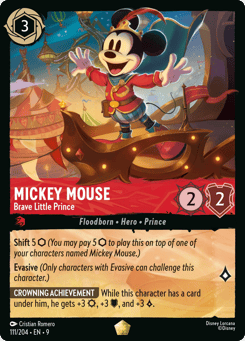 |
Mickey Mouse #111/204 Fabled (2025) |
$40.48 | $15,000 | 370.6× |
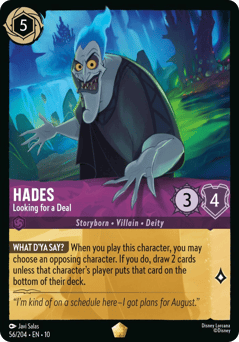 |
Hades #56/204 Whispers in the Well (2025) |
$26.13 | $2,477 | 94.8× |
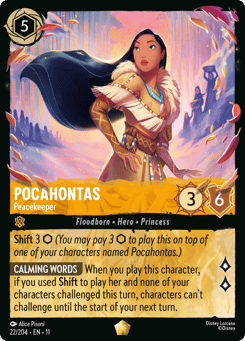 |
Pocahontas #22/204 Winterspell (2026) |
$38.30 | $2,310 | 60.3× |
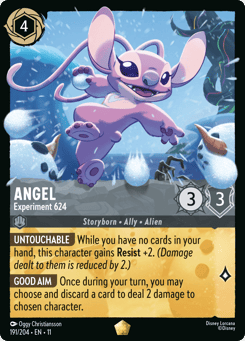 |
Angel #191/204 Winterspell (2026) |
$47.80 | $2,333 | 48.8× |
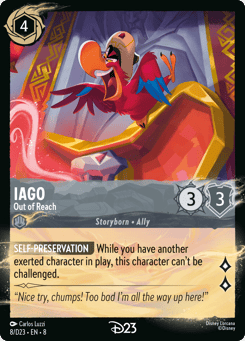 |
Iago #8/D23 D23 Collection 2024 (2024) |
$40.24 | $1,397 | 34.7× |
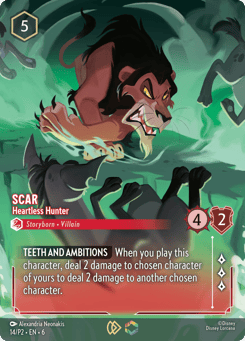 |
Scar #14/P2 Promo Expansion 2 (2024) |
$46.36 | $1,570 | 33.9× |
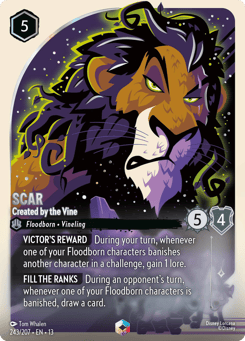 |
Scar #243/207 Attack of the Vine! (2026) |
$102.61 | $3,400 | 33.1× |
 |
Scar - Created by the Vine #243 Lorcana Attack of the Vine |
$121.68 | $2,500 | 20.6× |
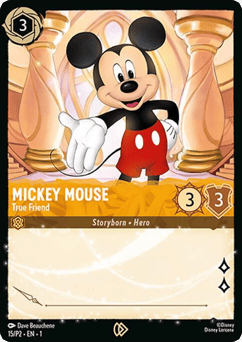 |
Mickey Mouse #15/P2 Promo Expansion 2 (2024) |
$62.72 | $1,121 | 17.9× |
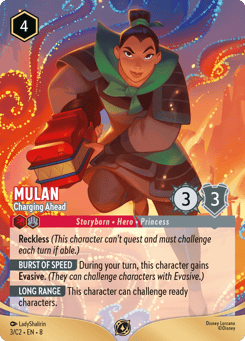 |
Mulan #3/C2 Challenge Promos 2 (2025) |
$54.71 | $959.36 | 17.5× |
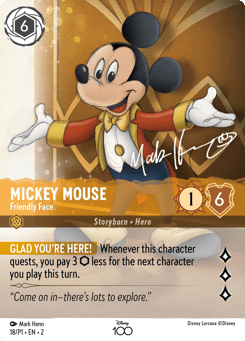 |
Mickey Mouse #18/P1 Disney100 (2023) |
$33.01 | $541.32 | 16.4× |
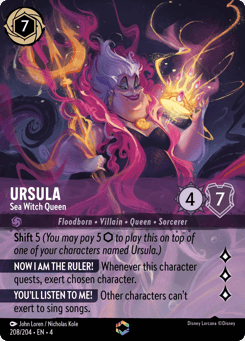 |
Ursula #208/204 Ursula's Return (2024) |
$52.35 | $591.52 | 11.3× |
Look up any card's current raw and graded value in Midpoint — and get an estimated grade before you pay to submit.
1. Enchanted and Iconic Lorcana Cards Tend to Command the Highest Graded Premiums
Among Lorcana cards, the Enchanted and Iconic variants generally stand out as the most valuable when graded. For example, the Enchanted Elsa card has been observed with a raw market price around $150 and PSA 10 prices approximately $450 in some cases, reflecting a potential 3x premium. Iconic Mickey Mouse cards have shown similar trends, with raw values near $200 and PSA 10 prices sometimes exceeding $500.
These special illustration cards' rarity and demand appear to drive their graded premiums, making them prime candidates for submission if condition is pristine. Other chase cards like Legendary Buzz Lightyear and Ursula have also shown notable PSA 10 premiums but generally less than Enchanted and Iconic types.
Focusing on these variants may help offset grading fees and risks through resale gains.
- Enchanted Elsa PSA 10 premium: up to ~3x raw price
- Iconic Mickey Mouse PSA 10 premium: up to ~2.5x raw price
- Legendary Buzz Lightyear PSA 10 premium: up to ~1.8x raw price
2. Raw vs Graded Lorcana Cards: Understanding Price Gaps and Premiums
Price differences between raw and graded Lorcana cards, particularly PSA 10s, can be significant but vary widely by card. Cards like Stitch and Belle have shown raw values around $100-$120, with PSA 10s reaching $250-$300 in some sales. Ursula’s raw price has hovered near $80, while PSA 10 examples have sold for $140 or more.
This spread results from collector confidence in condition authenticity, rarity certification, and market demand. However, many common and uncommon Lorcana cards show minimal price lift post-grading, making grading economically unjustifiable in many cases.
Consulting accurate market data before submission is important—tools like Midpoint provide side-by-side raw and graded price histories for over 250,000 cards, including Lorcana.
3. Character-Specific Grading Premiums: Elsa, Mickey Mouse, Stitch, Ursula, Belle, Buzz Lightyear
Certain characters tend to enjoy stronger graded premiums, influenced by popularity and card rarity. Elsa and Mickey Mouse generally dominate the top tier, with PSA 10 premiums sometimes exceeding 2.5x raw prices. Stitch and Belle often follow closely, with roughly 2x premiums, while Ursula and Buzz Lightyear cards typically yield 1.5x to 1.8x increases in observed sales.
These figures highlight which characters may be prioritized for grading if seeking better return on investment, though premiums can fluctuate.
- Elsa: raw ~$150, PSA 10 up to ~$450
- Mickey Mouse: raw ~$200, PSA 10 up to ~$500+
- Stitch: raw ~$110, PSA 10 up to ~$250
- Belle: raw ~$120, PSA 10 up to ~$280
- Ursula: raw ~$80, PSA 10 up to ~$140
- Buzz Lightyear: raw ~$90, PSA 10 up to ~$160
4. Grading Cost Math and Break-Even Thresholds for Lorcana Cards
Grading fees, shipping, and marketplace commissions significantly impact profitability. PSA grading typically costs $20-$30 per card plus shipping; marketplace fees on resale can be 10-15%. To break even, a graded card’s premium over raw must exceed these combined costs.
For example, submitting a $100 raw card with $30 grading and $15 selling fees requires a PSA 10 price above $145 to profit. Cards with less than 1.5x PSA 10 premiums often fail to cover these expenses, making pre-grading evaluation essential.
Using Midpoint’s digital grading estimates can help anticipate achievable grades and refine submission strategies, potentially saving money and time.
5. Condition Requirements: Centering, Corners, Surface, Whitening, Print Lines, Scratches
Achieving a PSA 10 or equivalent grade generally demands near flawless condition. Centering should be very close to perfect, often less than 1 millimeter off-center. Corners should be sharp, edges clean, and surfaces free from whitening, print lines, or scratches.
Many Lorcana cards fail to reach top grades due to subtle wear or centering issues. For this reason, accurate condition analysis tools like Midpoint’s AI surface grading and precise centering calculators can help determine grade viability before submitting.
Failing to meet stringent standards risks receiving a PSA 9 or lower, which in some cases may reduce value below raw price for certain Lorcana cards.
6. Choosing the Best Grading Company for Lorcana: PSA vs CGC vs BGS
PSA currently dominates Lorcana grading with the largest market recognition and price premiums, especially for PSA 10s. CGC and BGS offer alternatives—CGC often has faster turnaround and slightly lower fees, while BGS provides detailed subgrades but typically commands lower resale prices for Lorcana cards.
Collectors prioritizing maximum value and liquidity generally prefer PSA slabs. However, cost-sensitive graders or those targeting niche markets may consider CGC or BGS. Regardless, pre-grading condition verification is important across all companies.
7. Rarity Tiers and Value Hierarchy in Lorcana Cards
Lorcana card values correlate strongly with rarity tiers: Common, Uncommon, Rare, Legendary, Enchanted, and Iconic. Common and Uncommon cards rarely justify grading due to low PSA 10 premiums. Rare cards sometimes break even, but the true grading value tends to lie in Legendary, Enchanted, and Iconic cards.
Enchanted and Iconic cards are often chase cards with limited print runs and unique art, driving higher demand and price surges when graded. Understanding this hierarchy helps collectors focus grading budgets strategically.
8. Checking Sold Comps and Market Data Before Grading Lorcana Cards
Before submitting any Lorcana card for grading, reviewing recent sold comps is essential. Prices fluctuate with market trends, and a card’s premium can rise or fall rapidly. Platforms like Midpoint provide comprehensive sales histories, showing raw vs graded price trajectories and population data.
Analyzing this data helps identify temporary price movers and avoid grading cards unlikely to appreciate.
9. When Grading Lorcana Cards Can Backfire: The Risk of PSA 9 or Lower
Not all grading outcomes guarantee profit. Many Lorcana cards graded PSA 9 or 8 have sold for less than raw counterparts, especially if raw condition is near mint. This scenario occurs when centering or surface issues prevent a perfect 10 but still incur grading fees.
Collectors should use digital pre-grading tools like Midpoint to estimate achievable grades and decide whether the risk outweighs potential reward.
10. Current Market Trends and Price Movers Creating Grading Opportunities
As of late 2026, Lorcana’s market shows increased interest in Enchanted Elsa and Iconic Mickey Mouse cards, driven by nostalgic demand and limited supply. Newer chase cards with unique art occasionally create short-term grading premiums.
Staying updated on these trends through market data analysis and community insights can help collectors time grading submissions for better potential outcomes.
Conclusion
Grading Lorcana cards can significantly boost value—especially for Enchanted, Iconic, and other chase variants. However, not all Lorcana cards are worth grading due to cost and condition risks. Understanding raw vs graded price premiums, character-specific demand, and grading company differences is important for success.
Leverage tools like Midpoint to pre-grade cards with AI accuracy, measure centering precisely, and track market data. This approach helps ensure informed grading decisions, maximize profits, and avoid costly grading mistakes.
FAQ
Q: Which Lorcana cards are worth the most when graded?
A: Enchanted Elsa and Iconic Mickey Mouse cards generally lead in graded premiums, often selling for 2.5-3x their raw prices as PSA 10s. Legendary and chase cards also show value but typically less than these top variants.
Q: Is it worth grading Lorcana cards for resale?
A: Grading is primarily worthwhile for rare, Enchanted, and Iconic cards with stronger PSA 10 premiums. Common or low-tier cards usually don’t yield enough premium to cover grading and selling fees.
Q: What Lorcana cards should I not grade?
A: Avoid grading common, uncommon, and many rare cards without proven 1.5x+ PSA 10 premiums. Cards with visible centering or surface flaws also risk low grades and reduced resale value.
Q: How much more is a PSA 10 Lorcana card worth than raw?
A: PSA 10 premiums vary from about 1.5x to 3x raw values depending on card rarity and character. For example, Enchanted Elsa can approach triple raw price, while Buzz Lightyear might increase around 1.8x.
Q: Should I grade Enchanted or Iconic Lorcana cards?
A: Yes, these cards typically command the highest graded premiums and may justify grading costs if condition is near perfect.
Q: What condition does a Lorcana card need to be to get a 10?
A: Near flawless centering (within about 1 mm), pristine corners, and no surface whitening, scratches, or print lines are generally required to achieve a PSA 10 grade.
Free to start
Try the Midpoint app
Grade any card from a photo, see its raw and PSA 10 value, and track what your collection is worth — free.
Get it on iPhoneGet it on Android