Most Valuable Hockey Cards: Top Picks and Grading Insights
Discover the most valuable hockey cards, their PSA 10 values, and how grading impacts prices. Learn to spot rare hockey cards worth money today.

Estimated reading time: 12 min
Key Takeaways
- The 1979-80 O-Pee-Chee Wayne Gretzky rookie card is widely regarded as the hobby’s top benchmark, with PSA 10 values reported to exceed $1.5M.
- Rookie cards of legends like Bobby Orr, Gordie Howe, and Maurice Richard remain highly sought after and valuable.
- Modern premium rookies such as Connor McDavid and Sidney Crosby from sets like The Cup command strong prices.
- Card grading, centering, and condition significantly affect hockey card values, with PSA 10 and Gem Mint grades being most prized.
- Using tools like Midpoint can help collectors pre-grade and measure centering to better understand card condition before submitting for grading.
Hockey card collecting continues to flourish, with select cards commanding prices that rival other sports. Whether you’re a seasoned collector or new to the hobby, knowing which hockey cards are the most valuable and why is essential. This guide breaks down some of the most expensive hockey cards, grading considerations, and how to identify rare cards potentially worth money. We’ll also explore how grading and condition impact prices, helping you make informed buying or selling decisions with the help of tools like Midpoint.
Card values — live data from Midpoint's card database, as of 2026-09-04. Prices move; Midpoint refreshes these daily.
| Card | Raw | PSA 10 | Gem premium | |
|---|---|---|---|---|
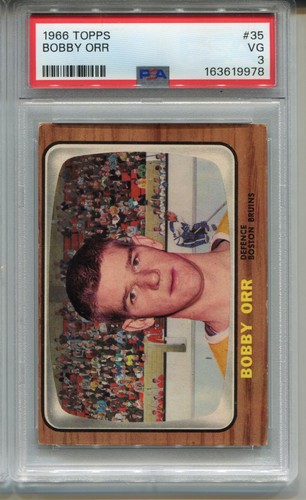 |
Bobby Orr #35 1966 Topps |
$2,243 | $337,283 | 150.4× |
 |
Tim Horton #58 1952 Parkhurst |
$677.91 | $161,206 | 237.8× |
 |
Gordie Howe #88 1952 Parkhurst |
$600.10 | $145,264 | 242.1× |
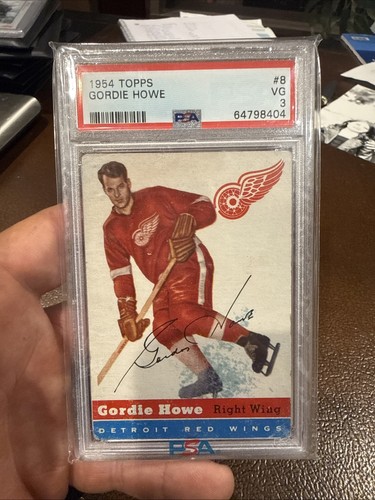 |
Gordie Howe #8 1954 Topps |
$746.58 | $139,124 | 186.4× |
 |
Jean Beliveau #27 1953 Parkhurst |
$455.79 | $107,407 | 235.7× |
 |
Bobby Hull #66 1958 Topps |
$537.06 | $106,605 | 198.5× |
 |
Jacques Plante #50 1955 Parkhurst |
$450.92 | $99,499 | 220.7× |
 |
Frank Mahovlich #17 1957 Parkhurst |
$358.79 | $74,399 | 207.4× |
![Connor Bedard [Rookie Patch Auto] #150 2023 Upper Deck The Cup card](https://i.ebayimg.com/images/g/6hQAAeSwDe5p-8b9/s-l500.jpg) |
Connor Bedard [Rookie Patch Auto] #150 2023 Upper Deck The Cup |
$19,074 | $72,962 | 3.8× |
 |
Phil Esposito #116 1965 Topps |
$394.88 | $59,706 | 151.2× |
 |
Wayne Gretzky #18 1979 Topps |
$645.85 | $56,286 | 87.2× |
 |
Boom Boom Geoffrion #14 1951 Parkhurst |
$220.50 | $55,134 | 250× |
 |
Maurice Richard #1 1952 Parkhurst |
$219.75 | $53,311 | 242.6× |
 |
The Winning Goal #52 1951 Parkhurst |
$205.02 | $49,987 | 243.8× |
 |
Bobby Orr #92 1967 Topps |
$276.26 | $49,972 | 180.9× |
Look up any card's current raw and graded value in Midpoint — and get an estimated grade before you pay to submit.
1. 1979-80 O-Pee-Chee Wayne Gretzky Rookie Card
The 1979-80 O-Pee-Chee Wayne Gretzky rookie card is often considered the king of hockey cards and sets a high standard for value in the hobby. As of 2026-09-04, PSA 10 copies of this card have been reported to sell for over $1.5 million, making it one of the most expensive hockey cards known.
This card’s value is driven by Gretzky’s status as one of the greatest hockey players of all time, combined with the relative rarity of high-grade O-Pee-Chee cards due to print runs and condition challenges. The O-Pee-Chee version is often preferred over the 1979 Topps Gretzky rookie due to its Canadian origin and slightly different design.
- PSA 10 value: $1,550,000+ (as of 2026-09-04, based on reported sales)
- Raw card values vary widely based on centering and surface condition
- Centered and high-grade copies are rare and highly prized
2. 1979 Topps Wayne Gretzky Rookie Card
The Topps Gretzky rookie card is also highly valuable but generally commands slightly less than the O-Pee-Chee version. PSA 10 values are typically reported in the high six-figure range but can approach seven figures for Gem Mint copies.
Collectors prize this card for its place in hockey card history and its iconic design. Condition and centering remain crucial, and many collectors use apps like Midpoint to estimate grading before paying expensive submission fees.
- PSA 10 value: Approximately $850,000 (as of 2026-09-04, based on reported sales)
- Condition and centering impact value significantly
3. Vintage Legends: Bobby Orr, Gordie Howe, Maurice Richard, and Bobby Hull
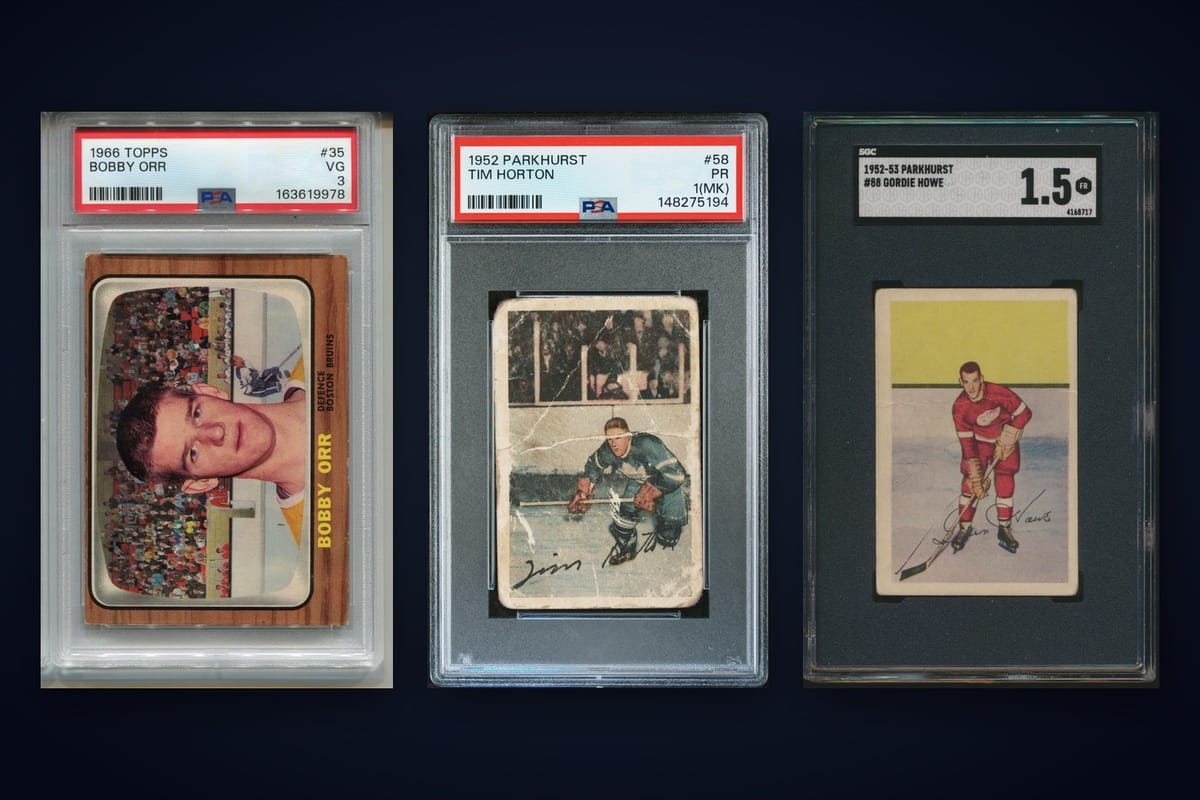
Cards from these Hall of Famers regularly appear in top value lists. For example, Bobby Orr’s 1966-67 Topps rookie card in PSA 10 condition can fetch six figures, as can Gordie Howe’s 1951 Parkhurst rookie. Maurice Richard and Bobby Hull cards from the 1950s and 1960s also command strong prices.
These players’ legendary status and the scarcity of high-grade vintage hockey cards contribute to their values. Cards with strong centering and minimal surface wear are especially prized.
- Orr 1966-67 Topps PSA 10: $100,000+ (approximate, based on market observations)
- Howe 1951 Parkhurst PSA 10: $120,000+ (approximate, based on market observations)
- Richard and Hull vintage cards vary but remain in high demand
4. Modern Grails: Connor McDavid, Sidney Crosby, and Young Guns
Modern premium rookie cards from sets like Upper Deck’s The Cup and Young Guns have seen significant increases in value. Connor McDavid’s 2015 Young Guns rookie card and Sidney Crosby’s 2005 Young Guns card are notable examples.
These cards combine star power with limited print runs, autographs, and premium card stock, which can drive value. PSA 10 graded copies have been reported to sell for tens or hundreds of thousands depending on rarity and condition.
- Connor McDavid 2015 Young Guns PSA 10: $100,000+ (approximate, based on market observations)
- Sidney Crosby 2005 Young Guns PSA 10: $50,000+ (approximate, based on market observations)
- Autographed and patch variants often command higher prices
5. What Drives Value: Rookie Status, Autographs, Patches, and Serial Numbers
The most valuable hockey cards share several key features beyond player and set. Rookie card status is a primary driver, but autograph presence, game-used patches, and serial-numbered limited prints can elevate prices significantly.
For example, a Gretzky rookie card with an authenticated autograph and patch can increase value substantially compared to a base card. Serial numbering to low print runs like /25 or fewer also boosts scarcity and demand.
- Rookie card designation is usually the highest value factor
- Autographs and patches add collectible uniqueness
- Serial-numbered limited editions increase scarcity
6. The Role of Grading and Condition in Hockey Card Values
Grading standards from PSA, BGS, CGC, and TAG are important for establishing value. A PSA 10 or BGS Gem Mint grade can multiply a card’s worth by several times compared to raw or lower-grade examples.
Key condition elements include centering, corners, edges, and surface quality. Centering is often the most difficult to perfect and directly impacts grade. Midpoint’s AI grading and precise centering tool can help collectors estimate grades before submission, potentially saving money and improving selling outcomes.
- PSA 10 or Gem Mint grades command top dollar
- PSA 9 and BGS 9.5 also retain strong value
- Condition flaws can drastically reduce prices

7. Auction Records vs. Raw Card Estimates
Auction sale prices for top-grade hockey cards often set public records but can differ from current market price guides and raw card values. Auction results reflect buyer competition and rarity at a specific time, while raw card prices depend heavily on condition and centering.
Collectors should track recent auction comps and marketplace sales for accurate valuation. Tools like Midpoint provide up-to-date PSA 10 values and raw estimates based on thousands of transactions.
- Auction prices often exceed raw card estimates by large margins
- Graded card population and recent sales data influence value
- Regularly checking sold listings helps set realistic expectations
8. How to Identify Valuable Hockey Cards
Knowing what to look for is key to spotting hockey cards potentially worth money. Important factors include the set, year, card number, manufacturer, and print run details. Rookie cards from 1979 Topps and O-Pee-Chee, vintage Parkhurst, and high-end modern sets like The Cup are prime targets.
Collectors should verify authenticity and condition carefully. Using Midpoint’s card lookup feature can help confirm raw vs graded values and assist in identifying rare variants.
- Key sets: 1979 Topps/O-Pee-Chee, Parkhurst, The Cup, Young Guns
- Check rookie card designation and card number
- Look for serial numbers, autographs, and patches
9. Price Tiers by Era: Vintage vs. Modern Hockey Cards
Vintage hockey cards (pre-1980) generally hold higher value due to rarity and age, with some exceptions in the modern era where limited print runs and star power elevate prices. For example, Gretzky’s 1979 O-Pee-Chee rookie is among the highest valued cards, but modern McDavid and Crosby rookies also command premium prices.
Understanding price tiers by era helps collectors build balanced portfolios and recognize investment potential.
- Vintage cards: higher scarcity, condition challenges
- Modern cards: often limited runs, premium inserts
- Both eras have high-value cards depending on player and condition
10. Practical Buying and Selling Signals for Hockey Cards
When buying or selling, always check recent sold listings and auction comps to understand current market conditions. Grading is usually worth the cost for high-value cards but can be skipped for lower-tier cards or those with condition issues.
Use pre-grading tools like Midpoint to measure centering and estimate grades, helping avoid overpaying for grading or underselling your cards.
- Review recent sales and auction data carefully
- Consider grading if card is likely to get PSA 9 or higher
- Use AI tools to pre-grade and measure centering precisely
Conclusion
The market for valuable hockey cards is rich with history, star power, and investment potential. From the iconic 1979-80 O-Pee-Chee Wayne Gretzky rookie card to modern gems like Connor McDavid’s Young Guns, condition and grading remain paramount to value. Leveraging digital tools like Midpoint to measure centering and estimate grading can help collectors make more informed decisions and potentially secure better prices when buying or selling. Whether hunting for rare vintage legends or premium modern rookies, understanding what drives value will enhance your hockey card collecting experience.
FAQ
Q: What is the most valuable hockey card ever sold?
A: The 1979-80 O-Pee-Chee Wayne Gretzky rookie card is widely considered the most valuable, with PSA 10 copies reported to have sold for over $1.5 million as of 2026-09-04.
Q: Why is the 1979-80 O-Pee-Chee Wayne Gretzky rookie card so valuable?
A: Its value stems from Gretzky’s legendary status, the relative rarity of high-grade copies, and the card’s iconic design and Canadian print run.
Q: What are the most valuable modern hockey rookie cards?
A: Connor McDavid’s 2015 Young Guns and Sidney Crosby’s 2005 Young Guns cards from premium sets like The Cup are among the most valuable modern rookies.
Q: How much is a Gretzky rookie card worth in different grades?
A: PSA 10 O-Pee-Chee Gretzky cards have been reported to sell for $1.5 million+, while PSA 9 or lower grades typically have significantly lower values. Topps Gretzky rookie cards generally have slightly lower but still strong values.
Q: Which hockey cards should I look for if I think I found a rare card?
A: Focus on rookie cards from key sets like 1979 Topps/O-Pee-Chee, vintage Parkhurst, and premium modern inserts with serial numbers, autographs, or patches.
Q: Are Topps and O-Pee-Chee hockey rookies worth different amounts?
A: Yes, O-Pee-Chee versions, especially the Gretzky rookie, typically command higher prices due to scarcity and collector preference.
Free to start
Try the Midpoint app
Grade any card from a photo, see its raw and PSA 10 value, and track what your collection is worth — free.
Get it on iPhoneGet it on Android