
11 Hockey Cards Worth More Graded: Raw vs PSA 10 Values Explained
Discover which hockey cards are worth more graded, why the PSA 10 premium exists, and how raw vs graded values compare. See top cards and smart grading tips.

Estimated reading time: 12 min
Key Takeaways
- Graded hockey cards—especially PSA 10s—can be worth significantly more than raw cards.
- Vintage stars and rare early rookie cards often see the biggest jump in value from grading.
- Condition, centering, and low population typically drive the graded premium.
- Modern rookies and parallels can be profitable to grade if in top condition.
- App tools like Midpoint can help estimate cards' PSA/BGS grades before spending on grading fees.
When collectors ask which hockey cards are worth more graded, the answer is often clear: for many vintage and key rookie cards, a PSA 10 can multiply market value by a large factor. But not all cards are created equal—knowing which ones to submit, why raw vs graded prices differ, and how to spot a winner can mean the difference between a big profit and a loss. This guide breaks down the hockey cards worth more graded, the data behind the PSA 10 premium, and how to maximize your grading decisions using real-world examples and expert tips.
Raw vs PSA 10 value (biggest grading premium) — live data from Midpoint's card database, as of 2026-08-16. Prices move; Midpoint refreshes these daily.
| Card | Raw | PSA 10 | Gem premium | |
|---|---|---|---|---|
 |
Wayne Gretzky #18 1979 Topps |
$840.00 | $720,000 | 857.1× |
 |
Happy Emms #59 1937 V356 World Wide Gum |
$30.19 | $11,502 | 381× |
 |
Ray Bourque #140 1980 O-Pee-Chee |
$37.39 | $13,900 | 371.8× |
 |
Tony Esposito #138 1969 O-Pee-Chee |
$48.00 | $16,800 | 350× |
 |
Bobby Orr #100 1971 O-Pee-Chee |
$54.08 | $18,000 | 332.8× |
 |
Jean Beliveau #27 1953 Parkhurst |
$471.26 | $133,063 | 282.4× |
 |
Alex Delvecchio #53 1952 Parkhurst |
$42.50 | $11,998 | 282.3× |
 |
Johnny Peirson #34 1951 Parkhurst |
$25.09 | $6,948 | 276.9× |
 |
Wayne Gretzky #120 1985 O-Pee-Chee |
$25.30 | $7,000 | 276.7× |
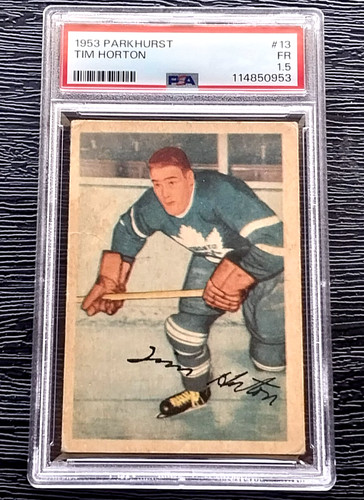 |
Tim Horton #13 1953 Parkhurst |
$71.58 | $19,055 | 266.2× |
 |
Benny Woit #58 1951 Parkhurst |
$25.01 | $6,591 | 263.5× |
 |
Gerry McNeil #15 1951 Parkhurst |
$42.46 | $10,810 | 254.6× |
Look up any card's current raw and graded value in Midpoint — and get an estimated grade before you pay to submit.
1. Wayne Gretzky #18 (1979 Topps): The Ultimate Gem Premium
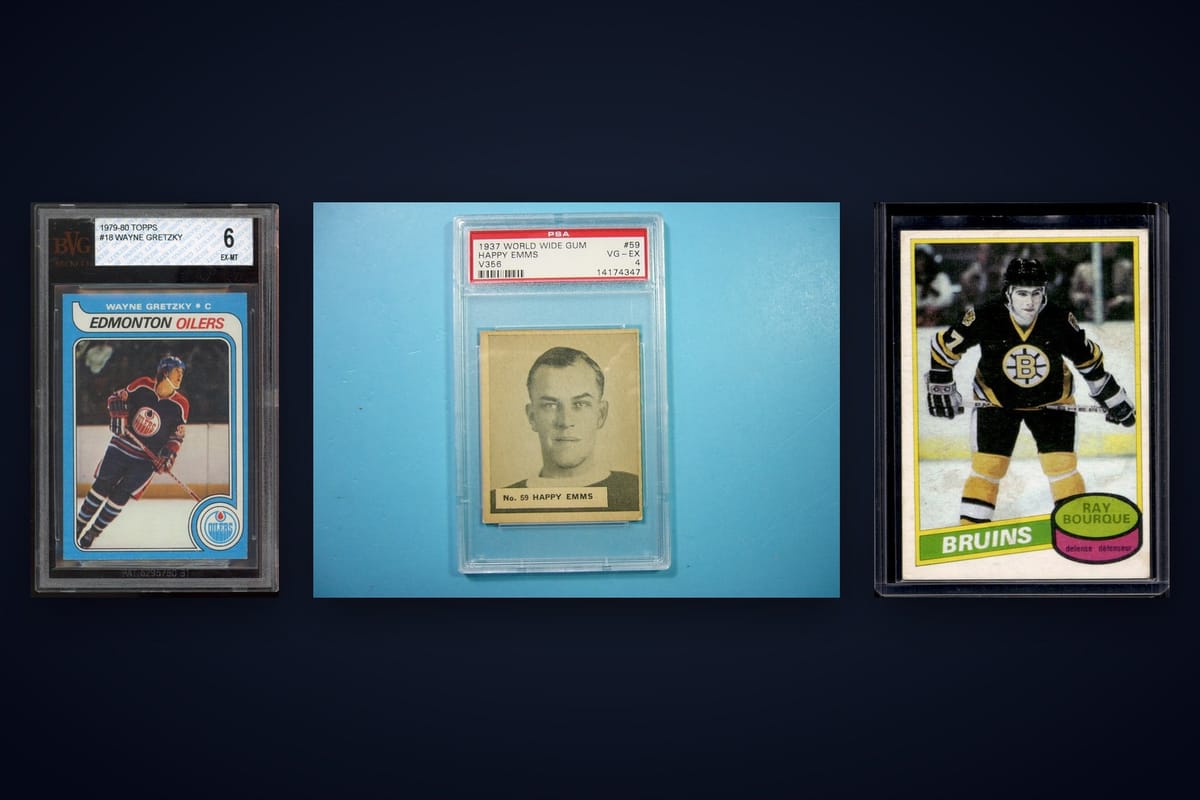
No list of hockey cards worth more graded is complete without the iconic 1979 Topps Wayne Gretzky rookie. As of 2026-08-16, a raw copy sells for around $840.00, but a PSA 10 has sold for as much as $720,000—a gem premium of over 850 times the raw price. This is among the largest raw-to-graded multipliers in modern hockey cards and demonstrates how legendary player status, set popularity, and ultra-low PSA 10 population can drive value.
Gretzky’s rookie is notoriously tough to grade due to centering and printing flaws. Fewer than 0.02% of submissions have achieved PSA 10. If you suspect your copy is flawless, it’s worth a close look—use a digital grading app like Midpoint to pre-grade before risking expensive grading fees.
- Raw: $840.00
- PSA 10: $720,000
- Gem premium: 857.1x
2. Happy Emms #59 (1937 V356 World Wide Gum): Early Vintage Power
Vintage hockey cards can see enormous value jumps when graded gem mint. Happy Emms’s 1937 rookie is a prime example: raw value sits at just $30.19, but a PSA 10 has been valued at $11,502 (381x premium as of 2026-08-16). Early gum cards rarely survive in high grade, so gem examples attract serious collector demand.
This kind of premium isn’t unique—many 1930s-50s Parkhurst and World Wide Gum cards show similar trends. If you own pre-1960s hockey in clean condition, grading can be transformative.
- Raw: $30.19
- PSA 10: $11,502
- Gem premium: 381x
3. Ray Bourque #140 (1980 O-Pee-Chee): Rookie Card ROI
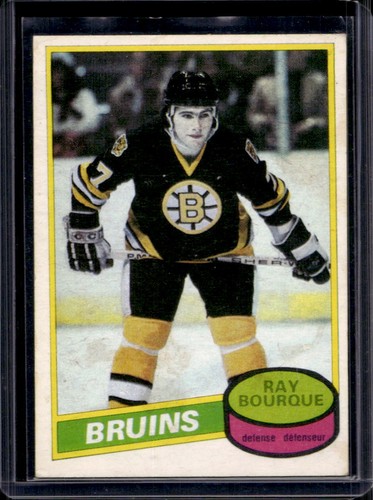
Not just the oldest cards benefit. Ray Bourque’s 1980 O-Pee-Chee rookie is a modern classic, sometimes commanding $37.39 raw but up to $13,900 in PSA 10 (371.8x premium). This dramatic difference is mostly due to O-Pee-Chee’s known centering and print issues—finding a true gem is rare.
If you have a minty Bourque rookie, scan for edge nicks, focus on centering, and consider a pre-grade tool to estimate your odds. Even a small flaw can drop value by 90% or more, so be selective with submissions.
- Raw: $37.39
- PSA 10: $13,900
- Gem premium: 371.8x
4. Tony Esposito #138 (1969 O-Pee-Chee): Vintage Hall of Fame Value
Hall of Famers from the 1960s-70s often see major graded premiums. Tony Esposito’s rookie (1969 O-Pee-Chee) is a standout, with raw copies at $48.00 and PSA 10s reaching $16,800 (350x premium as of 2026-08-16).
These cards were frequently mishandled, making pristine examples ultra-rare. For any high-grade vintage star, check for sharp corners and clean surfaces before submitting.
- Raw: $48.00
- PSA 10: $16,800
- Gem premium: 350x
5. Bobby Orr #100 (1971 O-Pee-Chee): Condition Sensitivity
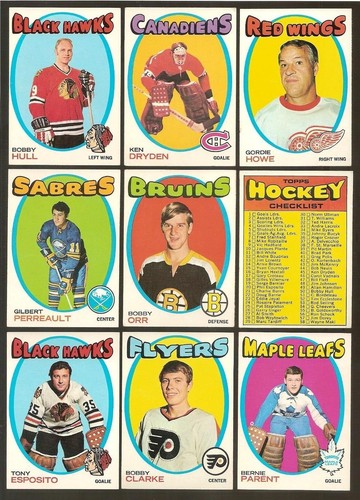
Bobby Orr’s 1971 O-Pee-Chee is a case study in how condition drives the PSA 10 premium. Raw value is $54.08, but a PSA 10 can command $18,000 (332.8x premium). Extremely tough to find centered and without surface defects, this card highlights why so few make the grade.
Collectors should examine not just corners, but also print dots and surface gloss. Small flaws can mean the difference between an $80 PSA 7 and a five-figure PSA 10.
- Raw: $54.08
- PSA 10: $18,000
- Gem premium: 332.8x
6. Jean Beliveau #27 (1953 Parkhurst): Vintage Scarcity
Jean Beliveau’s 1953 Parkhurst rookie combines rarity and star power. Its raw price is already high at $471.26, but a PSA 10 has reached $133,063—a 282.4x premium. Scarcity of high-grade 1950s cards, due to decades of wear and poor original handling, drives a big part of this jump.
When reviewing 1950s Parkhurst cards, look for sharp edges and minimal toning. Even lower grades can be desirable, but PSA 10s are in a league of their own.
- Raw: $471.26
- PSA 10: $133,063
- Gem premium: 282.4x
7. Alex Delvecchio #53 (1952 Parkhurst): Hidden Gems
Some vintage stars, like Alex Delvecchio, fly under the radar but can deliver significant raw-to-graded upside. His 1952 Parkhurst rookie is worth $42.50 raw and $11,998 as a PSA 10 (282.3x premium as of 2026-08-16). Cards from this era were rarely preserved, making high grades particularly valuable for less-hyped names.
- Raw: $42.50
- PSA 10: $11,998
- Gem premium: 282.3x
Use a centering calculator—like the free one on Midpoint—to check these cards before grading. Even small print shifts can knock a card down to near raw value.
8. Modern Rookie Cards and Parallels: When Grading Pays Off
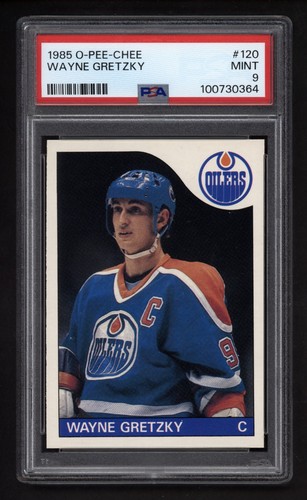
While vintage cards often see the biggest raw vs graded hockey card gaps, select modern rookies and parallels can also be among the best hockey cards to grade for profit—if you have perfect copies. For example, Wayne Gretzky’s 1985 O-Pee-Chee (#120) sells for $25.30 raw and $7,000 in PSA 10 (276.7x premium).
Modern parallels, low-numbered inserts, and Young Guns rookies (such as McDavid, Matthews) can yield strong returns if flawless. Use AI grading tools to weed out cards with print lines or soft corners before submitting.
- Key: Only grade modern cards if you’re confident in a shot at PSA 10.
- Check comps for similar pop reports and recent sales.
- Factor in grading fees—modern base cards with high populations often aren’t worth it unless perfect.
9. The Grading Company Effect: PSA vs BGS vs SGC
Not all graded cards command the same premium. PSA 10 is widely considered the gold standard for hockey, generally selling for more than BGS 9.5 or SGC 10 equivalents. This is due to PSA’s reputation, registry popularity, and perceived consistency.
For high-end vintage, always check which company’s slabs are pulling top dollar. If you’re unsure which service to use, read this in-depth guide on grading scale differences. For most profit, many collectors target PSA 10s for their best candidates.
- PSA 10: typically highest value at resale
- BGS 9.5: sometimes close for ultra-modern or if subgrades are perfect
- SGC: gaining traction, especially for vintage, but slightly lower premiums
10. How Card Condition Drives Graded Value
The difference between a PSA 8, 9, and a true PSA 10 can mean thousands—or even hundreds of thousands—of dollars. Issues like centering, edge wear, print dots, and surface scratches are the most common reasons a card fails to achieve gem mint.

Use digital tools (like Midpoint) or detailed guides (see how centering is measured) to assess your cards pre-submission. Even slight off-centering can drop a card from a $10,000 PSA 10 to a $600 PSA 8. For more on centering and value, check out this detailed guide.
- Centering: Most common grading killer
- Surface: Look for scratches, print lines, or stains
- Edges/corners: Even tiny dings matter at top grades
11. Calculating Grading Costs and Break-Even Points
Grading fees (often $20-$40+ per card for PSA) can eat into profit. Before submitting, compare your card’s estimated grade and value against costs. For example, sending a $25 raw card that will likely grade PSA 8 (worth $60) may not be worth it after fees and shipping. But a potential PSA 10 candidate—like the examples above—can pay off dramatically.
Always check recent "sold" comps for both raw and graded versions before deciding. Use apps or marketplaces that break out prices by grade and year. For step-by-step grading prep, see this guide to pre-grading.
- Only submit cards with a realistic shot at PSA 10 or very strong value at PSA 9.
- Factor in shipping, insurance, and time to process.
- Use a digital pre-grade tool to avoid costly mistakes.
Conclusion
The gap between raw vs graded hockey cards—especially PSA 10s—can be dramatic for vintage stars and key rookies. A handful of cards, like Wayne Gretzky’s 1979 Topps rookie, illustrate the kind of "gem premium" that can transform a collection’s value. But not every card deserves grading: focus on iconic rookies, vintage sets, and flawless modern parallels. Condition and centering are key, so use digital tools like Midpoint to maximize your odds and profits. Always research comps, consider your break-even, and remember: in hockey collecting, grading smart pays off.
FAQ
Q: Which hockey cards are worth grading?
A: Focus on iconic rookies (like Gretzky #18, Bourque #140), vintage stars, and low-population modern parallels in top condition. Cards with big raw-to-graded premiums and strong collector demand are the best candidates.
Q: Do graded hockey cards sell for more than raw cards?
A: Yes, especially in PSA 10. Some cards (like Gretzky’s 1979 Topps) have sold for hundreds or even thousands of times more when graded gem mint compared to raw.
Q: What hockey cards are worth the most when graded?
A: Vintage legends (Gretzky, Orr, Beliveau), rookie cards, and rare parallels in PSA 10 have the highest premiums. See the examples above for specific cards and values.
Q: Is it worth grading modern hockey cards?
A: Only if they are flawless and high-demand (top rookies or low-numbered inserts). High population base cards are rarely worth grading unless you’re confident in a PSA 10.
Q: How much does PSA 10 increase hockey card value?
A: The premium varies: some cards (like 1979 Gretzky) can be worth over 800x more as PSA 10, while others may see smaller jumps. Always check recent sales for your specific card and grade.
Q: Should I sell my hockey card raw or graded?
A: If your card is a likely PSA 10 or high-grade rookie/vintage, grading usually increases value and buyer trust. For lower-grade or common cards, selling raw may be more cost-effective.
Free to start
Try the Midpoint app
Grade any card from a photo, see its raw and PSA 10 value, and track what your collection is worth — free.
Get it on iPhoneGet it on Android


