
1933 Goudey Baseball Cards Value: The Ultimate Price & Grading Guide
Discover the true value of 1933 Goudey baseball cards by condition, grade, and star player. See which cards are most valuable and worth grading today.

Estimated reading time: 14 min
Key Takeaways
- The 1933 Goudey set features some of the most valuable baseball cards ever, with a massive premium for PSA 10 grades.
- Babe Ruth, Lou Gehrig, and other stars drive the highest prices; some commons are also worth grading if in top condition.
- Raw-to-PSA 10 value multipliers can exceed 400x, showing the impact of condition and grading on price.
- Short prints, series scarcity, and card number affect both rarity and value, especially for Ruth #53.
- Tools like Midpoint help collectors analyze centering and pre-grade cards before submitting to PSA, BGS, or CGC.
Card values — live data from Midpoint's card database, as of 2026-08-09. Prices move; Midpoint refreshes these daily.
| Card | Raw | PSA 10 | Gem premium | |
|---|---|---|---|---|
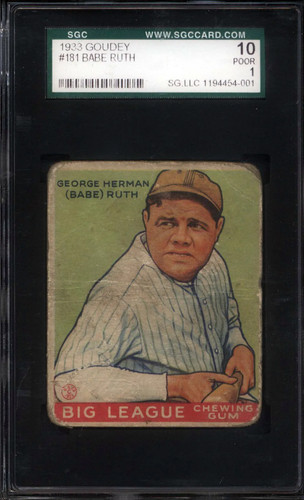 |
Babe Ruth #181 1933 Goudey |
$5,313 | $2,127,736 | 400.5× |
 |
Lou Gehrig #160 1933 Goudey |
$3,116 | $1,257,795 | 403.7× |
 |
Lou Gehrig #92 1933 Goudey |
$2,952 | $1,187,868 | 402.4× |
 |
Dizzy Dean #223 1933 Goudey |
$643.40 | $215,081 | 334.3× |
 |
Moe Berg #158 1933 Goudey |
$486.54 | $196,895 | 404.7× |
 |
Jimmy Foxx #29 1933 Goudey |
$602.76 | $172,885 | 286.8× |
 |
Rogers Hornsby #119 1933 Goudey |
$588.36 | $158,514 | 269.4× |
 |
Mel Ott #127 1933 Goudey |
$346.75 | $151,041 | 435.6× |
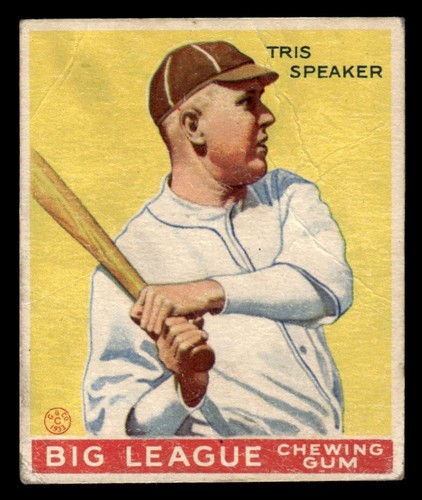 |
Tris Speaker #89 1933 Goudey |
$350.00 | $140,259 | 400.7× |
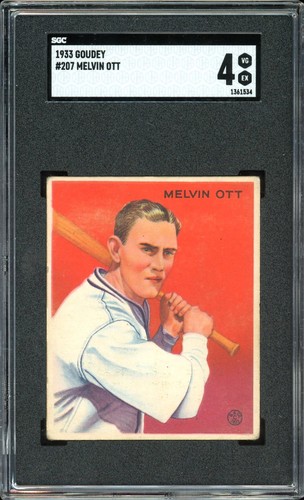 |
Mel Ott #207 1933 Goudey |
$240.50 | $96,365 | 400.7× |
 |
Charley Gehringer #222 1933 Goudey |
$176.65 | $70,022 | 396.4× |
 |
Mickey Cochrane #76 1933 Goudey |
$141.24 | $52,022 | 368.3× |
Look up any card's current raw and graded value in Midpoint — and get an estimated grade before you pay to submit.
Table of Contents
- Section 1: 1933 Goudey Set Overview & Historical Significance
- Section 2: 1933 Goudey Baseball Cards Value by Condition & Grade
- Section 3: Most Valuable 1933 Goudey Cards & Key Value Drivers
- Section 4: Short Prints, Series Differences & Set Checklist
- Section 5: Graded vs. Raw: Why PSA 10 Value Multiplies So High
- Section 6: Should You Grade Your 1933 Goudey Cards?
- Conclusion
- FAQ
Section 1: 1933 Goudey Set Overview & Historical Significance
The Birth of Modern Collecting
The 1933 Goudey baseball card set is widely regarded as a foundational release of the modern hobby era. Produced by the Goudey Gum Company of Boston, it was among the first major bubblegum card sets distributed nationwide, influencing how young fans collected and traded cards. With vibrant color lithography, a larger card size (2-3/8" x 2-7/8"), and a checklist packed with Hall of Famers, the 1933 Goudey set quickly became iconic.
Set Checklist & Scope
The full 1933 Goudey set contains 240 cards, offering collectors a comprehensive look at baseball's stars and regulars of the early 1930s. Notable features:
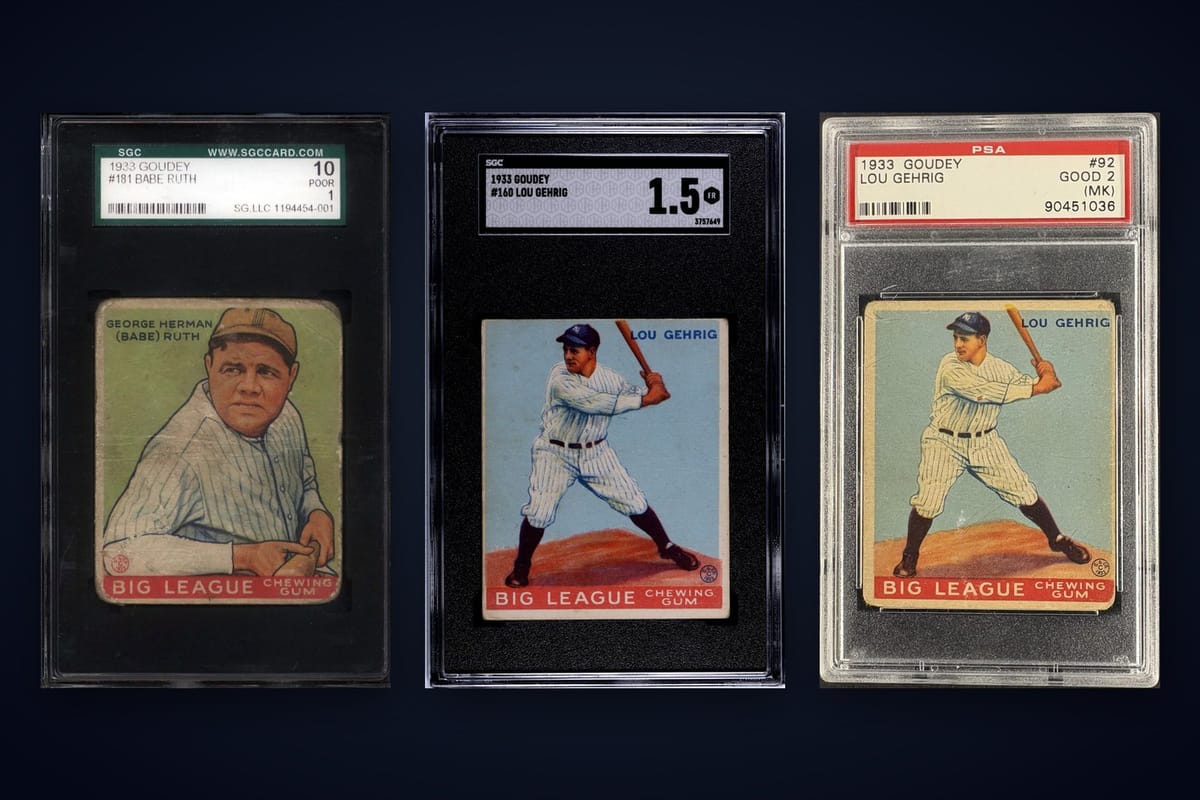
- Four different Babe Ruth cards (#53, #144, #149, #181)
- Two Lou Gehrig cards (#92, #160)
- Challenging short prints, especially Nap Lajoie (#106)
- Colorful, cartoonish backgrounds that set it apart from previous black-and-white issues
Historical Value Drivers
Collectors prize the 1933 Goudey set for several reasons:
- Firsts: Among the first widely distributed gum card sets, and among the first color litho sets of the era
- Star Power: Ruth, Gehrig, Foxx, Hornsby, Ott, and more
- Difficulty: Scarcity of high-grade examples, legendary short prints
The set's cultural impact and visual appeal ensure strong demand and high prices for top examples. For a detailed look at how centering, corners, and surface affect card value, see How Centering Impacts Card Value: A Detailed Guide.
Section 2: 1933 Goudey Baseball Cards Value by Condition & Grade
Raw Values vs. PSA 10: The Gem Premium
As of 2026-08-09, raw 1933 Goudey cards can range from a few hundred dollars for commons in well-worn shape to several thousand for stars. However, in PSA 10 "Gem Mint" condition, values can increase dramatically—sometimes over 400 times the raw price. For example:
- Babe Ruth #181: Raw $5,313, PSA 10 $2,127,736 (gem premium 400.5x)
- Lou Gehrig #160: Raw $3,116, PSA 10 $1,257,795 (gem premium 403.7x)
- Dizzy Dean #223: Raw $643.40, PSA 10 $215,081 (gem premium 334.3x)
- Mel Ott #127: Raw $346.75, PSA 10 $151,041 (gem premium 435.6x)
Even commons like Charley Gehringer (#222, raw $176.65, PSA 10 $70,022) exhibit enormous jumps for pristine examples.
Understanding the PSA Price Guide & Grading Chart
The PSA price guide reflects these sharp value increases by grade. For most 1933 Goudey cards:
- PSA 1-2 (Poor to Good): Often 2-4x raw value
- PSA 5-7 (Excellent to Near Mint): 10-50x raw value for stars, 5-10x for commons
- PSA 9-10 (Mint-Gem Mint): 100x+ for stars, up to 400x for the rarest, best-centered cards
These multipliers show why grading is so critical for 1933 Goudey cards worth grading. Centering, corners, and surface are especially scrutinized by PSA and BGS for this set.
Recent Market Trends
Card values can fluctuate. For example, Babe Ruth #181 reportedly fell 14.6% over a recent 30-day period, while Dizzy Dean #223 rose 39.3%. Monitoring these trends is easier with digital portfolio tracking tools like Midpoint, which tracks your collection's value over time and offers instant AI grading estimates.

Section 3: Most Valuable 1933 Goudey Cards & Key Value Drivers
Babe Ruth: The Gold Standard
Babe Ruth's four cards (#53, #144, #149, #181) are the most prominent in the 1933 Goudey set. Of these, card #53 is often considered the most desirable due to its low-series scarcity and iconic status. However, even the "lowest" Ruth, #181, is a high-value card in top grade.
- Ruth #181: Raw $5,313, PSA 10 $2,127,736
The difference in value between Ruth #53 and the other Ruths is influenced by population scarcity, historical demand, and low-series print run quirks. Ruth #53 is often seen as the "face" of vintage baseball cards, which helps explain its strong auction results.
Lou Gehrig, Foxx, Hornsby, Ott, and Other Hall of Famers
- Lou Gehrig #160: Raw $3,116, PSA 10 $1,257,795
- Jimmie Foxx #29: Raw $602.76, PSA 10 $172,885
- Rogers Hornsby #119: Raw $588.36, PSA 10 $158,514
- Mel Ott #127: Raw $346.75, PSA 10 $151,041
These cards are highly sought after, with gem-mint examples achieving strong auction prices. For instance, Mel Ott #127 reportedly saw a 23.8% price increase in a recent month, reflecting renewed collector enthusiasm.
Commons Can Be Valuable Too
High-grade commons, like Charley Gehringer (#222) and Mickey Cochrane (#76), can fetch strong prices in PSA 10:
- Charley Gehringer #222: Raw $176.65, PSA 10 $70,022
- Mickey Cochrane #76: Raw $141.24, PSA 10 $52,022
This shows that even non-superstar cards may be worth grading if they possess strong centering and clean surfaces.
If you want to learn more about how AI analysis is changing the way collectors evaluate centering and condition, see this in-depth comparison of AI-powered card centering analysis tools.
Section 4: Short Prints, Series Differences & Set Checklist
Understanding Short Prints
The 1933 Goudey set has several notable short prints, most famously the Nap Lajoie #106, which was not included in packs and only available by mail request. This card is so rare that it can sell for more than most Ruths in high grade. Other short prints and low-series cards also carry significant premiums due to scarcity.
Series Structure: Low vs. High Number
The set was released in series, with lower numbers (1-52) generally being scarcer. The Ruth #53 is a low-series card and is considered tougher to find in high grade compared to his higher-numbered cards (#144, #149, #181). This series and sheet difference helps explain much of the value gap between Ruth #53 and the others.
- Low series (1–52): Scarcer, often better centered, more condition sensitive
- High series (53–240): More common, but still valuable in high grade
For a detailed list of every card, refer to published set checklists or use Midpoint’s card lookup feature to make sure you have the exact card number and player for accurate price research.
Identifying Your Card
Because the set includes multiple cards for major stars, always identify the card number (front or back) before searching for value. For example, not all Lou Gehrig cards are equal: #92 vs. #160 have slight price differences due to population and print run.
Section 5: Graded vs. Raw: Why PSA 10 Value Multiplies So High
Population Reports and Scarcity
Few 1933 Goudey cards survive in top condition. For many keys, there are very few PSA 10s in existence. This rarity, combined with strong collector demand, creates the large 200x–400x "gem premium" over raw, ungraded prices. For example, Moe Berg #158 shows a 404.7x multiplier from raw ($486.54) to PSA 10 ($196,895).
What Makes a PSA 10?
PSA 10 "Gem Mint" requires excellent centering (rare for Goudey!), sharp corners, clean edges, and a pristine surface. The majority of raw cards, even if they look nice, grade PSA 2–6 due to print defects, centering issues, or edge/corner wear. Top grades are the exception, not the rule.
Use digital tools like Midpoint’s centering calculator and AI-driven grading to estimate your card’s likely grade before submitting. This helps avoid costly mistakes in sending cards unlikely to reach high grades. For a step-by-step process, refer to How to Pre-Grade Your Card: A Step-by-Step Guide.
Ungraded (Raw) Card Pricing
- Poor/fair (creases, major wear): Often $50–$200 for commons, $500–$2,000 for stars
- Raw "eye appeal" cards (no major flaws): $200–$700 for commons, $2,000–$6,000 for stars
- High-grade raw (rare): May be worth grading if centering/edges are exceptional
But only a very small fraction of raw cards will achieve the highest PSA 10 values shown in the price guide.
Section 6: Should You Grade Your 1933 Goudey Cards?
Which 1933 Goudey Cards Are Worth Grading?
Start with stars: Ruth, Gehrig, Foxx, Hornsby, Ott, and short prints like Lajoie. But grading is also worthwhile for commons in exceptional condition—especially if centering is nearly perfect and there’s minimal surface wear. Use a free centering tool like Midpoint's Centering Calculator to measure before you pay for grading services.
PSA 10 Value vs. Grading Costs
Professional grading (PSA, BGS, CGC) typically costs $30–$100+ per card. Because only the very best-centered, sharpest raw cards have a realistic shot at PSA 8–10, pre-grading and digital assessment are essential. Submitting a Ruth, Gehrig, or short print may make sense even in mid-grade, but most commons should only be graded if they appear near-mint or better.
AI Tools & Pre-Submission Analysis
Modern apps like Midpoint use AI to estimate the likely grade from a scan or photo, which can help collectors save money and avoid disappointment. Features include:
- Centering measurement down to millimeters
- Surface, corner, and edge analysis
- Estimated PSA, BGS, CGC, and TAG grades
- Value lookup for over 250,000 cards, including all 1933 Goudeys
For more on how centering impacts final grade and value, see this guide to accurate card grading estimates.
Conclusion
The 1933 Goudey baseball cards value landscape is defined by condition, grade, and the star power of players like Babe Ruth and Lou Gehrig. With PSA 10 examples sometimes trading for hundreds of thousands—or even millions—of dollars, the jump from raw to graded can be breathtaking. Yet, only a tiny percentage of cards will ever reach those heights; careful pre-grading and condition assessment are crucial. Whether you’re holding a Ruth, a tough short print, or a sharp common, use digital tools like Midpoint to maximize your card’s potential and make informed grading and selling decisions.
FAQ
Q: How much are 1933 Goudey baseball cards worth today?
A: As of 2026-08-09, raw 1933 Goudey cards can range from about $140 for low-value commons in average shape to over $5,000 for stars like Babe Ruth. In PSA 10, values can exceed $2 million for the biggest names.
Q: Which 1933 Goudey cards are the most valuable?
A: Babe Ruth’s four cards (#53, #144, #149, #181) are among the most valuable, especially #53, which is a low-series short print. Lou Gehrig, Jimmie Foxx, Rogers Hornsby, and Mel Ott cards also command high prices, particularly in top grades.
Q: Why is Babe Ruth card #53 worth more than the other Ruth cards?
A: Ruth #53 is scarcer due to its low-series print run and has become the most iconic card in the set. Its rarity and demand push prices higher than the other Ruths.
Q: How much is a 1933 Goudey common card worth in poor or raw condition?
A: Most 1933 Goudey commons in poor/raw condition (creased, worn) sell for $50–$200. High-grade raw commons can be worth much more, especially if they look nearly mint.
Q: Should I grade my 1933 Goudey card before selling it?
A: Grading is often worth it for star players, short prints, and any card in excellent or better condition. Pre-grade your card digitally to estimate its likely grade and value before paying for PSA, BGS, or CGC submission.
Q: What makes 1933 Goudey cards more valuable than other vintage baseball cards?
A: Their historical significance, vivid color art, inclusion of multiple Ruths and Gehrigs, and the challenge of finding high-grade examples make 1933 Goudeys highly regarded in vintage baseball card collecting.
Free to start
Try the Midpoint app
Grade any card from a photo, see its raw and PSA 10 value, and track what your collection is worth — free.
Get it on iPhoneGet it on Android


