1934 Goudey Baseball Cards Value: Complete Guide & Price Insights
Discover the 1934 Goudey baseball cards value, key stars, grading tips, and market prices from raw to PSA 10 with expert insights for collectors.

Estimated reading time: 15 min
Key Takeaways
- The 1934 Goudey set is a significant vintage baseball card collection, featuring notable Hall of Famers and scarce high-grade examples that are sought after by collectors.
- Key cards like Lou Gehrig #37 and #61, and Jimmie Foxx #1 often command the highest prices, especially in PSA 10 condition where premiums can be substantially higher than raw values.
- Understanding grading factors such as centering, corners, edges, surface quality, and eye appeal is important for evaluating 1934 Goudey cards worth grading to potentially maximize return on investment.
- Raw card values vary widely from commons to stars; grading premiums can multiply prices significantly at the top tier, with high-grade population scarcity influencing auction prices.
- Using tools like Midpoint’s AI grading, precise centering measurement, and portfolio tracking can help collectors make informed decisions before paying for professional grading, potentially avoiding costly grading mistakes.
Card values — live data from Midpoint's card database, as of 2026-08-23. Prices move; Midpoint refreshes these daily.
| Card | Raw | PSA 10 | Gem premium | |
|---|---|---|---|---|
 |
Lou Gehrig #37 1934 Goudey |
$4,321 | $1,691,565 | 391.5× |
 |
Lou Gehrig #61 1934 Goudey |
$2,766 | $1,127,760 | 407.7× |
 |
Hank Greenberg #62 1934 Goudey |
$1,258 | $492,460 | 391.5× |
 |
Dizzy Dean #6 1934 Goudey |
$506.71 | $201,158 | 397× |
 |
Jimmy Foxx #1 1934 Goudey |
$334.02 | $130,783 | 391.5× |
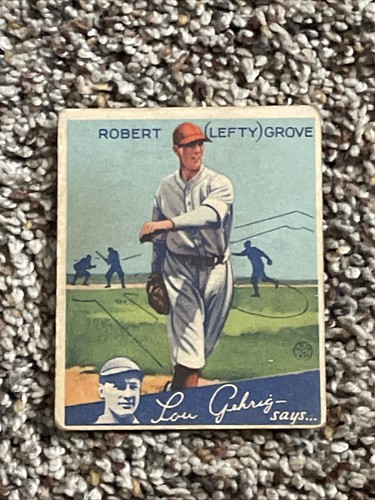 |
Lefty Grove #19 1934 Goudey |
$300.00 | $117,510 | 391.7× |
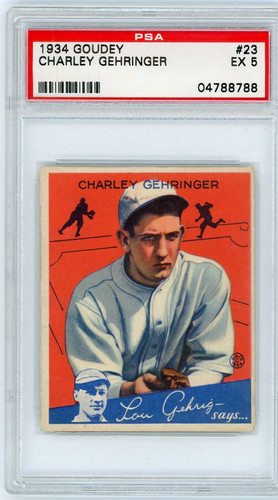 |
Charley Gehringer #23 1934 Goudey |
$169.36 | $68,077 | 402× |
 |
Hal Trosky #76 1934 Goudey |
$51.32 | $51,600 | 1005.5× |
 |
Frank Frisch #13 1934 Goudey |
$87.50 | $47,335 | 541× |
 |
Luke Appling #27 1934 Goudey |
$132.64 | $46,216 | 348.4× |
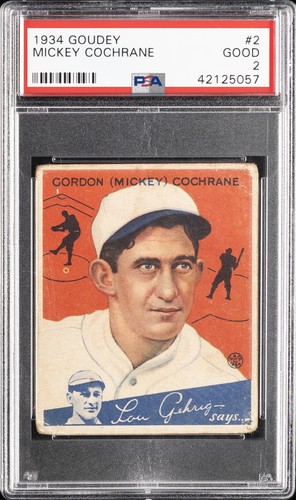 |
Mickey Cochrane #2 1934 Goudey |
$128.83 | $42,457 | 329.6× |
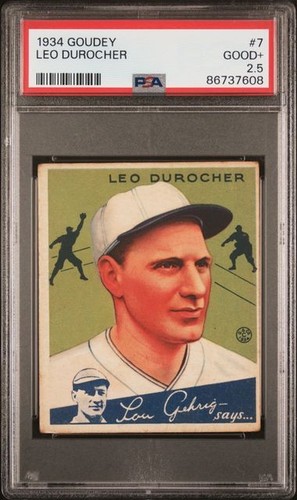 |
Leo Durocher #7 1934 Goudey |
$105.50 | $41,231 | 390.8× |
Look up any card's current raw and graded value in Midpoint — and get an estimated grade before you pay to submit.
Table of Contents
- Section 1: Overview of the 1934 Goudey Set and Its Significance
- Section 2: Comprehensive 1934 Goudey Checklist and Hall of Famers
- Section 3: Value Breakdown by Grade and Key Cards
- Section 4: Grading Factors Impacting 1934 Goudey Cards Worth Grading
- Section 5: Market Trends, Auction Results & Population Scarcity
- Section 6: Authentication and Avoiding Reprints or Altered Cards
- Section 7: Collector Tips for Buying, Selling, and Using Midpoint
Conclusion
FAQ
Section 1: Overview of the 1934 Goudey Set and Its Significance
Historical Context and Importance
The 1934 Goudey baseball card set holds a notable place in vintage card collecting, bridging the gap between the 1933 Goudey phenomenon and later pre-war sets. Produced by the Goudey Gum Company, this set is known for its vibrant artwork and inclusion of many Hall of Famers. Unlike its predecessor, the 1934 series is slightly smaller with 240 cards, each featuring player portraits framed in colorful borders that remain sought after by collectors today.
Historically, the 1933 Goudey set was among the first major mass-produced sets to feature colorful player portraits, and the 1934 set refined this formula. Released during the Great Depression, the set’s availability was somewhat limited, contributing to its relative rarity today. The colorful borders and photo-quality lithographs represented an advancement in card production, making the 1934 Goudey a notable collector’s set reflecting the era’s baseball stars.
Why Collectors Value 1934 Goudey Cards
This set is prized not only for its aesthetics but also for its relative rarity and the inclusion of marquee players. The cards were distributed in packs with gum, often resulting in condition issues like edge wear and centering problems. As a result, well-preserved examples, especially in high grade, are less common and desirable. The cards also have a place in baseball history, featuring legends such as Lou Gehrig and Jimmie Foxx.
Collectors are drawn to the set’s nostalgic value and the challenge of obtaining high-grade examples, which are scarce due to the fragile nature of the original cardstock and the gum included in packs. The presence of dominant Hall of Famers who defined the 1930s baseball era adds sentimental and monetary value, cementing the 1934 Goudey’s place as a sought-after vintage collection.
Set Composition and Variations
The 240-card set covers a broad spectrum of players from stars to common role players, with some cards released in multiple variations or with known printing differences. Collectors should be aware that condition and centering vary significantly, impacting value. This makes precise grading and centering measurement helpful for assessing true worth.
Notably, some cards have known color variations or printing anomalies, such as differing shades in the borders or slight differences in player portraits, which can affect rarity and desirability. For example, Card #1 (Jimmie Foxx) has a known shade variation that collectors track. Understanding these nuances is important for accurate identification and valuation.
Section 2: Comprehensive 1934 Goudey Checklist and Hall of Famers
Complete Checklist Overview
The 1934 Goudey set consists of 240 cards numbered from #1 to #240. Each card features a player's portrait, with star players often placed early in the numbering series. The set includes a mix of well-known Hall of Famers and lesser-known players, making it a challenging but rewarding set to complete for collectors.
Completing the set requires attention to detail, especially because some cards are scarce due to limited print runs or distribution. Many commons are available in significant quantities but often suffer from centering or condition issues, so finding high-grade copies can be difficult. The checklist is essential for tracking progress and verifying authenticity before grading or sale.
Key Hall of Famers to Collect
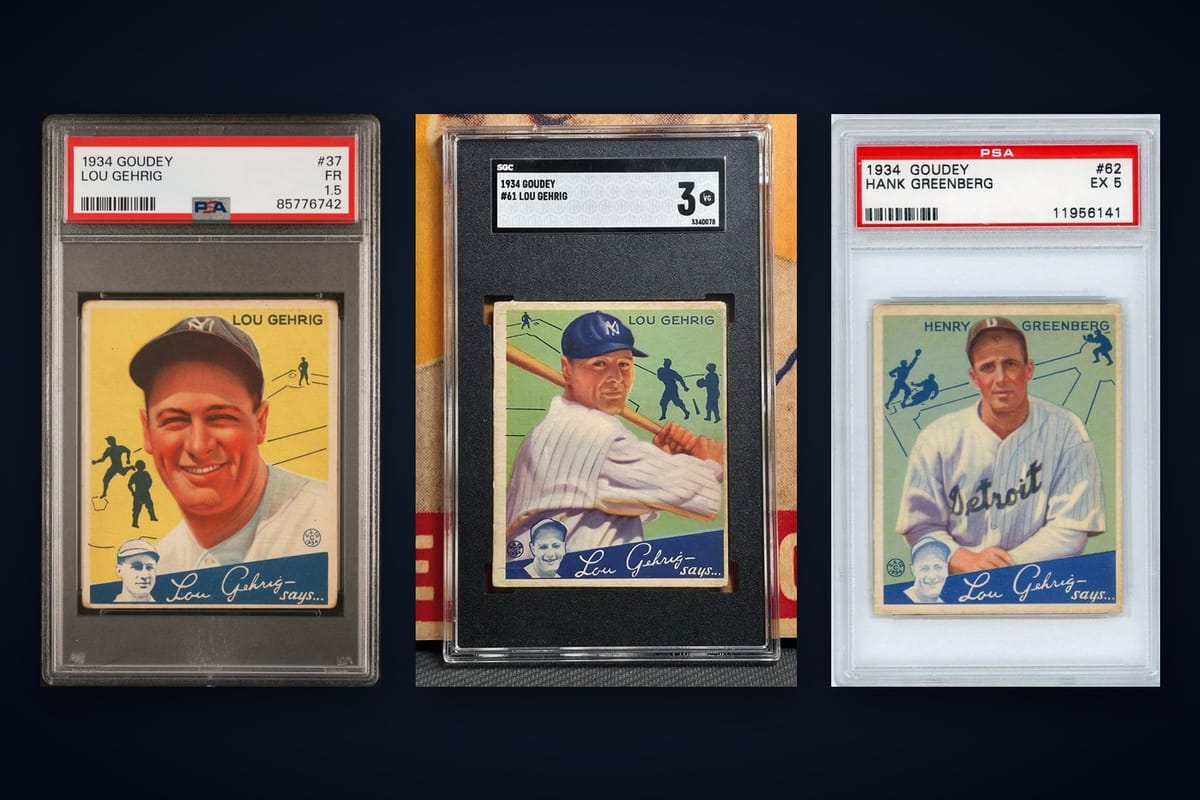
- Lou Gehrig – Cards #37 and #61, both valuable (see Section 3 for value details). #37 is generally considered the more sought-after of the two.
- Jimmie Foxx – Card #1, the set’s top card and one of the most valuable, often considered the “flagship” card.
- Other Notables – Cards featuring players like Lefty Grove (#16), Dizzy Dean (#18), and Frankie Frisch (#2) are also prized and can command premium prices.
Importance of the Checklist for Grading and Pricing
Knowing the exact card number and identifying key Hall of Famers is important when evaluating 1934 Goudey baseball cards value. Some cards have multiple print runs or variations, which affect rarity and price. Collectors should cross-reference their cards with an up-to-date checklist to ensure accurate identification before grading or selling.
For example, a misidentified card can lead to undervaluing or overpaying for grading services. Additionally, some cards have short-prints or known variations that are more valuable, making the checklist a useful tool for collectors and dealers alike.
Section 3: Value Breakdown by Grade and Key Cards
Raw vs Graded Values
Raw 1934 Goudey cards range widely in value depending on condition and player prominence. For example, common cards in lower grades typically fetch under $50 as of 2026-08-23, while star cards like Lou Gehrig #37 in raw condition can reach several hundred dollars. Grading can significantly increase values, especially at PSA 9 and PSA 10 levels.
To illustrate, a mid-grade raw Lou Gehrig #37 (with moderate edge wear and off-centering) might sell for $300–$500, but a PSA 9 (Mint) can fetch several thousand dollars, showing a substantial increase. PSA 10 (Gem Mint) examples are very rare; only a few exist, pushing values higher. Similarly, Jimmie Foxx #1 in raw condition can command several hundred dollars, but PSA 10 examples often sell for tens of thousands at auction.
Top Cards and Their Price Points
- Lou Gehrig #37: Raw values start around $300; PSA 10 examples can command tens of thousands due to scarcity and demand.
- Lou Gehrig #61: PSA 10 values are also high, raw prices significantly lower, typically a few hundred dollars depending on condition.
- Jimmie Foxx #1: PSA 10 values can reach tens of thousands, with raw values in the several hundred dollar range depending on condition and centering.
- Dizzy Dean #18: PSA 10 prices can be in the mid-five-figure range, raw values under $500, reflecting strong market demand for pitching legends.
1934 Goudey PSA 10 Value Insights
PSA 10 grades represent the highest condition level, and very few 1934 Goudey cards achieve this due to centering and surface challenges. The premium for PSA 10 can be many times higher compared to raw low-grade cards, especially for star cards. This makes pre-grading assessment helpful before submitting cards to grading services. Tools like Midpoint can assist in estimating PSA 10 likelihood by analyzing centering and surface quality.
For collectors, understanding the rarity of PSA 10 copies is important. For example, PSA’s population report as of mid-2026 shows fewer than 10 Lou Gehrig #37 cards graded PSA 10 worldwide. This scarcity supports the strong premium. The value jump between PSA 9 and PSA 10 is often significant, reflecting the rarity of perfect centering and flawless surfaces.
Section 4: Grading Factors Impacting 1934 Goudey Cards Worth Grading
Centering and Its Critical Role
Centering measures how evenly the card’s image is positioned within its borders. For 1934 Goudey cards, centering is one of the most important—and challenging—grading factors due to the printing technology of the era. Cards that are even slightly off-center can see notable value drops, particularly for high-grade submissions.
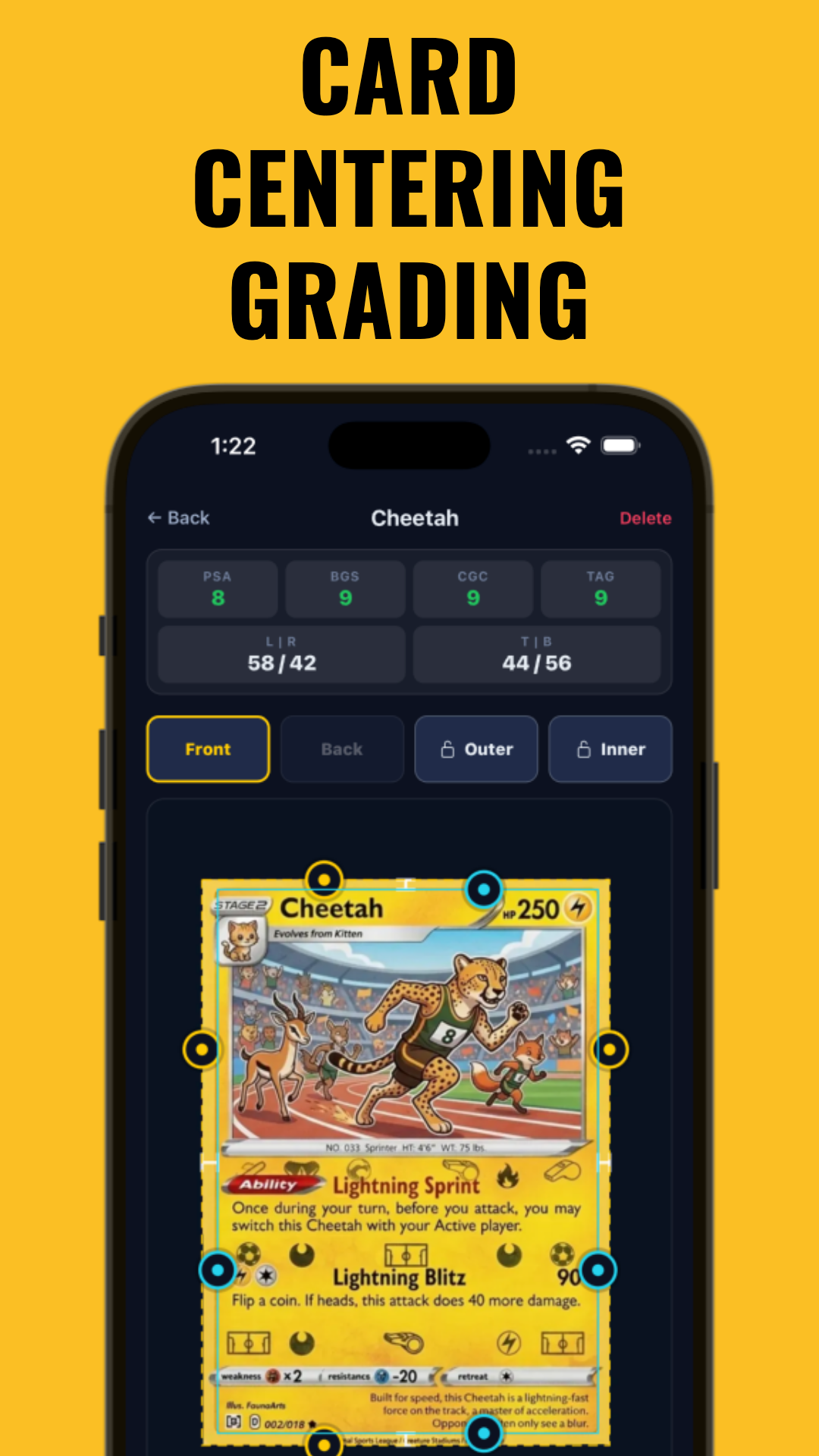
Midpoint’s precise centering measurement tool can assess centering down to fractions of a millimeter, helping collectors decide if a card is worth grading or likely to receive a lower grade. For example, a card with centering of 55/45 or better (meaning the image is nearly perfectly centered left-to-right and top-to-bottom) is a stronger candidate for PSA 9 or 10, whereas cards with off-centering greater than 60/40 often receive lower grades.
Corners, Edges, and Surface Conditions
- Corners: Sharp, undamaged corners are uncommon for 1934 Goudeys, and critical for high grades. Even minor wear or slight rounding can reduce grade by one or more points.
- Edges: Look for minimal chipping, wear, or fraying along edges. Gum packs often caused chipping, so pristine edges are prized.
- Surface: Assess for creases, stains, print defects, or restoration which can significantly lower value. Surface gloss is usually diminished, but clean, bright surfaces are preferred.
Eye Appeal and Gloss
While gloss is difficult to maintain on cards this old, eye appeal—how attractive the card looks overall—also influences grading outcomes and resale value. Cards with clean surfaces, vibrant colors, and good gloss tend to fetch higher prices. Eye appeal is somewhat subjective, but grading companies increasingly consider it in their assessments, particularly for high-end submissions.
Damage such as minor creases, discoloration, or print defects can lower eye appeal and grades. Conversely, cards with vibrant color saturation and minimal blemishes receive higher grades and premiums.
Section 5: Market Trends, Auction Results & Population Scarcity
Population Reports and Scarcity
The 1934 Goudey set has relatively low population counts at high grades, especially PSA 10. For instance, only a few Lou Gehrig #37 cards exist in PSA 10, contributing to premium prices. Even mid-grade cards with strong centering and corners are less common, creating scarcity that benefits sellers and challenges buyers.
Population scarcity is a key driver of value. PSA’s population report as of 2026 lists fewer than 10 PSA 10 Lou Gehrig #37 cards, about 15 PSA 10 Jimmie Foxx #1 cards, and fewer than 20 of key Hall of Famers in gem mint condition. This scarcity encourages collectors to pay premiums for certified high-grade examples.
Recent Auction Results
Recent sales show that star cards in PSA 9 and 10 grades often sell above retail price guides, sometimes exceeding $30,000 for Lou Gehrig or Jimmie Foxx. Lower-grade auction lots typically range from a few hundred to a few thousand dollars depending on star power and condition.
For example, a recent auction in mid-2026 featured a PSA 10 Lou Gehrig #37 which sold for approximately $48,000 after fees, while a PSA 9 sold for roughly $12,000. A raw near-mint Jimmie Foxx #1 with strong centering sold for around $600 online, while a PSA 9 graded version commanded about $18,000. These trends illustrate the significant premiums grading can confer.
Price Guide Insights
The 1934 Goudey price guide reflects these trends with a notable multiplier effect from raw to graded values. For example, a raw Lou Gehrig #37 in VG condition may be valued at $300-$500, but PSA 9 examples can reach $10,000+, and PSA 10 examples may exceed $45,000 as of 2026-08-23.
Price guides also note that mid-grade cards with centering issues or surface flaws may see less benefit from grading, so pre-grading evaluation is important to avoid paying for grades that do not increase value proportionally.
Section 6: Authentication and Avoiding Reprints or Altered Cards
Identifying Authentic 1934 Goudey Cards
Due to the set’s popularity, counterfeit and reprint 1934 Goudey cards exist. Authentic cards feature specific cardstock thickness, paper texture, and printing characteristics unique to the era. Using a loupe to inspect ink patterns and surface details can help confirm authenticity.
Original 1934 Goudey cards have a matte finish, relatively thick cardstock, and subtle ink dot patterns visible under magnification. Collectors should watch for inconsistencies in font, back design, and gum residue marks. Authentic cards also exhibit natural aging signs such as slight toning or edge wear consistent with their age.
Common Reprint Signs
- Glossier or brighter paper stock inconsistent with original matte finish, often indicating modern reprints.
- Misaligned borders or color inaccuracies, such as colors that are too vivid or faded compared to known authentic examples.
- Incorrect card back design or missing gum residue marks that were typical of original packs.
- Edges that appear artificially cut or trimmed, indicative of alteration.
Why Professional Authentication Matters
For high-value 1934 Goudey cards, professional grading companies like PSA or BGS provide authentication as part of their service. Before paying for grading, collectors can use AI grading apps such as Midpoint to preliminarily assess condition and authenticity risk, potentially saving time and money.
Professional authentication helps reduce the risk of costly mistakes, especially since counterfeiters have become more sophisticated. Grading companies use advanced technology to detect alterations, reprints, and counterfeit cards. Midpoint’s AI grading provides an initial filter, highlighting cards that merit professional review versus those that may not grade well or could be suspect.
Section 7: Collector Tips for Buying, Selling, and Using Midpoint
Deciding Which Cards Are Worth Grading
Not all 1934 Goudey cards warrant the cost of professional grading, especially if raw condition is poor or centering is off. Focus grading submissions on star cards with strong centering and minimal surface flaws to maximize potential return. Midpoint’s AI grading estimates and precise centering tool provide useful data to guide submission choices.
For example, a raw Lou Gehrig #37 with centering above 55/45, sharp corners, and minimal surface wear is a stronger candidate for PSA 9 or 10. Conversely, a common card with heavy edge wear or off-centering over 60/40 is less likely to justify grading fees. Using Midpoint before submission can help avoid unnecessary expenses.
Tracking Collection Value and Market Prices
Using portfolio tracking within Midpoint helps collectors monitor their 1934 Goudey cards’ value fluctuations over time. The app’s integrated price guide data across raw and graded conditions supports accurate valuation for insurance or resale.
This feature is especially useful as market prices fluctuate with player popularity, auction results, and economic conditions. Tracking helps collectors identify favorable times to buy or sell and provides a consolidated view of collection worth.
Best Practices for Buying and Selling
- Buy cards with verified provenance or prior grading to reduce risk of counterfeits or misgrades.
- When selling, provide clear high-resolution images and grading data when available to build buyer trust and justify asking prices.
- Use Midpoint’s card lookup feature to compare current market prices before listing to optimize sale timing and pricing.
- Read How to Store Valuable Cards: The Ultimate Collector's Guide to protect your investment from environmental damage and wear.
For collectors serious about maximizing their 1934 Goudey collection’s value, integrating digital tools like Midpoint can be beneficial, offering AI-graded estimates and centering analysis that help avoid costly grading missteps, streamline portfolio management, and improve buying and selling strategies.
Conclusion
The 1934 Goudey baseball cards value landscape offers opportunities but requires a nuanced understanding of grading, rarity, and market dynamics. Key cards like Lou Gehrig #37 and Jimmie Foxx #1 stand out as prized assets whose value can increase significantly with high grades, especially PSA 10. Collectors may benefit from leveraging precise centering tools and AI grading estimates to identify which cards are worth grading, potentially avoiding costly mistakes.
By mastering the checklist, understanding grading factors like centering and surface condition, and staying current on market trends, collectors can more confidently buy, sell, and protect their 1934 Goudey investments. Digital apps such as Midpoint can help streamline this process, making it easier to navigate the complexities of vintage card collecting with data-driven insights and time-saving tools.
FAQ
Q: How much is a 1934 Goudey baseball card worth?
A: Values vary widely depending on the player and condition. Common cards in lower grades may be worth under $50, while star cards like Lou Gehrig #37 can fetch several hundred raw and significantly higher amounts graded PSA 10 (as of 2026-08-23). Mid-grade raw cards often sell in the low hundreds, but grading can increase these values substantially.
Q: What is the most valuable card in the 1934 Goudey set?
A: Lou Gehrig #37 is generally considered the most valuable, especially in PSA 10 condition where it can exceed tens of thousands of dollars. Its rarity and iconic player status contribute to this premium.
Q: How much are 1934 Goudey common cards worth?
A: Common cards typically range from $10 to $50 raw depending on condition, with modest increases if graded but generally less dramatic than star cards. High-grade commons can still command premiums but rarely exceed a few hundred dollars.
Q: Why are Lou Gehrig 1934 Goudey cards so expensive?
A: Their rarity in high grade, iconic player status, and scarcity of PSA 10 examples create strong demand and higher prices. Additionally, the limited population of gem mint copies and their historical significance increase desirability.
Q: How many cards are in the 1934 Goudey set?
A: The set includes 240 cards numbered from #1 to #240, featuring a wide range of players from stars to lesser-known athletes.
Q: What grade should I get my 1934 Goudey card authenticated or graded in?
A: Cards with strong centering, sharp corners, and clean surfaces that could reach PSA 8 or higher are typically worth grading. Use tools like Midpoint to estimate grades and centering before submitting to maximize grading value.
Free to start
Try the Midpoint app
Grade any card from a photo, see its raw and PSA 10 value, and track what your collection is worth — free.
Get it on iPhoneGet it on Android