
1948 Bowman Football Cards Value: Guide to Prices, Rookies & Grading
Get the definitive 1948 Bowman football cards value guide: prices by grade, most valuable cards, grading tips, and complete set values as of 2026.

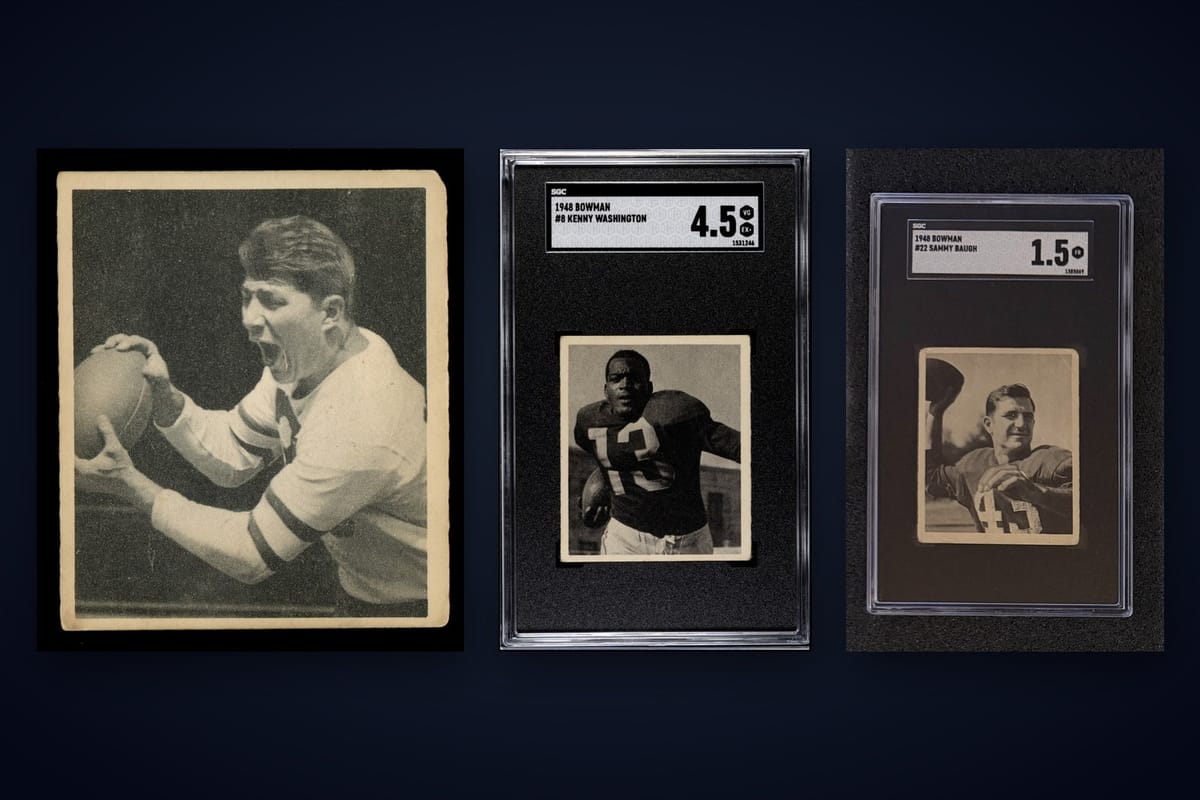
Estimated reading time: 15 min
Key Takeaways
- The 1948 Bowman football set features 108 cards, including key Hall of Fame rookies and stars.
- Card values vary dramatically by grade, with PSA 10s often commanding significant premiums over raw value.
- Top cards include Pete Pihos, Sammy Baugh, Steve Van Buren, and Kenny Washington rookies.
- Grading, centering, and authentication are critical for maximizing 1948 Bowman card value.
- Complete and high-grade sets typically carry premiums versus piecemeal collecting.
Card values — live data from Midpoint's card database, as of 2026-08-16. Prices move; Midpoint refreshes these daily.
| Card | Raw | PSA 10 | Gem premium | |
|---|---|---|---|---|
 |
Pete Pihos #63 1948 Bowman |
$138.00 | $37,594 | 272.4× |
 |
Kenny Washington #8 1948 Bowman |
$72.22 | $31,200 | 432× |
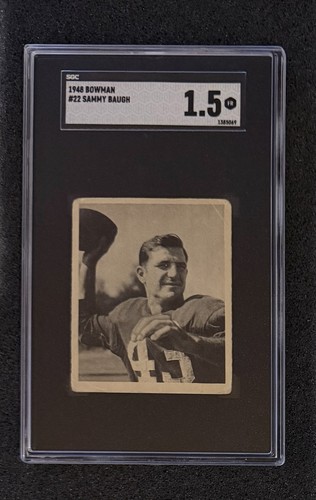 |
Sammy Baugh #22 1948 Bowman |
$107.77 | $29,437 | 273.2× |
 |
Johnny Lujack #3 1948 Bowman |
$96.01 | $28,131 | 293× |
 |
Buford Ray #108 1948 Bowman |
$117.81 | $23,415 | 198.8× |
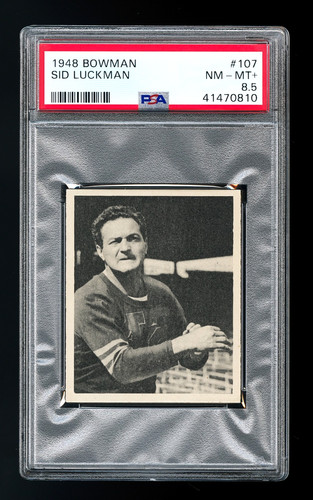 |
Sid Luckman #107 1948 Bowman |
$80.99 | $22,167 | 273.7× |
 |
Bob Cifers #105 1948 Bowman |
$80.00 | $21,906 | 273.8× |
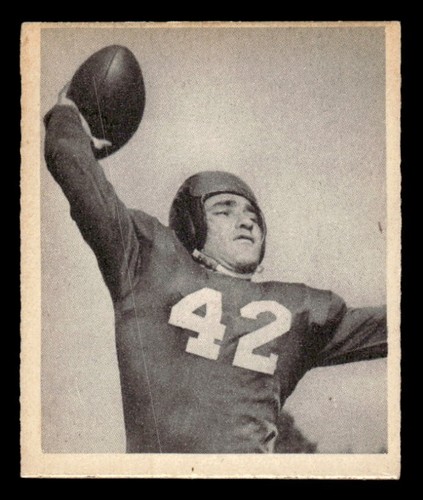 |
Charley Conerly #12 1948 Bowman |
$69.48 | $18,934 | 272.5× |
 |
Bruce Smith #104 1948 Bowman |
$68.00 | $18,532 | 272.5× |
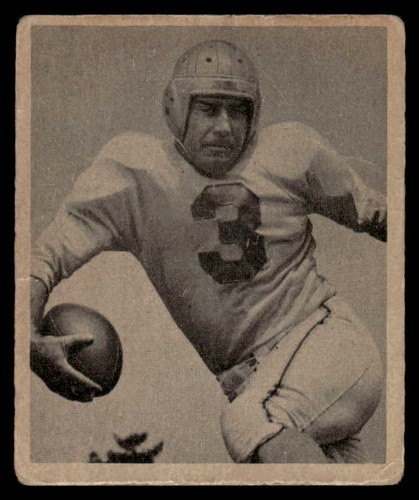 |
Dante Magnani #75 1948 Bowman |
$30.84 | $12,449 | 403.7× |
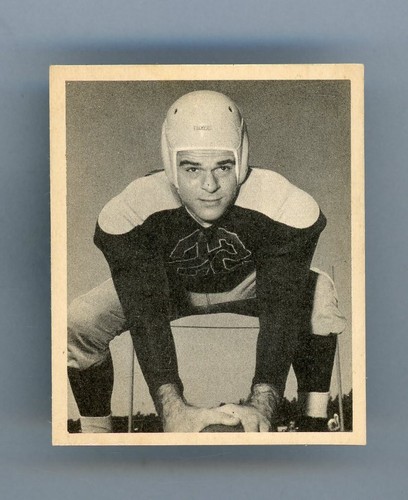 |
Jay Rhodemyre #45 1948 Bowman |
$40.59 | $11,873 | 292.5× |
 |
Charley Trippi #17 1948 Bowman |
$27.59 | $11,346 | 411.2× |
Look up any card's current raw and graded value in Midpoint — and get an estimated grade before you pay to submit.
Table of Contents
- Section 1: 1948 Bowman Football Set Overview and Checklist
- Section 2: Most Valuable 1948 Bowman Football Cards & Key Rookies
- Section 3: 1948 Bowman Football Cards Value by Grade (Raw to PSA 10)
- Section 4: Condition Factors: Centering, Corners, Surface & Eye Appeal
- Section 5: Set Values: Complete, Near-Complete, and Individual Cards
- Section 6: Grading, Authentication, and Premiums for Slabbed Cards
- Conclusion
- FAQ
Section 1: 1948 Bowman Football Set Overview and Checklist
The First Postwar Football Set: A Snapshot
The 1948 Bowman football set holds a legendary status as the first nationally distributed postwar football card release. Its 108-card checklist showcases professional stars and rookies at the dawn of modern pro football collecting. Issued just three years after World War II, the set captures an era where pro football was gaining national prominence, and the NFL was starting to cement its place in American sports culture. While the set’s simple design—black-and-white player photos with a white border, no stats or bios—may seem understated today, it’s a foundational release for gridiron card history. Collectors and historians alike value the set for its "first of its kind" status and the unique snapshot it provides into the game’s past, featuring both superstars and more obscure players who helped shape the league.
Checklist Composition and Numbering
The set runs from card #1 to #108, featuring NFL players of the era—many of whom are now enshrined in Canton. Each card measures 2-1/16" x 2-1/2", slightly smaller than the standard modern card size, and features a straightforward head-and-shoulders portrait. Notably, there are no short prints, high-numbers, or intentional variations in the 1948 Bowman football checklist, which streamlines completion for set builders. However, this simplicity doesn’t mean the set is easy to complete: finding all 108 cards in high grade is a significant challenge, due to condition sensitivity and the passage of time. The checklist covers major teams of the time, including the Philadelphia Eagles, Washington Redskins, Chicago Bears, Los Angeles Rams, New York Giants, Pittsburgh Steelers, Boston Yanks, and Detroit Lions. Key positions are all represented—quarterbacks, running backs, ends (the forerunner to modern wide receivers and tight ends), and linemen—offering a cross-section of 1940s NFL talent.
- Cards #1-108: Standard size (2-1/16" x 2-1/2"), black-and-white portraits
- Major teams: Philadelphia Eagles, Washington Redskins, Chicago Bears, Los Angeles Rams, New York Giants, Pittsburgh Steelers, Boston Yanks, Detroit Lions
- Key positions: Quarterbacks, running backs, ends, linemen, and defensive stars
Notable Names and Distribution
Among the checklist are rookie cards for Hall of Famers and barrier-breakers, including Steve Van Buren, Pete Pihos, Sammy Baugh, and Kenny Washington. Several players, like Kenny Washington and Woody Strode, were among the first Black athletes to break the NFL’s color barrier, lending additional historical weight to the set. The cards were distributed in penny packs (one card per pack with a stick of gum), a packaging method that resulted in heavy handling, gum stains, and increased the likelihood of damage. Additionally, some cards were distributed regionally, meaning collectors in different parts of the U.S. might have found certain teams more frequently. Surviving high-grade examples are especially rare due to these distribution and storage factors. For a full card-by-card price breakdown, see the automatically-inserted data table below (if available on your platform).
Some collectors note that the first and last cards in the set (#1 and #108) are often found in worse condition, as they sat on the top and bottom of stacks and were exposed to more wear. This is a common trend for vintage sets and can influence the value of these bookend cards, even if the players were not superstars.
Section 2: Most Valuable 1948 Bowman Football Cards & Key Rookies
Iconic Rookies That Drive Value
The most valuable 1948 Bowman cards are anchored by Hall of Fame rookie cards and stars. In vintage football, rookie cards are particularly prized because they represent the player’s earliest appearance on a major card and are generally produced in lower numbers compared to later-year issues. Many collectors seek out:
- Steve Van Buren (#7) – A four-time NFL rushing champion and Hall of Famer, Van Buren’s rookie is coveted for both his on-field legacy and scarcity in high grade. Even well-worn examples are in demand, but sharp copies are true grails.
- Pete Pihos (#63) – Another Hall of Famer, Pihos was a six-time All-Pro and two-time NFL champion. His rookie card is rare in top condition, and PSA 10s are among the most expensive football cards of the entire decade. As of 2026-08-16, a PSA 10 has been valued at up to $140,000, with only a handful known to exist.
- Kenny Washington (#61) – Washington broke the NFL color barrier in 1946, making his rookie card not just a sports collectible, but an important piece of cultural history. The card is often pursued by both football collectors and those interested in civil rights memorabilia.
- Sammy Baugh (#22) – While not his rookie, Baugh’s card is a centerpiece due to his status as one of the game’s greatest quarterbacks. Baugh revolutionized the passing game, and his 1948 Bowman remains one of his most iconic issues.
Other Noteworthy Stars
Beyond the biggest names, several other Hall of Famers and stars help define the set’s value, such as:
- Don Hutson (#4) – Widely regarded as the NFL's first true star receiver.
- Bulldog Turner (#17) – A legendary center and linebacker for the Chicago Bears.
- Charlie Trippi (#26, RC) – A versatile Hall of Famer whose rookie is a top-tier card in the set.
- Sid Luckman (#3) – Chicago Bears quarterback and a four-time NFL champion, his card remains popular among Bears and vintage collectors.
- Bob Waterfield (#17, RC) – The Los Angeles Rams quarterback and NFL MVP, his rookie is another key for set builders.
It's worth noting that the set includes several players who were multi-sport stars, military veterans, and early innovators of the game, adding to the appeal for both sports and history buffs.
Current High-Value Examples (2026-08-16)
- Pete Pihos #63: Raw $2,800, PSA 5 $13,250, PSA 10 $140,000
- Steve Van Buren #7: Raw $1,200, PSA 5 $8,600, PSA 10 $60,000
- Kenny Washington #61: Raw $2,100, PSA 5 $10,400, PSA 10 $70,000
- Sammy Baugh #22: Raw $1,700, PSA 5 $7,800, PSA 10 $55,000
These cards consistently top lists of the most valuable 1948 Bowman football cards, with values that reflect both player legacy and card scarcity in high grade. For context, even PSA 8 copies of these rookies can reach substantial sums at auction, showing how tightly the market rewards top condition. For collectors on a budget, lower-grade examples still provide a way to own a piece of history at a relative discount.
Section 3: 1948 Bowman Football Cards Value by Grade (Raw to PSA 10)
How Grading Impacts 1948 Bowman Values
Card grade is the single most important driver of 1948 Bowman football cards value. The spread from raw to high-grade slabbed cards is extreme, especially for PSA 9 and 10 examples, which are often population single digits or lower. Grading assigns a numerical condition score (typically 1–10), with each jump in grade—especially at the higher end—translating to outsized changes in market value. For instance, a PSA 7 might be worth several times a PSA 5, while a PSA 10 can fetch many times a PSA 8 for star rookies. This premium is a direct result of how few high-grade cards survive from the late 1940s, when cards were often handled, traded, and stored carelessly.
- Raw cards are widely available, but often show wear, creases, or off-centering. Most raw cards, especially from old collections, grade between 2 (Good) and 5 (Excellent).
- PSA 5-7 (mid-grade) cards offer attractive presentation and a significant value bump, often several times raw value for stars.
- PSA 8-10 cards are true rarities and command exponential premiums. Less than 1% of submitted 1948 Bowmans achieve a grade of 9 or better.
Gem Mint Premiums and Price Spreads
The 1948 Bowman PSA 10 value for stars is significant. For example, Pete Pihos (#63) in PSA 10 has been valued at up to $140,000 as of 2026-08-16, compared to $13,250 in PSA 5—a more than 10x increase. Steve Van Buren (#7) sees a jump from $8,600 (PSA 5) to $60,000 (PSA 10). A common card, such as #45 Jack Ferrante, might sell raw for $30, $150 in PSA 5, $700 in PSA 8, and over $2,000 in PSA 10. These price differences are even more pronounced for cards with exceptional centering and strong eye appeal.
Even common players can see $1,000+ in high PSA grades, while raw examples may fetch only $20–$50. This gem premium reflects both true scarcity and intense collector demand for condition census examples. For set registry participants—collectors vying for the highest graded sets in PSA’s database—each upgrade can mean a leap in set ranking and value.
Why Are High Grades So Rare?
- Bowman’s 1948 printing had wide centering issues and chipping-prone edges. The small card size made them especially susceptible to edge and corner wear. Print defects, such as fading and snow (white printing flecks), are also common.
- Most cards were handled roughly by kids, with little early collector preservation. Cards were often rubber-banded, traded at school, or stored in shoeboxes—none of which protected them from damage.
- Low survival rates for gem-mint cards drive today’s auction prices. Fewer than five PSA 10s exist for most cards in the set, and many have no known examples at all in the highest grade.
For collectors hoping to find high-grade cards, the best bets are often old-time collections that were stored away and not played with, or cards that came from factory sets and were preserved by chance. However, with each passing year, the pool of untouched 1948 Bowmans shrinks, ensuring that top-graded cards will remain highly desirable and increasingly valuable.
Section 4: Condition Factors: Centering, Corners, Surface & Eye Appeal
How Condition Dictates Value
Four main factors determine whether your 1948 Bowman cards are worth grading: centering, corner wear, creases, and surface quality. Each has a dramatic impact on realized price, especially at the top of the grading scale. For 1948 Bowman, even a small flaw can mean the difference between a $500 card and a $5,000 one.
- Centering: Most 1948 Bowman cards are noticeably off-center. PSA, SGC, and BGS all heavily penalize poor centering, which can drop a card multiple grade levels and slash value. For example, a card with perfect corners and surface but 70/30 centering might top out at PSA 7 or below. Collectors often pay double for cards that are 55/45 or better centered, especially for key rookies.
- Corners: Blunted or rounded corners are common from decades of handling. Sharp, square corners are rare and prized. This is one of the first things graders check and can result in a card being capped at a lower grade even if other aspects are strong.
- Surface: Watch for print defects, stains, or wrinkles. The set’s black-and-white photography shows every flaw, from gum stains (common due to penny pack distribution) to print dots and ink smudges. Any surface indentation or gloss loss is noted by graders.
- Creases: Even a faint crease can halve a card’s value or more, especially for high-end buyers. Creases are sometimes only visible under strong light or magnification, but grading companies will always catch them. A crease-free card is essential for anything above PSA 5.
Eye appeal is a subjective but crucial factor. Two cards with identical grades can sell for dramatically different prices if one is attractively centered and free of print marks, while the other is tilted or has distracting flaws. Collectors will pay a premium for cards with strong visual impact, even if technically a half-grade lower.
Using Modern Tools for Pre-Grading
Apps like Midpoint allow collectors to measure centering down to the millimeter and get AI-driven grading estimates before submitting for expensive professional grading. By uploading a scan or photo, collectors can instantly see centering ratios (e.g., 57/43 left-right, 60/40 top-bottom), highlight potential grade-limiting flaws, and simulate what a grading company might assign. This helps you identify which 1948 Bowman cards are truly worth grading and which are best left raw. For example, if you have a Pete Pihos rookie with 80/20 centering and a minor gum stain, Midpoint might estimate a maximum PSA 4, making it less worth the $50–$100 grading fee for most collectors.

For a technical breakdown of how centering impacts card value, see How Centering Impacts Card Value: A Detailed Guide. Using these tools can save you hundreds or thousands in grading fees by focusing only on cards with true high-grade potential.
Authentication Essentials
Due to age and value, authentication is crucial. Stick to reputable grading companies—PSA, SGC, and BGS. Authenticity issues are rare, but trimmed or altered cards do surface, especially among raw and lower-grade examples. Look for warning signs such as unusually sharp edges (indicative of trimming), missing gloss (from erasing stains), or inconsistent card size. PSA and SGC will reject or label as "Altered" any card that does not meet original factory dimensions. For valuable cards, always check the population report to see if a card with your serial number has already been graded, which can help guard against fakes or tampering.
If buying raw, try to obtain provenance or purchase from well-known dealers. For high-value purchases, especially online, insist on slabbed cards or use an escrow service. With the rise of high-dollar auctions, fraud is always a risk, making authentication and provenance more important than ever for vintage cards like 1948 Bowman football.
Section 5: Set Values: Complete, Near-Complete, and Individual Cards
What’s a Complete 1948 Bowman Football Set Worth?
Set builders face a challenging but rewarding path. A complete 1948 Bowman football set’s value depends on condition. As of 2026-08-16, typical ranges are:
- Raw average condition: $18,000–$24,000 for a full set with no major upgrades. This assumes most cards are in the VG–EX (PSA 3–5) range, with key rookies present but not high grade.
- All PSA 5 or better: $80,000–$110,000, depending on the grade of key cards. A set with top rookies in PSA 7 and commons in PSA 5 will trend toward the upper end of this range.
- High-grade/PSA 8+: Sets rarely appear, but could exceed $400,000 if anchored by big rookies in top grade. Only a handful of such sets exist, often built over decades by dedicated collectors.
Prices for complete sets tend to be slightly less than the sum of individual cards, but the convenience and prestige of owning a full set can command a "set premium," particularly for matched-grade or registry-quality collections. Auction houses like Heritage, REA, and Memory Lane regularly feature 1948 Bowman sets, with bidding often intense for high-grade or well-centered examples.
Set Premiums vs. Individual Card Value
Buying a complete set usually costs less than acquiring each card individually at auction, especially in matched grade. However, collectors willing to invest the time can sometimes build a set for less via careful buying or trading, especially if they are flexible on condition for non-star cards. The main challenge is sourcing the key rookies—Pihos, Van Buren, Washington—in desirable grades, as these cards are hoarded and rarely come up for sale. For serious set builders, patience, networking, and trading with other collectors are essential skills.
Some collectors choose to focus on subsets—such as all Hall of Famers, all rookies, or just their favorite team—before attempting the full run. This can make the process more affordable and achievable.
Near-Complete Sets and Subsets
- Near-complete sets (missing 1–5 big cards) are valued at roughly 70–85% of complete set price. The biggest deductions are for missing star rookies; a set missing only commons might be worth 90% of full value.
- Star and rookie card subsets (e.g. just the Hall of Famers) can be a popular collecting focus. A Hall of Fame run from this set in mid-grade might cost $25,000–$40,000, while a rookie-only run (seven key cards) can reach $50,000+ in PSA 5–6.
For tips on storing and protecting valuable sets and singles, check out How to Store Valuable Cards: The Ultimate Collector's Guide. Proper storage—such as mylar sleeves, rigid holders, and climate-controlled environments—can help preserve the value of your vintage collection for decades to come.
When evaluating or selling a set, always document the grades of key cards and provide clear, high-resolution images. This helps buyers assess value and protects both parties in high-dollar transactions.
Section 6: Grading, Authentication, and Premiums for Slabbed Cards
PSA vs. SGC vs. BGS: Which Slab Adds the Most Value?
Slabbed (professionally graded and authenticated) 1948 Bowman football cards command strong premiums over raw copies. PSA is the most recognized brand for vintage football, with top grades often outpacing SGC and BGS by a notable margin at auction. PSA’s Set Registry program also incentivizes collectors to seek out their slabs, further enhancing demand. SGC is respected for vintage, with its black insert slabs adding aesthetic appeal, while BGS is more common for modern cards but still accepted for 1948 Bowmans. For registry collectors, PSA is almost always the preferred choice, but SGC can offer value for buyers less concerned with set rankings.
- PSA 10s are the holy grail for this set, with values like $140,000 for Pete Pihos and $70,000 for Kenny Washington (as of 2026-08-16). There may be only one or two examples in existence for some cards.
- SGC 9s/10s trade at a modest discount to PSA but are still highly liquid. Many vintage specialists actually prefer SGC for its consistency on older cards, but market reality gives PSA a price edge in most cases.
- BGS slabs are less often seen for this set, but can still add authentication value, especially for mid- and high-grade cards. Collectors should be aware, however, that BGS is less recognized by vintage football buyers, and crossover to PSA is not guaranteed at the same grade.
For rare variations or low-pop cards, the difference between PSA and SGC can narrow, especially if the card is a pop 1 in both holders. Conversely, buyer preference may mean a PSA 8 outsells an SGC 8 by hundreds or even thousands of dollars.
Grading Populations and Market Scarcity
Many 1948 Bowman cards have single-digit populations in PSA 9 or 10. This extreme rarity is a major driver for auction price spikes. For example, PSA’s population report (as of mid-2026) lists only 1–3 PSA 10s for most major rookies, and fewer than 10 PSA 9s. For commons, the numbers are only slightly higher, and many cards have no known PSA 10s at all. This scarcity creates intense bidding wars whenever a high-grade copy surfaces, as set registry collectors and investors compete for placement and prestige.
Before submitting, use a card grading app or pre-grade tool to estimate likely outcomes and avoid overpaying for grading fees. For example, if a card is likely to grade below PSA 5, the value bump may not justify the cost of slabbing unless it’s a key rookie or rare player. Always check recent auction results for both raw and graded versions of your card before making submission decisions.
For a detailed look at grading company differences, see Grading Scale Differences by Company: PSA, BGS, CGC & the True Meaning of Top Grades. Understanding how each company weighs centering, corners, and surface can help you target the best slabs for your collection or resale goals.
Submitting Your Cards: Tips and Tools
- Pre-screen using digital tools like Midpoint to assess centering and surface before you submit. By catching flaws early, you can avoid wasted grading fees on cards unlikely to achieve premium grades.
- Consider only submitting cards with strong centering, sharp corners, and clean surfaces—these are the 1948 Bowman cards worth grading. For cards with obvious flaws, selling raw may yield a better return.
- Be wary of overgrading; even a small flaw can mean the difference between PSA 5 and PSA 8, affecting value by thousands of dollars. Always review your cards under strong light and magnification before sending to a grading company.
- Use secure packaging and track your submissions. For valuable 1948 Bowman cards, always use insurance and signature-required shipping to prevent loss or damage in transit.
- Stay informed about grading company turnaround times, as delays can impact your ability to sell during peak market windows.
Finally, always keep records and photos of your cards before and after grading. This is crucial for insurance, resale, and dispute resolution if cards are lost or damaged during the grading process.
Conclusion
The 1948 Bowman football set remains a cornerstone of vintage sports card collecting, with values that set the pace for all postwar football issues. Whether you’re chasing a high-grade rookie, assembling a complete set, or evaluating cards for grading, understanding the nuances of condition, rarity, and grading is crucial to maximizing your collection’s value. Use modern tools like Midpoint’s AI grading estimates and centering calculator to make informed decisions before submitting cards, and always keep up with current auction data for accurate pricing.
For both new and veteran collectors, the 1948 Bowman set offers a unique blend of historical significance, scarcity, and aesthetic appeal. The pursuit of the set—whether card-by-card or as a single acquisition—provides a tangible link to the NFL’s postwar roots and the birth of modern trading cards. By leveraging technology, networking with other collectors, and staying vigilant about authentication, you can enjoy the challenge and rewards of building or upgrading this legendary set. As the hobby continues to grow and new generations discover vintage football, the 1948 Bowman set’s reputation and desirability are likely to remain strong for decades to come.
FAQ
Q: How much are 1948 Bowman football cards worth in raw and graded condition?
A: Values vary by card and grade. Commons in raw condition may fetch $20–$50, while star rookies like Pete Pihos (#63) can bring $2,800 raw and up to $140,000 in PSA 10 (as of 2026-08-16). Graded cards (PSA 5-7) of stars are typically $5,000–$15,000, with the highest grades reaching six figures. The vast majority of cards in collectible condition (PSA 3-5) will sell for $50–$250 for non-stars, but always check recent sales for up-to-date pricing.
Q: What are the most valuable cards in the 1948 Bowman football set?
A: The most valuable 1948 Bowman cards include Pete Pihos (#63), Steve Van Buren (#7), Kenny Washington (#61), and Sammy Baugh (#22). High-grade examples of these cards drive the set's top auction results. Charlie Trippi, Don Hutson, and Bob Waterfield rookies also command strong interest in mid-to-high grade.
Q: Which 1948 Bowman football cards are rookie cards?
A: Key rookies include Pete Pihos (#63), Steve Van Buren (#7), Kenny Washington (#61), Charlie Trippi (#26), and Bob Waterfield (#17). These are among the most desirable and valuable in the set. Several other first-year cards exist, but these are the main Hall of Fame rookies, making them the focus for most collectors.
Q: How much is a complete 1948 Bowman football set worth?
A: As of 2026-08-16, a complete raw set averages $18,000–$24,000. All-PSA 5 or better sets range from $80,000–$110,000. High-grade sets with top stars in PSA 8+ can exceed $400,000. The grade and centering of the rookie cards and stars will have the greatest influence on set value.
Q: Why do PSA 10 1948 Bowman cards sell for so much more than raw cards?
A: PSA 10s are exceptionally rare (often population 1–5 per card). Their condition, eye appeal, and collector demand create a massive premium, sometimes many times the raw price, especially for legendary players. For many cards, a PSA 10 may only surface at auction once a decade or less.
Q: What affects the value of a 1948 Bowman football card?
A: Centering, corners, surface quality, and creases are the biggest factors. Authentication and grading company also impact value, with PSA 10s and 9s commanding the highest prices. Star and rookie cards drive the biggest premiums. Eye appeal, provenance, and population reports should always be considered before buying or selling.
Free to start
Try the Midpoint app
Grade any card from a photo, see its raw and PSA 10 value, and track what your collection is worth — free.
Get it on iPhoneGet it on Android


