1949 Leaf Football Cards Value: Complete Guide to Pricing, Grading & Rarity
Discover the 1949 Leaf football cards value, top cards, grading tips, and where to sell. Learn which cards are worth grading and their PSA 10 prices.

Estimated reading time: 15 min
Key Takeaways
- The 1949 Leaf football set consists of 49 cards, featuring key Hall of Famers like Sammy Baugh and Sid Luckman, representing a notable era in football card collecting history.
- Raw 1949 Leaf football cards value varies widely, with high-grade PSA 10 examples often commanding significantly higher prices than raw counterparts.
- Critical grading factors such as centering, corners, edges, surface condition, and authenticity directly impact card value and grading potential.
- Cards like Sammy Baugh #26 and Sid Luckman #15 are among the most valuable and sought after by collectors, often influencing the overall market for the set.
- Utilizing AI tools like Midpoint for pre-grading can help collectors strategically select cards for professional grading, potentially optimizing investment returns and avoiding costly grading pitfalls.
Card values — live data from Midpoint's card database, as of 2026-11-01. Prices move; Midpoint refreshes these daily.
| Card | Raw | PSA 10 | Gem premium | |
|---|---|---|---|---|
 |
Chuck Bednarik #134 1949 Leaf |
$350.33 | $93,227 | 266.1× |
 |
Sammy Baugh #26 1949 Leaf |
$205.71 | $56,526 | 274.8× |
 |
Sid Luckman #15 1949 Leaf |
$115.00 | $33,765 | 293.6× |
 |
Bobby Layne #67 1949 Leaf |
$108.24 | $29,895 | 276.2× |
 |
Kenny Washington #95 1949 Leaf |
$104.93 | $28,037 | 267.2× |
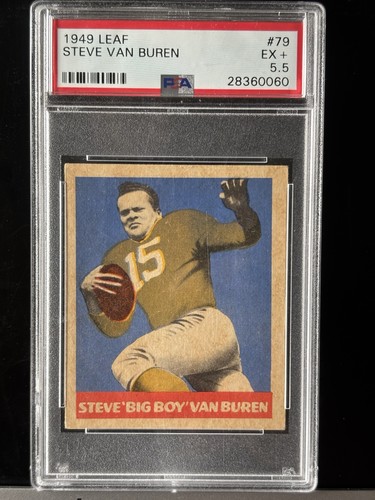 |
Steve Van Buren #79 1949 Leaf |
$76.71 | $20,340 | 265.2× |
 |
Charley Conerly #49 1949 Leaf |
$52.23 | $13,831 | 264.8× |
 |
Bob Waterfield #89 1949 Leaf |
$49.50 | $11,172 | 225.7× |
 |
Pete Pihos #28 1949 Leaf |
$40.17 | $9,097 | 226.5× |
 |
Johnny Lujack #56 1949 Leaf |
$32.57 | $7,846 | 240.9× |
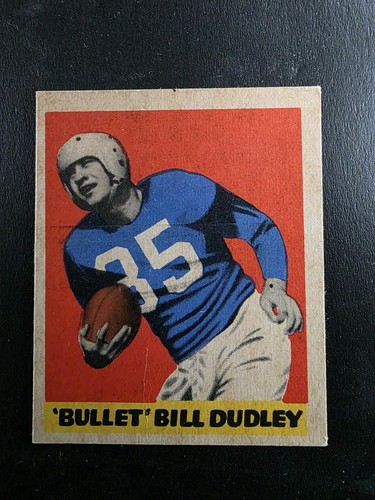 |
Bill Dudley #22 1949 Leaf |
$19.83 | $7,699 | 388.2× |
 |
Bulldog Turner #150 1949 Leaf |
$32.49 | $7,142 | 219.8× |
Look up any card's current raw and graded value in Midpoint — and get an estimated grade before you pay to submit.
Table of Contents
- Section 1: Understanding the 1949 Leaf Football Card Set and Checklist
- Section 2: Raw 1949 Leaf Football Cards Value and Market Price Guide
- Section 3: Graded Price Guide and the Gem-Mint Premium for 1949 Leaf Cards
- Section 4: Key Players and Most Valuable 1949 Leaf Cards
- Section 5: How Grading Factors Affect 1949 Leaf Football Cards Value
- Section 6: Should You Grade Your 1949 Leaf Football Cards? Tips and Tools
- Section 7: Identifying Authentic 1949 Leaf Cards and Avoiding Fakes
- Section 8: Selling 1949 Leaf Football Cards: Marketplaces, Pricing, and Demand
- Conclusion
- FAQ
Section 1: Understanding the 1949 Leaf Football Card Set and Checklist
The Complete 1949 Leaf Football Checklist
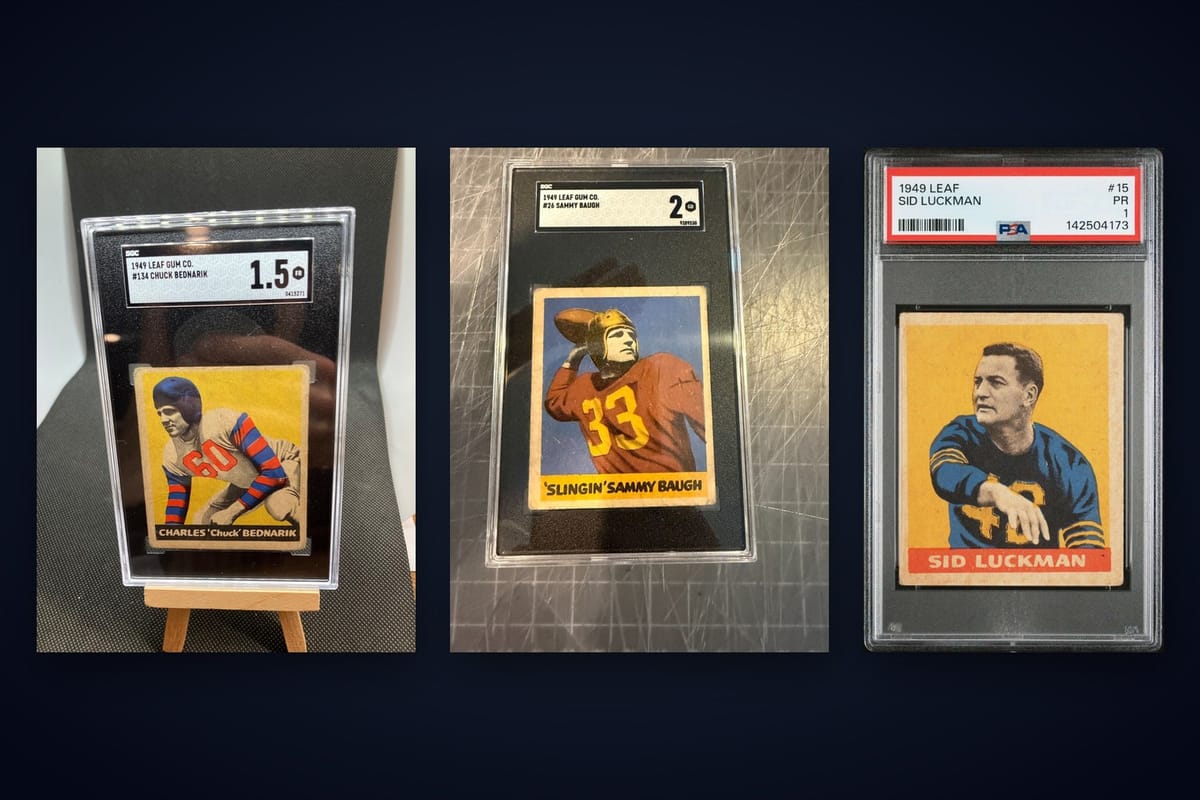
The 1949 Leaf football card set is a classic vintage collection comprising 49 cards. Produced by the Leaf Candy Company, this set is an iconic representation of post-war football card collecting and holds a special place for vintage enthusiasts. It includes many legendary NFL Hall of Famers, making it desirable among collectors. Each card typically features a player’s portrait or action photo on the front, along with individual statistics, biographical details, and team information printed on the back. Key cards include Sammy Baugh #26, Sid Luckman #15, and Chuck Bednarik #134, each representing some of the influential football figures of the era.
Set Composition and Tracked Cards
The 49-card set is compact but diverse, covering star players and fan favorites from the late 1940s football scene. This includes quarterbacks, running backs, linemen, and defensive players from prominent NFL teams of that period. Collectors should note that while some cards appear more frequently in the market in raw condition, others rarely surface at high grades due to the fragile nature of the cardstock and storage practices over the decades. For example, cards like Sid Luckman #15 and Sammy Baugh #26 are often found with more wear because of their popularity, while others may be scarce simply because fewer were originally produced or have survived intact. Tracking the entire set’s availability across various grades—ranging from poor to gem mint—helps collectors establish realistic values and set achievable goals for completing the set. Population reports from grading companies provide valuable data on how many cards of each number have been graded at each tier.
Why the Checklist Matters for Valuation
Understanding the exact checklist is important for accurately evaluating your collection’s worth. Some cards have smaller print runs or survived fewer decades intact, which can boost their rarity and value. For instance, the Sammy Baugh #26 card is known for a relatively limited supply in high-grade condition, making it especially valuable. Tracking these cards’ condition and population reports helps inform grading decisions and pricing estimates. Additionally, knowing which cards are more common or rare enables collectors to prioritize acquisitions or sales accordingly. For example, a collector focusing on investment-grade cards might concentrate on the top 5 most valuable cards in the set, while a set completionist might seek out the full 49 cards regardless of individual card value. This strategic approach to the checklist can enhance both collecting enjoyment and financial outcomes.

Section 2: Raw 1949 Leaf Football Cards Value and Market Price Guide
Current Ungraded Values as of 2026-11-01
Raw 1949 Leaf football cards value varies significantly depending on condition, player, and market trends. As of late 2026, a typical ungraded Sammy Baugh #26 card in decent condition can range from approximately $200 to $600. More common cards in average condition typically sell between $15 and $50. This wide range underscores the importance of condition assessment prior to purchase or sale. Raw card prices fluctuate based on collector demand, with some cards appreciating due to player legacy or rarity. For example, a well-centered, clean surface Sid Luckman #15 card could command toward the higher end of its range, especially if corners and edges are sharp.
Factors Influencing Raw Card Prices
- Condition: Cards free of creases, stains, and significant wear generally command higher prices. Even minor surface imperfections can reduce value notably, especially for vintage cards where condition is important.
- Centering: Cards with centering close to 50/50 ratio are more desirable. Off-center cards, particularly those with uneven borders or cut-offs, typically see a decrease in value.
- Edges and Corners: Cards with sharp, clean edges and corners—no chipping, fraying, or rounding—are more attractive to buyers.
- Player Popularity: Hall of Famers and star players such as Sammy Baugh and Sid Luckman tend to have stronger demand, which can increase market prices.
Example Market Price Ranges for Raw Cards
- Sammy Baugh #26: $350 to $600 for well-preserved raw examples, with lower-grade copies falling below $200.
- Sid Luckman #15: $300 to $550, depending on centering and surface condition.
- Chuck Bednarik #134: $150 to $400, with higher values for cleaner cards possessing minimal wear.
- Other common cards: Generally $15 to $50, varying with player popularity and condition.
Collectors looking to purchase raw cards should carefully evaluate these condition factors, as a card priced at $350 with poor centering and edge wear may not be a good candidate for grading investment.
Section 3: Graded Price Guide and the Gem-Mint Premium for 1949 Leaf Cards
PSA 10 and Other Top Graded Values
The premium associated with graded 1949 Leaf cards—especially PSA 10 Gem Mint grades—can be substantial. For example, a PSA 10 Sammy Baugh #26 has sold for prices exceeding $15,000, representing a significant multiplier from raw values. Similarly, the Sid Luckman #15 in PSA 10 condition has sold for prices around $12,000. These premiums are driven by the rarity of such high-grade examples, as only a limited number of 1949 Leaf cards have achieved PSA 10 status due to the age and condition challenges inherent to the set. Other grading tiers such as PSA 9 or BGS 9.5 also command strong premiums but generally less than PSA 10 prices. This price disparity highlights the importance of securing the highest possible grade for investment-grade cards.
Grading Companies and Their Price Impact
PSA remains the most recognized and influential grading company in the vintage football card market, often commanding the highest resale values. Beckett Grading Services (BGS) and Certified Guaranty Company (CGC) also provide respected grading services, with slightly different grading scales and subgrades. For example, BGS uses a 10-point scale with subgrades for centering, corners, edges, and surface, allowing for nuanced grade designations like 9.5 “Black Label” or 9.5 “Gem Mint.” CGC, a newer entrant, is increasingly accepted, especially for vintage cards, offering competitive turnaround times and grading standards. Midpoint’s AI grading tool estimates potential grades across PSA, BGS, CGC, and TAG grading companies, helping collectors assess which grading service might deliver the best value for their specific card and condition. This cross-company perspective assists collectors in making informed submission choices tailored to their needs.
Gem-Mint Premium Explained
- Rarity of PSA 10s: Due to the fragile cardstock and production quality of the late 1940s, very few 1949 Leaf cards survive in Gem Mint condition, making PSA 10 grades rare and highly sought after.
- Price Multipliers: PSA 10 cards often command prices many times greater than their raw high-grade counterparts. For example, a raw Sammy Baugh #26 might sell for $500, while a PSA 10 version could exceed $15,000.
- Investment Potential: Graded Gem-Mint cards attract serious collectors and investors who seek the rarest and best-preserved examples. Such cards tend to hold or appreciate value over time, especially as vintage football collecting continues to grow.
- Market Liquidity: PSA 10 graded cards generally sell faster and with more bidding competition, enhancing seller returns.
Section 4: Key Players and Most Valuable 1949 Leaf Cards
Top Valued Cards in the Set
The most valuable 1949 Leaf cards include:
- Sammy Baugh #26: Often considered the crown jewel of the set, this card is highly sought after in all grades and especially in Gem Mint condition. Baugh’s legendary career as a pioneering NFL quarterback contributes to his card’s status.
- Sid Luckman #15: Another Hall of Fame quarterback, Luckman’s card commands premium prices due to his historic significance and relative scarcity in high condition.
- Chuck Bednarik #134: Known as one of the toughest players in NFL history, Bednarik’s card holds strong market value and is a favorite among collectors who appreciate his legacy.
- Other Hall of Famers: Including Bill Dudley, Pete Pihos, Harry Gilmer, and Charley Trippi, whose cards also have value, though typically less than the top three.
Why These Cards Command Premiums
The combination of player legacy, card rarity, and condition drives value. Sammy Baugh’s #26 card, for example, is prized because he’s a pioneering NFL star, and the card is relatively scarce in high grade. Sid Luckman’s #15 follows a similar logic, with strong collector demand rooted in his leadership of the Chicago Bears and historic achievements. The scarcity of high-quality examples across the set amplifies premiums, especially for cards that have survived with minimal wear despite being over 75 years old. Collector interest is also influenced by the player’s overall historical importance, Hall of Fame status, and nostalgia.
Value Beyond Hall of Famers
While Hall of Famers dominate the high end, other players like Steve Van Buren and Bill Swiacki also attract collector attention. Cards with clean surfaces, strong centering, and minimal wear can sometimes have decent value, especially when combined with good grading. For example, a well-centered Van Buren card in PSA 8 or 9 could fetch hundreds of dollars, making it a potential investment candidate. Many collectors find value in completing the full set, which helps maintain demand for less prominent cards, supporting a stable market for the entire 49-card checklist.
Section 5: How Grading Factors Affect 1949 Leaf Football Cards Value
Centering
Centering is one of the most critical factors influencing a card’s grade and market value. Ideally, a card should be centered within a 55/45 to 60/40 tolerance ratio, meaning the image is nearly perfectly balanced within the card borders. Cards with centering worse than 70/30 typically see steep value reductions. Midpoint’s precise centering measurement tool can analyze centering down to the millimeter, offering collectors an objective metric before submitting to PSA or BGS. For example, a Sammy Baugh card centered at 60/40 is more likely to achieve a higher grade and command a premium price than one centered at 75/25. Understanding how centering affects grading can help collectors target cards with the best potential.
Additional resource: Learn more about how centering impacts card value.
Corners and Edges
Sharp corners and clean edges are essential for top grades. Vintage cards often suffer from rounded or frayed corners due to handling and storage. Cards with damaged edges or chipped corners typically cannot earn top grades, drastically lowering their market price. For instance, even a card with perfect centering may fail to reach PSA 9 or 10 if the corners show visible wear or rounding. Collectors should carefully inspect the card edges under magnification to identify any subtle damage that could impact grading. Midpoint’s AI tools assess corners and edges visually, providing an additional layer of evaluation to complement physical inspection.
Surface Condition and Print Defects
Surface issues such as staining, creases, print defects, or discoloration can reduce a card’s value. Vintage cards like those from 1949 are particularly prone to these problems due to their age. Authenticity verification is also important to ensure the card is original and unaltered. Common print defects include miscuts, ink smudges, or surface cracks that can be visible under close examination. For example, a 1949 Leaf card with a small crease or faint stain on the front can lose 1-2 grade points, which could translate to significant value difference for key cards. Collectors should use good lighting and magnification when assessing surface condition and consider professional restoration cautiously, as restoration often negatively impacts resale value and grading eligibility.
Section 6: Should You Grade Your 1949 Leaf Football Cards? Tips and Tools
When Grading Is Worth It
Grading is typically worthwhile for cards that possess strong raw condition and rarity, especially Hall of Famers or key stars. Cards exhibiting decent centering, sharp corners, clean edges, and minimal surface wear are prime candidates. In contrast, many common cards or those showing significant wear may not benefit financially from grading, as the cost of submission—often $30 or more per card—may exceed any resale price increase. For example, grading a raw Sammy Baugh #26 with good centering and clean corners could yield a PSA 9 or 10, resulting in a substantial premium. However, a heavily creased or off-center Sid Luckman card might only grade PSA 3 or 4, offering limited value increase. Thus, evaluating each card carefully prior to submission is important.
Using AI to Estimate Grades Before Submission
Services like Midpoint offer AI-based digital grading that estimates potential PSA, BGS, CGC, and TAG grades free of charge. This technology assesses centering, corners, edges, and surface quality, giving collectors a realistic preview of how a card might be graded professionally. By pre-grading cards, collectors can avoid costly surprises and prioritize which cards to send for professional grading. For instance, Midpoint’s AI might indicate a card is unlikely to achieve PSA 8 or higher, enabling the owner to reconsider submission or attempt restoration. This approach can save time and money, particularly when grading fees, shipping, and insurance costs are factored in. See how AI transforms card centering analysis in this in-depth comparison.
Cost-Benefit Analysis for Grading 1949 Leaf Cards
- Estimate the raw card value and potential PSA 10 or other high-grade values using trusted price guides and recent sales data.
- Use AI grading tools to predict achievable grades and associated market premiums realistically.
- Calculate all submission-related costs including grading fees, shipping, insurance, and potential restoration expenses.
- Submit only cards that are likely to gain significant value after grading, ideally those that could at least double in price to justify costs.
- Consider market timing and demand; grading during high interest periods can maximize returns.
Following these steps can help ensure a strategic approach to grading investment and maximize the potential return on your vintage football card collection.
Section 7: Identifying Authentic 1949 Leaf Cards and Avoiding Fakes
Recognizing Original 1949 Leaf Cards
Authentic 1949 Leaf cards have distinct printing characteristics reflecting the technology and materials of the late 1940s. The card stock is relatively thin and somewhat fragile compared to modern cards, with a semi-gloss finish and muted color saturation typical for the era. The back design features player statistics, brief biographies, and team info printed in consistent fonts and layouts across the set. Fading or yellowing is common due to age but should not be confused with alterations or counterfeit markers. The printing ink may show slight offsetting or wear, which is normal for cards that have not been stored in ideal conditions. Collectors should familiarize themselves with these hallmarks to differentiate genuine cards from reprints or fakes. Comparing suspected cards with known authentic examples under magnification can reveal differences in paper texture, gloss, and print quality.
Common Reprints and Altered Cards
Beware of reprints or counterfeit cards that mimic the 1949 Leaf design but are produced with modern techniques or inferior materials. Reprints may display sharper colors, different paper texture, or inconsistencies in the back print layout. Altered cards might show signs of trimming (cutting edges to improve centering), recoloring (touching up faded areas), or corner enhancement (rounding or sharpening corners artificially). Such modifications can be difficult to detect without careful inspection. Using magnification and UV light can help reveal alterations, such as glue residue from corner repairs or inconsistent gloss patterns. Provenance and seller reputation are also important factors when purchasing vintage cards to reduce the risk of acquiring fakes or altered items.
Tools and Resources to Verify Authenticity
Professional graders authenticate cards during submission, providing a high level of assurance. However, collectors and enthusiasts can also leverage apps like Midpoint, which combine AI condition and centering analysis with expert guides and reference images to assist in authenticity assessments. Educating yourself on the set’s specifics, including printing details, known reprint marks, and common alterations, can reduce risk when buying or selling. Additionally, consulting online databases, population reports, and collector forums offers valuable community insights and verification support.
Section 8: Selling 1949 Leaf Football Cards: Marketplaces, Pricing, and Demand
Best Platforms to Sell Vintage Cards
Online marketplaces such as eBay remain primary venues for selling 1949 Leaf football cards, offering broad access to collectors worldwide. High-value cards often perform well in auction formats, where bidding competition can drive prices above retail. Specialized auction houses focusing on sports memorabilia—such as Heritage Auctions or Goldin Auctions—provide additional options for premium cards, often attracting serious collectors and institutional buyers. Local sports card shows, conventions, and collector group meetups can also provide opportunities for direct sales, often with lower fees but limited buyer pools. Sellers should select platforms based on card value, desired exposure, and cost efficiency.
How Auction Results and Buyer Demand Affect Prices
Analyzing completed sales data from platforms like eBay gives insights into market trends. For example, recent sales indicate demand for Hall of Fame cards such as Sammy Baugh #26, with prices showing strength over recent years. Meanwhile, common cards fluctuate more based on supply and seasonal interest. Sales volume and bidding competition heavily influence final prices; a card that attracts multiple bidders typically sells for more than a similar card with little interest. Understanding current buyer demand helps sellers time their listings effectively and set realistic reserve prices to maximize returns.
Maximizing Sale Price Tips
- Grade cards professionally to enhance buyer confidence, especially for high-value examples. A PSA or BGS graded card often sells for a premium over raw equivalents.
- Provide accurate centering and condition descriptions using tools like Midpoint to transparently communicate card quality and reduce buyer hesitation.
- Include high-quality photos showing corners, edges, surfaces, and back details to give buyers a clear view of the card’s condition.
- Time sales during peak collecting seasons, such as the winter holiday period or major sports events, when buyer interest tends to spike.
- Consider offering combined shipping discounts or bundling multiple cards to attract collectors seeking to complete sets.
- Maintain clear and prompt communication with potential buyers to build trust and encourage bidding activity.
Conclusion
Understanding the 1949 Leaf football cards value requires knowledge of the set checklist, condition factors, grading impact, and market dynamics. The most valuable cards like Sammy Baugh #26 and Sid Luckman #15 can command high prices in PSA 10 condition, creating an incentive to grade wisely and selectively. Using AI-powered tools such as Midpoint can help collectors objectively measure centering, estimate achievable grades, and make informed decisions before investing in grading fees. This can reduce the risk of costly grading surprises and help maximize potential returns. Whether you’re completing your set or evaluating a prized card, combining expert knowledge with modern technology can optimize your collection’s value and enjoyment, supporting a rewarding vintage football card collecting experience.
FAQ
Q: How much are 1949 Leaf football cards worth?
A: Raw 1949 Leaf football cards value ranges broadly from about $15 for common cards to over $600 for key stars like Sammy Baugh in good raw condition. Graded PSA 10 examples, especially for top cards, have sold for prices exceeding $15,000 due to rarity and collector demand.
Q: What is the most valuable 1949 Leaf football card?
A: The Sammy Baugh #26 card is widely regarded as the most valuable, particularly in high-grade PSA 10 condition where it has sold for upwards of $15,000 due to its scarcity and player legacy.
Q: How much is a 1949 Leaf Sammy Baugh #26 worth?
A: As of 2026-11-01, raw Sammy Baugh #26 cards typically range from $350 to $600 depending on condition, while PSA 10 graded copies have sold for prices exceeding $15,000, reflecting a significant premium for gem mint condition.
Q: How much is a 1949 Leaf Sid Luckman #15 worth?
A: Raw Sid Luckman #15 cards generally sell between $300 and $550, with PSA 10 graded cards valued around $12,000 based on recent auction results and population scarcity.
Q: Are 1949 Leaf football cards rare?
A: The set itself is relatively small with 49 cards, but high-grade examples are rare due to age, fragile card stock, and condition issues accumulated over decades. PSA 10 graded cards, in particular, are scarce and highly prized.
Q: Should I get my 1949 Leaf football cards graded?
A: Grading is recommended for cards in strong raw condition, especially key players and Hall of Famers, as high-grade designations like PSA 10 can significantly increase value. Using AI tools such as Midpoint can help determine which cards are good grading candidates, making grading a more strategic and cost-effective process.
Free to start
Try the Midpoint app
Grade any card from a photo, see its raw and PSA 10 value, and track what your collection is worth — free.
Get it on iPhoneGet it on Android