1951 Parkhurst Hockey Cards Value: Ultimate Guide to Pricing & Grading
Explore the 1951 Parkhurst hockey cards value, top cards, grading impact, and pricing guide to maximize your collection's worth with expert tips.

Estimated reading time: 15 min
Key Takeaways
- The 1951 Parkhurst hockey cards are among the most sought-after vintage hockey collectibles, with key rookies often commanding premium prices due to their scarcity and iconic status.
- Centering, corners, edges, and surface condition significantly affect card value, especially for high-demand cards like Gordie Howe #66 and Maurice Richard #4, where even slight imperfections can reduce value substantially.
- PSA 10 graded examples can fetch multiples of raw card prices, but grading costs (typically $50–$150 per card) mean only certain cards with excellent raw condition are worth submitting to grading companies.
- Population scarcity makes high-grade 1951 Parkhurst cards rare and valuable, underscoring the importance of authentication and condition assessment before purchase or sale.
- Using tools like Midpoint’s AI grading and centering measurement can help collectors estimate card grades before grading submission, potentially saving grading fees and improving return on investment.
Card values — live data from Midpoint's card database, as of 2026-09-04. Prices move; Midpoint refreshes these daily.
| Card | Raw | PSA 10 | Gem premium | |
|---|---|---|---|---|
 |
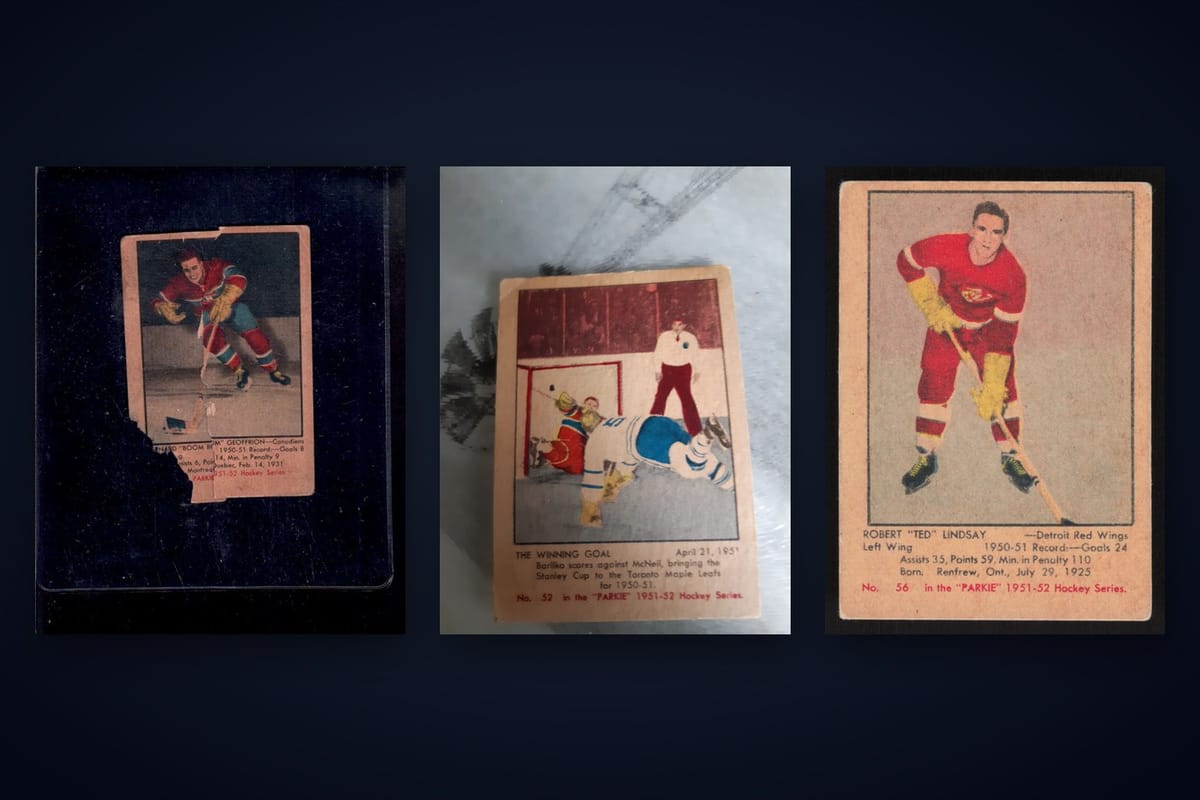
Boom Boom Geoffrion #14 1951 Parkhurst |
$220.50 | $55,134 | 250× |
 |
The Winning Goal #52 1951 Parkhurst |
$205.02 | $49,987 | 243.8× |
 |
Ted Lindsay #56 1951 Parkhurst |
$155.57 | $38,943 | 250.3× |
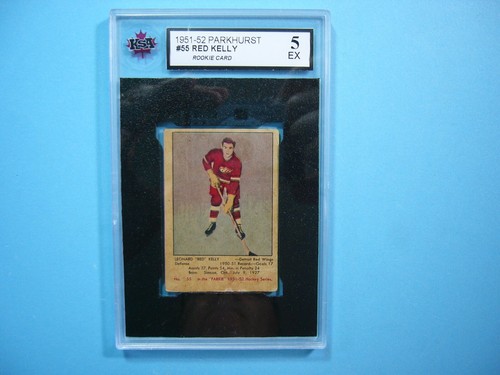 |
Red Kelly #55 1951 Parkhurst |
$136.16 | $33,576 | 246.6× |
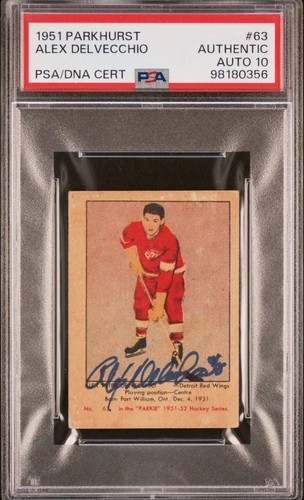 |
Alex Delvecchio #63 1951 Parkhurst |
$106.63 | $26,669 | 250.1× |
 |
Turk Broda #75 1951 Parkhurst |
$108.39 | $25,730 | 237.4× |
 |
Elmer Lach #1 1951 Parkhurst |
$95.33 | $23,841 | 250.1× |
 |
Teeder Kennedy #86 1951 Parkhurst |
$84.87 | $21,248 | 250.4× |
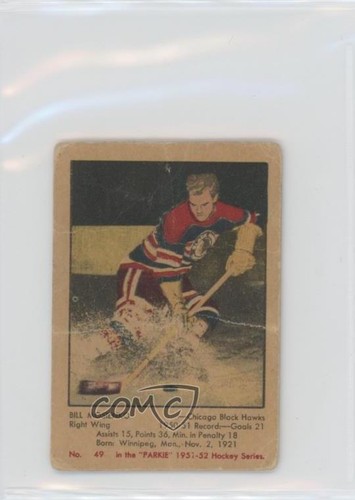 |
Bill Mosienko #49 1951 Parkhurst |
$80.94 | $20,211 | 249.7× |
 |
Sid Abel #64 1951 Parkhurst |
$66.11 | $18,314 | 277× |
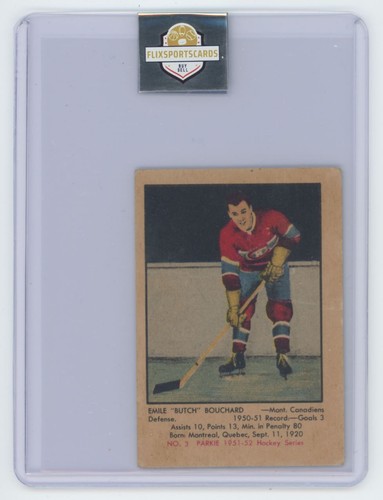 |
Butch Bouchard #3 1951 Parkhurst |
$68.35 | $17,371 | 254.2× |
 |
Howie Meeker #72 1951 Parkhurst |
$59.40 | $14,986 | 252.3× |
Look up any card's current raw and graded value in Midpoint — and get an estimated grade before you pay to submit.
Table of Contents
- Section 1: Overview and Significance of the 1951 Parkhurst Set
- Section 2: Complete Checklist and Card Numbering Explained
- Section 3: Rookie Cards and Major Stars to Watch
- Section 4: Value by Card and Grade – Raw vs PSA Graded
- Section 5: Condition Factors that Drive 1951 Parkhurst Value
- Section 6: Auction Comparables and Market Trends
- Section 7: Population Scarcity and Authenticity Considerations
- Conclusion
- FAQ
Section 1: Overview and Significance of the 1951 Parkhurst Set
The Historical Importance of 1951 Parkhurst Hockey Cards
The 1951 Parkhurst hockey card set is widely regarded as a cornerstone of vintage hockey card collecting, representing one of the most pivotal releases in early NHL memorabilia history. Issued during the early post-war era, this set captures an iconic moment in NHL history, showcasing legendary players like Gordie Howe and Maurice Richard at or near their prime. The cards reflect not only player portraits but also the era's unique printing techniques and design aesthetics, making them historically significant beyond mere player depiction.
Its importance is amplified by the relative scarcity of surviving sets in high condition. Unlike mass-produced modern cards, the 1951 Parkhurst cards were printed on thin, fragile stock prone to damage, resulting in relatively few high-grade examples. The set is often compared with the 1951-52 Topps hockey cards but maintains its own distinct cachet due to its exclusive distribution in Canada, unique layout, and the inclusion of key rookie cards absent from other sets.
Collectors and historians alike value the set for its snapshot of the NHL's Original Six era, when the league consisted of only six teams and the sport was rapidly growing in popularity. The Parkhurst set provides a tangible link to that time, preserving images of players who shaped hockey’s development as a major North American sport.
Why 1951 Parkhurst Cards Are a Key Vintage Release
- Limited print runs: Parkhurst produced fewer cards than Topps during that period, due in part to regional distribution primarily in Canada and smaller production runs. This scarcity is a critical factor driving value, as fewer cards survived in collectible condition.
- Key rookies and stars: The set includes rookie cards of hockey legends such as Gordie Howe (#66) and Terry Sawchuk (#61), as well as established stars like Maurice Richard (#4), making it a must-have for collectors focused on iconic NHL figures.
- Condition sensitivity: Printed on thin card stock with a matte finish subject to wear, these cards are notoriously difficult to find in high-grade condition. The smallest imperfections—off-centering, corner wear, surface scratches—can drastically reduce a card’s value.
- Market demand: The vintage hockey card market has expanded significantly over the past decade, driven by nostalgia, investment interest, and the gradual scarcity of quality vintage cards. Demand for premium 1951 Parkhurst cards remains strong and continues to grow.
Midpoint’s Role in Assessing 1951 Parkhurst Cards
Given the premium values and grading costs associated with 1951 Parkhurst cards, collectors need reliable tools to assess condition and grade potential before committing to grading submissions. Midpoint offers a powerful app that uses artificial intelligence to measure card centering, corners, edges, and surface quality, estimating potential grades from major grading companies such as PSA, BGS, CGC, and TAG.
This technology helps collectors reduce guesswork and avoid costly grading fees for cards unlikely to receive high grades. For example, Midpoint’s millimeter-precise centering measurement can identify suboptimal centering that could prevent a card from obtaining a PSA 10. By filtering cards with true gem potential, collectors can maximize their return on investment and make more informed buying, selling, and grading decisions.

Section 2: Complete Checklist and Card Numbering Explained
The 105-Card Set Breakdown
The 1951 Parkhurst hockey set consists of 105 cards, sequentially numbered from #1 through #105. This extensive roster features a mixture of star players, rookies, and notable role players from the NHL’s Original Six teams: Montreal Canadiens, Toronto Maple Leafs, Detroit Red Wings, Boston Bruins, Chicago Black Hawks, and New York Rangers.
The set offers a comprehensive snapshot of the league’s key figures during the early 1950s. Collectors often pursue a complete set both for historical completeness and for the value contained in individual key cards.
Card Numbering and Subsets
The cards are numbered sequentially with no official subsets; however, distinct groupings can be identified based on the players’ status and card content:
- Cards #1–30: Primarily established stars and veteran players, including notable names like Bill Barilko (#1) and Maurice Richard (#4).
- Cards #31–70: A blend of rookies and emerging young stars, including the all-important Gordie Howe rookie card (#66) and Terry Sawchuk (#61).
- Cards #71–105: Role players and lesser-known figures, often of value for completionists but typically with lower market demand.
Understanding this breakdown helps collectors prioritize acquisitions and grading submissions based on card significance and value potential.
Using the Checklist to Track Collection Progress
A thorough checklist is essential for collectors to monitor which cards they own, identify missing pieces, and plan acquisitions according to personal or investment goals. Many collectors use printed or digital checklists, but Midpoint’s app provides enhanced portfolio tracking features that integrate checklist management with estimated card values and grading potential.
By linking scan data and AI-assessed condition, Midpoint allows collectors to maintain an up-to-date inventory, track value appreciation over time, and identify which cards might benefit most from grading submissions or sales.
Section 3: Rookie Cards and Major Stars to Watch
Gordie Howe #66 – The Set’s Crown Jewel
Gordie Howe’s #66 card is widely considered the most iconic and valuable rookie card in the 1951 Parkhurst set. Howe’s legendary 26-season NHL career, Hall of Fame status, and enduring nickname “Mr. Hockey” have solidified this card as a centerpiece for collectors and investors.
Raw examples of this card in decent condition typically range from approximately $15,000 to $30,000. PSA 10 graded examples have been known to command prices well above $250,000, with auction records exceeding $300,000 for pristine copies. This remarkable price differential highlights the gem premium for flawless centering, sharp corners, and pristine surfaces.
Because the card’s thin stock and print quality often result in centering challenges and surface wear, a PSA 10 is extremely rare, with fewer than 10 copies graded at this level according to population reports. This scarcity underpins the card’s extraordinary market value.
Maurice Richard #4 – Another Hall of Fame Rookie
Maurice "Rocket" Richard’s #4 card is another marquee rookie card in the set, reflecting his status as an NHL legend and the first player to score 50 goals in 50 games. Raw cards in good condition typically sell for around $10,000, while PSA 10 graded copies have approached $100,000 at auction.
Richard’s card is often slightly easier to find in high grade than Howe’s but still commands a significant premium due to his legendary career and cultural impact in hockey history.
Terry Sawchuk #61 – Elite Goalie Rookie
The Terry Sawchuk #61 card is prized primarily by collectors focusing on elite goaltenders. Sawchuk’s four Stanley Cup wins and status as one of the greatest goalies in NHL history make this card highly desirable.
Raw values generally range from about $5,000 to $10,000, with PSA 10 grades reaching as high as $30,000. While lower than Howe or Richard, this card still commands a strong market due to its relative scarcity and importance.
Other Notable Stars and Rookies
- Bill Barilko #1: Famous for scoring the Stanley Cup-winning goal in 1951 before tragically disappearing in a plane crash, his card commands approximately $3,000+ raw and can achieve $15,000+ in top grades.
- Doug Harvey #44: Hall of Fame defenseman with growing collector interest, raw cards sell for roughly $1,500-$3,000, with PSA 9 or 10 copies commanding higher prices.
- Jean Beliveau #92: A rookie card with increasing value as his career legacy grows, often worth grading when raw prices are near $2,000–$4,000.
Section 4: Value by Card and Grade – Raw vs PSA Graded
Raw Card Values for Key Cards
Raw 1951 Parkhurst cards exhibit wide price variation depending on condition, centering, and rarity. For example, the following approximate raw price ranges are observed:
- Gordie Howe #66: $15,000–$30,000 for mid-grade to high-grade raw cards.
- Maurice Richard #4: $10,000–$20,000 raw, with top raw cards pushing higher.
- Terry Sawchuk #61: $5,000–$10,000 raw.
- Bill Barilko #1: $3,000–$5,000 raw.
- Jean Beliveau #92: $2,000–$4,000 raw.
Lower-tier or heavily worn cards in the set may be worth under $100, highlighting the importance of condition in this set.
PSA Graded Values and the Gem Premium
Professional grading can amplify card values significantly, especially at PSA 9 and PSA 10 levels. For example, a PSA 10 Gordie Howe #66 card can command prices many times the raw price, reaching $250,000 or more. Similarly, Maurice Richard #4 PSA 10 cards often top $90,000, while Terry Sawchuk #61 PSA 10s can reach $30,000.
This gem premium reflects the rarity of perfectly centered cards with sharp corners, flawless edges, and pristine surfaces. Population reports show fewer than 10 PSA 10 examples for several key cards, making them highly coveted.
Midpoint’s AI grading tool assists collectors in estimating these grades by analyzing centering to the millimeter and evaluating corners, edges, and surface characteristics before costly grading submissions.
Which 1951 Parkhurst Cards Are Worth Grading?
- High-value rookies and stars such as Gordie Howe #66, Maurice Richard #4, and Terry Sawchuk #61, which can multiply value significantly.
- Cards exhibiting strong raw condition, including sharp corners, minimal surface wear, and near-perfect centering that might achieve PSA 9 or 10 grades.
- Rare cards with limited population but decent visual quality, which can appreciate after professional grading.
Conversely, lower-value or poor-condition cards generally do not recoup grading fees, which can range from $50 to over $150 per card depending on service and turnaround time. Such cards are better sold raw or held for personal collections.
Section 5: Condition Factors that Drive 1951 Parkhurst Value
Centering – The Most Critical Factor
Centering is a primary driver of value for 1951 Parkhurst cards. It refers to how evenly the player's image is positioned within the white borders of the card. Due to the printing and cutting processes used in the early 1950s, many cards were cut off-center, resulting in uneven borders.
Cards with perfect or near-perfect centering (within approximately 55/45 to 60/40 ratios) command significantly higher prices because they meet strict grading standards—especially for PSA 10, which requires centering no worse than 55/45 on the front and 75/25 on the back.
Even a millimeter of deviation can downgrade a card from PSA 10 to PSA 9 or lower, dramatically impacting value. For instance, a Gordie Howe #66 card graded PSA 9 instead of PSA 10 can lose a substantial portion of its value.
Midpoint’s free centering calculator and AI tools help collectors measure centering precisely by analyzing high-resolution scans or photos, providing a numerical centering ratio. This objective data assists in deciding whether a card is worth grading or better sold raw.
Corners and Edges
Sharp, undamaged corners and clean edges are essential for high grades. Vintage cards often suffer from rounded or frayed corners due to handling and storage over decades. Cards with four razor-sharp corners free of dings or bends are rare and command a premium.
Edges must be free from chipping, dents, or discoloration. Cards with edge wear or chipping typically receive lower grades, reducing their market value. Collectors should closely inspect under magnification before grading submissions.
Surface and Print Quality
Surface condition encompasses gloss, scratches, staining, creases, and print defects. The 1951 Parkhurst set’s thin card stock is prone to creasing and surface wear, making flawless surfaces difficult to find.
Print quality issues such as color fading or misalignment can also impact value. Cards with original gloss intact, free of scratches or stains, are highly prized.
Collecting and grading experts recommend using natural light and magnification to detect surface flaws, as these imperfections heavily influence final grading.
Section 6: Auction Comparables and Market Trends
Recent Sales Highlight Value Trends
Recent auction results provide concrete data on the market value of 1951 Parkhurst cards. High-grade Gordie Howe #66 cards have sold for amounts exceeding $200,000, with top PSA 10 copies breaking $300,000. Maurice Richard #4 PSA 10 cards have fetched over $90,000, and Terry Sawchuk #61 PSA 10s approach $30,000.
Mid-grade raw cards commonly sell in the mid-five-figure range, such as a $15,000–$25,000 range for Howe or Richard cards graded raw but well-centered and preserved. These auctions illustrate the premium collectors place on condition and verified grades.
Impact of PSA 10 and Low Population Grades
PSA 10 examples remain exceedingly rare due to the cards’ inherent printing and cutting inconsistencies. Population reports confirm fewer than 10 PSA 10 Gordie Howe #66 cards exist, and similar scarcity applies to other key rookies.
This scarcity creates a strong gem premium and steady price appreciation, with recent years seeing consistent upward trends in pricing for PSA 9 and PSA 10 examples. As fewer high-grade cards enter the market, prices are expected to continue climbing.
Collectors and investors benefit from understanding these trends by focusing on high-grade submissions and leveraging Midpoint’s tools to identify cards with the best grading potential.
Should You Buy Singles or Full Sets?
- Individual star cards: Often provide better return on investment (ROI) and liquidity. High-demand singles like Gordie Howe #66 or Maurice Richard #4 can be sold more quickly and at higher margins.
- Complete sets: Appeal to investors, museums, and serious collectors seeking historical completeness. Complete sets typically require significant capital, especially if including multiple high-grade key cards, and pose challenges in balancing condition throughout.
For collectors focused on value growth and flexibility, targeting the most valuable singles with high grading potential is generally the most strategic approach.
Section 7: Population Scarcity and Authenticity Considerations
Population Scarcity of High-Grade Cards
The vintage age and fragile stock of the 1951 Parkhurst set mean that PSA 10 or BGS 9.5+ cards are exceptionally scarce. Population reports from grading companies provide transparency, showing, for example, fewer than 10 PSA 10 Gordie Howe #66 cards certified worldwide.
This scarcity elevates market value and underscores the importance of verifying population counts before investing. Collectors should consult up-to-date population reports to understand rarity and market dynamics.
Identifying Authentic 1951 Parkhurst Cards
Given the high values of key cards, counterfeit and altered cards occasionally surface on the market. Authenticity checks include examining card stock thickness, printing style, color saturation, and wear patterns consistent with 1951 production methods.
Collectors are advised to use trusted grading services that authenticate cards as part of their grading process. Additionally, tools like Midpoint can verify centering and condition prior to purchase or grading submissions, providing confidence in a card’s legitimacy and quality.
Avoiding Reprints and Altered Cards
- Be cautious of color reprints or repackaged cards marketed as originals. Authentic 1951 Parkhurst cards have unique printing characteristics, such as matte finishes and specific ink textures.
- Watch for signs of trimming or surface tampering, such as artificially sharpened corners or altered edges, which can falsely improve condition but are detectable by experienced graders and AI tools.
- Professional grading reduces risk by providing independent authentication, but collectors should always conduct due diligence on provenance, seller reputation, and card history.
Conclusion
The 1951 Parkhurst hockey cards remain a pinnacle of vintage hockey collecting, boasting iconic rookies, scarce high-grade examples, and strong market demand. Understanding the value of these cards requires knowledge of card condition, grading impact, population scarcity, and evolving market trends.
Using Midpoint’s AI-powered grading estimates and precise centering measurements allows collectors to make informed decisions about which cards to grade and invest in, potentially saving grading fees and maximizing investment returns.
Whether you’re pursuing a complete set or focusing on key rookies like Gordie Howe #66, Maurice Richard #4, and Terry Sawchuk #61, this guide equips you to navigate the complex 1951 Parkhurst market confidently and strategically.
Explore more on grading and value with Midpoint at Midpoint and enhance your vintage hockey card collecting experience today.
FAQ
Q: How much is a 1951 Parkhurst Gordie Howe rookie card worth?
A: Raw Gordie Howe #66 cards typically range from approximately $15,000 to $30,000, depending on condition and centering, while PSA 10 graded examples can exceed $250,000 due to rarity and collector demand.
Q: How much is a 1951 Parkhurst Maurice Richard rookie card worth?
A: Maurice Richard #4 cards in raw condition sell for about $10,000 to $20,000, with PSA 10 graded copies valued near $100,000, reflecting their iconic status and scarcity.
Q: How much is a 1951 Parkhurst Terry Sawchuk rookie card worth?
A: Raw Terry Sawchuk #61 cards generally range from $5,000 to $10,000, and PSA 10 grades can reach $30,000, making it a valuable goalie rookie card.
Q: What is a complete 1951 Parkhurst hockey set worth?
A: Complete sets vary widely depending on overall condition but typically start around $50,000 for lower-grade sets and can climb significantly if including high-grade key cards like Howe, Richard, and Sawchuk.
Q: What are the most valuable cards in the 1951 Parkhurst set?
A: The most valuable cards include Gordie Howe #66, Maurice Richard #4, Terry Sawchuk #61, Bill Barilko #1, and Jean Beliveau #92.
Q: How much does PSA grading affect the value of 1951 Parkhurst cards?
A: PSA grading can multiply raw card values by several times, especially at PSA 9 and PSA 10 levels, due to verified condition and the rarity of gem grades. Grading costs should be considered before submission.
For detailed guides on grading impact and centering, see our posts on Card Centering Tool: Accurate Card Grading Estimates and How Centering Impacts Card Value.
Free to start
Try the Midpoint app
Grade any card from a photo, see its raw and PSA 10 value, and track what your collection is worth — free.
Get it on iPhoneGet it on Android