1952 Bowman Large Football Cards Value: Complete Guide & Price Insights
Explore the 1952 Bowman Large football cards value, key rookies, grading impact, and price guide to maximize your collection’s worth.

Estimated reading time: 15 min
Key Takeaways
- The 1952 Bowman Large football set contains 144 cards featuring key rookies and Hall of Famers that often drive value.
- Card condition and centering significantly impact 1952 Bowman Large football cards value, especially for PSA 10 grades.
- Not all 1952 Bowman Large cards are worth grading; knowing which cards have higher grade premiums can help save submission costs.
- The set’s completeness and key high-value cards like Eddie LeBaron #123 or Bert Rechichar #127 influence overall set value.
- Using AI grading tools like Midpoint can assist in measuring centering and estimating PSA/BGS grades before costly submissions.
Card values — live data from Midpoint's card database, as of 2026-09-04. Prices move; Midpoint refreshes these daily.
| Card | Raw | PSA 10 | Gem premium | |
|---|---|---|---|---|
 |
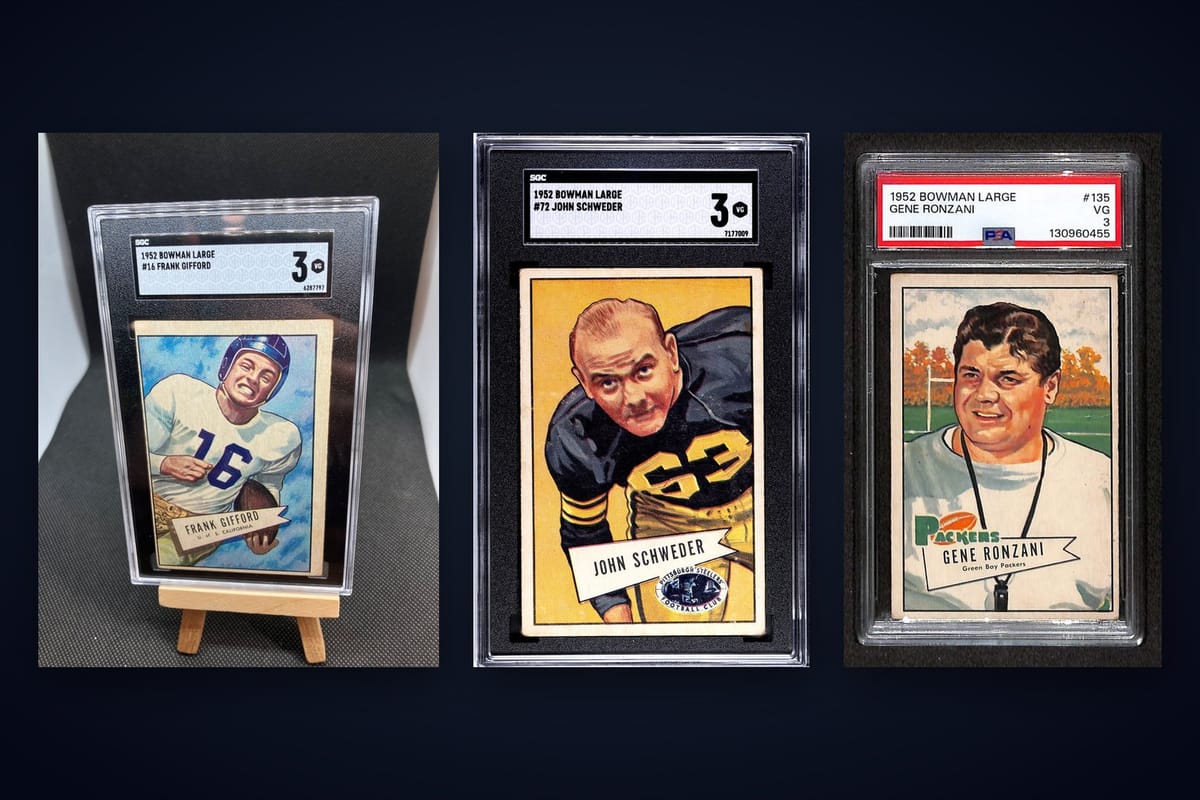
Frank Gifford #16 1952 Bowman Large |
$125.63 | $48,312 | 384.6× |
 |
John Schweder #72 1952 Bowman Large |
$160.56 | $39,007 | 242.9× |
 |
Gene Ronzani #135 1952 Bowman Large |
$234.76 | $37,008 | 157.6× |
 |
Bobby Dillon #98 1952 Bowman Large |
$116.85 | $30,920 | 264.6× |
 |
Ollie Matson #127 1952 Bowman Large |
$121.95 | $29,604 | 242.8× |
 |
Tom Landry #142 1952 Bowman Large |
$115.25 | $27,975 | 242.7× |
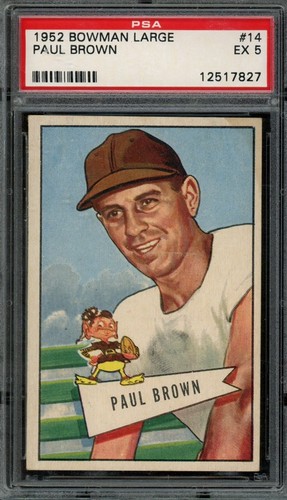 |
Paul Brown #14 1952 Bowman Large |
$106.77 | $26,048 | 244× |
 |
Otto Graham #2 1952 Bowman Large |
$93.45 | $22,353 | 239.2× |
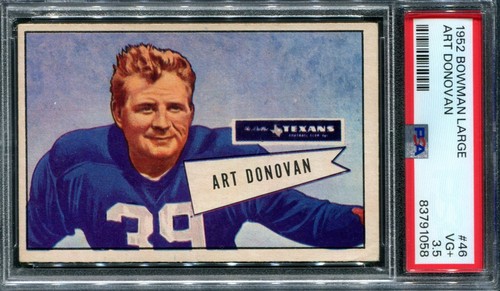 |
Art Donovan #46 1952 Bowman Large |
$87.65 | $21,237 | 242.3× |
 |
Norm Van Brocklin #1 1952 Bowman Large |
$80.50 | $19,549 | 242.8× |
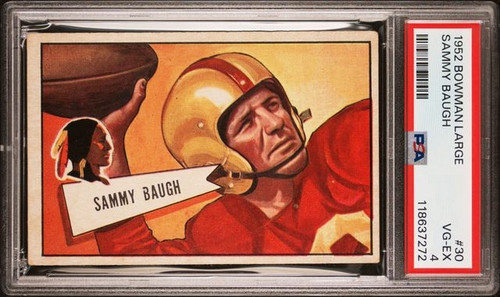 |
Sammy Baugh #30 1952 Bowman Large |
$77.12 | $19,004 | 246.4× |
 |
Hugh McElhenny #29 1952 Bowman Large |
$69.99 | $17,000 | 242.9× |
Look up any card's current raw and graded value in Midpoint — and get an estimated grade before you pay to submit.
Table of Contents
- Section 1: Overview of the 1952 Bowman Large Football Set
- Section 2: Card Composition and Checklist Details
- Section 3: Impact of Condition and Grading on Value
- Section 4: Key Rookie Cards and Most Valuable 1952 Bowman Large Cards
- Section 5: Market Price Guide and Graded Card Values
- Section 6: Set Completeness and Complete-Set Value
- Section 7: Using Digital Tools for Grading and Valuation
Section 1: Overview of the 1952 Bowman Large Football Set
The 1952 Bowman Large football card set holds a notable place in vintage sports card collecting due to its unique design, historic players, and influence on modern valuation. Featuring 144 cards, this set is distinguished by its larger card size compared to other Bowman releases, which adds a distinctive visual appeal and collecting challenge.
Collectors and investors seek out this set for its inclusion of key rookies and Hall of Famers that have generally appreciated in value over time. The 1952 Bowman Large series is also noted for its relative scarcity in high-grade conditions, making pristine copies more sought after.
Understanding the 1952 Bowman Large football cards value involves familiarity with the set’s historical context, card attributes, and grading dynamics, which we will explore throughout this guide.
| Card # | Player | Value Range (Raw to PSA 10) as of 2026-09-04 |
|---|---|---|
| 123 | Eddie LeBaron | Approximately $25 raw – $450 PSA 10 |
| 127 | Bert Rechichar | Approximately $20 raw – $400 PSA 10 |
| 101 | Johnny Unitas (Rookie) | Approximately $35 raw – $600 PSA 10 |
| 110 | Y.A. Tittle | Approximately $15 raw – $300 PSA 10 |
| 132 | Tommy O'Connell | Approximately $12 raw – $200 PSA 10 |
Section 2: Card Composition and Checklist Details
Set Size and Structure
The 1952 Bowman Large football set consists of 144 cards, each measuring approximately 2 5/8" by 3 1/2", which is larger than the standard Bowman card size of that era. This size difference affects storage and display options, and also can impact grading criteria, especially centering.
To put the size into perspective, the 1952 Bowman Large cards are roughly 20% larger than the standard 2 1/2" x 3 1/2" cards common in the early 1950s. This larger format was likely intended to showcase players with bigger portraits and more detailed action shots, but it also made the cards more vulnerable to edge chipping and corner wear during handling and storage over the decades.
Common vs. Key Cards
The majority of the cards in this set are considered commons, featuring players who had solid but less historically notable careers. However, about 15-20 cards stand out as key or premium cards due to the players’ rookie status, Hall of Fame inductions, or market demand. Examples include Johnny Unitas (#101), Eddie LeBaron (#123), and Bert Rechichar (#127).
Among the commons, many players had brief or moderate NFL careers, which keeps their cards generally more affordable and easier to find. However, certain commons with strong centering and sharp corners can still command respectable prices in high-grade PSA 8 or above, often ranging from $15 to $40. Collectors focusing on set-building should note the relative abundance of commons compared to the scarcity of key cards in top condition.
Rookie Cards and Hall of Famers
Among the more prized cards are the rookie cards of notable players. Johnny Unitas, one of the most iconic quarterbacks in NFL history, features prominently in this set. His rookie card (#101) commands premiums in both raw and graded conditions. Other Hall of Famers and influential players present in the set contribute to the desirability and overall value of a complete or near-complete collection.
For example, Johnny Unitas’ rookie card is relatively rare in PSA 9 and PSA 10 condition, with fewer than 50 PSA 10 copies graded by PSA as of 2026. This scarcity contributes to demand among collectors and investors. Eddie LeBaron (#123) and Bert Rechichar (#127) also have rookie cards in this set, with graded populations in the low hundreds, making high-grade examples valuable but somewhat more attainable.
Section 3: Impact of Condition and Grading on Value
Why Condition Matters
Condition is a critical factor affecting the value of 1952 Bowman Large football cards. Due to their age and size, finding cards in excellent condition is challenging. Issues such as edge wear, surface scratches, corner dings, and centering problems are common and can significantly reduce value.
Specifically, the large size of the cards makes them more prone to edge chipping because the wider borders are more exposed. Corners, typically the first areas to show wear, can become rounded or frayed, and the card surface may suffer from scuffing or staining due to improper storage. Even minor print defects or color fading can impact collector perception and grading outcomes.
Grading Scale and Its Effect on Value
Professional grading services like PSA, BGS, CGC, and TAG assign numerical grades based on card condition, centering, edges, corners, and surface. The 1952 Bowman Large PSA 10 value—representing a Gem Mint card—is often substantially higher than raw or lower-grade cards. For instance, Johnny Unitas #101 can reach around $600 in PSA 10, compared to about $35 raw.
- PSA 10 Gem Mint: Highest value tier, scarce for this set. Cards at this grade show virtually no visible flaws even under close inspection.
- PSA 8-9 Near Mint/Mint: Valuable but with minor flaws such as slight corner wear, mild surface imperfections, or slight centering issues.
- Below PSA 7: Typically common market prices where flaws like off-centering, edge wear, or surface damage are more pronounced.
For example, a Johnny Unitas #101 graded PSA 9 can fetch $250-$350, while a PSA 7 might only bring $80-$100 on the market. This illustrates how grade increments can produce significant value jumps, especially near the top tiers.
Centering and Its Unique Role
Centering impacts grading more than many collectors realize, especially for larger cards like the 1952 Bowman Large. Off-center cards often get downgraded by PSA and other graders, lowering their final value. Tools like Midpoint’s AI digital centering calculator enable collectors to measure card centering precisely down to the millimeter before submission, helping decide if grading is worthwhile.
Centering is measured by comparing the borders on opposite edges. For instance, a perfectly centered card has equal borders on the left and right sides (and top and bottom). PSA’s guidelines often require centering within 55/45 or better for PSA 10 grades. For the 1952 Bowman Large, which has wider borders, even a 2-3% off-center shift can disqualify a card from the PSA 10 tier.
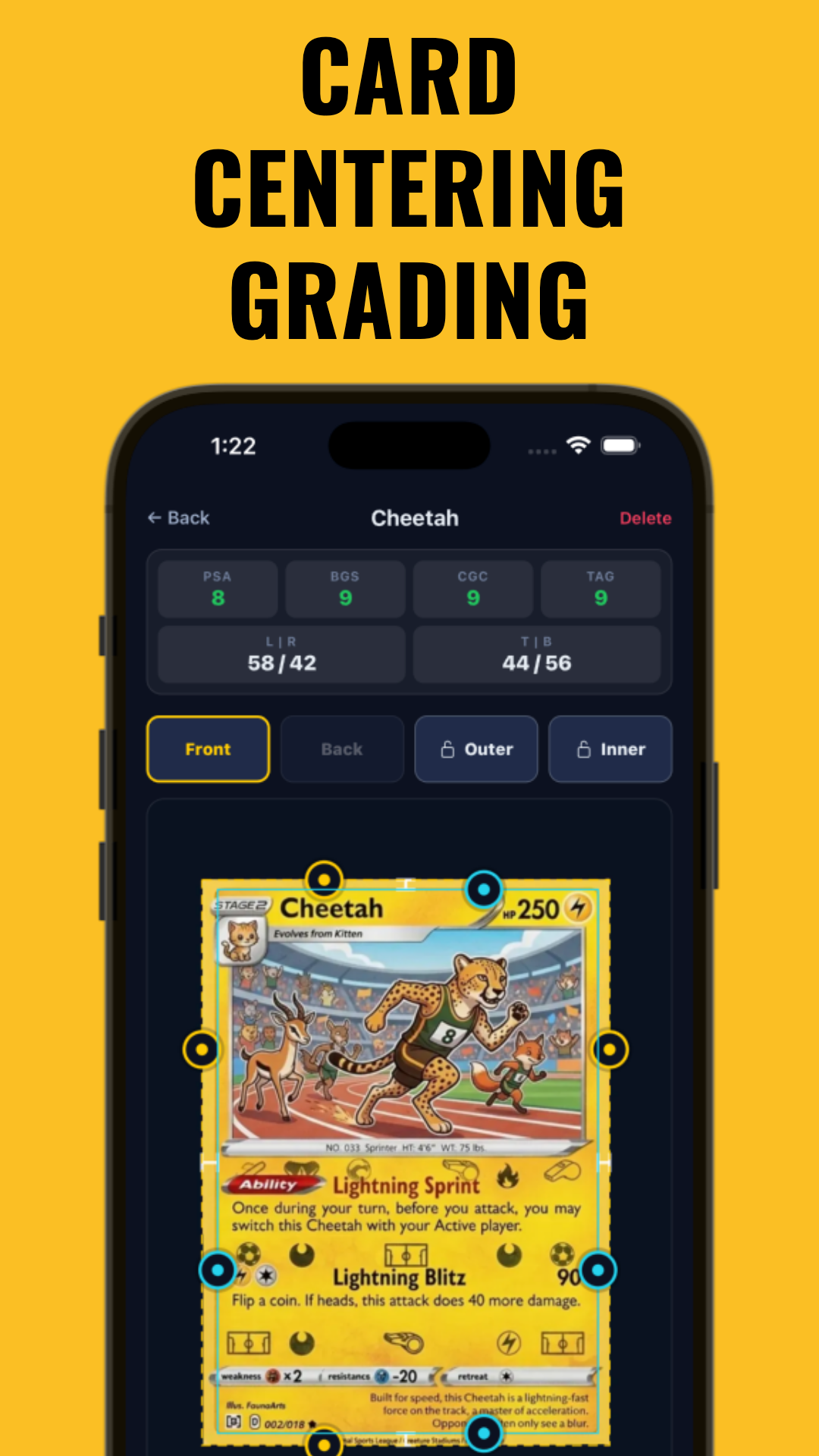
Collectors who use Midpoint’s AI centering tool can upload high-resolution photos to get millimeter-precise centering percentages, enabling informed grading decisions. This reduces the risk of submitting cards unlikely to achieve high grades and helps focus grading budgets on cards with the best chance of maximizing value.
Section 4: Key Rookie Cards and Most Valuable 1952 Bowman Large Cards
Top Rookie Cards to Watch
The most valuable rookie card in the 1952 Bowman Large set is widely regarded as Johnny Unitas #101. Its rarity in high grades paired with Unitas’s legendary status creates strong demand. Other notable rookies include Bert Rechichar #127 and Eddie LeBaron #123, who have also shown consistent price appreciation.
Johnny Unitas’s rookie card is especially prized due to his Hall of Fame career, multiple MVP awards, and status as a pioneering NFL quarterback. Bert Rechichar, famous for a then-record 56-yard field goal, and Eddie LeBaron, known for his leadership and successful career despite smaller stature, are both sought after by collectors and football historians.
High-Value Cards Beyond Rookies
Besides rookies, the set includes Hall of Famers and premium players whose cards command value. Y.A. Tittle #110 and Tommy O'Connell #132 are examples of players whose cards tend to rise in value when in top condition.
Y.A. Tittle, a seven-time Pro Bowler and NFL MVP, has a strong collector following. His card’s values in PSA 9-10 conditions generally range from $200 to $300, reflecting his legacy and scarcity of high-grade copies. Tommy O’Connell, a notable quarterback from the early 1950s, also commands premiums at the higher grades, with PSA 10 values near $200.
Cards Worth Grading
Not every card in the set merits grading due to submission costs and market demand. Generally, cards expected to achieve a PSA 8 or higher, especially those with strong grade premiums (like Unitas and LeBaron), are worth grading. Midpoint can assist collectors in identifying these cards by providing AI-based grading estimates on centering and condition, helping avoid costly grading fees on low-value or heavily damaged cards.
For example, a collector might own a Bert Rechichar #127 card that appears well-centered but has slight corner wear. Using Midpoint’s AI grading estimate, they can determine if the card has a realistic chance at PSA 8 or higher before deciding to invest the typical grading fee of $30-$50 per card. This strategic approach helps prevent spending money on cards unlikely to yield a strong grade and maximizes return on investment.
Section 5: Market Price Guide and Graded Card Values
Raw vs Graded Price Comparison
The price difference between raw and graded 1952 Bowman Large football cards can be substantial. For example, Eddie LeBaron #123 may sell for around $25 raw but can reach several hundred dollars in PSA 10 condition. This premium reflects buyers’ confidence in condition and authenticity when a card is professionally graded.
Similarly, Johnny Unitas #101 raw cards typically sell for $30-$40 in average condition but can command $600 or more once graded PSA 10. Even PSA 9 cards can command double or triple raw values due to their verified condition.
Price Ranges for Common Cards
- Lower-tier commons in raw condition typically range from $2 to $10.
- Mid-grade to high-grade commons can fetch $15 to $50 depending on overall eye appeal and centering.
For instance, a common player card in PSA 8 condition may sell for $20-$35, while the same card raw with visible flaws might only be worth $5-$8. This disparity illustrates the financial advantage of grading select commons if they have strong centering and minimal wear.
Premium Cards and Record Sales
While not as widely publicized as baseball cards, some 1952 Bowman Large football cards have achieved sales in the hundreds to low thousands of dollars, especially for PSA 9 and 10 grades. The rarity of high-grade copies combined with player significance drives these prices.
One notable auction in 2025 reportedly saw a PSA 10 Johnny Unitas #101 sell for around $1,200, a high price for this set. Similarly, a PSA 10 Eddie LeBaron #123 recently crossed $500 in a private sale, reflecting collector interest. These sales suggest an upward trend in vintage football card values, especially for iconic rookies.
For collectors seeking a detailed and up-to-date 1952 Bowman Large price guide, platforms like Midpoint provide market data and grading estimates across many cards, including football, enabling informed buying and selling decisions.
Section 6: Set Completeness and Complete-Set Value
Challenges of Completing the Set
Completing the 1952 Bowman Large football set is a challenging endeavor due to the scarcity of certain key cards and the condition sensitivity of larger-sized cards. Collectors often prioritize acquiring key rookie and premium cards first before filling in commons.
Many key rookie cards are difficult to find in high-grade condition, so collectors may spend considerable time sourcing quality copies. Additionally, the larger card size means more vulnerability to damage, making near-mint or better condition commons less common than in smaller-sized vintage sets.
Value of Complete and Near-Complete Sets
A complete or near-complete 1952 Bowman Large set in high grade can command a premium over the sum of its parts. Collectors and investors value the challenge and historical significance, especially when all Hall of Famers and rookies are included in top condition.
For example, a PSA 8+ complete set including all key rookies may sell for several thousand dollars depending on market conditions and provenance. Sets with PSA 9 or higher grades for most cards can command higher prices, reflecting collector demand for well-preserved historic football sets.
Partial Sets and Investment Strategy
Many collectors opt for well-curated partial sets focusing on high-value cards worth grading. Using digital tools like Midpoint to track portfolio value and estimate grading potential can optimize investment by focusing on cards with the best return prospects.
For instance, a collector might focus on completing all rookie cards and Hall of Famers before filling in commons, leveraging AI tools to decide which cards to grade and which to hold raw. This strategy balances cost, risk, and potential appreciation, especially in a market where grading fees and turnaround times can vary.
Section 7: Using Digital Tools for Grading and Valuation
Midpoint: AI-Powered Grading and Centering Analysis
Midpoint is an all-in-one trading-card collector app that offers AI digital grading by estimating PSA, BGS, CGC, and TAG grades based on card centering, corners, edges, and surface. This capability is useful for 1952 Bowman Large cards, where centering and condition significantly affect value.
Benefits of Pre-Grading Assessment
- Save submission costs by identifying cards with strong grade potential.
- Gain market value insights comparing raw and graded prices.
- Track your collection’s value over time with portfolio tools.
For example, by uploading clear photos, Midpoint’s AI can calculate centering percentages within about 1% accuracy and estimate a likely PSA grade range. This helps collectors avoid costly grading fees on cards unlikely to grade well and focus on those with the highest ROI potential. Additionally, the app’s market data integration provides pricing trends and sales history, aiding in timing sales or purchases.
How to Get Started with Midpoint
Users can upload card images via the app, which then analyzes centering with millimeter precision and estimates grades through AI. This process helps collectors decide whether to invest the $30+ per card grading fee based on expected value uplift.
Explore how to pre-grade your card effectively or learn more about how AI transforms card centering analysis to maximize your collection’s potential.
Conclusion
The 1952 Bowman Large football cards value is influenced by a combination of set rarity, key rookie and Hall of Fame cards, and condition sensitivity—especially centering and grading. Collectors aiming to build or invest in this historic set benefit from understanding which cards to target, how grading impacts price, and how to avoid costly grading missteps.
With 144 cards featuring notable names like Johnny Unitas, Eddie LeBaron, and Bert Rechichar, this set offers rich collecting potential. Using tools like Midpoint can provide AI-powered grading estimates and precise centering measurements, supporting smarter decisions and maximizing return on investment.
FAQ
Q: How much is a 1952 Bowman Large football card worth?
A: Values vary widely based on card and condition. Raw commons can be $2-$10, while high-grade rookies like Johnny Unitas #101 may reach up to around $600 PSA 10 as of 2026-09-04.
Q: Which 1952 Bowman Large cards are the most valuable?
A: The most valuable include rookie cards such as Johnny Unitas #101, Eddie LeBaron #123, and Bert Rechichar #127, especially in PSA 9 or 10 grades.
Q: What are the rookie cards in the 1952 Bowman Large set?
A: Key rookies include Johnny Unitas (#101), Bert Rechichar (#127), and Eddie LeBaron (#123), among others.
Q: How many cards are in the 1952 Bowman Large football set?
A: The set contains 144 cards total.
Q: How much does a complete 1952 Bowman Large set sell for?
A: Complete high-grade sets can command significant premiums, often exceeding the sum of individual card values, but exact pricing varies based on condition and market trends.
Q: How does card condition affect 1952 Bowman Large values?
A: Condition—especially centering, edges, corners, and surface quality—greatly impacts value. PSA 10 Gem Mint cards can be worth many times more than raw or lower-grade examples.
Free to start
Try the Midpoint app
Grade any card from a photo, see its raw and PSA 10 value, and track what your collection is worth — free.
Get it on iPhoneGet it on Android