1955 Parkhurst Hockey Cards Value: Complete Collector’s Guide
Discover the 1955 Parkhurst hockey cards value, top rookies, grading insights, and price guide to maximize your vintage card investment.

Estimated reading time: 14 min
Key Takeaways
- The 1955 Parkhurst set features 79 cards focused on Montreal Canadiens and Toronto Maple Leafs players, showcasing a notable era in NHL history.
- Key rookie cards such as Jacques Plante and Tim Horton are among the highest valued 1955 Parkhurst hockey cards, especially in gem mint conditions.
- PSA 10 graded cards can fetch prices significantly higher than raw values, but grading costs and condition nuances should be carefully considered to maximize investment potential.
- The Quaker Oats subset is rarer, with distinct production variations, and can be more valuable than the base set cards.
- Using AI grading tools like Midpoint can help estimate a card’s centering, surface, and overall grade and value before costly grading submissions, potentially improving grading success rates.
Card values — live data from Midpoint's card database, as of 2026-09-04. Prices move; Midpoint refreshes these daily.
| Card | Raw | PSA 10 | Gem premium | |
|---|---|---|---|---|
 |
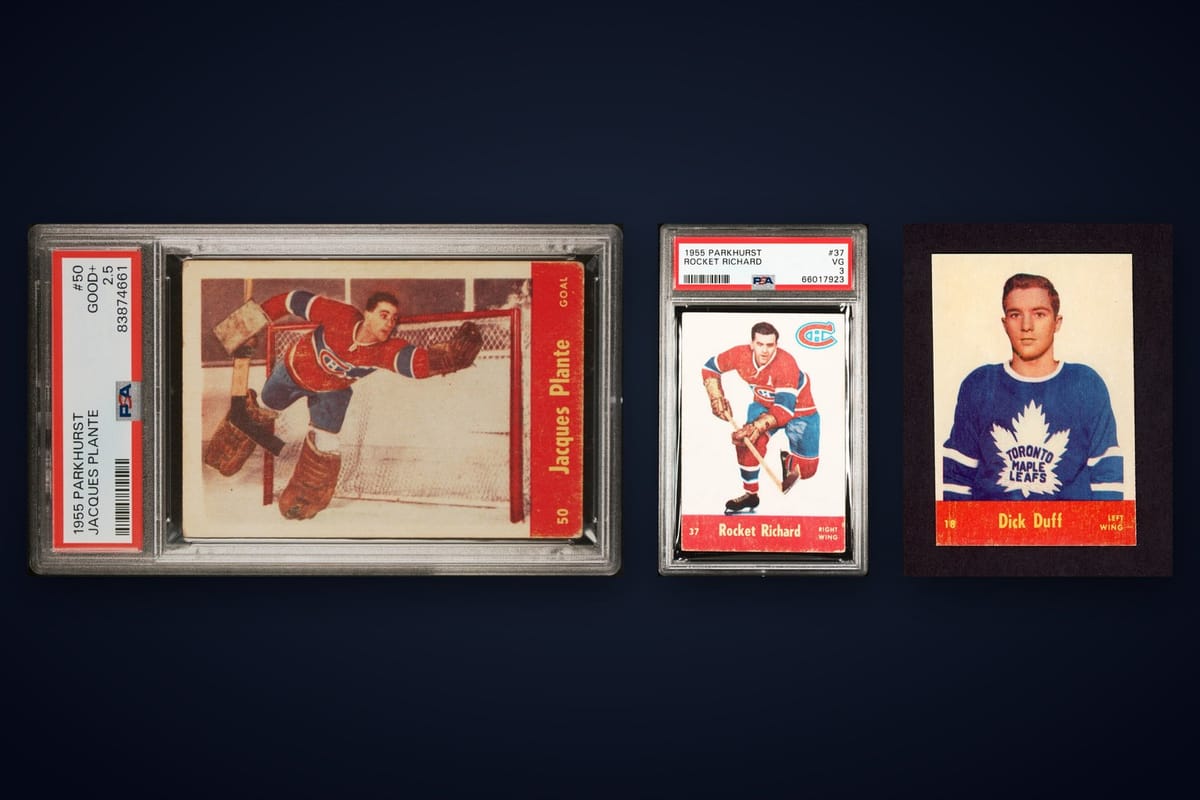
Jacques Plante #50 1955 Parkhurst |
$450.92 | $99,499 | 220.7× |
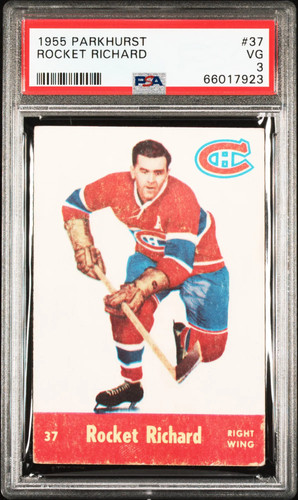 |
Rocket Richard #37 1955 Parkhurst |
$117.40 | $25,986 | 221.3× |
 |
Dick Duff #18 1955 Parkhurst |
$108.38 | $23,296 | 215× |
 |
Tim Horton #3 1955 Parkhurst |
$95.30 | $21,086 | 221.3× |
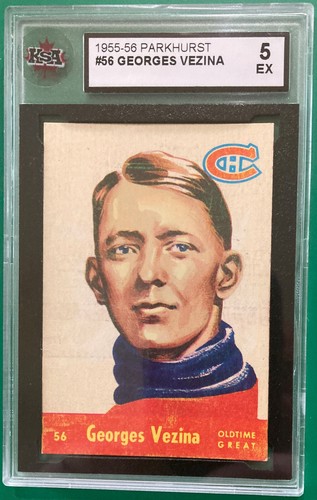 |
Georges Vezina #56 1955 Parkhurst |
$80.00 | $19,407 | 242.6× |
 |
Jean Beliveau #44 1955 Parkhurst |
$85.80 | $18,985 | 221.3× |
 |
The Montreal Forum #78 1955 Parkhurst |
$68.41 | $15,154 | 221.5× |
![Richard Tests [Lumley] #73 1955 Parkhurst card](https://i.ebayimg.com/images/g/Eb4AAeSwJaRqUQ6N/s-l500.jpg) |
Richard Tests [Lumley] #73 1955 Parkhurst |
$53.25 | $11,796 | 221.5× |
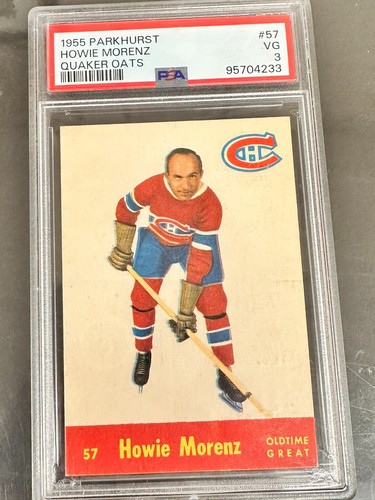 |
Howie Morenz #57 1955 Parkhurst |
$52.79 | $11,719 | 222× |
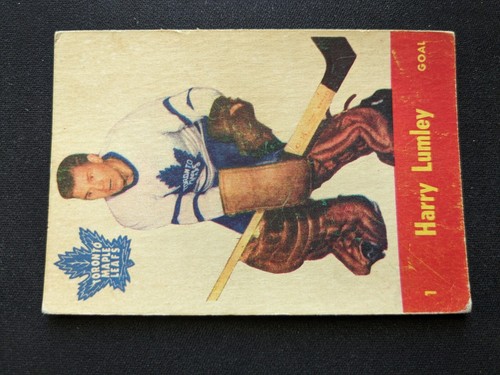 |
Harry Lumley #1 1955 Parkhurst |
$50.30 | $11,149 | 221.7× |
 |
Bill Durnan #63 1955 Parkhurst |
$48.49 | $10,746 | 221.6× |
 |
Plante Is Protected #71 1955 Parkhurst |
$46.07 | $10,220 | 221.8× |
Look up any card's current raw and graded value in Midpoint — and get an estimated grade before you pay to submit.
Table of Contents
- Section 1: Overview of the 1955-56 Parkhurst Hockey Card Set
- Section 2: Most Valuable 1955 Parkhurst Cards and Key Rookies
- Section 3: 1955 Parkhurst Price Guide and Grading Value Differences
- Section 4: Condition, Grading Companies, and PSA 10 Values
- Section 5: The Quaker Oats Subset: What Makes These Cards Special?
- Section 6: Buying, Selling, and Grading Strategies for 1955 Parkhurst Cards
- Conclusion
- FAQ
Section 1: Overview of the 1955-56 Parkhurst Hockey Card Set
Historical Context and Set Composition
The 1955-56 Parkhurst hockey card set represents a focused vintage hockey card issue, released during the post-war era of the NHL. Parkhurst, a Canadian company, concentrated exclusively on two of the league’s franchises: the Montreal Canadiens and the Toronto Maple Leafs. This set, consisting of 79 cards, captures a snapshot of mid-1950s hockey, featuring star players, Hall of Famers, and promising rookies. The design features a clean white border with player portraits, team logos prominently displayed, and player statistics on the reverse. This minimalistic approach has contributed to the set’s appeal among collectors. The set was primarily distributed in Canada through candy boxes, which contributes to the relative rarity of high-grade cards outside Canada.
Player Focus & Team Representation
Unlike modern NHL card sets that typically include all teams, the 1955 Parkhurst set highlights only the Canadiens and Maple Leafs, reflecting their prominence at the time. This selective focus means that iconic players such as Maurice "Rocket" Richard, Jacques Plante, Tim Horton, and Bill Durnan have multiple cards that are prized by collectors. It also creates a more specialized collecting niche, appealing primarily to fans of these franchises or vintage hockey collectors focusing on the Original Six era. The set includes both seasoned veterans and emerging rookies, providing a blend of established legends and future stars. The player representation is weighted towards forwards and goalies who were instrumental in Stanley Cup runs during the 1950s.
Set Rarity and Availability
Given the set’s age—over 65 years old—surviving cards, especially in top condition, are scarce. Most cards were produced on relatively thin card stock compared to today’s standards, making them prone to edge wear, corner rounding, and surface imperfections. Commons in lower grades remain relatively affordable, generally ranging from $10 to $50, depending on the player and condition. However, cards in high-grade condition (PSA 8 and above) are harder to find, with PSA 9 and especially PSA 10 examples commanding significant premiums. Population reports from PSA indicate that only a limited number of cards in the set have been graded PSA 10, making these cards sought after by collectors and investors. The combination of limited print runs, Canadian distribution channels, and the fragile nature of the cards contribute to their scarcity in pristine condition.
| Card Number | Player | Estimated Raw Value | PSA 10 Value (As of 2026-09-04) |
|---|---|---|---|
| #56 | Jacques Plante Rookie | $1,200 | $40,000 |
| #52 | Bill Durnan | $150 | $2,500 |
| #66 | Tim Horton Rookie | $300 | $15,000 |
| #57 | Maurice Richard | $250 | $7,000 |
| #37 | Rocket Richard | $200 | $6,500 |
Section 2: Most Valuable 1955 Parkhurst Cards and Key Rookies
Jacques Plante Rookie Card (#56)
The Jacques Plante rookie card (#56) is widely regarded as a flagship card from the 1955 Parkhurst set and one of the notable vintage hockey cards on the market. Plante’s goaltending innovations, including being one of the first to regularly wear a goalie mask, have cemented his status as a hockey icon. The card’s value is influenced by the player's career and the scarcity of high-grade copies. Raw cards in fair condition typically start around $1,200, with prices increasing as condition improves. PSA 9 graded Plante rookies have been known to command prices between $15,000 and $20,000, while PSA 10 examples have sold for significantly higher amounts at auction. A key challenge for collectors is the card’s centering, which often does not meet PSA’s strict criteria for gem mint grades, making PSA 10 specimens rare.
Tim Horton Rookie Card (#66)
Tim Horton’s rookie card (#66) is another important card in the set, valued for both his on-ice achievements and off-ice legacy as co-founder of the Tim Hortons coffee franchise. The card’s raw market value is around $300 for well-preserved examples, but graded PSA 10 cards have realized prices upwards of $15,000. Horton’s card is challenging to find in top condition due to centering issues and the delicate card stock. Collectors and investors prize this card as a long-term hold, given Horton’s popularity and cultural significance in Canada.
Other Headliners: Maurice “Rocket” Richard and Bill Durnan
Maurice Richard’s (#57) and Rocket Richard’s (#37) cards refer to the same player; the set features two cards (#37 and #57) related to Maurice "Rocket" Richard, each with differing poses and design. Both cards are valuable, with raw prices typically ranging from $200 to $250. PSA 10 graded versions can fetch between $6,500 and $7,000. Bill Durnan (#52), a six-time Vezina Trophy winner and Hall of Fame goaltender, rounds out the premium tier. His card’s raw value averages $150, while PSA 10 graded examples have sold for around $2,500. These headliners form the core of a serious 1955 Parkhurst collection and often drive set completion efforts.
Most Valuable Commons and Budget Options
While the star cards dominate headlines, many commons from this set provide affordable entry points. Lesser-known players’ cards usually trade for $10 to $50 in raw condition, making it possible to assemble a near-complete set on a budget. Examples include role players and depth forwards from the Canadiens and Maple Leafs, whose cards have stable, modest values. Collectors looking for potential growth should focus on commons with clean centering and sharp corners, as these may be candidates for affordable grading submissions. Tracking market trends through tools like Midpoint can help identify commons that may be appreciating in value due to increased interest in Original Six memorabilia.
Section 3: 1955 Parkhurst Price Guide and Grading Value Differences
Raw vs Graded Prices
The disparity between raw and graded card prices in the 1955 Parkhurst set is notable among vintage hockey cards. For instance, the Jacques Plante rookie raw card averages around $1,200, but when graded PSA 10, it can command prices significantly higher, reflecting a substantial increase. Similarly, the Tim Horton rookie raw cards sell around $300, while PSA 10 graded copies reach much higher prices. This pattern highlights the value collectors place on condition and professional authentication. However, it’s important to note the grading costs, which typically range from $20 to $100 per card depending on service level and turnaround time, plus shipping and insurance. These expenses can reduce profits if the card does not achieve a high grade, underscoring the importance of pre-grading evaluation tools like Midpoint.
Price Guide Highlights (As of 2026-09-04)
- Jacques Plante (#56): Raw $1,200 / PSA 10 $40,000
- Tim Horton (#66): Raw $300 / PSA 10 $15,000
- Maurice Richard (#57): Raw $250 / PSA 10 $7,000
- Bill Durnan (#52): Raw $150 / PSA 10 $2,500
- Rocket Richard (#37): Raw $200 / PSA 10 $6,500
Set Completion Value
Completing the 1955-56 Parkhurst set in raw condition typically requires a budget between $7,000 and $10,000, depending on the condition of the cards and the completeness of the set. Raw sets often include lower-grade commons and some mid-tier cards in fair condition. In contrast, fully graded sets, especially those including key rookie cards graded PSA 9 or 10, can fetch significantly higher prices at auction. Achieving a gem mint complete set is extremely challenging, as many commons and rookies fail to meet the exacting standards required for PSA 9 and 10 grades, particularly with centering and surface wear. The scarcity of high-grade cards makes these sets prized by high-end collectors and investors who value historical significance as well as condition rarity.
Section 4: Condition, Grading Companies, and PSA 10 Values
Understanding Grading Companies and Their Impact
PSA (Professional Sports Authenticator) is the most widely recognized and trusted grading company for vintage hockey cards, including the 1955 Parkhurst set. PSA’s grading scale and population reports are considered industry standards, often setting benchmark values and market liquidity. Beckett Grading Services (BGS) and Sportscard Guaranty Corporation (SGC) also grade 1955 Parkhurst cards, sometimes with subtle differences in grading criteria and population reports. While BGS is known for its subgrades (centering, corners, edges, surface), PSA’s one-number scale remains highly influential on price. Generally, PSA graded cards command higher prices and easier marketability, especially for high-grade examples. Collectors often prefer PSA 10 for its market recognition, though BGS 9.5 and SGC 10 (Black Label) can also command premiums.
Grading Scale and Value Multipliers
The PSA grading scale ranges from 1 (Poor) to 10 (Gem Mint). The value difference between PSA 9 (Mint) and PSA 10 (Gem Mint) can be substantial, often doubling or tripling the card’s price. For example, a Jacques Plante rookie graded PSA 9 might sell for $15,000 to $20,000, while a PSA 10 example commands significantly higher prices. Cards graded between PSA 7 and 8 offer a middle ground, typically valued at 30–50% of PSA 10 prices, appealing to collectors who seek quality without the premium of gem mint cards. Lower grades (1–6) generally reflect cards with visible wear, off-centering, or surface issues and have significantly less value but still serve as affordable entry points. Understanding this scale helps collectors decide whether submitting a card for grading is financially justified based on its current raw condition and the likelihood of a high grade.
Key Factors Affecting Grade: Centering, Corners, Edges, Surface
Centering is often the most critical factor affecting the grade of 1955 Parkhurst cards. PSA requires centering to be within 60/40 or better for a PSA 9, and 55/45 or better for PSA 10. Since many Parkhurst cards exhibit off-center printing, achieving a gem mint grade is difficult. Sharp, crisp corners free of rounding or chipping significantly enhance grade potential. Edges must be clean and free from fraying or dings, which are common due to the thin cardstock. Surface condition is equally important; spotting, creases, print defects, or surface stains can reduce grade and value. Collectors should thoroughly inspect cards under bright light and magnification, focusing on these areas before grading. Tools like Midpoint utilize AI to analyze centering percentages and surface quality, offering a digital pre-grade that can help predict grading outcomes and avoid costly disappointments.

Section 5: The Quaker Oats Subset: What Makes These Cards Special?
Subset Overview and Rarity
The Quaker Oats 1955 Parkhurst subset is a smaller, promotional series released in conjunction with the cereal brand. These cards often feature similar player images but include slight design variations, such as unique borders, logos, or back print differences. Because these cards were distributed through limited promotional runs rather than standard retail packs, they are generally rarer. This scarcity is reflected in both population reports and market demand, with some Quaker Oats cards existing only in limited quantities in high grades. Collectors specializing in 1950s hockey cards prize this subset for its novelty and rarity. The Quaker Oats cards are particularly sought after among Canadian collectors, where the promotion was strongest.
Comparing Values: Quaker Oats vs Base Set Cards
Quaker Oats cards generally sell at a premium compared to their base set counterparts. For instance, a Quaker Oats Jacques Plante rookie PSA 10 can exceed $50,000, surpassing the base card by an estimated 20-30%. This premium reflects both rarity and collector enthusiasm. However, the market for Quaker Oats cards is more niche, with fewer transactions, meaning pricing can fluctuate more than base cards. Other key cards in the subset, such as Tim Horton’s Quaker Oats rookie, also command substantial premiums, sometimes reaching 25-40% above base card prices at similar grades. Collectors should be aware that authentication is critical, as the promotional nature and different print runs can lead to confusion or counterfeit attempts in lower grades.
Authenticity and Condition Challenges
Due to their rarity and promotional distribution, Quaker Oats cards require thorough authentication. Differences in paper stock, print quality, and design can help experts verify authenticity. Condition challenges are often greater due to the cards’ older, less robust paper stock and the storage conditions typical of promotional items, which were often kept loose or handled more frequently. Surface wear, yellowing, and edge chipping are common issues. Grading these cards can be riskier and more expensive, but the potential reward is higher. Using AI-based tools like Midpoint prior to submission can help identify cards with the best chance of achieving high grades, mitigating the risk of costly grading fees on fragile cards. Additionally, consulting experts or experienced collectors familiar with the Quaker Oats subset can be valuable.
Section 6: Buying, Selling, and Grading Strategies for 1955 Parkhurst Cards
When to Grade Your 1955 Parkhurst Cards
Grading should generally be reserved for cards that have a reasonable chance of achieving PSA 9 or 10 grades, especially for high-value rookies and stars like Jacques Plante (#56) and Tim Horton (#66). Grading commons or lower-grade cards often does not increase their value enough to offset submission and service fees. Utilizing Midpoint’s AI grading feature allows collectors to estimate centering, detect surface flaws, and assess overall grade potential before committing. This pre-grade assessment can optimize grading investments by focusing only on cards likely to fetch a premium in high grades. Additionally, timing submissions during grading company promotions or lower-cost windows can reduce expenses. For bulk grading, sorting by likely grade tiers before submission improves overall return on investment.
Buying Tips: Raw vs Graded Cards
Purchasing raw cards offers opportunities to acquire key pieces at lower entry prices but carries the risk of unseen condition issues. Buyers should carefully inspect cards for centering, corner sharpness, edge condition, and surface quality, or leverage AI tools like Midpoint to digitally evaluate condition remotely. When buying high-value cards, consider asking for high-resolution photos or videos showing card edges and surfaces. Graded cards provide condition assurance and easier resale but come at a premium price. For long-term investment, acquiring raw cards with gem mint potential for subsequent grading can offer significant upside. However, raw cards in poor condition should generally be avoided unless priced accordingly. Collectors should also be aware of market trends and recent auction results to ensure fair pricing.
Selling Strategies and Market Timing
The vintage hockey card market fluctuates based on player legacy, anniversaries, and broader collector interest. Selling graded PSA 10 cards often yields the highest returns, particularly for marquee rookies like Plante and Horton. To maximize sale prices, sellers should consider auction platforms with established vintage card audiences, such as Heritage Auctions or Goldin Auctions, which attract serious collectors and investors. Budget cards can be sold as raw singles or in lots to beginner collectors or vintage hobbyists. Professional photography and accurate grading summaries can enhance buyer confidence. Timing sales around NHL events, Hall of Fame inductions, or player anniversaries can also increase demand. Always disclose card condition honestly and provide all pertinent information, including grading certificates and provenance when possible.
Preserving Value with Proper Storage
Maintaining card condition is important to preserving and enhancing value. Cards should be stored in acid-free sleeves and rigid top loaders to protect against physical damage. Avoid exposure to direct sunlight, which can cause fading and discoloration, as well as high humidity environments that may lead to warping or mold. For long-term storage, consider temperature-controlled environments with stable humidity levels between 35-50%. Use archival-quality storage boxes designed specifically for trading cards. For detailed storage strategies, see our Ultimate Collector's Guide to Storing Valuable Cards. Proper care can help prevent condition loss that would reduce 1955 Parkhurst hockey cards’ value over time.
Conclusion
The 1955 Parkhurst hockey cards value landscape offers a rich tapestry of nostalgia, rarity, and condition-driven pricing. Key rookies like Jacques Plante and Tim Horton dominate top values, especially in PSA 10 grades, with premiums that justify careful grading decisions. The Quaker Oats subset adds an additional layer of rarity and collecting intrigue, while commons provide accessible entry points for new collectors. Employing AI tools such as Midpoint enables collectors to evaluate centering and surface imperfections digitally, allowing for informed choices before incurring grading fees. This approach can help maximize investment returns and navigate the challenges of acquiring and preserving one of hockey’s most iconic vintage card sets. As the market for vintage hockey cards continues to evolve, understanding the nuances of condition, grading, and subset rarity is important for collectors and investors alike.
FAQ
Q: How much is a 1955 Parkhurst hockey card worth in different grades?
A: Values vary widely by card and grade. For example, the Jacques Plante rookie (#56) is approximately $1,200 raw, $3,000 PSA 7, $15,000 PSA 9, and $40,000 PSA 10 as of 2026-09-04. Lower grades command significantly less, while key rookies see the largest premiums at high grades. Mid-tier grades (PSA 8) often represent a balance between affordability and quality.
Q: What are the most valuable 1955 Parkhurst hockey cards?
A: The most valuable include the Jacques Plante rookie (#56), Tim Horton rookie (#66), Maurice Richard (#57), Rocket Richard (#37), and Bill Durnan (#52). Plante and Horton rookies lead the pack especially in gem mint condition, with PSA 10 examples fetching tens of thousands of dollars.
Q: How much is a 1955-56 Parkhurst complete set worth?
A: A raw complete set typically ranges from $7,000 to $10,000 depending on condition and completeness. Graded complete sets, particularly those with high-grade key cards, can exceed $100,000. Achieving a gem mint complete set is extremely challenging due to scarcity of high-grade commons and rookies.
Q: What is the value of a Jacques Plante 1955 Parkhurst rookie card?
A: Raw copies generally trade around $1,200, while PSA 10 graded cards reach upwards of $40,000. The Plante rookie commands the highest value in the set due to rarity and the player’s enduring legacy as a Hall of Fame goaltender and innovator.
Q: Are 1955 Parkhurst Quaker Oats cards worth more than the base cards?
A: Yes, Quaker Oats subset cards are rarer and often fetch higher prices, especially in top grades. For example, a Quaker Oats Jacques Plante rookie can exceed the base card’s value by an estimated 20-30% or more due to limited distribution and collector demand.
Q: How do I tell if my 1955 Parkhurst card is authentic and what grade it might get?
A: Authenticity is verified through expert visual inspection, comparison to known authentic examples, and professional grading companies. To estimate grade, assess centering, corners, edges, and surface condition carefully. Using AI tools like Midpoint can provide digital grading estimates, highlighting centering percentages and surface defects, which help predict official grading outcomes before submitting to PSA or other graders.
Free to start
Try the Midpoint app
Grade any card from a photo, see its raw and PSA 10 value, and track what your collection is worth — free.
Get it on iPhoneGet it on Android