1955 Topps All American Football Cards Value Guide
Explore the comprehensive 1955 Topps All American football cards value guide, grading tips, and top card prices including PSA 10 values and rare gems.

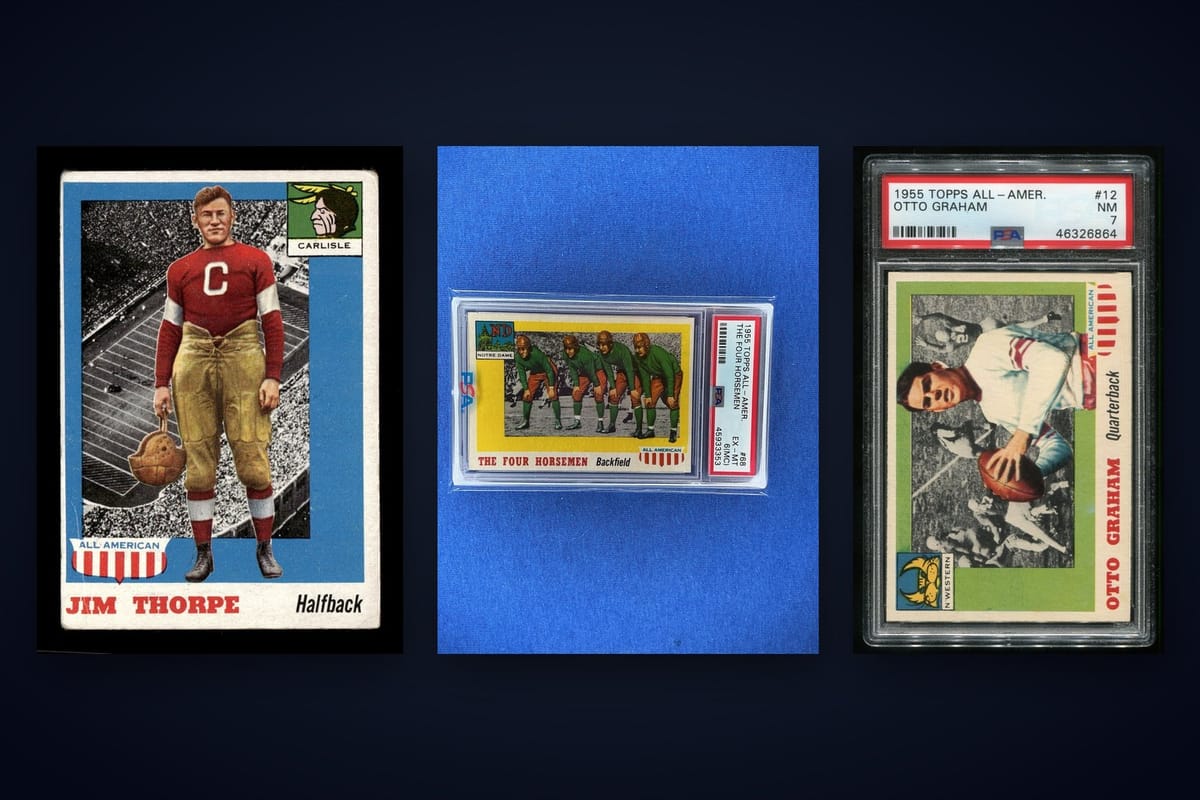
Estimated reading time: 16 min
Key Takeaways
- The 1955 Topps All American set includes 100 cards featuring notable football players and is recognized for its unique horizontal design, distinguishing it among vintage football card sets.
- Card condition aspects such as centering, corners, edges, and surface quality all impact the 1955 Topps All American football cards’ value, often influencing price differences significantly.
- Key cards like Jim Thorpe #37 and Don Hutson #97 are among the most valuable, both raw and graded, often serving as cornerstone pieces for collectors and investors.
- PSA 10 graded cards can fetch prices several times higher than raw cards in excellent condition, reflecting the premium placed on near-perfect preservation and authentication.
- Using tools like Midpoint’s AI digital grading and centering measurement can help collectors estimate card grades before submission, potentially reducing the risk of expensive grading fees on undervalued cards.
Card values — live data from Midpoint's card database, as of 2026-11-01. Prices move; Midpoint refreshes these daily.
| Card | Raw | PSA 10 | Gem premium | |
|---|---|---|---|---|
 |
Jim Thorpe #37 1955 Topps All American |
$281.16 | $63,176 | 224.7× |
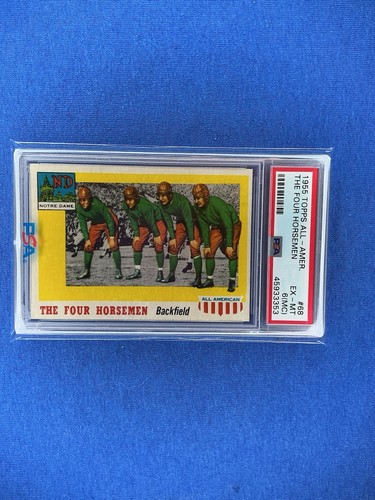 |
The Four Horsemen #68 1955 Topps All American |
$179.72 | $39,793 | 221.4× |
 |
Otto Graham #12 1955 Topps All American |
$75.40 | $35,000 | 464.2× |
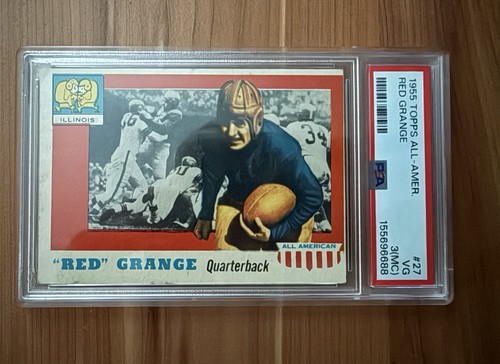 |
Red Grange #27 1955 Topps All American |
$124.99 | $30,153 | 241.3× |
 |
Knute Rockne #16 1955 Topps All American |
$88.10 | $19,621 | 222.7× |
 |
Sammy Baugh #20 1955 Topps All American |
$67.59 | $14,818 | 219.2× |
 |
Niles Kinnick #6 1955 Topps All American |
$66.64 | $14,653 | 219.9× |
 |
Tom Harmon #35 1955 Topps All American |
$51.00 | $11,732 | 230× |
 |
Whizzer White [Correct Bio] #21 1955 Topps All American |
$40.00 | $9,843 | 246.1× |
 |
Sid Luckman #85 1955 Topps All American |
$30.57 | $8,021 | 262.4× |
 |
Davey O'Brien #34 1955 Topps All American |
$29.97 | $7,102 | 237× |
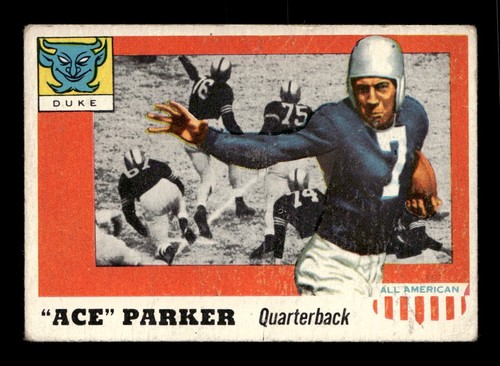 |
Ace Parker #84 1955 Topps All American |
$25.62 | $6,436 | 251.2× |
Look up any card's current raw and graded value in Midpoint — and get an estimated grade before you pay to submit.
Table of Contents
- Section 1: Overview of the 1955 Topps All American Football Card Set
- Section 2: Complete Card Checklist and Variations
- Section 3: Raw Card Values and Key Players
- Section 4: Graded Values and PSA 10 Premiums
- Section 5: Factors Affecting Card Value and Grading Worthiness
- Section 6: Market Trends, Recent Sales, and Set Completion Values
- Conclusion
- FAQ
Section 1: Overview of the 1955 Topps All American Football Card Set
Historical Context and Release
The 1955 Topps All American football card set is a notable vintage football memorabilia release, consisting of 100 cards issued in a single series. This set was released during a period of growth in professional football in the United States, featuring players from the NFL's earlier years and some of the sport's early legends. Released in 1955, the set is recognized for its distinct horizontal design that differed from the more common vertical layouts of the period, showcasing portrait and action images that reflect the football culture of the mid-20th century.
At the time, Topps was innovating in sports card design, and this set was part of their effort to appeal to football fans by highlighting both current stars and historical figures, bridging different eras of the sport. The cards were distributed primarily through retail outlets and vending machines, contributing to their relative scarcity today compared to multi-series releases.
Card Design and Dimensions
The 1955 Topps All American cards measure approximately 2-5/8 inches by 3-3/4 inches, consistent with other Topps releases from the early to mid-1950s. Their horizontal (landscape) orientation sets them apart, giving a panoramic effect that allowed for larger player images and more detailed backgrounds. The front of each card features a color photograph of the player, often with a neutral or stadium backdrop, sometimes showing the player in uniform mid-action or posed shots.
The backs of the cards contain statistical summaries and biographical information, including collegiate and professional career highlights, physical measurements, and occasionally anecdotal notes. This level of detail was notable for the time and provides valuable context for collectors and historians.
Significance and Popularity
This set holds a special place in football card collecting circles due to factors such as its limited print run, the inclusion of many Hall of Famers and pioneering players like Jim Thorpe and Don Hutson, and the unique horizontal format that collectors find visually appealing. Its single-series nature means there are no subsequent cards from this particular design to dilute its significance, which can enhance its rarity and desirability.
Additionally, the set is valued by those interested in historically significant football cards because it bridges early 20th-century legends with mid-century stars. The presence of key figures from the NFL’s early days makes it a valuable educational piece as well as a collector’s item.

Section 2: Complete Card Checklist and Variations
The Full 100-Card Checklist
The 1955 Topps All American football card set is composed of cards numbered 1 through 100, each representing a different player. The checklist includes a roster of significant football figures, including:
- Jim Thorpe (#37): A multi-sport athlete and football pioneer, often regarded as one of the greatest athletes of the early 20th century.
- Don Hutson (#97): Known as one of the NFL’s early great receivers, holding numerous records during his career.
- Knute Rockne (#16): Legendary Notre Dame coach whose contributions to football strategy remain influential.
- Otto Graham (#12): A dominant quarterback for the Cleveland Browns during the 1940s and 1950s.
Collectors seeking a full set should ensure that all 100 cards are accounted for, as certain cards within the series are known to be short prints or have distinct variations that affect their availability and value.
Short Prints and Key Variations
Several cards in the set are recognized as short prints, meaning they were produced in smaller quantities or have known variations that make them more elusive. For example:
- Fats Henry (#100): Considered one of the rarer cards in the set, this card’s limited print run can increase collector interest and market prices.
- Otto Graham (#12): Exists with slight variations in printing and color saturation, with some versions more sought-after due to image quality or rarity.
- Other Variations: Some cards show minor differences in back print fonts or front photo cropping, which can affect desirability for specialized collectors.
Identifying these variations requires careful examination, often with the aid of reference guides. Collectors should consult reputable checklists, such as those provided by PSA or Beckett, to verify which variations exist and their relative scarcity.
Identifying Authentic Cards
Due to the vintage nature of the 1955 Topps All American set, the market has seen reprints, counterfeit cards, and altered originals. Authentic cards feature specific printing techniques, paper stock, and wear patterns consistent with 1950s manufacturing. Key features to look for include:
- Printing Characteristics: The use of lithographic printing with subtle dot patterns visible under magnification.
- Paper Quality: Vintage cards have a certain thickness and texture, often with minor yellowing or age spots but no plastic feel.
- Wear Patterns: Genuine cards show natural corner wear and edge fraying consistent with age, whereas reprints may appear artificially aged or too pristine.
To assist in authentication, collectors can use digital tools like Midpoint, which provides AI-driven analysis of card centering, surface condition, and potential alterations. Using such tools before purchase or grading submission can help reduce the risk of acquiring fakes or overpaying for altered cards.
Section 3: Raw Card Values and Key Players
Value Ranges for Raw Cards
Raw 1955 Topps All American football cards exhibit a wide value spectrum that depends heavily on condition factors such as centering, surface wear, and corner sharpness. As of November 1, 2026, market data suggests the following approximate raw value ranges:
- Lower-tier cards: Cards in poor to good condition, often exhibiting heavy edge wear, creases, or discoloration, typically sell between $10 and $25.
- Mid-grade cards: Those in Very Good to Fine condition with moderate wear and decent centering generally fetch $50 to $150.
- High-grade cards: Examples in Excellent to Near Mint condition with sharp corners, minimal surface defects, and strong centering can command $200 to $400 or more, particularly for sought-after players.
These values fluctuate depending on player popularity and scarcity, with key cards commanding the highest premiums.
Highlighting Most Valuable Raw Cards
- Jim Thorpe (#37): This card is among the most valuable raw cards due to Thorpe’s legendary status. Excellent condition copies often sell around $350, with Near Mint examples sometimes exceeding $450. Cards with exceptional centering and minimal surface wear may approach higher values.
- Don Hutson (#97): A highly sought-after card, especially in high-grade condition, where prices can range from $300 to $400. Its scarcity as a late-numbered card contributes to higher value.
- Fats Henry (#100): As a noted short print, raw copies in Excellent condition usually trade between $150 and $250, with rarer Near Mint examples potentially achieving higher prices.
- Nile Kinnick (#6) and Knute Rockne (#16): These Hall of Famers’ cards often fetch $200 to $300 in top raw condition, reflecting their historical importance and collector demand.
Condition Impact on Raw Value
The importance of clean condition is significant. For instance, a Jim Thorpe #37 card with off-center borders (e.g., 65/35 centering), minor creases, or slight surface scratches may see its value reduced compared to a well-centered, pristine example. Centering is especially critical because the 1955 Topps All American set has relatively narrow borders, meaning even slight shifts are visually noticeable.
Similarly, sharp corners without fraying or dents can add value, while clean surfaces free of print defects or stains are essential for attracting buyers willing to pay premium prices. This variability underscores the practical value of pre-purchase condition assessments using digital grading aids like Midpoint.
Section 4: Graded Values and PSA 10 Premiums
Grading Companies and Their Influence
Professional grading has become important in the vintage card market, providing authentication and condition certification that increase buyer confidence. The primary grading companies active in football card grading include PSA (Professional Sports Authenticator), BGS (Beckett Grading Services), CGC (Certified Guaranty Company), and TAG Grading.
Among these, PSA is widely recognized due to its market presence and established reputation, often influencing pricing and desirability. Cards graded by PSA are assigned numerical grades from 1 (Poor) to 10 (Gem Mint), with higher grades generally commanding higher values.
PSA 10 Values and Gem-Mint Premiums
PSA 10 cards represent the highest condition level, exhibiting virtually flawless centering, sharp corners, clean edges, and pristine surfaces. As of November 1, 2026, the following PSA 10 values illustrate the premium placed on gem-mint examples:
- Jim Thorpe #37: Values have been reported up to around $9,500, reflecting its iconic status and rarity in top condition.
- Don Hutson #97: Approximately $8,000, driven by scarcity and collector demand.
- Fats Henry #100: Around $6,500, notable for its short print status.
- Nile Kinnick #6: Near $7,800, prized for historical significance.
- Knute Rockne #16: About $7,200, reflecting its appeal to both card collectors and football historians.
- Otto Graham #12: Roughly $6,000, representing a key modern-era player in the set.
These values demonstrate a substantial multiplier over raw Excellent condition pricing, underscoring the financial impact of achieving a gem mint grade.
Comparing PSA 5 through PSA 9 Grades
Intermediate grades provide a nuanced picture of value increments. For example, a Jim Thorpe #37 card graded PSA 5 (Excellent) might sell for approximately $800 to $1,200, while a PSA 7 (Near Mint) could fetch $2,000 to $3,000. PSA 9 (Mint) copies can command prices exceeding $6,000. This range shows how incremental improvements in condition, particularly centering and surface quality, can yield substantial price increases.
Similarly, Don Hutson #97 cards graded PSA 7 to PSA 9 can range from $1,500 to $5,500, with each grade level attracting a progressively more discerning pool of collectors and investors.
This gradation encourages collectors to invest in condition preservation and utilize pre-grading tools to maximize the chance of obtaining higher grades.
Section 5: Factors Affecting Card Value and Grading Worthiness
Centering and Its Impact on Value
Centering refers to the uniformity of the card image’s placement relative to its borders and is one of the most critical factors in grading the 1955 Topps All American set. Ideally, centering should be as close to 50/50 as possible on both the horizontal and vertical axes. Cards with centering outside of approximately 65/35 ratios are often downgraded.
For example, a card centered at 60/40 may lose grade points compared to a perfectly centered card, reducing its market value. Collectors should carefully measure centering using tools like Midpoint, which provides precise digital calculations of border ratios, enabling informed grading decisions and negotiation leverage.
Understanding the centering impact is important, as some cards with slightly lower raw condition but perfect centering can outperform higher-condition but off-center cards in market value.
Further reading on this topic can be found in our comprehensive guide on centering impact, which explains how centering affects grading and pricing across various card sets.
Corners, Edges, and Surface Quality
In addition to centering, the sharpness of corners is crucial. Vintage cards often suffer from rounded or frayed corners due to handling over decades. Cards with four sharp, crisp corners are rare and highly prized. Edges must be free from chipping or paper loss, especially important on horizontal cards where the longer sides are more vulnerable.
Surface quality encompasses print defects, stains, creases, scratches, and print lines. Even minor surface flaws can cause a card to fail grading or drop grade points, affecting value. Cards with clean, gloss-retained surfaces and no print imperfections are scarce, hence their premium in the market.
Collectors are advised to inspect cards under strong light and magnification, using magnifiers or digital scanning tools, to detect subtle surface defects before investing or submitting for grading.
Authentication and Avoiding Altered Cards
Given the financial stakes, some individuals attempt to enhance card appearance via trimming (cutting edges to improve centering), recoloring, or other alterations. Professional graders are trained to detect these modifications, but pre-screening is critical to avoid costly grading fees on altered cards.
Midpoint’s AI grading tool assists by analyzing edge integrity, surface texture, and print quality, flagging potential alterations such as uneven edges or inconsistent coloring. Using such technology prior to submission helps collectors make informed decisions and avoid fraud.
Which Cards Are Worth Grading?
Submitting cards for professional grading involves fees, shipping risks, and waiting periods. Therefore, it is advisable to only grade cards with a realistic chance of achieving a high grade. Generally, cards with:
- Strong raw condition (minimal wear, no creases)
- Excellent centering (ideally better than 60/40 ratio)
- Sharp corners and clean edges
- Pristine surface quality free from stains or print defects
are worth grading. For the 1955 Topps All American set, this often means key cards such as Jim Thorpe #37, Don Hutson #97, Otto Graham #12, and Fats Henry #100.
Lower-grade cards may be better sold raw, as the cost to grade them often outweighs the incremental value gained.
Section 6: Market Trends, Recent Sales, and Set Completion Values
Recent Auction and eBay Sales
Monitoring recent sales is useful for understanding current market dynamics. As of late 2026, PSA 10 Jim Thorpe #37 cards have sold for prices reported up to around $9,500 at prominent auction houses, reflecting strong interest among vintage football card collectors. Similarly, Don Hutson #97 PSA 10 examples have sold near $8,000, reaffirming their status as highly desirable vintage football cards.
Raw cards in Excellent condition have shown steady demand as well, with Jim Thorpe #37 cards trading for $300 to $400 on platforms like eBay, and Fats Henry #100 cards selling for $150 to $250. These sales indicate an active secondary market driven by both hobbyists and investors.
Seasonal factors and high-profile auctions can cause temporary price fluctuations, so tracking multiple data points over time is advisable.
Complete Set Values
Completing the entire 100-card set in high-quality condition is a challenging but rewarding endeavor. Raw sets in Excellent condition, including all key short prints, typically command between $8,000 and $12,000. The variation depends on the condition of the rarest cards and overall centering consistency.
Graded complete sets can command higher prices, especially those graded PSA 8 or higher across all cards. Such sets may exceed $30,000 due to the scarcity of high-grade examples and the premium collectors place on fully graded, authenticated collections.
Set builders often use digital grading tools to assess each card’s grading potential before submission, avoiding costly grading fees on lower-grade cards and focusing investment on those likely to yield higher returns.
Long-Term Investment Outlook
The 1955 Topps All American set is considered by many collectors as a solid long-term investment given its limited print run, historic roster, and ongoing interest in vintage football memorabilia. Graded cards, especially those with high centering and minimal wear, have shown appreciation over recent years.
As the vintage card market evolves and more collectors seek iconic football cards, demand for this set is expected to remain strong. Utilizing AI-powered tools like Midpoint can help collectors make data-driven decisions, ensuring that grading submissions occur at optimal times and maximizing potential returns.
Moreover, the set's unique horizontal design and inclusion of both early legends and mid-century stars provide enduring appeal, attracting a broad spectrum of collectors.
Conclusion
The 1955 Topps All American football cards’ value is influenced by condition, centering, and professional grading. Key cards such as Jim Thorpe #37 and Don Hutson #97 are among the highest-value targets for collectors and investors. Grading these cards can increase their worth significantly, especially when achieving PSA 10 gem-mint status, which can command prices multiple times higher than raw Excellent condition examples.
Accurately assessing card condition through AI-enabled apps like Midpoint prior to grading submissions can help collectors avoid costly mistakes and optimize their investment strategies. These tools offer precise centering measurements, surface defect detection, and condition estimates, empowering collectors to select only the most promising cards for professional grading.
Whether completing the full 100-card set or targeting individual stars, understanding the nuances of raw and graded values, combined with leveraging technological advances in card evaluation, is important for making informed decisions in today’s vintage football card market.
FAQ
Q: How much is a 1955 Topps All American football card worth?
A: The value varies widely based on the specific card and its condition. Raw cards can range from around $10 for lower-grade examples up to several hundred dollars for high-grade versions. PSA 10 graded key cards command premium prices, ranging from several thousand dollars to near $10,000 as of November 1, 2026.
Q: What is the most valuable 1955 Topps All American card?
A: The Jim Thorpe #37 card is generally considered the most valuable, especially in PSA 10 condition, where it has sold for prices reported up to around $9,500 at auction.
Q: How much is a 1955 Topps Jim Thorpe #37 card worth?
A: Raw cards in Excellent condition typically sell for several hundred dollars, while PSA 10 graded copies can reach values close to $9,500.
Q: What is a 1955 Topps All American complete set worth?
A: A raw complete set in Excellent condition may be valued between $8,000 and $12,000 depending on condition and inclusion of rare short prints. Graded complete sets, notably those graded PSA 8 or higher, can command significantly higher prices due to the scarcity of high-grade examples.
Q: Are 1955 Topps All American football cards rare?
A: Yes, particularly short print cards and those in high-grade condition are less common. The set’s unique horizontal design and single-series release contribute to its overall rarity and desirability.
Q: How do I determine the grade and value of my 1955 Topps All American card?
A: Using tools like Midpoint allows for digital measurement of centering, evaluation of corners, edges, and surface condition. Comparing raw market values and grading estimates can help decide if professional grading submission is worthwhile for a given card.
Free to start
Try the Midpoint app
Grade any card from a photo, see its raw and PSA 10 value, and track what your collection is worth — free.
Get it on iPhoneGet it on Android