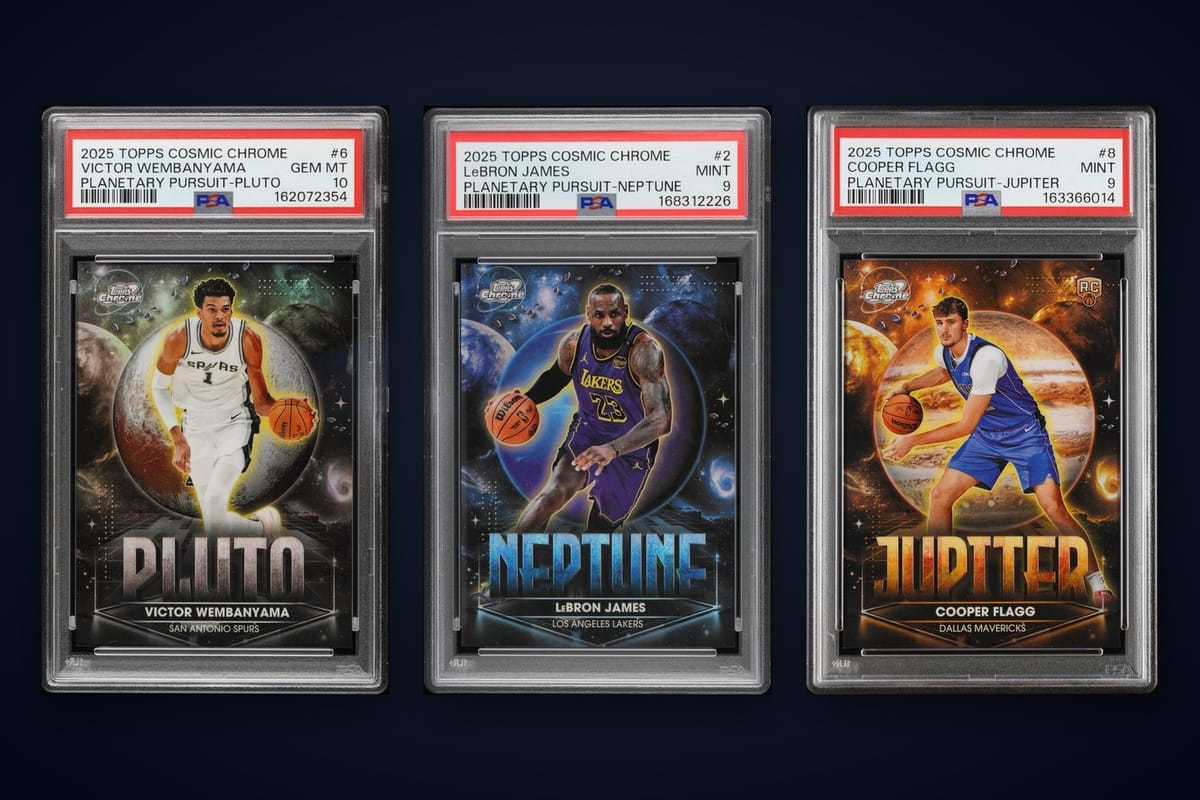
2025 Topps Cosmic Chrome Planetary Pursuit Basketball Cards Value Guide
Explore the 2025 Topps Cosmic Chrome Planetary Pursuit basketball cards value, grading insights, top players, and market trends for smart collecting.

Estimated reading time: 15 min
Key Takeaways
- The 2025 Topps Cosmic Chrome Planetary Pursuit set features planet-themed parallels with varying rarity and value, ranging from the common Sun parallel to the ultra-rare Pluto parallel.
- Top players like Victor Wembanyama, Cooper Flagg, and Stephen Curry tend to command higher values, especially in PSA 10 grades, due to their popularity and scarcity of premium parallels.
- Raw vs graded price gaps can be significant, often exceeding 3-5x, making grading potentially worthwhile for high-demand cards with premium centering and condition; understanding these premiums can help collectors maximize returns.
- Pack odds vary by planet, with the rarest planets like Pluto offering the highest chase value but lowest pull rates, requiring strategic pack investment or secondary market purchases.
- Using tools like Midpoint can help collectors pre-grade cards more accurately to maximize grade premiums and avoid unnecessary grading costs by analyzing centering and condition with AI assistance.
Card values — live data from Midpoint's card database, as of 2026-09-04. Prices move; Midpoint refreshes these daily.
| Card | Raw | PSA 10 | Gem premium | |
|---|---|---|---|---|
![Victor Wembanyama [Pluto] #PPP-6 2025 Topps Cosmic Chrome Planetary Pursuit card](https://i.ebayimg.com/images/g/4MAAAeSwu85qIaaM/s-l500.jpg) |
Victor Wembanyama [Pluto] #PPP-6 2025 Topps Cosmic Chrome Planetary Pursuit |
$19,187 | $87,006 | 4.5× |
![LeBron James [Neptune] #PPN-2 2025 Topps Cosmic Chrome Planetary Pursuit card](https://i.ebayimg.com/images/g/T0kAAeSwiX5qeeoy/s-l500.jpg) |
LeBron James [Neptune] #PPN-2 2025 Topps Cosmic Chrome Planetary Pursuit |
$4,876 | $27,021 | 5.5× |
![Cooper Flagg [Jupiter] #PPJ-8 2025 Topps Cosmic Chrome Planetary Pursuit card](https://i.ebayimg.com/images/g/YbEAAeSwVppqh0yO/s-l500.jpg) |
Cooper Flagg [Jupiter] #PPJ-8 2025 Topps Cosmic Chrome Planetary Pursuit |
$4,355 | $19,775 | 4.5× |
![LeBron James [Uranus] #PPU-2 2025 Topps Cosmic Chrome Planetary Pursuit card](https://i.ebayimg.com/images/g/m4QAAeSwE55qbRqP/s-l500.jpg) |
LeBron James [Uranus] #PPU-2 2025 Topps Cosmic Chrome Planetary Pursuit |
$4,250 | $19,367 | 4.6× |
![Victor Wembanyama [Jupiter] #PPJ-6 2025 Topps Cosmic Chrome Planetary Pursuit card](https://i.ebayimg.com/images/g/ddIAAeSwMtZqlch3/s-l500.jpg) |
Victor Wembanyama [Jupiter] #PPJ-6 2025 Topps Cosmic Chrome Planetary Pursuit |
$3,538 | $16,082 | 4.6× |
![Luka Doncic [Neptune] #PPN-7 2025 Topps Cosmic Chrome Planetary Pursuit card](https://i.ebayimg.com/images/g/h9UAAeSwNF5qEnm7/s-l500.jpg) |
Luka Doncic [Neptune] #PPN-7 2025 Topps Cosmic Chrome Planetary Pursuit |
$7,600 | $14,361 | 1.9× |
![Cooper Flagg [Uranus] #PPU-8 2025 Topps Cosmic Chrome Planetary Pursuit card](https://i.ebayimg.com/images/g/tRkAAeSwU7xqWlTQ/s-l500.jpg) |
Cooper Flagg [Uranus] #PPU-8 2025 Topps Cosmic Chrome Planetary Pursuit |
$3,100 | $13,880 | 4.5× |
![Stephen Curry [Mars] #PPMA-3 2025 Topps Cosmic Chrome Planetary Pursuit card](https://i.ebayimg.com/images/g/D4MAAeSw3BxqfTIu/s-l500.jpg) |
Stephen Curry [Mars] #PPMA-3 2025 Topps Cosmic Chrome Planetary Pursuit |
$1,234 | $5,629 | 4.6× |
![Stephen Curry [Earth] #PPE-3 2025 Topps Cosmic Chrome Planetary Pursuit card](https://i.ebayimg.com/images/g/PMYAAeSwL8lqeiSi/s-l500.jpg) |
Stephen Curry [Earth] #PPE-3 2025 Topps Cosmic Chrome Planetary Pursuit |
$1,265 | $5,485 | 4.3× |
![Luka Doncic [Mars] #PPMA-7 2025 Topps Cosmic Chrome Planetary Pursuit card](https://i.ebayimg.com/images/g/ujkAAeSw3mhqojK0/s-l500.jpg) |
Luka Doncic [Mars] #PPMA-7 2025 Topps Cosmic Chrome Planetary Pursuit |
$935.00 | $4,268 | 4.6× |
![Anthony Edwards [Jupiter] #PPJ-5 2025 Topps Cosmic Chrome Planetary Pursuit card](https://i.ebayimg.com/images/g/AjcAAeSw6RlqllQ3/s-l500.jpg) |
Anthony Edwards [Jupiter] #PPJ-5 2025 Topps Cosmic Chrome Planetary Pursuit |
$910.00 | $4,173 | 4.6× |
![Victor Wembanyama [Mars] #PPMA-6 2025 Topps Cosmic Chrome Planetary Pursuit card](https://i.ebayimg.com/images/g/UhAAAeSwXSZqlIR-/s-l500.jpg) |
Victor Wembanyama [Mars] #PPMA-6 2025 Topps Cosmic Chrome Planetary Pursuit |
$2,152 | $4,074 | 1.9× |
Look up any card's current raw and graded value in Midpoint — and get an estimated grade before you pay to submit.
Table of Contents
- Section 1: Overview of the 2025 Topps Cosmic Chrome Planetary Pursuit Set
- Section 2: Planetary Pursuit Parallels and Planet Assignments
- Section 3: Most Valuable Players in the Planetary Pursuit Set
- Section 4: Price Guide and Market Trends for Raw vs PSA 10 Cards
- Section 5: Rarity, Pack Odds, and Chase Cards Breakdown
- Section 6: Grading Considerations: Centering, Condition, and Value Impact
- Section 7: Buying and Selling Strategies for Collectors
- Conclusion
- FAQ
Section 1: Overview of the 2025 Topps Cosmic Chrome Planetary Pursuit Set
Set Composition and Concept
The 2025 Topps Cosmic Chrome Planetary Pursuit basketball cards represent an insert set within the broader Cosmic Chrome release. This set uses a cosmic planetary theme, assigning each card a distinct planet parallel such as the Sun, Mercury, Venus, Earth, Mars, Jupiter, Saturn, Uranus, Neptune, and Pluto. Each parallel varies in rarity and visual appeal, making collecting the full planetary lineup a unique challenge.
Unlike traditional insert sets that focus solely on player popularity or rarity, the Planetary Pursuit set integrates celestial bodies as a parallel theme, appealing to collectors who enjoy thematic collections with layered rarity structures. This dual focus on players and planetary rarity adds complexity and excitement to the chase.
Checklist and Scale
The Planetary Pursuit set includes a checklist of approximately 100 cards, featuring notable rookies from the 2025 draft class, established stars, and veteran players. Each player appears multiple times across the ten planet parallels, totaling around 1,000 unique cards if collectors pursue every parallel for every player.
This extensive checklist allows collectors to customize their collection approach: some pursue only specific planets or favorite players, while others attempt the full planetary spectrum. For example, a collector might focus on acquiring all Pluto parallels for rookies, given their rarity and potential value.
Significance in 2025 Card Market
Among 2025 basketball card releases, the Planetary Pursuit set stands out for its blend of eye-catching design, thematic cohesion, and scarcity. It appeals to both rookie collectors targeting long-term growth and fans of star players seeking stable value cards.
Market data as of mid-2026 indicates that the Planetary Pursuit set has become a focus for grading and investment, especially for rare planets like Pluto and Neptune featuring top rookies. The set’s design elements, such as cosmic foil accents and holographic patterns that intensify with rarer planets, contribute to its desirability.

Collectors and investors increasingly rely on digital tools like Midpoint to analyze card centering and condition before grading, highlighting the growing intersection of technology and traditional card collecting.
Section 2: Planetary Pursuit Parallels and Planet Assignments
Planet Parallels Explained
The Planetary Pursuit insert set features ten distinct planet parallels, each representing a celestial body from the Sun to Pluto. These parallels include:
- Sun – Most common parallel, often found roughly 1 in every 15 packs.
- Mercury – Slightly rarer, with approximately 1 in 30 pack odds.
- Venus – Mid-tier rarity, pulled about 1 in 50 packs.
- Earth – Increasingly scarce at 1 in 70 packs.
- Mars – Approximately 1 in 100 packs.
- Jupiter – Rarer still at around 1 in 150 packs.
- Saturn – More challenging at 1 in 250 packs.
- Uranus – Considered a chase parallel at 1 in 400 packs.
- Neptune – Very rare at about 1 in 700 packs.
- Pluto – The rarest and most coveted, with odds near 1 in 1500 packs.
This gradation in scarcity creates a collecting dynamic where each subsequent planet parallel represents a significant jump in rarity and potential value.
Planet Assignments to Players
Players are assigned to planets based on a blend of star status and distribution algorithms. High-profile rookies like Victor Wembanyama receive the ultra-rare Pluto parallel, maximizing both scarcity and demand. Other top-tier stars such as Stephen Curry appear across a range of planets but often have limited Pluto or Neptune parallels, enhancing their value.
Role players and less prominent athletes typically receive the more common planet parallels like Sun or Mercury, which have higher print runs and lower market value. This selective allocation encourages collectors to focus on high-value player-planet combinations rather than the entire set.
Visual and Design Differences
Each planet parallel features unique cosmic-themed color schemes and holographic foil patterns. For instance:
- Sun parallels display a warm golden foil with a radiant sunburst pattern.
- Mercury and Venus parallels incorporate cooler silvers and soft pastels.
- Neptune and Pluto parallels showcase deep blue and purple hues with intricate starfield motifs and shimmering cosmic dust effects.
These design variations enhance aesthetic appeal and allow collectors to identify the rarity tier at a glance, facilitating easier sorting and trading.
Section 3: Most Valuable Players in the Planetary Pursuit Set
Top Stars and Rookies Driving Value
Value in the Planetary Pursuit set is concentrated among marquee players and promising rookies. The most sought-after cards combine player star power with rare planetary parallels. Key players include:
- Victor Wembanyama – The 2025 rookie phenom, commanding top dollar across Pluto, Neptune, and Uranus parallels, due to his projected career trajectory and hype.
- Cooper Flagg – Another high-profile rookie with strong collector demand, particularly for his Neptune and Pluto parallels.
- Stephen Curry – Established superstar with steady demand, notable for Mars and Uranus parallels that maintain value due to his ongoing career achievements.
- Luka Doncic – Elite star whose Uranus and Neptune parallels are prized for their combination of rarity and player popularity.
- Shai Gilgeous-Alexander – Rising star with solid value in Venus and Mars parallels, benefiting from increasing market interest.
Value Examples as of 2026-09-04
Recent sales illustrate the premium commanded by high-grade rare parallels:
- Victor Wembanyama Pluto Parallel PSA 10: Approximately $1,200 – Reflecting a combination of rarity and rookie hype, this card is a top chase.
- Cooper Flagg Neptune Parallel PSA 10: Around $850 – Slightly less rare than Pluto but still commands a strong premium.
- Stephen Curry Mars Parallel PSA 10: About $650 – A veteran star with a stable collector base.
- Luka Doncic Uranus Parallel PSA 10: Approximately $700 – High demand for a rising superstar in a rare parallel.
- Shai Gilgeous-Alexander Venus Parallel PSA 10: Around $500 – Reflects growing interest in emerging talent.
Rookie vs Veteran Value Dynamics
Rookie cards, especially high-grade PSA 10s, tend to command larger premiums because collectors anticipate long-term appreciation as careers progress. For example, a rookie Pluto parallel graded PSA 10 can be worth multiple times its raw value due to scarcity and demand.
Veterans maintain value primarily due to star power and nostalgia. However, their market prices are generally more stable and less volatile, as their career trajectories are established. For instance, Stephen Curry's Mars parallel holds steady value and may appreciate gradually with milestones or media attention.
It's also important to note that rookie cards often have multiple waves of demand: initial hype at release, mid-career surges, and potential Hall of Fame consideration years later.
Section 4: Price Guide and Market Trends for Raw vs PSA 10 Cards
Raw Card Values Compared to Graded PSA 10
Understanding the price gap between raw and graded cards is essential for collectors deciding whether to invest in grading. The 2025 Topps Cosmic Chrome Planetary Pursuit cards demonstrate substantial premiums for PSA 10 grades, especially for rare planets and star players.
Examples of price disparities include:
- Raw Victor Wembanyama Pluto Parallel: Approximately $350 on average, varying slightly by centering and minor surface flaws.
- PSA 10 Victor Wembanyama Pluto Parallel: Around $1,200 or more, showing a significant increase due to grading premium.
- Raw Cooper Flagg Neptune Parallel: Roughly $250, with fluctuations based on condition.
- PSA 10 Cooper Flagg Neptune Parallel: Approximately $850, representing a strong multiplier.
- Raw Stephen Curry Mars Parallel: Around $180, typically stable given his veteran status.
- PSA 10 Stephen Curry Mars Parallel: About $650, indicating a premium for top grade.
These figures highlight the financial advantage of submitting only the best-centered and highest-condition cards for grading, to justify fees and turnaround times.
Market Movement and Recent Sales
Market trends as of mid-2026 show upward movement for high-grade rare parallels, fueled by continued interest in rookies and star players. PSA 10 Pluto and Neptune parallels have seen price appreciation over recent months, driven by scarcity and collector enthusiasm.
Conversely, more common parallels like Sun and Mercury remain steady, with modest fluctuations reflecting general market health rather than speculative demand. This divergence highlights the importance of targeting rare parallels and premium players for investment.
Price Guide Utility
Utilizing a reliable price guide such as the one integrated into the Midpoint app enables collectors to track real-time market values and recent sales trends. These tools aggregate data from major marketplaces, providing transparent insights into current pricing, historical fluctuations, and grade-specific premiums.
Such information is valuable for decisions on when to buy, sell, or grade cards. For example, if a particular Pluto parallel has recently seen a spike in PSA 10 sales, it may suggest an opportune moment to sell or hold.
Section 5: Rarity, Pack Odds, and Chase Cards Breakdown
Pull Odds by Planet
Pack odds for Planetary Pursuit parallels vary widely, influencing collector strategy and market availability. Approximate pack odds are:
- Sun: 1 in 15 packs — most commonly pulled and widely available.
- Mercury: 1 in 30 packs — moderately common.
- Venus: 1 in 50 packs — mid-tier rarity.
- Earth: 1 in 70 packs — increasingly scarce.
- Mars: 1 in 100 packs — entering chase territory.
- Jupiter: 1 in 150 packs — solidly rare.
- Saturn: 1 in 250 packs — challenging pulls.
- Uranus: 1 in 400 packs — coveted rarity.
- Neptune: 1 in 700 packs — very rare, high chase value.
- Pluto: 1 in 1500 packs — ultra-rare chase card with the highest value potential.
These odds mean that pulling a Pluto parallel is a very rare event, often requiring opening many packs or purchasing on the secondary market. Collectors often balance pack investment with cost per pull and potential resale value.
Chase Cards and Their Market Impact
Pluto parallels, especially those featuring top rookies like Victor Wembanyama, represent the pinnacle chase cards within the set. Their scarcity and player hype combine to create strong demand and price appreciation over time.
Collectors chasing Pluto parallels often pay significant premiums on the secondary market, sometimes exceeding $1,200 for PSA 10 graded cards. This demand also influences prices for adjacent rare planets like Neptune and Uranus, which serve as more accessible alternatives.
Special Insert Cards and Parallels
Beyond the planetary parallels, the 2025 Topps Cosmic Chrome release includes special inserts such as autographed cards, low serial-numbered variants, and printing plates. These chase cards are rarer and can increase a card’s value significantly.
While these inserts are outside the scope of the Planetary Pursuit set guide, collectors should be aware that pull rates for autographs are often low, and printing plates are typically one-of-a-kind. These factors create a layered chase experience within the broader set.
Section 6: Grading Considerations: Centering, Condition, and Value Impact
Why Centering Matters
Centering is one of the most critical factors influencing card grade and market value. PSA and other grading companies place significant emphasis on how well the card image is centered within its borders. Perfect or near-perfect centering greatly increases the likelihood of achieving a PSA 10, the highest grade.
Even minor centering imperfections — such as an off-center image by 1-2 millimeters — can cause a card to receive a PSA 9 or lower, which typically commands less value. For example, a Victor Wembanyama Pluto parallel graded PSA 9 may sell for a lower price than the PSA 10 version.
Using AI Tools for Pre-Grading
Collectors can leverage AI-powered apps like Midpoint to pre-assess cards before submitting for grading. Midpoint’s technology measures centering with millimeter precision, evaluates edges, corners, and surface condition, then estimates likely grades across major grading companies such as PSA, BGS, CGC, and TAG.
This pre-grading capability helps collectors avoid costly grading fees on cards unlikely to earn top grades. For example, if Midpoint indicates a card’s centering is off by 3 millimeters, collectors might decide to hold or sell raw rather than pay grading fees.
Impact of Other Condition Factors
Besides centering, corners, edges, and surface quality significantly affect grading outcomes. Cards with sharp corners, clean edges free of whitening, and flawless surfaces are prime candidates for PSA 10 grades.
Midpoint’s comprehensive AI grading evaluates all these factors holistically, providing a more reliable grading estimate than subjective manual assessments. Cards with minor scratches or edge wear may be downgraded even if centering is perfect.
Grading Worthiness for Planetary Pursuit Cards
Not all Planetary Pursuit cards justify grading costs. Cards featuring lower-value planets or less popular players usually do not recoup grading expenses unless in pristine condition. On the other hand, high-demand rookie Pluto parallels and well-centered star player cards often increase in value when graded PSA 10.
Collectors should prioritize grading for cards where the expected value increase exceeds grading fees plus shipping and insurance, typically cards valued above $200 raw. For example, a $350 raw Victor Wembanyama Pluto parallel with good centering is an ideal grading candidate.
Section 7: Buying and Selling Strategies for Collectors
Which Planets and Players to Target
Collectors aiming to maximize investment potential should focus on high-demand players in rare planetary parallels such as Pluto, Neptune, and Uranus. Rookies like Victor Wembanyama and Cooper Flagg represent prime long-term targets due to growth potential and scarcity.
Established stars like Stephen Curry and Luka Doncic offer stable value and can serve as core collection pieces or trading assets. Diversifying across a few planets and players balances risk and potential upside.
Using Market Data for Timing
Staying informed on recent sales data and price trends is important for timing purchases and sales effectively. Player performance, media attention, and broader market sentiment influence prices.
Platforms like Midpoint provide real-time card lookup and portfolio tracking, enabling collectors to monitor fluctuations and identify optimal buy or sell windows. For example, prices may spike after a rookie’s standout game or dip during market corrections.
Maximizing Value Through Grading
Grading submissions should be selective and based on thorough pre-assessment. Paying $30+ per grading submission is justified when the PSA 10 or equivalent grade can multiply the card’s value several times over.
Utilizing AI pre-grading tools reduces the risk of costly grading failures. Collectors should also consider grading turnaround times and promotional grading events from companies like PSA or BGS to optimize cost-efficiency.
Storage and Preservation Tips
Maintaining card condition post-purchase is vital to preserve value. Collectors should employ high-quality storage solutions, including:
- Protective sleeves or penny sleeves to guard against scratches.
- Top loaders or semi-rigid holders to prevent bending or corner damage.
- Temperature and humidity controlled environments to avoid warping or moisture damage.
- UV-resistant storage boxes or cases to prevent color fading.
For detailed best practices, see our comprehensive guide on How to Store Valuable Cards, which covers everything from handling protocols to environmental controls.
Conclusion
The 2025 Topps Cosmic Chrome Planetary Pursuit basketball cards offer opportunities for collectors focused on rare parallels and star players. Understanding the value dynamics between raw and graded cards, rarity by planet, and smart grading strategies can enhance collecting success.
The set’s blend of thematic design and tiered scarcity creates a compelling collecting experience that rewards knowledge and precision. Tools like Midpoint provide AI-powered grading estimates and market data, empowering collectors to make informed decisions, avoid unnecessary grading costs, and maximize portfolio value.
Whether chasing rookie Pluto parallels or stable veteran Mars parallels, mastering the nuances of this set through diligent research and strategic investing is key to long-term collecting success in the dynamic 2025 basketball card market.
FAQ
Q: What is the rarest Planetary Pursuit card in 2025 Topps Cosmic Chrome Basketball?
A: The Pluto parallel is the rarest Planetary Pursuit card, featuring pull odds around 1 in 1500 packs. This parallel holds the highest demand, especially for rookie players like Victor Wembanyama, making it a top chase card.
Q: How much is a 2025 Topps Cosmic Chrome Planetary Pursuit basketball card worth raw or graded?
A: Values vary depending on player, planet, and condition. For example, a raw Victor Wembanyama Pluto Parallel averages about $350, whereas the PSA 10 graded version can reach around $1,200 as of mid-2026. Other players and planets exhibit similar grade premiums, underscoring the value of grading top-condition cards.
Q: Which 2025 Topps Cosmic Chrome Planetary Pursuit player cards are the most valuable?
A: Victor Wembanyama, Cooper Flagg, Stephen Curry, Luka Doncic, and Shai Gilgeous-Alexander are among the most valuable players. Rookie Pluto parallels for these players command the highest prices due to rarity and hype.
Q: What are the odds of pulling a Planetary Pursuit card from 2025 Topps Cosmic Chrome Basketball?
A: Odds depend on the planet parallel. The common Sun parallel appears roughly 1 in 15 packs, while rare Pluto parallels have pull odds near 1 in 1500 packs, reflecting their scarcity.
Q: Do PSA 10 Planetary Pursuit cards sell for much more than raw copies?
A: Yes, PSA 10 cards often sell for multiple times the price of raw cards, particularly for rare planets and high-demand players. This makes grading a worthwhile investment for premium cards in excellent condition.
Q: Which Planetary Pursuit planet parallel is the best investment?
A: Pluto parallels are generally regarded as the best investment due to their rarity and association with top rookies, offering the greatest potential for price appreciation over time.
Free to start
Try the Midpoint app
Grade any card from a photo, see its raw and PSA 10 value, and track what your collection is worth — free.
Get it on iPhoneGet it on Android