30th Anniversary Edition MTG Cards Value: Complete Collector’s Guide
Discover the 30th Anniversary Edition MTG cards value, top cards, grading tips, and price insights to maximize your collection’s potential.

Estimated reading time: 20 min
Key Takeaways
- The 30th Anniversary Edition MTG cards value varies widely: sealed sets and premium cards often command higher prices, reflecting collector interest and limited availability.
- Most valuable 30th Anniversary Edition cards include Black Lotus and other Power Nine reprints, which maintain iconic status and limited availability.
- Grading, especially PSA 10, can increase card value, but centering and condition are important; even slight imperfections can affect grade outcomes.
- Raw versus graded prices differ; understanding grading ROI helps decide which cards to submit, factoring in grading fees, turnaround times, and market demand.
- Sealed products hold value but singles, especially rare variants, may offer better liquidity; unopened booster boxes and packs also serve as long-term investments due to scarcity and potential for rare pulls.
Card values — live data from Midpoint's card database, as of 2026-08-09. Prices move; Midpoint refreshes these daily.
| Card | Raw | PSA 10 | Gem premium | |
|---|---|---|---|---|
 |
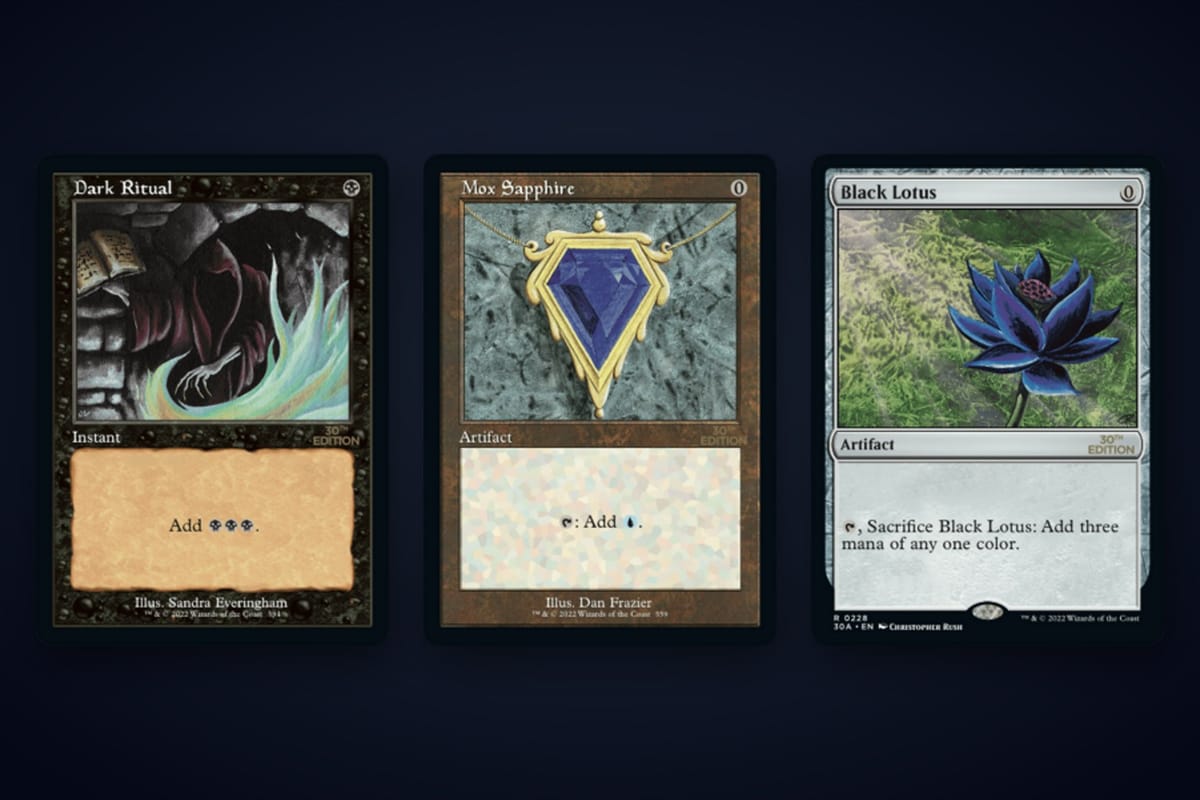
Dark Ritual #394 30th Anniversary Edition (2022) |
$399.98 | — | — |
 |
Mox Sapphire #559 30th Anniversary Edition (2022) |
$1,600 | — | — |
 |
Black Lotus #228 30th Anniversary Edition (2022) |
$3,300 | — | — |
 |
Plateau #275 30th Anniversary Edition (2022) |
$200.00 | — | — |
 |
Plateau #572 30th Anniversary Edition (2022) |
$285.99 | — | — |
 |
Animate Wall #1 30th Anniversary Edition (2022) |
$22.64 | — | — |
 |
Ley Druid #201 30th Anniversary Edition (2022) |
$8.00 | — | — |
 |
Lifeforce #202 30th Anniversary Edition (2022) |
$3.50 | — | — |
 |
Lifelace #203 30th Anniversary Edition (2022) |
$7.14 | — | — |
 |
Living Artifact #204 30th Anniversary Edition (2022) |
$11.30 | — | — |
 |
Living Lands #205 30th Anniversary Edition (2022) |
$4.26 | — | — |
 |
Llanowar Elves #206 30th Anniversary Edition (2022) |
$4.38 | — | — |
Look up any card's current raw and graded value in Midpoint — and get an estimated grade before you pay to submit.
Table of Contents
- Section 1: Understanding 30th Anniversary Edition MTG Cards Value
- Section 2: Identifying the Most Valuable 30th Anniversary Edition Cards
- Section 3: Grading 30th Anniversary Edition Cards – Worth the Investment?
- Section 4: Price Guide Overview – Raw vs. Graded Market Trends
- Section 5: Sealed Products and Their Market Impact
- Section 6: Play Legality, Scarcity, and Collector Demand
- FAQ
Conclusion
Section 1: Understanding 30th Anniversary Edition MTG Cards Value
Background and Market Release
The 30th Anniversary Edition of Magic: The Gathering, launched in late 2022, was a milestone release celebrating 30 years since the game's inception in 1993. This commemorative set featured a curated selection of iconic cards, including the legendary Power Nine, reprinted with a distinctive retro frame design reminiscent of early Magic printings—invoking nostalgia for veteran players and collectors alike. The set had a limited print run, with sealed boxes and booster packs distributed through select channels, creating scarcity that has contributed to collector enthusiasm.
Unlike a standard expansion, the 30th Anniversary Edition was marketed primarily towards collectors rather than competitive players, emphasizing presentation and rarity. This approach influenced the market dynamics, with many buyers treating the cards as collectibles rather than playing cards. The combination of nostalgia, limited availability, and premium packaging has led to ongoing demand since release.
Key Factors Influencing Value
Several elements influence the 30th Anniversary Edition MTG cards value, each affecting pricing and desirability:
- Card rarity and print variants: The set includes regular-frame and retro-frame printings, with retro-frame versions generally commanding higher premiums due to their nostalgic appeal and limited numbers. Additionally, foil, embossed, or alternate art variants, if present, can enhance value.
- Condition and centering: Condition is important in card collecting. Cards should be free from surface scratches, whitening, edge wear, or bends. Centering—the alignment of the printed image within the card borders—is a critical grading factor. For 30th Anniversary cards, which are often thicker and have unique border designs, centering variations can be more pronounced, affecting grading outcomes and market prices.
- Grading status: PSA, Beckett (BGS), and CGC grading services provide standardized assessments of condition and authenticity. Cards graded PSA 10 (Gem Mint) or equivalent generally command premiums. However, the cost of grading and the risk of lower-than-expected grades should be considered.
- Market demand and supply: Scarcity from limited print runs, coupled with ongoing collector interest, drives prices. Market sentiment can fluctuate with broader MTG trends, new releases, or shifts in collector demographics.
- Authenticity and provenance: Verified authenticity and documented ownership history can add confidence for buyers, especially at higher price points.
Current Market Snapshot (as of 2026-08-09)
The complete 30th Anniversary Edition sealed set currently holds a market value estimated between $2,200 and $2,500 depending on condition and seller reputation. Sealed booster boxes, with original shrink wrap intact, are especially prized, with some sales reported above $2,800 in premium auction settings.
Individual card prices vary widely, with the Black Lotus and other Power Nine cards among the most valuable. The following table illustrates typical raw and PSA 10 graded values, reflecting the grading premiums for high-demand cards:
| Card Name | Raw Value | PSA 10 Value | Variant |
|---|---|---|---|
| Black Lotus (Retro Frame) | $13,000 | $40,000 | Retro Frame |
| Mox Sapphire | $3,500 | $10,500 | Retro Frame |
| Time Walk | $3,000 | $9,000 | Retro Frame |
| Dark Ritual | $90 | $300 | Regular Frame |
| Serra Angel | $30 | $150 | Regular Frame |
For collectors aiming to assess grading potential before committing, Midpoint provides centering and condition analysis (Midpoint) to estimate PSA/BGS grades. This AI-driven technology evaluates high-resolution scans to deliver centering percentages and condition flags, enabling informed decisions and reducing the risk of costly grading surprises.
Section 2: Identifying the Most Valuable 30th Anniversary Edition Cards
Power Nine Reprints Lead the Market
The Power Nine cards—Black Lotus, Mox Sapphire, Mox Jet, Mox Ruby, Mox Pearl, Mox Emerald, Time Walk, Ancestral Recall, and Timetwister—are the most sought-after cards of the 30th Anniversary Edition. These cards are historically rare and powerful from early Magic sets, and their reprints in this commemorative set have preserved that prestige.
Their values remain high due to factors such as limited print quantity, reverence within the MTG community, and the nostalgic retro frame treatment. The availability of each Power Nine card in the 30th Anniversary Edition was intentionally limited to maintain exclusivity, with estimated print runs in the tens of thousands—far lower than mass-market sets where millions of copies may be printed.
Black Lotus Dominance
Among these, the Black Lotus Retro Frame holds the highest value. Black Lotus is often regarded as the most iconic Magic card ever printed due to its game-breaking effect and extreme scarcity in original printings. The 30th Anniversary Retro Frame reprint retains that allure, particularly among collectors who may not be able to afford or find original Alpha or Beta Black Lotus cards.
Raw Black Lotus cards from this edition are valued around $13,000, with PSA 10 graded examples commanding significantly higher prices, with recent sales reported near $40,000. This premium reflects both the card's legendary status and the confidence grading imparts in card condition authenticity. Achieving a PSA 10 grade can be challenging due to the thicker card stock and retro frame printing process, which sometimes leads to centering or surface imperfections.
Other Notable Cards
- Mox Sapphire: Raw copies typically sell around $3,500, with PSA 10 grades exceeding $10,000. Mox Sapphire’s demand is bolstered by its iconic status and relative scarcity within the set.
- Time Walk: This card commands raw prices of about $3,000 and PSA 10 values near $9,000. Its unique game effect and nostalgic frame add to collector appeal.
- Regular Frame Commons and Uncommons: Cards like Dark Ritual and Serra Angel retain modest raw values ($30 to $90), with PSA 9-10 graded versions potentially fetching higher prices due to collector interest in high-grade vintage-themed cards.
Price Differences by Frame and Variant
The 30th Anniversary Edition includes both regular-frame and retro-frame printings, with retro-frame versions generally valued higher due to their collector appeal and limited print runs. For example, a Mox Jet retro-frame card may command 20%-30% more than its regular frame counterpart.
Variant printings such as foil embossing, if available, typically command additional premiums but remain less valuable than Power Nine variants. Collectors often prioritize condition and centering over foil status, especially given the historical significance of the Power Nine cards.
Section 3: Grading 30th Anniversary Edition Cards – Worth the Investment?
Grading Premiums Explained
Graded cards, especially those with PSA 10 or equivalent top-tier grades, tend to sell for multiples of raw card prices. The premium for a PSA 10 Black Lotus can be roughly 3x the raw value, turning a $13,000 card into a $40,000 sale. This premium is driven by buyer confidence in the card’s pristine condition and authenticity, reducing risks associated with raw card imperfections or misrepresentation.
However, not all cards benefit equally from grading. Lower-value cards may not justify grading fees, which can range from $20 to over $100 per card depending on service speed and declared value. Additionally, wait times can extend from several weeks to months, potentially impacting market timing.
Centering and Condition Impact
Among grading criteria, centering is crucial. Cards with centering close to perfect (50/50 distribution of borders) are more likely to receive PSA 10 grades. For the 30th Anniversary Edition, the unique border designs and printing variations can cause centering inconsistencies, making pre-grading evaluation important.
Midpoint’s AI-powered centering measurement tool analyzes high-resolution scans, providing precise numerical centering percentages. For example, a centering of 49/51 or better in both horizontal and vertical axes can increase the chance of a PSA 10 grade. The tool also flags potential surface wear, print defects, or corner damage, enabling collectors to avoid costly grading submissions on cards unlikely to receive top grades.
Which 30th Anniversary Edition Cards Are Worth Grading?
- High-value Power Nine cards: Generally good candidates for grading due to strong price multipliers and collector demand. Even a PSA 9 grade can increase value substantially.
- Mid-tier cards with excellent condition: Cards like Serra Angel or Dark Ritual may see gains if PSA 9-10 graded, especially if they have good centering and no surface flaws.
- Lower-value commons: Usually not worth grading unless pristine or part of a high-demand variant (such as an error or foil). Grading these cards often yields negative ROI.
Grading ROI Considerations
Grading fees and wait times can add up, so collectors should calculate expected returns before submission. For example, PSA charges $50-$100 per card at higher declared values, plus shipping and insurance. Turnaround times vary from 4 weeks to several months depending on service level.
Using Midpoint’s grading estimate tools (How to Pre-Grade Your Card) can inform whether grading costs justify the potential price increase. A key step is comparing recent sale prices of graded versus raw cards with similar centering and condition. Collectors should factor in grading fees, time value of money, and market volatility to decide.
Section 4: Price Guide Overview – Raw vs. Graded Market Trends
Recent Sold Prices vs. Listing Prices
The market for 30th Anniversary Edition cards is dynamic and often fluid. Sold prices frequently differ from listing prices, reflecting negotiation, condition nuances, and scarcity. For instance, a Black Lotus PSA 10 might list at $45,000 on platforms like eBay or TCGPlayer but sell closer to $40,000 after bidding competition or private negotiation.
Raw copies can fluctuate between $12,000 and $14,000 depending on centering and minor wear. Buyers often seek cards with top centering and no surface defects, creating a price gradient within raw examples.
Raw and Graded Price Ranges
Understanding different price brackets helps collectors and investors set realistic expectations and strategize sales or purchases:
- Raw cards: Commons and uncommons generally range from $30 to $90, while Power Nine cards can reach up to $13,000 (e.g., Black Lotus).
- PSA 10 graded cards: For premium cards, prices can be up to 3x raw value. Mid-tier cards may see 2-3x increases, while lower-value cards often see smaller or negligible grading premiums.
Value Fluctuations and Market Timing
Market values fluctuate based on collector interest, tournament news, new product releases, and overall Magic: The Gathering market trends. For example, announcements of upcoming vintage formats or new card reprints can temporarily increase demand for iconic cards.
Monitoring platforms like Midpoint’s portfolio tracker allows collectors to track their holdings, analyze value trends, and identify optimal sales windows. Timely selling during peak interest periods can maximize return, while holding during downturns or low demand may risk depreciation.
Price Differences by Print Frame
Retro-frame cards consistently command higher premiums than regular-frame counterparts. The premium ranges from 20% to 30%, especially for Power Nine cards. For instance, a retro-frame Mox Sapphire might sell for $3,500 raw, whereas the regular-frame version may list around $2,700.
Variant printings, such as foil embossing or alternate art, add incremental value typically in the range of 10% to 15%, though such variants are less common in the 30th Anniversary Edition set. Collectors prioritize authenticity, condition, and centering over minor variant status, especially for high-value cards.
Section 5: Sealed Products and Their Market Impact
Sealed Booster Packs and Display Boxes Value
Sealed 30th Anniversary Edition booster packs and display boxes are prized for their unopened status and potential to contain rare cards, including Power Nine reprints. Sealed booster boxes typically contain 36 packs, each with 15 cards, including the possibility of rare, foil, or alternate art variants.
A sealed booster box can fetch prices over $2,500 in secondary markets, sometimes exceeding $2,800 in auction formats, especially when original shrink wrap and packaging condition are pristine. Collector demand for sealed boxes remains strong due to the chance of pulling high-value cards.
Expected Value Compared with Singles
While sealed products hold aggregate value and offer a diversified portfolio of cards, singles—especially high-demand Power Nine cards—often yield higher liquidity and faster sales. For example, selling a graded Black Lotus individually can be quicker and more profitable than waiting for a sealed box to appreciate.
However, sealed boxes represent a lower-risk investment for speculators betting on future appreciation. Since individual card centering and condition do not impact sealed products, buyers pay a premium for guaranteed mint condition. Over time, as sealed quantities dwindle, these boxes could command higher prices.
Investment Risks and Considerations
- Original product cost and limited supply contribute to long-term value; however, market fluctuations can temporarily affect prices.
- Collector demand for sealed condition is strong but can vary with economic conditions and shifts in hobby interest.
- Sealed products are less affected by individual card centering issues, offering a more uniform investment, but packaging damage or shrink wrap tears can negatively impact value.
- Speculators should consider storage conditions carefully to avoid box damage, humidity effects, or other deterioration risks.
Section 6: Play Legality, Scarcity, and Collector Demand
Non-Tournament-Legal Status
30th Anniversary Edition cards are printed with unique retro frames and are generally not tournament-legal in sanctioned play formats such as Standard, Modern, or Legacy. This is primarily due to the distinct frames and Wizards of the Coast’s policy on reprints and tournament legality.
This limitation means these cards appeal mainly to collectors, investors, and casual fans rather than competitive players. Their value stems from nostalgia, scarcity, and investment potential rather than gameplay utility.
Scarcity and Pull Odds of Power Nine Cards
The pull odds of Power Nine cards in 30th Anniversary Edition booster packs are very low, reflecting deliberate scarcity to preserve exclusivity. While exact odds were not officially published, community estimates and pack break data suggest pull rates of approximately 1 in 500 packs for Power Nine cards, with variations depending on the card.
This low pull rate drives demand and justifies premiums on graded copies. Furthermore, sealed products containing unopened packs offer the chance—albeit slim—for collectors to pull these rare cards themselves, adding value to sealed boxes and packs.
Collector Demand and Market Drivers
- High nostalgia factor and limited release boost collector interest, especially among players who grew up with original Alpha/Beta cards.
- Investment potential as iconic cards with historical significance encourages buyers to hold for appreciation.
- Market fluctuations are driven by grading population (number of graded copies available), new collectors entering the scene, and broader trends in the trading card market.
- Special events, anniversaries, or Magic-related news can temporarily spike interest and prices.

Conclusion
The 30th Anniversary Edition MTG cards value depends on a combination of rarity, condition, grading status, and market dynamics. Power Nine reprints, especially the Black Lotus, top the value charts, with PSA 10 graded cards commanding significant premiums that can be several times raw card prices. Grading can be a worthwhile investment, particularly for high-value cards, but collectors should carefully assess condition and centering first to reduce risks.
Sealed products offer an alternative investment, providing exposure to multiple rare cards and eliminating concerns about individual card centering or surface wear. However, sealed products trade with a premium and may have lower liquidity.
Regular-frame and commons hold modest but stable value, and grading mid-tier cards can yield returns if condition is excellent.
Tools like Midpoint provide AI-driven grading estimates and precise centering measurements, helping collectors reduce grading risks and maximize returns. Whether you’re an investor, player, or collector, understanding these factors can help you navigate the 30th Anniversary Edition market more confidently.
FAQ
Q: How much is the Magic: The Gathering 30th Anniversary Edition set worth?
A: As of 2026-08-09, a complete sealed 30th Anniversary Edition set is estimated between $2,200 and $2,500, with individual card values varying based on rarity and condition. Sealed booster boxes can command upwards of $2,800 in premium auction environments.
Q: What is the most valuable card in 30th Anniversary Edition?
A: The Black Lotus Retro Frame is generally considered the most valuable card, with raw values around $13,000 and PSA 10 graded copies reaching approximately $40,000. Its iconic status and scarcity contribute to these prices.
Q: How much is a 30th Anniversary Black Lotus worth?
A: Raw Black Lotus cards are valued near $13,000, while PSA 10 graded versions can sell for significantly higher prices, reflecting grading premiums. Achieving PSA 10 is challenging due to centering and condition standards.
Q: Are 30th Anniversary Edition MTG cards worth collecting or investing in?
A: Many collectors and investors find value in Power Nine cards and sealed products. Grading top-condition cards can increase value, but careful condition assessment and grading ROI analysis are important.
Q: What are the odds of pulling a Power Nine card from 30th Anniversary Edition?
A: Pull odds are very low, estimated around 1 in 500 packs, contributing to the scarcity and value of Power Nine cards from the set.
Q: Are MTG 30th Anniversary Edition cards tournament legal?
A: No, these cards are generally considered non-tournament-legal collectibles due to their unique retro-frame design and Wizards of the Coast policy. Their value is rooted in collecting and investment rather than competitive play.
Free to start
Try the Midpoint app
Grade any card from a photo, see its raw and PSA 10 value, and track what your collection is worth — free.
Get it on iPhoneGet it on Android