Automatic Centering: How Card Centering Tools Accurately Measure Grading
Learn how automatic centering tools measure trading card centering for accurate grading using card centering calculators and free online tools.


Estimated reading time: 15 min
Key Takeaways
- Automatic centering tools use measurements of card edges to calculate centering percentages important for grading.
- Card centering calculators and free card centering tools online provide instant, objective centering analysis to collectors.
- Accurate card centering measurements can impact card value and grading estimates from PSA, BGS, CGC, and TAG.
- Understanding how automatic centering works helps collectors make informed decisions about grading submissions.
- Midpoint integrates AI-powered centering measurement with grading estimates for informed trading card decisions.
Table of Contents
- Section 1: What Is Automatic Centering in Card Grading?
- Section 2: How Card Centering Calculators Work
- Section 3: Using Free Card Centering Tools Online
- Section 4: Understanding Card Centering Measurements
- Section 5: Common Centering Edge Cases and Limitations
- Section 6: Impact of Centering on Card Grading and Value
- Section 7: Integrating Automatic Centering Into Your Collection Workflow
- Conclusion
- FAQ
Section 1: What Is Automatic Centering in Card Grading?
Defining Automatic Centering
Automatic centering refers to the use of specialized software tools and algorithms designed to objectively measure how well a trading card’s front image is aligned within its borders. Unlike manual inspection, which can vary between graders due to subjectivity and human error, automatic centering applies calculations based on digital images of the card. This process involves detecting the card’s outer edges and the printed image boundaries to compute centering percentages, which are important factors considered in the card’s overall grade assigned by professional grading companies such as PSA, BGS, CGC, and TAG.
These tools often leverage computer vision techniques and machine learning to analyze high-resolution images, enabling consistent and repeatable measurements that are less influenced by human bias. This objectivity is particularly important because centering is a key component of grading criteria that can affect the card’s market value.
Why Centering Matters in Card Grading
Centering is one of the primary criteria graders evaluate because it affects the card’s visual appeal and perceived quality. A well-centered card typically exhibits nearly equal margins on all four sides—the top, bottom, left, and right edges—creating a balanced and aesthetically pleasing appearance. For example, a card with 60/40 centering (where one side’s margin is 60% and the opposite side’s is 40%) is considered off-center and may receive a lower grade compared to one with 50/50 or near-perfect centering.
The impact of centering on grading can be substantial. Cards with poor centering often receive grade reductions that can lower their final grade by one or more points. This downgrade is especially impactful on high-value cards where even a single grade difference can affect market price. Collectors and investors prioritize well-centered cards because they tend to retain higher resale value and are more desirable in the marketplace.
Role of Automatic Centering Tools in Modern Collecting
Automatic centering tools bring consistency, transparency, and efficiency to the card grading process. By providing collectors and sellers with centering data before submitting cards for professional grading, these tools help users make informed decisions and potentially avoid costly grading fees on cards unlikely to achieve high grades due to centering flaws.
For example, a collector considering grading a vintage sports card can upload an image to an automatic centering tool and receive an immediate centering percentage. If the card is significantly off-center, the collector might decide to hold off on grading or seek professional reconditioning. This pre-grading insight can help conserve grading costs and maximize return on investment.
Moreover, automatic centering tools are increasingly integrated with AI-powered grading estimate platforms like Midpoint, which combine centering data with other grading factors to provide comprehensive pre-grade assessments. This integration streamlines the workflow for collectors and dealers by consolidating critical evaluation metrics in one place.
Section 2: How Card Centering Calculators Work
Measuring Margins and Calculating Percentages
Card centering calculators operate by measuring the distances between the card’s printed image and its outer edges on all four sides—top, bottom, left, and right. These margins are used to calculate centering percentages, which express how well the image is centered horizontally and vertically.
The calculation typically involves taking the smaller margin and dividing it by the larger margin for each axis, then multiplying by 100 to get a percentage. For example:
- If the left margin is 6mm and the right margin is 7mm, the horizontal centering percentage is calculated as (6 / 7) × 100 = approximately 85.7%.
- Similarly, if the top margin is 5mm and the bottom margin is 5.5mm, the vertical centering percentage is (5 / 5.5) × 100 = approximately 90.9%.
Both horizontal and vertical centering percentages are considered independently, and some tools provide a combined or average centering score to give an overall centering assessment. The exact interpretation of these percentages varies among grading companies, but in general, higher percentages indicate better centering.
Image Processing and Edge Detection Techniques
Advanced card centering calculators rely on image processing methods to detect the card edges and the printed image boundaries automatically. Key techniques include:
- Edge Detection Filters: Algorithms such as the Canny edge detector or Sobel filter highlight contrast changes in pixel values, enabling the software to identify the card’s outer contours and inner image boundaries.
- Cropping and Masking: Once edges are detected, cropping algorithms isolate the card’s visible area, separating it from the background to improve measurement accuracy.
- Pixel-to-Millimeter Conversion: Since digital images are measured in pixels, the software calibrates the image scale using known card dimensions or reference objects to convert pixel distances into physical units like millimeters.
- Color and Contrast Analysis: Differentiating the card’s printed image from the white or colored borders involves analyzing color gradients and contrast levels, which helps delineate accurate margins.
These computational steps allow the calculator to measure margins accurately, even when images vary in lighting or background conditions.
Precision and Repeatability
One advantage of automatic centering calculators is their ability to deliver precise and repeatable measurements. Manual measurement methods, like using rulers or calipers, can introduce variability due to human inconsistency, parallax error, or misreading millimeter marks.
In contrast, automatic tools can measure down to fractions of a millimeter, often providing accuracy within ±0.1mm or better. This level of precision is important for high-grade cards, where minute differences in centering can influence grading outcomes.
Additionally, automated measurements are reproducible; repeated measurements on the same image or multiple images of the same card generally yield consistent centering percentages. This repeatability supports grading decisions that rely on centering accuracy.
Section 3: Using Free Card Centering Tools Online
Accessibility of Free Tools for Collectors
The availability of free online card centering tools has increased access to grading analytics for collectors of all experience levels. These web-based platforms require no specialized hardware beyond a smartphone or digital camera and an internet connection. Collectors can upload photos of their cards and receive centering analyses.
For example, the free card centering tool offered by Midpoint provides an interface where users upload images, and the underlying AI detects card edges and calculates centering percentages. This accessibility reduces barriers that previously limited accurate grading insights to professional graders or those with specialized equipment.
Step-by-Step Workflow
- Upload a high-quality image of the card: For best results, use images taken with good lighting (natural light or diffused artificial light) and a flat angle perpendicular to the card surface to minimize distortion.
- Tool processes the image: The software automatically detects the card’s outer edges and printed image boundaries.
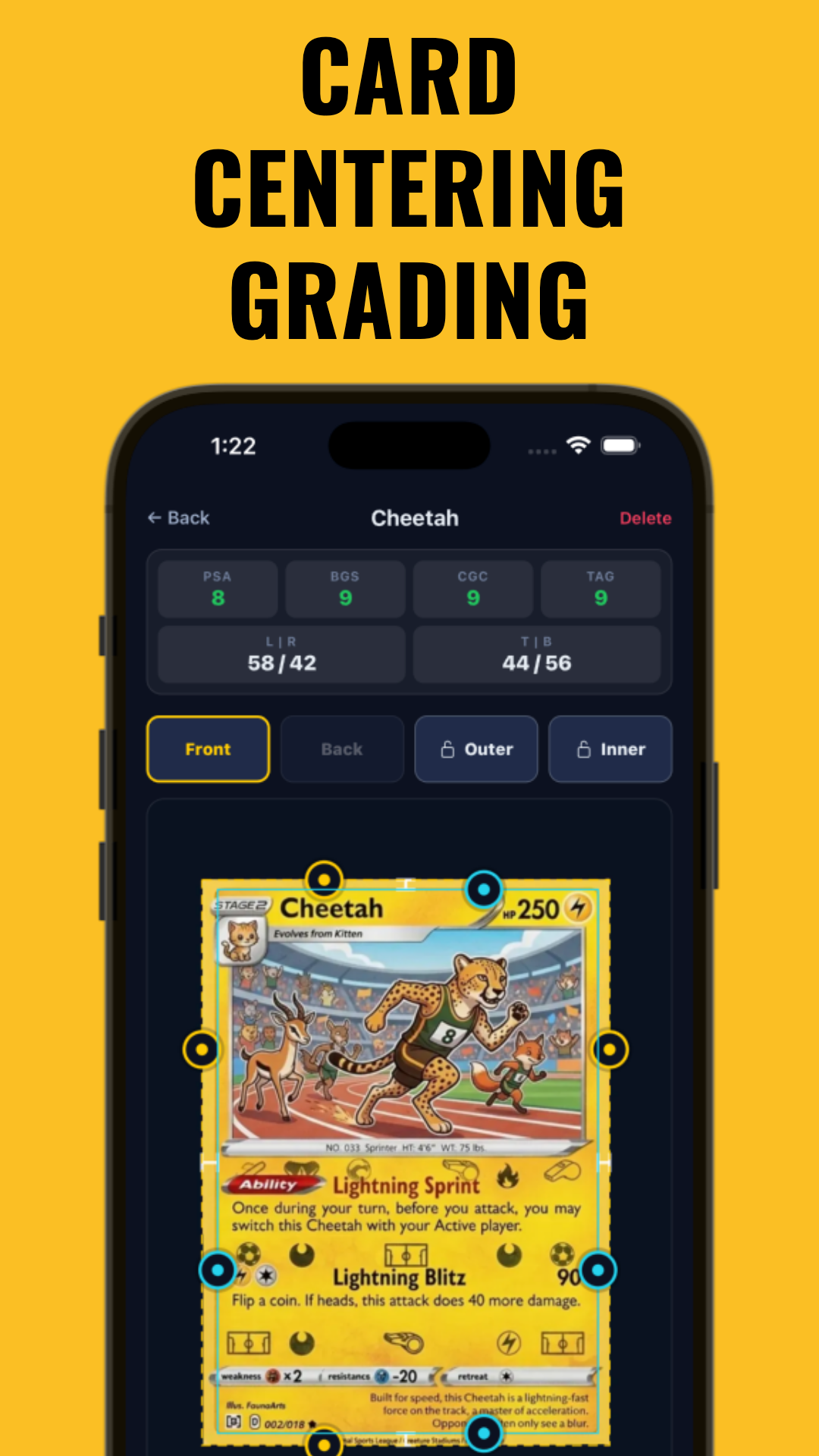
- Calculates centering percentages: The tool provides horizontal and vertical centering metrics, often accompanied by a visual overlay highlighting margins.
- Receive a detailed report: The user obtains a centering score and sometimes grading estimates based on centering and other factors.
- Decide on grading submission: Based on the centering data, collectors can make informed decisions whether to submit the card for professional grading or hold for improvement.
Benefits of Using Online Card Centering Tools
- No need for physical measuring tools or specialized equipment: This convenience allows collectors to analyze cards anywhere, anytime.
- Instant results: The speed of analysis reduces uncertainty and saves time compared to manual evaluation or waiting for professional grading feedback.
- Integration with other card data: Many tools, such as Midpoint, combine centering measurement with card lookup, pricing data, and grading estimates to provide comprehensive insights in one platform.
- Cost-effective: Free tools eliminate the expense of professional pre-grading services or equipment, lowering entry barriers for new collectors.
Section 4: Understanding Card Centering Measurements
Horizontal vs. Vertical Centering
Card centering measurements analyze two separate axes:
- Horizontal centering: This compares the left and right margins, measuring how centered the image is along the left-right axis. Ideally, these margins should be nearly equal.
- Vertical centering: This compares the top and bottom margins, assessing image placement along the up-down axis. Similar to horizontal centering, balanced margins indicate better centering.
Each axis is assessed independently because grading standards consider both dimensions. A card might be well-centered horizontally but off-center vertically, affecting the overall grade.
Interpreting Centering Percentages
Centering percentages range from 50% (extremely off-center) to 100% (perfect centering). Grading companies have published or inferred thresholds to guide centering assessments:
- PSA Centering Standards: For cards smaller than 54mm x 87mm, PSA generally requires centering to be at least 60/40 (60% to 40%) on the front image to qualify for top grades like Gem Mint 10. For cards larger than this size, more lenient centering (e.g., 65/35) may be acceptable.
- BGS Centering Requirements: Beckett Grading Services generally requires centering around 70/30 for high grades, but their subgrades separately evaluate centering, providing a numeric score from 1 to 10.
- CGC and TAG: Similar standards apply, with slight variations based on card size and type.
Cards with centering below approximately 50% are typically considered poorly centered and will receive lower grades regardless of condition. Conversely, centering above 90% is considered excellent and favors higher grades.
Card Centering Measurements and Grading Criteria
While centering is a crucial factor in grading, it represents only one component among others such as corners, edges, surface condition, and print quality. An otherwise flawless card with poor centering will still see its grade reduced, while a card with perfect centering but damaged corners may not achieve top grades.
Therefore, accurate centering measurements provide valuable predictive insight but should always be interpreted alongside a holistic condition assessment. For example, Midpoint combines centering data with AI-driven grading estimates that consider multiple grading criteria, giving collectors a comprehensive pre-grade outlook.
Section 5: Common Centering Edge Cases and Limitations
Handling Cards with Irregular Borders
Some trading cards, especially vintage or miscut examples, present irregular or uneven borders that pose challenges to automatic centering tools. For instance, older cards may have manufacturing inconsistencies causing non-uniform edges or faded borders that confuse edge detection algorithms.
In such cases, the automatic tools might inaccurately identify card edges or image boundaries, leading to erroneous centering percentages. To mitigate this, some tools allow manual cropping or adjustment features where the user can specify or correct detected borders before analysis.
Additionally, collectors dealing with rare or damaged cards may benefit from combining automated results with expert human evaluation to ensure centering assessments reflect true card condition.
Lighting and Image Quality Impact
The quality of the input image significantly affects the accuracy of automatic centering measurements. Key image properties include:
- Lighting: Even, diffused lighting helps avoid shadows and glare that can obscure edges or introduce false borders.
- Angle: Photos taken perpendicular to the card surface minimize distortion and perspective errors.
- Resolution: High-resolution images provide detailed edge data, improving measurement precision.
Poor lighting conditions such as harsh reflections, shadows, or colored light can cause edge detection algorithms to misinterpret the card’s boundaries, resulting in inaccurate centering percentages. Collectors should aim for consistent, bright, and shadow-free photography setups to maximize tool effectiveness.
Limitations of Automatic Algorithms
Although automatic centering tools employ advanced techniques, they are not infallible. Limitations include:
- Background Interference: Cards photographed on busy or patterned backgrounds may confuse edge detection.
- Design Elements: Some cards have printed border designs or gradients that blur the distinction between image and border.
- Wear and Damage: Physical card damage such as creases or edge wear can alter perceived borders.
- Shadow and Lighting Artifacts: Shadows cast by the card or glare from protective sleeves may be misread as edges.
To ensure the best results, it’s recommended to review automatic results critically and, if needed, supplement with manual checks or retake photos under improved conditions.
Section 6: Impact of Centering on Card Grading and Value
Centering’s Role in Final Grade Determination
Centering is an important factor in final card grades assigned by grading companies. Its importance stems from the visual impact and perceived quality it conveys. Cards with near-perfect centering are often rewarded with premium grades such as Gem Mint 10 or Pristine 10, which can elevate their market value.
For example, a PSA 10 graded card with 50/50 centering can command prices higher than a similar card graded PSA 9 with 60/40 centering. Even small deviations from perfect centering can cause grade reductions because graders view off-center cards as less desirable.
Conversely, cards with poor centering may not qualify for top grades regardless of other condition factors. Therefore, centering can influence whether a card is considered investment-grade or a lower-tier collectible.
Value Multiplication Effect
Centering influences value significantly. Cards graded at 9.5 or 10 with excellent centering often sell for multiple times the price of identical cards with lesser centering grades. The market recognizes the desirability of well-centered cards, especially in popular sets and rookie cards.
Collectors and investors use centering measurements to identify undervalued cards with potential for high grades, enabling strategic submission for grading and maximizing return on investment. Midpoint’s AI-powered platform helps by combining centering data with pricing trends and historical sales data to provide market valuations.
Using Midpoint for Grading and Portfolio Tracking
Midpoint’s app integrates automatic centering measurement with AI-driven grading estimates and portfolio tracking tools. This ecosystem allows collectors to:
- Pre-grade cards with detailed centering and condition analysis.
- Estimate potential grades from PSA, BGS, CGC, and TAG based on combined data.
- Track portfolio value fluctuations over time, monitor grading submissions, and record sales.
- Make informed decisions to submit, hold, or sell cards based on data-backed insights.
For in-depth guidance on pre-grading, collectors can explore Midpoint’s step-by-step pre-grade guide, which includes best practices for image capture, centering evaluation, and grading strategy.
Section 7: Integrating Automatic Centering Into Your Collection Workflow
Step 1: Initial Card Image Capture
The foundation of accurate centering measurement is a high-quality card image. Collectors should:
- Place the card on a flat, neutral-colored surface.
- Use consistent, diffused lighting to minimize shadows and glare. Natural daylight or a softbox light source works well.
- Ensure the camera or smartphone is held directly above the card, perpendicular to the surface, to avoid perspective distortion.
- Capture images at the highest possible resolution for detail.
- Avoid including other objects or clutter in the frame to prevent software misinterpretation.
Taking multiple images from slightly different angles or lighting setups can help ensure at least one meets quality standards.
Step 2: Upload to Card Centering Calculator
Use online free centering tools like Midpoint’s card centering calculator to upload your images. The tool will automatically process the photo, detect edges, and calculate horizontal and vertical centering percentages. If the tool provides options to adjust or crop edges, use them to refine measurements for irregular or damaged cards.
This quick analysis helps you determine whether the card’s centering is sufficient for professional grading or if it might be better to hold the card or seek restoration.
Step 3: Analyze Grading Estimates and Portfolio Impact
Beyond centering, incorporate AI grading estimates offered by platforms like Midpoint, which factor in corners, edges, surface condition, and print quality alongside centering. Reviewing these combined insights provides a realistic prediction of the card’s potential grade and market value.
Additionally, maintain a digital portfolio to track your card collection’s grading history, changes in estimated value, and grading submissions. This data helps identify trends, optimize grading timing, and manage investment risk.
Step 4: Submit or Hold Based on Data
Based on centering and grading estimates, make strategic decisions:
- Submit Cards: Cards with strong centering and overall condition are prime candidates for grading submission, maximizing chances for high grades and return on investment.
- Hold or Improve Cards: Cards with poor centering or condition might be held in inventory, sent for professional reconditioning, or reserved for future grading attempts.
- Sell or Trade: Data-driven valuation supports optimal timing for selling or trading cards when market conditions are favorable.
By integrating automatic centering into your collection workflow, you gain a competitive edge in the trading card marketplace. For more detailed insights, explore Card Centering Tool: Accurate Card Grading Estimates.
Conclusion
Automatic centering tools have enhanced trading card grading by delivering precise, objective measurements of card centering—a vital grading factor that influences final grades and market value. Utilizing card centering calculators and free online tools enables collectors to quickly assess centering quality, potentially avoiding costly grading submissions on poorly centered cards.
Accurate centering measurement enhances grading transparency and informs smarter collecting and investing decisions. Platforms like Midpoint extend this capability by integrating AI-driven grading estimates and portfolio tracking, offering a comprehensive solution to maximize collection value.
Collectors embracing automatic centering technology can gain an advantage in the competitive trading card world, helping ensure their investments are well-positioned.
FAQ
Q: How do you center an element in CSS?
A: In CSS, centering an element can be done using various methods such as setting margin: auto for horizontal centering of block elements, using text-align: center for inline content, or leveraging Flexbox/Grid layouts for both horizontal and vertical centering. For example, using Flexbox, applying display: flex; justify-content: center; align-items: center; on the container centers its child elements both horizontally and vertically.
Q: What is the difference between horizontal and vertical centering?
A: Horizontal centering aligns content along the left-right axis, ensuring equal space on both sides, while vertical centering aligns content along the top-bottom axis. Both are essential for balanced layout and are measured independently in card centering to assess image placement relative to card borders.
Q: How do Automatic CSS centering classes work?
A: Automatic CSS centering classes use predefined styles like Flexbox or Grid with properties such as justify-content: center and align-items: center to center content along horizontal and vertical axes without manual margin adjustments, providing responsive and easy-to-maintain layouts.
Q: How do you center a div in the middle of the page?
A: To center a div both horizontally and vertically on the page, CSS Flexbox is effective. Set the parent container to display: flex;, justify-content: center;, and align-items: center;, and ensure the div has a fixed or max width/height. Alternatively, CSS Grid or absolute positioning with transform can achieve similar results.
Q: What is the best way to center content with flexbox?
A: Use display: flex; on the parent container, with justify-content: center; to center horizontally and align-items: center; to center vertically. This method is responsive, widely supported, and requires minimal CSS.
Q: Why is vertical centering in CSS difficult?
A: Vertical centering is historically difficult because block elements flow top to bottom by default and CSS initially lacked straightforward vertical alignment properties. Modern layout modes like Flexbox and Grid have simplified vertical centering by providing intuitive alignment properties that center content along the vertical axis easily.
Free to start
Try the Midpoint app
Grade any card from a photo, see its raw and PSA 10 value, and track what your collection is worth — free.
Get it on iPhoneGet it on Android