Beckett Centering Standards Explained: How to Measure and Score Your Cards
Discover Beckett centering standards, how they're measured, thresholds for top grades, and how they differ from PSA and others in this detailed guide.


Estimated reading time: 15 min
Key Takeaways
- Beckett centering standards define how well a card’s image is centered front and back, impacting final grades significantly.
- Centering is measured by ratios such as 50/50 or 60/40, with tighter tolerances generally required for higher grades like BGS 10 and 9.5.
- Back centering tolerances are often more lenient than front, allowing more variance without grade penalties.
- Beckett standards differ from PSA, CGC, and SGC, with unique thresholds and grading philosophies.
- Black Label Beckett cards have stricter overall subgrade minima; centering alone is not sufficient to earn this prestigious label.
- Using tools like Midpoint can help measure centering precisely before submitting cards for grading.
Table of Contents
- Section 1: Understanding Beckett Centering Measurement
- Section 2: Beckett Centering Thresholds for Top Grades
- Section 3: How Beckett Centering Differs from PSA, CGC, and SGC
- Section 4: The Role of Subgrades and Centering Interaction
- Section 5: What the Black Label Means for Centering
- Section 6: Front vs. Back Centering Tolerances Explained
- Section 7: Decoding Beckett Centering Ratios
- Section 8: Common Misconceptions about Beckett Centering Standards
- Conclusion
- FAQ
Section 1: Understanding Beckett Centering Measurement
What Is Beckett Centering?
Beckett centering refers to how precisely the printed image on a trading card is aligned within its borders. Centering is a fundamental factor in grading because it directly affects the card’s visual appeal and value. Beckett Grading Services (BGS) evaluates centering on both the front and back of the card, measuring how evenly the card’s image is positioned between its edges.
Centering is not just about visual inspection; it is a quantifiable measurement that impacts the perceived quality and market desirability of the card. In Beckett’s grading scale, the centering subgrade can heavily influence the card’s overall grade, especially at the higher end of the spectrum where collectors seek near-perfect specimens.
How Beckett Measures Centering on Front and Back
Beckett measures centering by calculating the ratio of the border widths on opposite sides. For example, horizontal centering compares the left and right borders, while vertical centering compares the top and bottom borders. These measurements produce ratios such as 50/50, 55/45, or 60/40, indicating how close to perfect center the card is.
Importantly, Beckett uses precise millimeter measurements to determine these ratios. The process involves measuring the width of the border on one side of the image and dividing that by the total border width on both sides combined. For instance, if the left border is 3 mm and the right border is 3 mm, the ratio is 50/50, indicating perfect horizontal centering.
This measurement is done separately for both horizontal and vertical axes, and for both the front and back sides of the card. Beckett’s method ensures that slight differences—sometimes as small as fractions of a millimeter—are accounted for, which can be the difference between a 10 and a 9.5 grade.
The front side typically has stricter requirements, as it is the primary visual focus, while the back tolerates more variance. Beckett’s graders use calibrated tools and magnification to precisely gauge these distances, aiming for consistency across submissions.
Tools for Accurate Centering Measurement
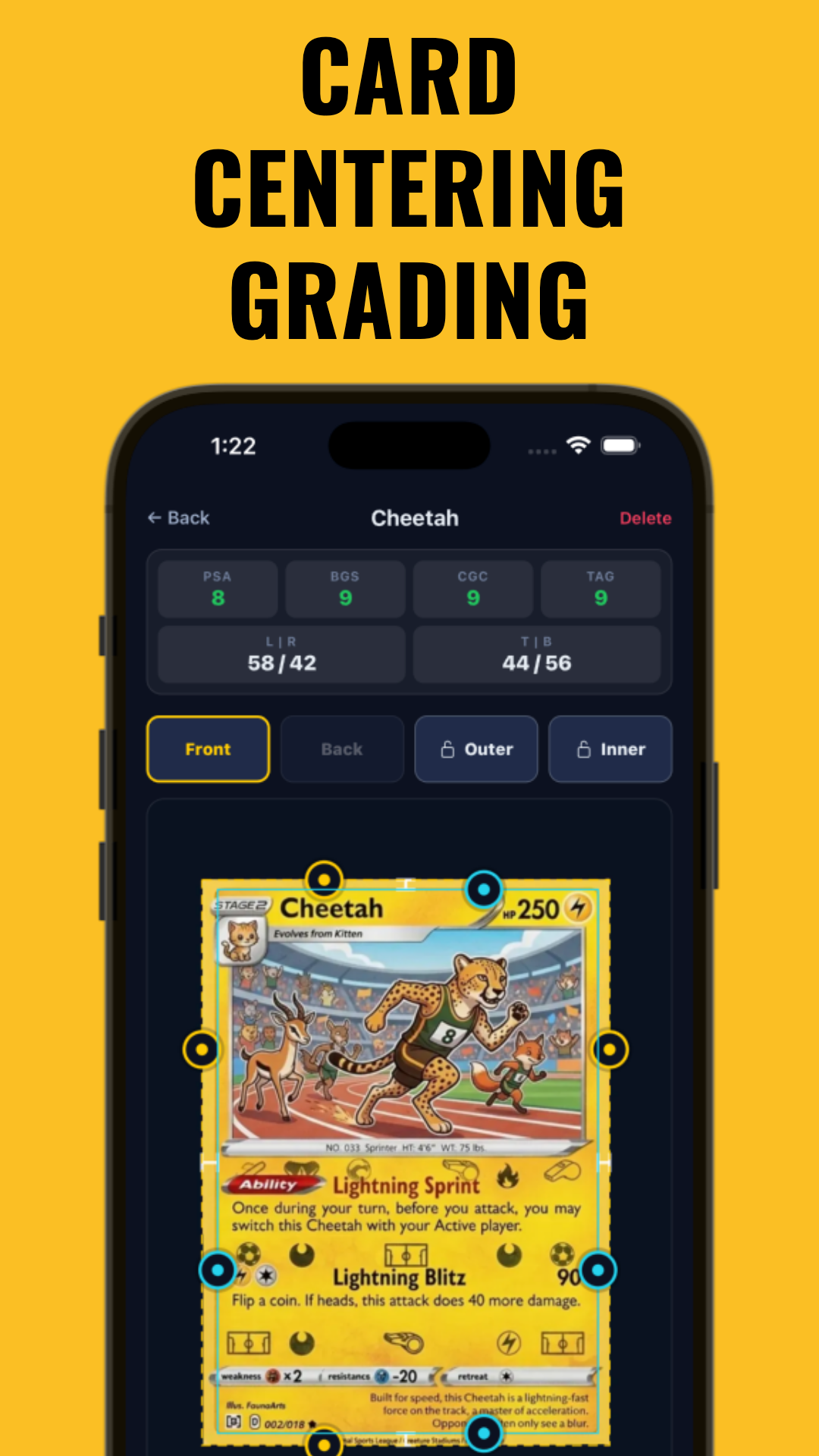
Before submitting a card for Beckett grading, collectors can use advanced tools like the Midpoint app to measure centering down to the millimeter. Midpoint’s AI digital grading provides instant centering ratios and grading estimates based on corners, edges, and surface conditions, helping collectors avoid costly grading fees on off-center cards.
Midpoint uses image recognition and machine learning to detect card edges and borders automatically. By uploading a high-quality scan or photo of the card, the app calculates precise border measurements and outputs centering ratios for front and back. Additionally, Midpoint estimates subgrades for corners, edges, and surface, giving collectors a comprehensive pre-grade assessment.
Using such tools reduces guesswork and increases submission confidence, especially for high-value cards where grading fees can be significant. Knowing your centering ratios beforehand helps avoid surprises and maximizes return on investment.
Section 2: Beckett Centering Thresholds for Top Grades
Pristine 10 Centering Requirements
To earn Beckett’s coveted Pristine 10 grade, a card generally must meet very tight centering criteria. The front centering ratio is typically close to 50/50, with a narrow tolerance around 55/45 at most. Deviations beyond this threshold often result in a lower grade.
On the back, centering can be slightly more forgiving, often allowing up to 60/40 without penalty. The combination of near-perfect front centering and acceptable back centering helps ensure a card’s overall visual balance meets high standards.
For example, a card with front centering measured at 51/49 and back centering at 58/42 would likely qualify for a Pristine 10 centering subgrade. However, a card with 57/43 front centering might not reach this top tier, even if other subgrades are perfect.
In addition to ratios, graders consider whether the centering looks balanced in both horizontal and vertical directions, as uneven centering along either axis can impact the grade.
Gem Mint 9.5 and Mint 9 Centering Standards
For a Gem Mint 9.5 grade, Beckett generally allows slightly looser centering, usually around 55/45 on the front and up to 65/35 on the back. This means a card can be a bit off center but still maintain high visual appeal.
A Mint 9 grade permits more variance, with front centering roughly up to 60/40 and the back allowed between 70/30. These tolerances recognize that minor centering flaws are acceptable for high-quality but not perfect cards.
For instance, a card with 56/44 front centering and 63/37 back centering might earn a 9.5 grade, while a card with 59/41 front and 69/31 back might fall into the Mint 9 category.
It’s important to note that centering is just one factor; a card with near-perfect centering but poor corners or surface issues might not receive a 9.5 or 9 overall.
Lower Grades and Centering Expectations
In grades below 9, centering is less critical but still factored into the overall grade. Cards with centering worse than about 60/40 on the front or 70/30 on the back typically receive grades of 8.5 or lower. Severe off-centering, such as 70/30 or greater, visibly detracts from the card’s aesthetics, limiting its grade potential.
For example, a card with 65/35 front centering and 75/25 back centering might receive an 8.5 overall grade if other subgrades are strong. However, if combined with imperfections like edge wear or surface scratches, the final grade could drop to 8.0 or below.
Collectors should understand that centering is part of a holistic grading process where corners, edges, and surface quality increasingly influence the grade as centering worsens.
Section 3: How Beckett Centering Differs from PSA, CGC, and SGC
Beckett vs. PSA Centering Standards
While both Beckett and PSA measure centering with ratios, Beckett’s standards for front centering tend to be slightly stricter for the highest grades. PSA often allows a bit more variance on the front before downgrading. For example, PSA’s Gem Mint 10 front centering threshold might allow up to approximately 55/45, while Beckett’s Pristine 10 generally requires closer to 50/50 or just slightly off.
On the back, Beckett is often more lenient than PSA, which expects tighter alignment on both sides. PSA grading often treats back centering almost as strictly as the front, potentially downgrading cards with more than 60/40 back centering. Beckett’s approach acknowledges the secondary visual importance of the back, allowing up to 65/35 or 70/30 in some cases without penalty.
This difference means that some cards may receive higher Beckett grades despite slight back centering flaws that PSA might consider more severely.
CGC and SGC Centering Approaches
CGC and SGC have their own grading philosophies. CGC’s centering standards resemble Beckett’s but often emphasize surface condition more heavily. This means that a CGC grader might be more forgiving on centering if the surface is pristine, or vice versa.
SGC grading typically features less granular centering ratios and focuses more on overall eye appeal, sometimes allowing cards with minor centering flaws to score higher if other aspects are excellent. SGC’s system uses visual inspection with less emphasis on exact millimeter ratios, which occasionally results in different grade outcomes than Beckett or PSA.
Why These Differences Matter
Understanding these differences helps collectors decide which grading service aligns with their card’s strengths. For example, a card with perfect corners but slight centering issues might fare better with PSA than Beckett. Conversely, a well-centered card with minor surface flaws might get a higher grade from Beckett.
Collectors targeting investment-grade cards often choose Beckett for its subgrade detail and stringent centering standards, while those prioritizing overall grade might prefer PSA for certain cards. CGC and SGC options can suit niche markets or specific collector preferences.
Using grading scale comparisons can help clarify these nuances before submission, allowing collectors to maximize value and grading outcomes.
Section 4: The Role of Subgrades and Centering Interaction
What Are BGS Subgrades?
Beckett Grading Services provides four subgrades on their slabs: Centering, Corners, Edges, and Surface. Each subgrade is scored on a scale from 1 to 10 (including half points) and combined to calculate the final overall grade. Centering is one of the most critical subgrades due to its visual impact and influence on value.
The final grade usually reflects a weighted average of the four subgrades, but often the lowest subgrade can cap the overall grade. For example, a card with perfect corners, edges, and surface but a centering subgrade of 8 might not achieve an overall 9 or 10.
How Centering Affects Other Subgrades
Centering interacts with other subgrades significantly. For example, a card with perfect centering but poor corners or surface will not receive a top overall grade. Conversely, a card with excellent corners and surface but off-center may still be capped at a lower grade due to centering deductions.
The interplay means collectors must consider all aspects of card condition. Centering is usually the most visible and immediately noticeable characteristic, but corners, edges, and surface condition can influence desirability and price just as much.
For instance, a card with a 9.5 centering subgrade but 8.5 edges and 8.5 corners might receive an overall 9 rather than a 9.5. This highlights the importance of balanced subgrades to achieve premium grades.
Balancing Subgrades for Maximum Grade
Collectors aiming for high Beckett grades should strive for balanced subgrades. Midpoint’s AI digital grading tool helps pre-grade each subgrade, including precise centering measurement, so you know where your card stands before paying for official grading.
This pre-submission evaluation enables informed decisions, such as whether to submit a card immediately or attempt to improve its condition through professional cleaning or edge work (where appropriate). Knowing your card’s strengths and weaknesses in each subgrade optimizes grading investment and potential resale value.
Section 5: What the Black Label Means for Centering
Understanding Beckett Black Label
Beckett’s Black Label is an elite tier reserved for cards that achieve subgrade minimums of 9.5 or higher in all four categories, including centering. It signals exceptional quality and can command premium prices in the market. Black Label cards represent a small percentage of all graded cards, making them highly coveted.
To qualify, a card must have balanced excellence across centering, corners, edges, and surface, each scoring at least 9.5. This stringent requirement ensures only near-perfect cards earn the label.
Can Centering Alone Earn Black Label?
Centering alone cannot earn a Black Label. Even perfect centering (10/10) must be complemented by equally high scores in corners, edges, and surface. A card with top centering but a corner subgrade below 9.5 will not qualify.
For example, a card with 10 centering but 9.0 corners and 9.5 edges and surface would receive a Silver Label or lower but not Black Label. This policy underscores the holistic grading philosophy Beckett follows.
Centering Thresholds Within Black Label
The centering subgrade for Black Label cards typically needs to be at least a 9.5, which corresponds roughly to front centering ratios around 50/50 to 55/45 and back centering close to 60/40 or better. This helps ensure the card is nearly perfectly centered overall.
For instance, a card with front centering at 52/48 and back centering at 59/41, combined with 9.5 or better in corners, edges, and surface, would likely earn a Black Label.
Achieving Black Label status can increase a card’s market value compared to a similar grade with a lower label, reflecting collector and investor demand for the highest quality.
Section 6: Front vs. Back Centering Tolerances Explained
Why Is Front Centering Stricter?
The front of a card is the primary visual element collectors and graders focus on. Since it showcases the player, artwork, or key details, Beckett enforces stricter centering tolerances to maintain aesthetic appeal and market value.
The front’s visual prominence means even slight off-centering can detract from the card’s attractiveness and lower its grade. For example, a 60/40 front centering ratio is typically considered too off-center for top grades due to noticeable imbalance.
Collectors often prioritize front centering when evaluating cards, understanding its outsized impact on desirability and price.
Why Does Beckett Allow More Back Centering Variance?
The back of a card usually contains secondary information such as stats or text, so minor centering flaws are less noticeable and less impactful on value. Beckett allows up to 60/40 or even 65/35 on the back without penalizing the overall grade, recognizing this difference.
This leniency reflects the practical reality that back centering imperfections are less likely to affect a card’s eye appeal or resale value significantly. As a result, cards with near-perfect front centering but moderate back off-centering can still earn high grades.
Examples of Front vs. Back Centering Effects
- A card with 50/50 front and 60/40 back centering may earn a BGS 10.
- A card with 55/45 front but 70/30 back centering might drop to a 9 or 9.5 due to back variance.
- Severe front off-centering (60/40 or worse) typically prevents top grades regardless of back centering.
- Cards with perfect back centering but poor front centering will generally not rank above 8.5 or 9.
These examples highlight how Beckett’s grading prioritizes front centering but still considers back centering within reasonable tolerances.
Section 7: Decoding Beckett Centering Ratios
What Do Ratios Like 50/50 or 55/45 Mean?
Beckett’s centering ratios express the proportional border widths on opposite sides of the card. For example, a 50/50 ratio means the image is perfectly centered horizontally or vertically, with equal borders on both sides.
These ratios are calculated by dividing the width of one border by the combined width of both borders on the same axis. For example, if the left border measures 4 mm and the right border 4 mm, the ratio is 4/(4+4) = 0.5 or 50%. A 55/45 ratio means one side’s border is 55% of the total while the other is 45%, indicating slight off-centering.
Interpreting Common Centering Ratios
- 50/50: Perfect centering, rare and ideal for top grades. Usually found on high-end cards or low print runs where manufacturing was precise.
- 55/45: Near perfect; generally acceptable for BGS 10 or 9.5 on the front. Most collectors consider this level visually balanced.
- 60/40: Slightly off-center; may still qualify for Mint 9 but unlikely for higher grades. Visible to the naked eye but not extreme.
- 70/30: Visible off-centering; generally too poor for grades above 8.5. Often considered a major defect in grading.
How to Measure These Ratios Accurately
Precise measurement requires digital tools or physical calipers measuring the borders in millimeters. The card should be placed on a flat surface with good lighting to ensure accuracy.
Midpoint offers an intuitive interface to measure these ratios quickly and consistently, helping collectors assess their card’s centering before submission. The app’s AI detects edges and calculates ratios automatically, reducing human error.
For collectors without digital tools, using a transparent ruler or calipers with millimeter precision and taking multiple measurements can approximate ratios, but this method is less reliable.
Section 8: Common Misconceptions about Beckett Centering Standards
Outdated Information and Conflicting Charts
Many online resources still reference older Beckett centering thresholds that may have changed. Some outdated blogs list looser tolerances or confuse Beckett’s requirements with PSA’s, leading to collector misunderstandings.
For example, prior to 2020, Beckett’s published centering standards were less transparent, causing speculation about exact thresholds. Recent clarifications by Beckett and third-party tools like Midpoint have improved accuracy in understanding.
Collectors should rely on updated official guidelines and reputable grading calculators to avoid misinformation.
Centering Alone Doesn’t Guarantee Grade
Another misconception is that perfect centering automatically guarantees a top Beckett grade. While centering is critical, corners, edges, and surface conditions must also meet strict standards.
A card with 10/10 centering but damaged corners or surface flaws will not receive a 10 overall grade. Beckett’s comprehensive grading approach evaluates all subgrades to ensure consistent quality.
Centering Requirements Are Set, Not Variable by Card or Set
Some collectors believe Beckett changes centering thresholds depending on the card’s age or set. However, Beckett maintains consistent centering standards across all trading cards, focusing on visual appeal rather than subjective criteria.
This uniformity helps ensure fairness and predictability in grading, regardless of card rarity or vintage. For example, a 1952 Topps card and a 2023 Panini card are judged by the same centering ratios for comparable grades.
Conclusion
Beckett centering standards are a crucial aspect of trading card grading, affecting value and desirability. By understanding how Beckett measures centering ratios on the front and back, the thresholds generally required for top grades, and how these differ from PSA and other graders, collectors can better prepare their cards for submission.
Using precise tools like the Midpoint app allows collectors to measure centering accurately and receive instant grading estimates. This pre-grading insight can save money and increase the chances of obtaining high Beckett grades, including the prestigious Black Label.
Investing time in accurately assessing your card’s centering and overall condition prior to grading submission can yield benefits in both grade outcomes and market value. As grading fees and turnaround times increase, smart preparation is essential in today’s competitive collecting environment.
FAQ
Q: What is Beckett's centering standard for a BGS 10 or 9.5?
A: For BGS 10, front centering is generally expected to be nearly perfect, around 50/50 to 55/45, with the back allowed up to 60/40. For a 9.5, front centering can be slightly looser, around 55/45, and the back up to 65/35.
Q: How does Beckett measure centering on the front and back of a card?
A: Beckett measures centering by comparing the widths of opposing borders on each side of the card’s image, producing ratios such as 50/50 or 60/40 separately for front and back.
Q: What centering is required for a Black Label Beckett card?
A: Black Label Beckett cards require subgrades of at least 9.5 in centering, meaning front centering close to 50/50 or 55/45 and back centering near 60/40 or better, combined with similarly high marks in corners, edges, and surface.
Q: Are Beckett centering standards stricter than PSA's?
A: Beckett’s front centering standards tend to be slightly stricter than PSA’s for top grades, while Beckett allows more variance on back centering compared to PSA.
Q: What centering ratio can still get a BGS 9 or 8.5?
A: A front centering ratio up to about 60/40 can still qualify for a BGS 9, while worse centering such as 70/30 generally lowers the grade to 8.5 or below.
Q: Do Beckett's centering thresholds change depending on the card or set?
A: No, Beckett maintains consistent centering standards across all cards regardless of the set or age, focusing on visual centering quality.
Free to start
Try the Midpoint app
Grade any card from a photo, see its raw and PSA 10 value, and track what your collection is worth — free.
Get it on iPhoneGet it on Android